Memristor
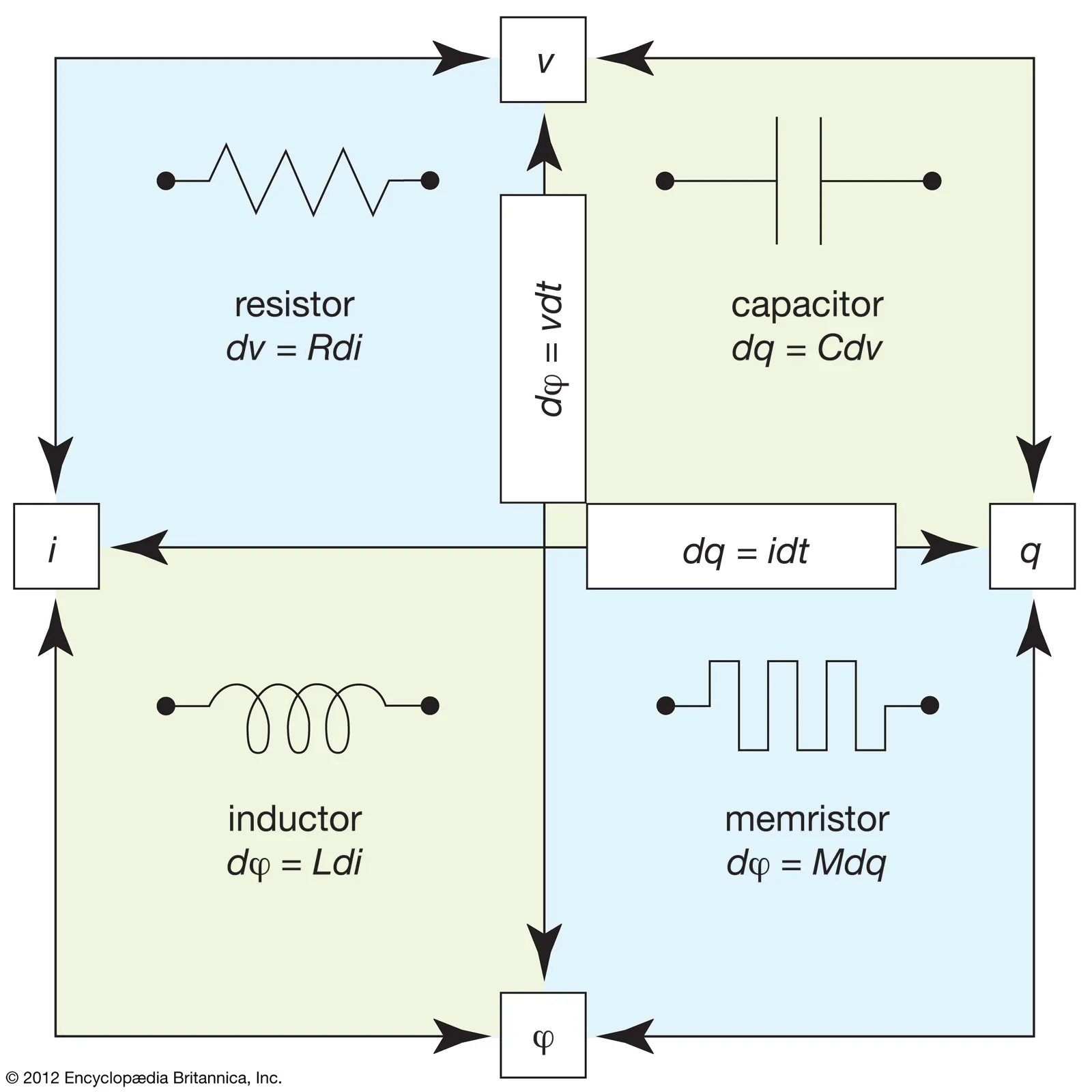
A memristor (a portmanteau of memory resistor) is a nonlinear two-terminal electrical component. Unlike traditional resistors, a memristor "remembers" the amount of electrical charge that has previously passed through it by permanently altering its resistance until an opposing electrical signal changes it back.
What makes it special?
- Non-volatile memory: Even when the power is turned off, the memristor retains its last resistance state, unlike volatile RAM.
- Integrated processing: Traditional computers separate memory (RAM) and processing (CPU) into different physical chips. Because memristors both store data and perform logic, they allow computation to happen directly inside the memory array itself.
- Fourth fundamental element: Before the memristor, the foundational quartet of passive electrical components consisted only of the resistor, capacitor, and inductor.
The Math and The Invention
In 1971, UC Berkeley professor Leon Chua deduced that there was a missing mathematical link between electrical charge and magnetic flux. For decades, it existed only on paper until 2008, when researchers at Hewlett-Packard (HP) Labs created the first physical memristor using a thin film of titanium dioxide (TiO₂) sandwiched between two electrodes.