Intelligence is everywhere. Now what? Natural intelligence in the age of the artificial.

Slides from a talk I gave last month to a team of researchers and engineers building oscillatory neural networks and analog computers. The argument: nature computes everywhere, oscillation is one of its core primitives, and the real frontier is not bigger datacenters but using AI to work with natural intelligence. Plus how a small team could get there with agentic science, and whether invention itself can scale.
Slide 1: Intelligence is everywhere. Now what? Natural intelligence in the age of the artificial samim.a.winiger · sept 2026
Slide 2: Overview 01 Why Natural Intelligence fascinates me 02 A vision for NI at scale 03 How could a small team "win"? 04 Agentic science & narrative engineering 05 Can we scale invention?
Slide 3: 01 Why Natural Intelligence fascinates me
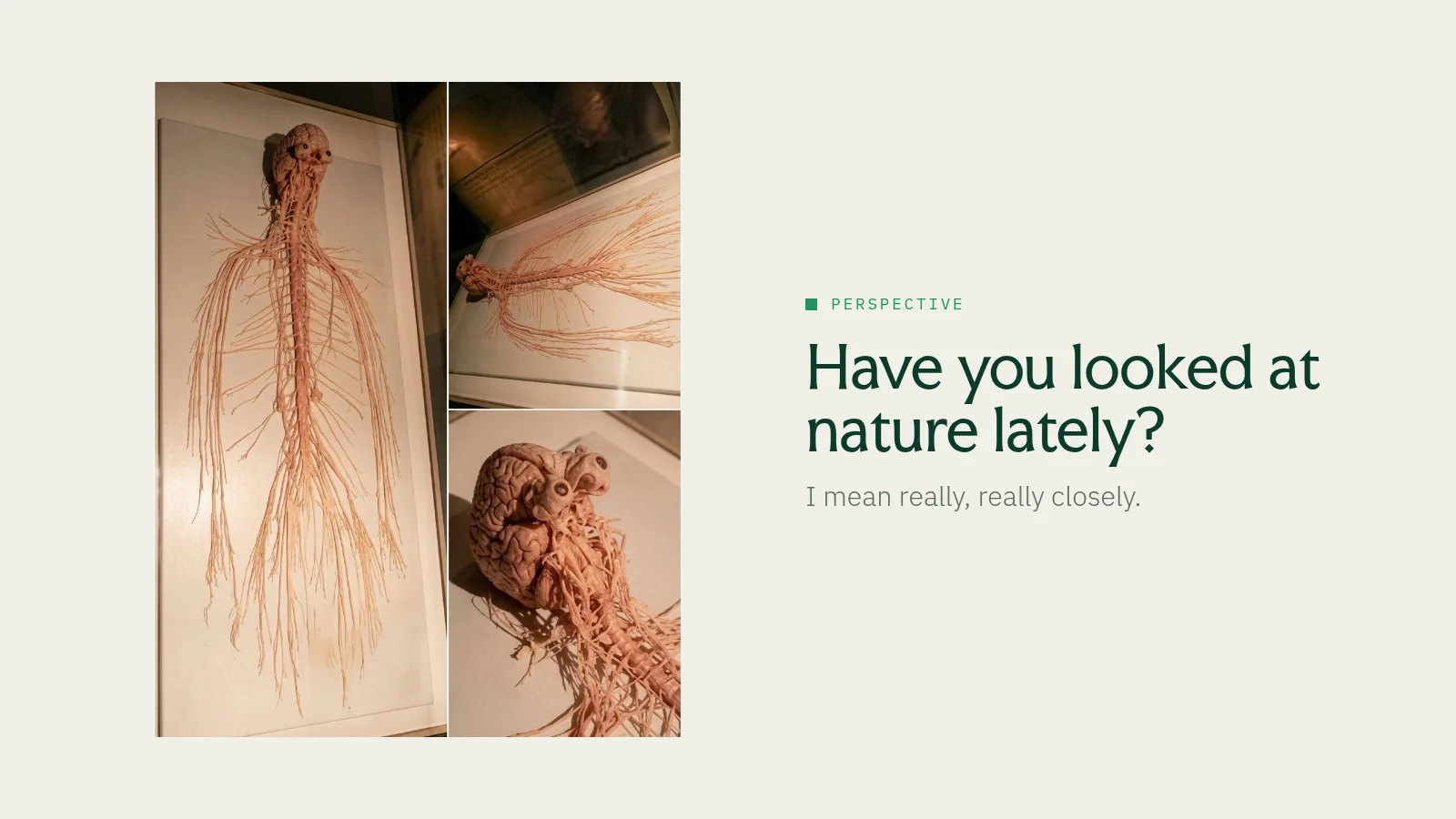
Slide 4: Perspective Have you looked at nature lately? I mean really, really closely.
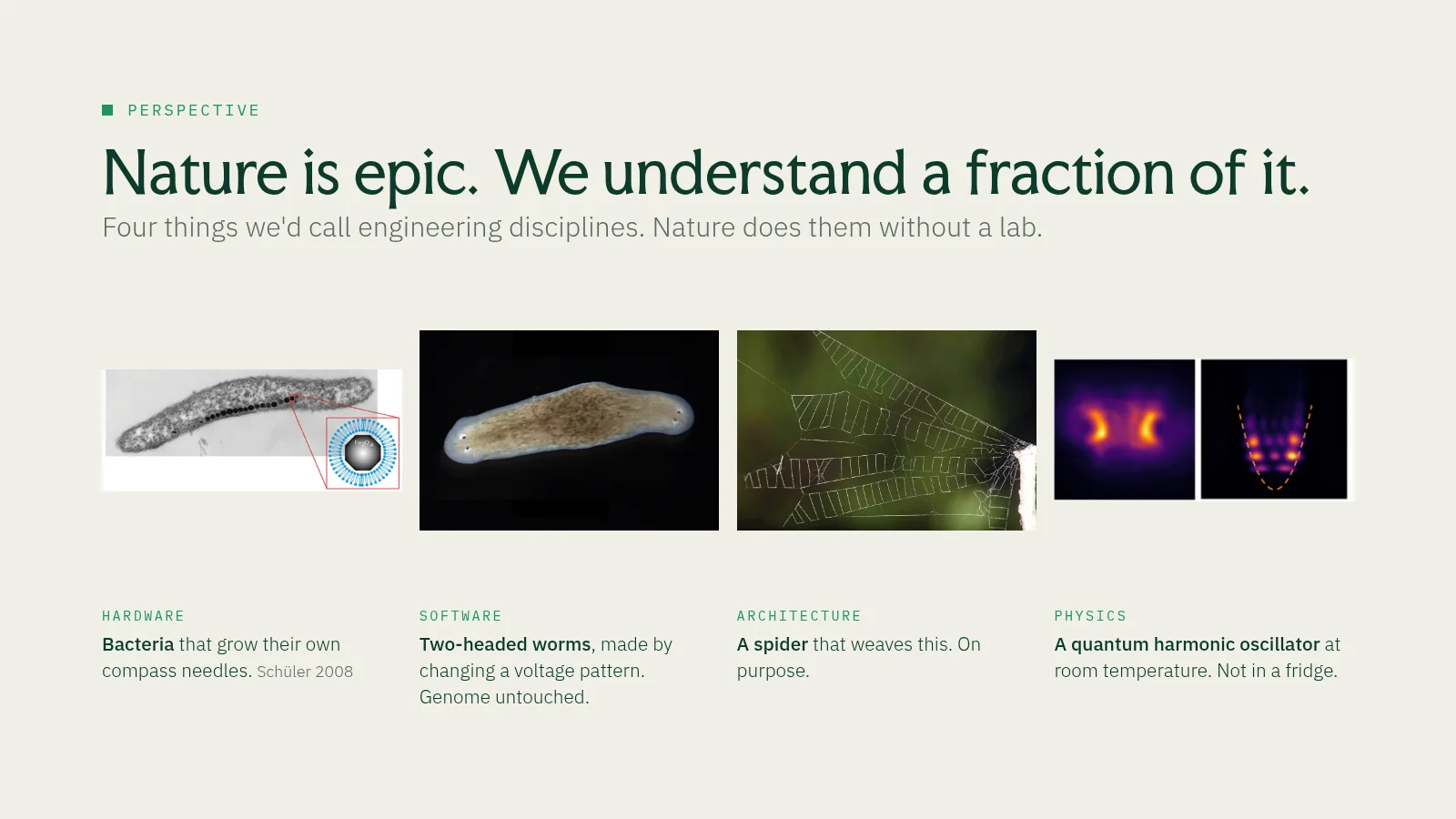
Slide 5: Perspective Nature is epic. We understand a fraction of it. Four things we'd call engineering disciplines. Nature does them without a lab. Hardware Bacteria that grow their own compass needles. Schüler 2008 Software…
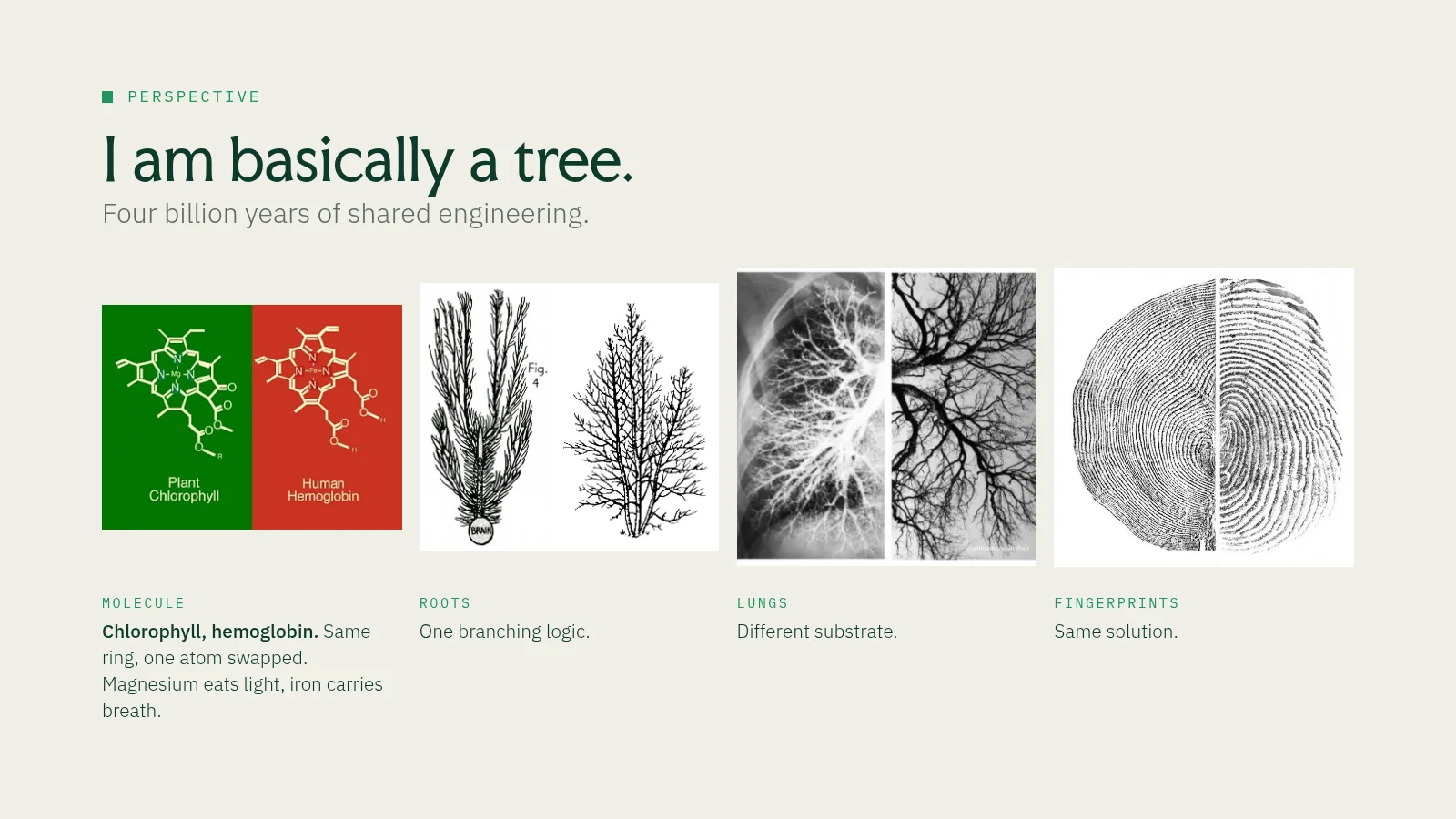
Slide 6: Perspective I am basically a tree. Four billion years of shared engineering. Molecule Chlorophyll, hemoglobin. Same ring, one atom swapped. Magnesium eats light, iron carries breath. Roots One branching logic. Lungs…
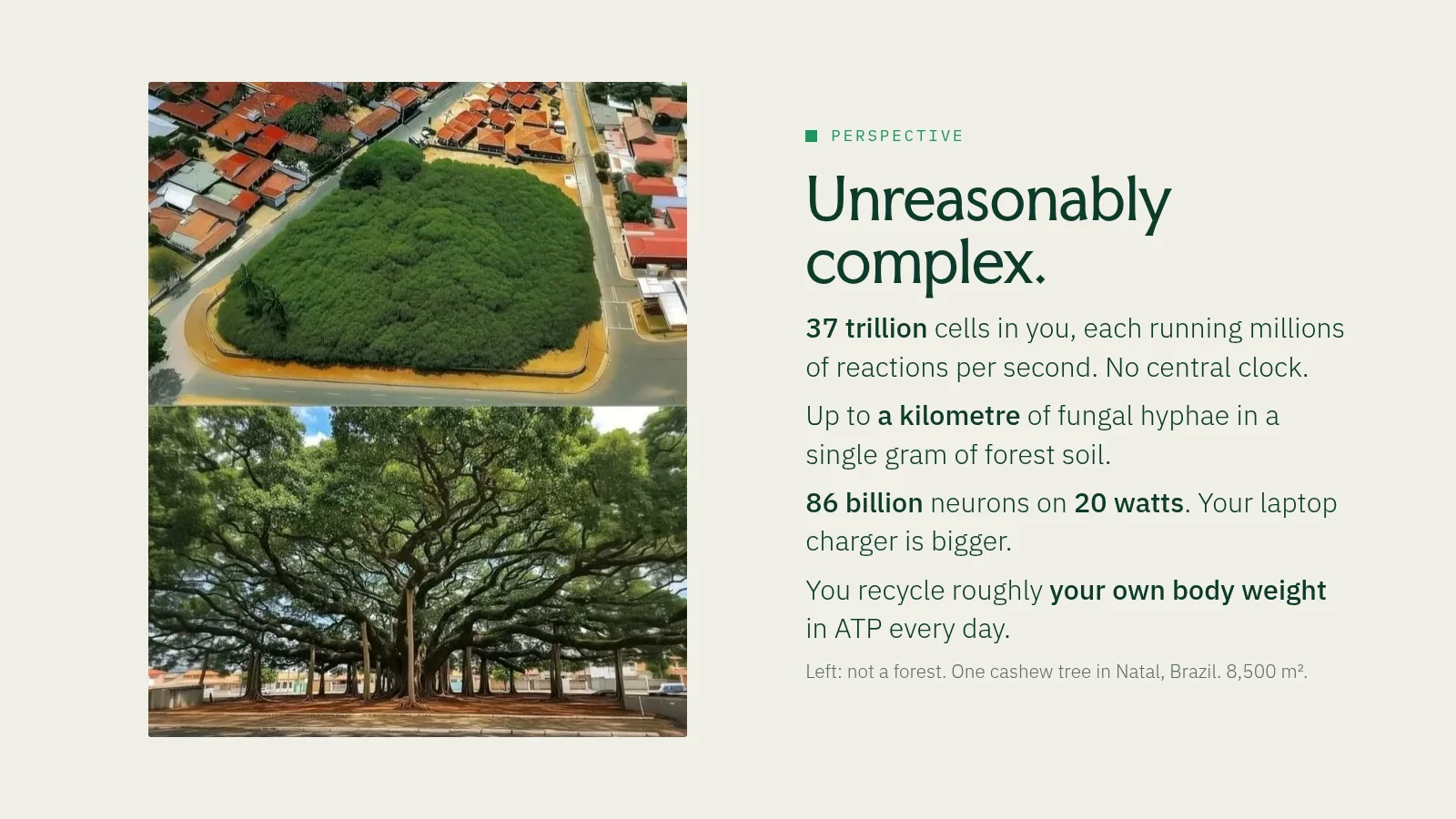
Slide 7: Perspective Unreasonably complex. 37 trillion cells in you, each running millions of reactions per second. No central clock. Up to a kilometre of fungal hyphae in a single gram of forest soil. 86 billion neurons on 20…
Slide 8: Perspective Any AI trick that seems amazing is nothing compared to nature. The more you study it, the more you realise it operates on a vastly higher order of intelligence, which we barely understand. The real frontier…
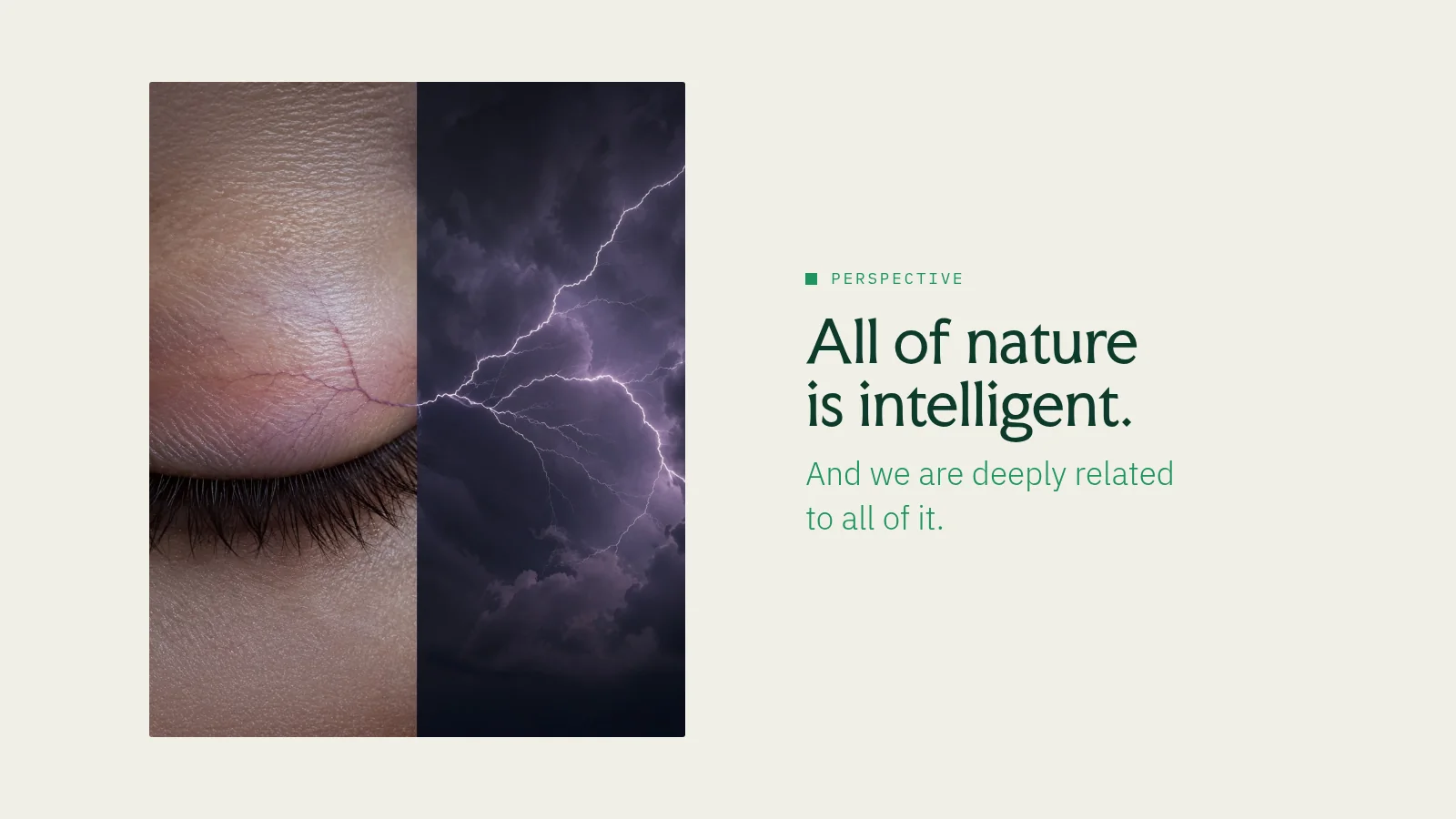
Slide 9: Perspective All of nature is intelligent. And we are deeply related to all of it.
Slide 10: My working hypothesis Oscillation is one of the most fundamental primitives in nature. Look closely at anything, and you find rhythm.
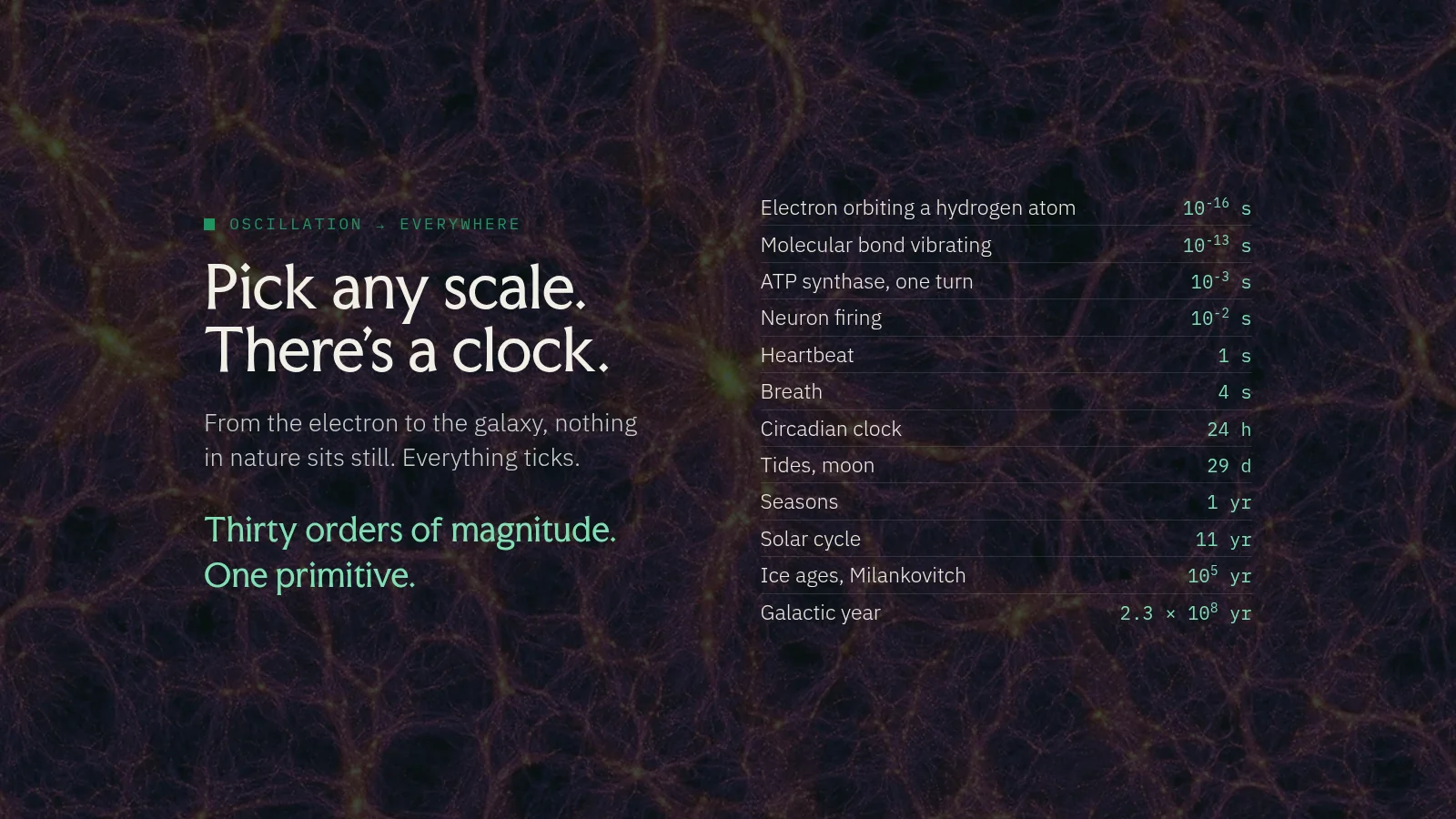
Slide 11: Oscillation → everywhere Pick any scale. There's a clock. From the electron to the galaxy, nothing in nature sits still. Everything ticks. Thirty orders of magnitude. One primitive. Electron orbiting a hydrogen atom 10…
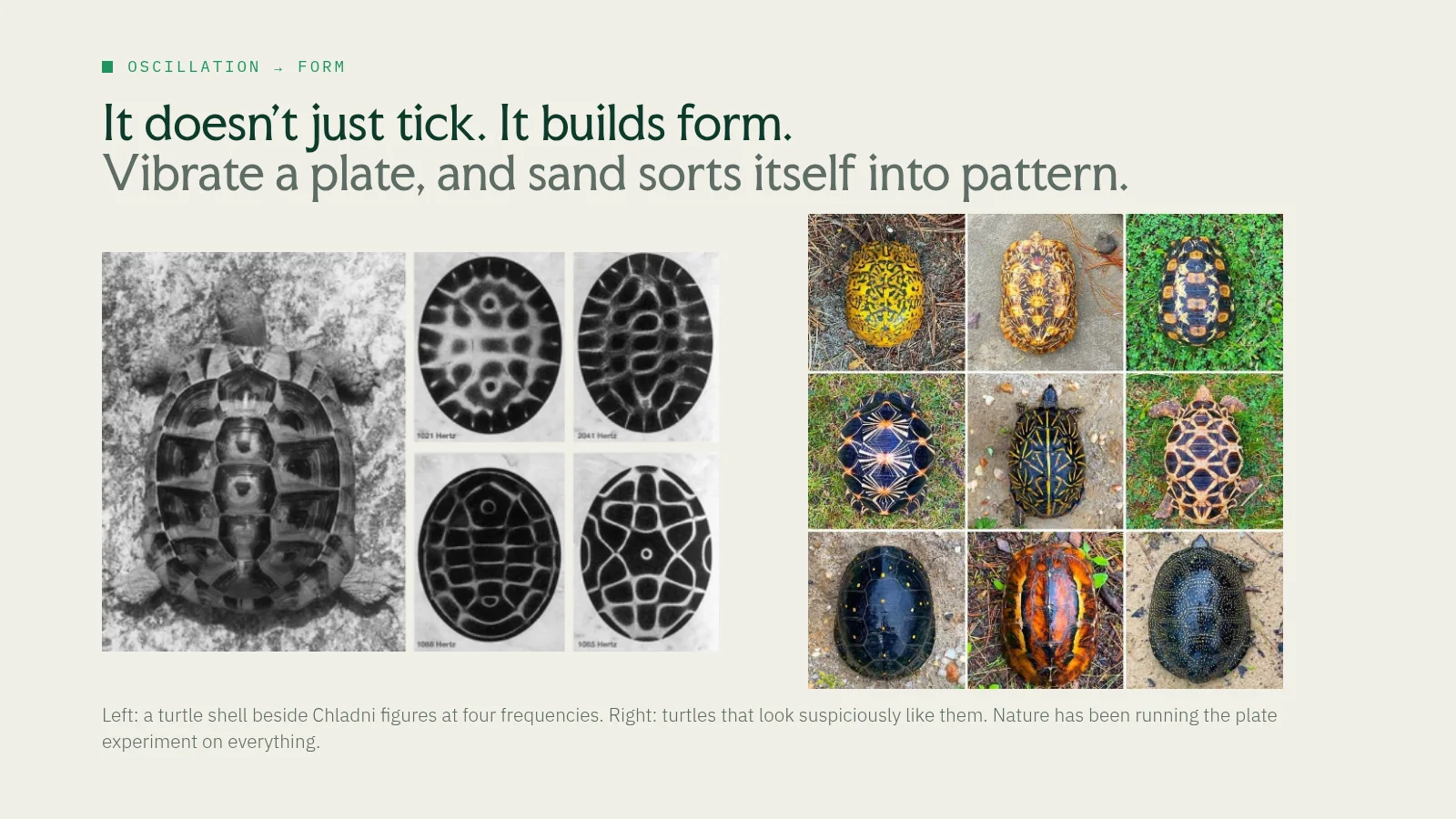
Slide 12: Oscillation → form It doesn't just tick. It builds form. Vibrate a plate, and sand sorts itself into pattern. Left: a turtle shell beside Chladni figures at four frequencies. Right: turtles that look suspiciously like…
Slide 13: Oscillation → computation You know coupled oscillators compute. So does nature. Kuramoto, Ising machines, ONNs: the field's daily bread. What surprised me is who else figured it out. And on what. Mushrooms · Slime · A…
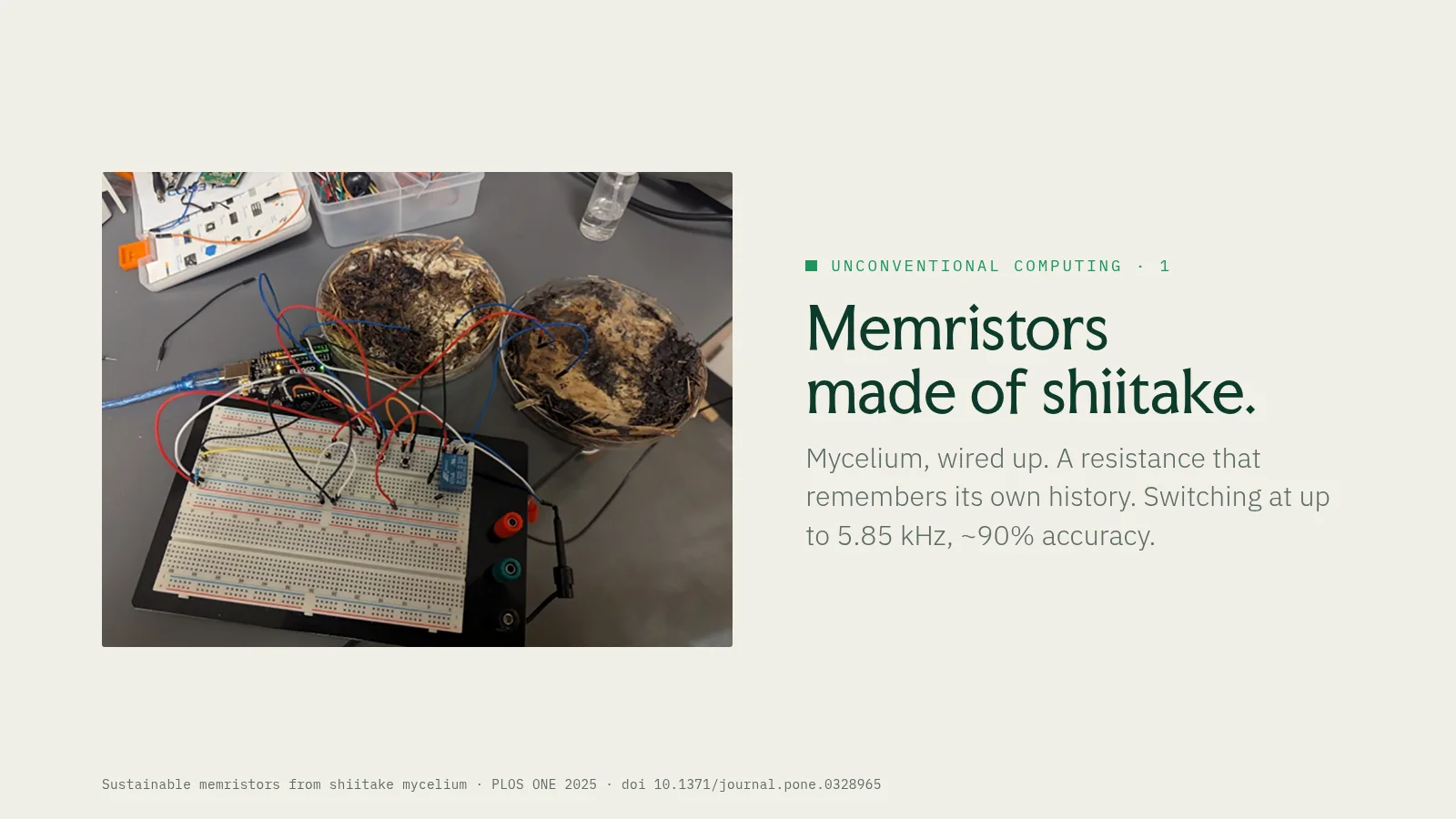
Slide 14: Unconventional computing · 1 Memristors made of shiitake. Mycelium, wired up. A resistance that remembers its own history. Switching at up to 5.85 kHz, ~90% accuracy. Sustainable memristors from shiitake mycelium · PLOS…
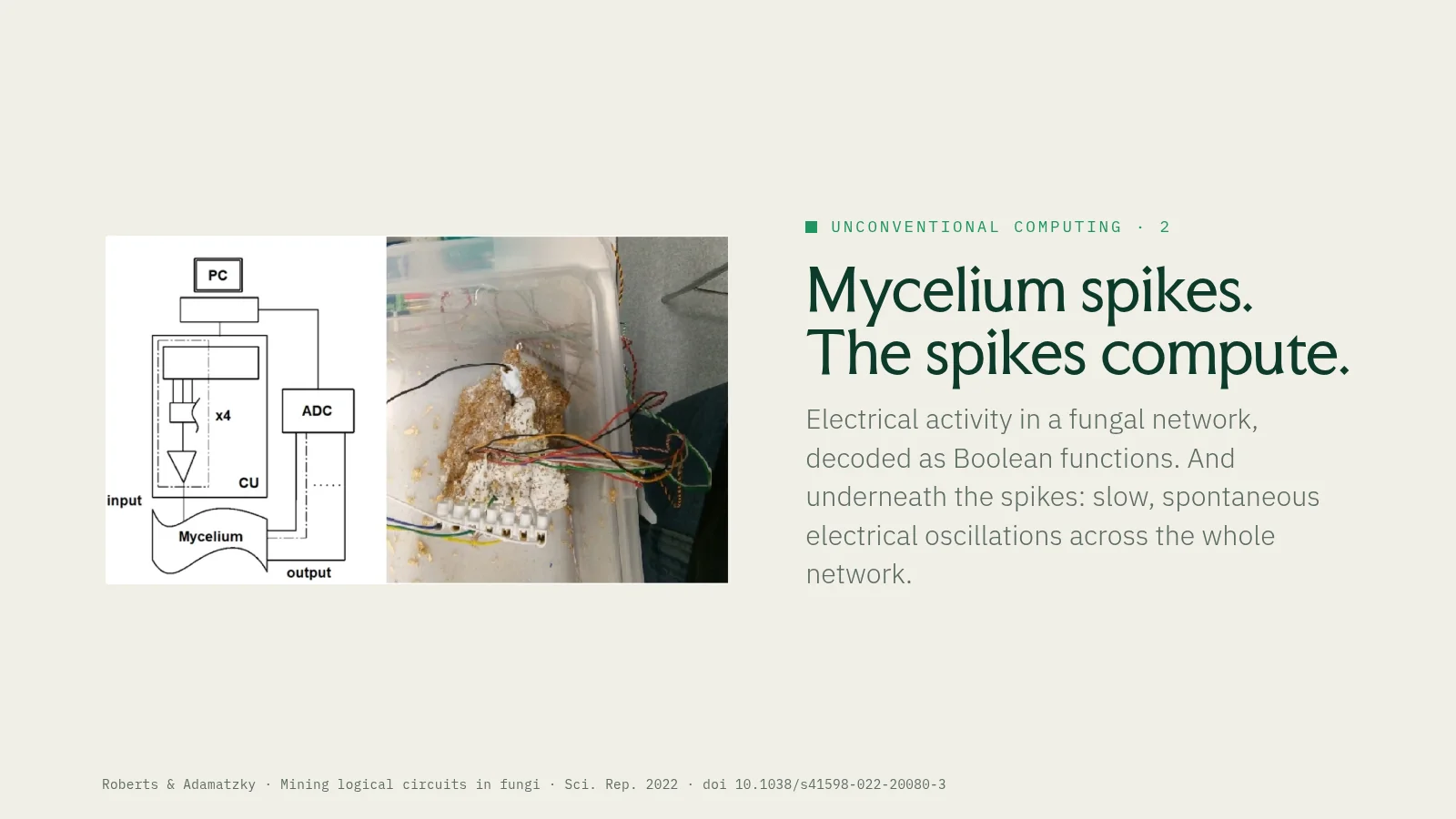
Slide 15: Unconventional computing · 2 Mycelium spikes. The spikes compute. Electrical activity in a fungal network, decoded as Boolean functions. And underneath the spikes: slow, spontaneous electrical oscillations across the…
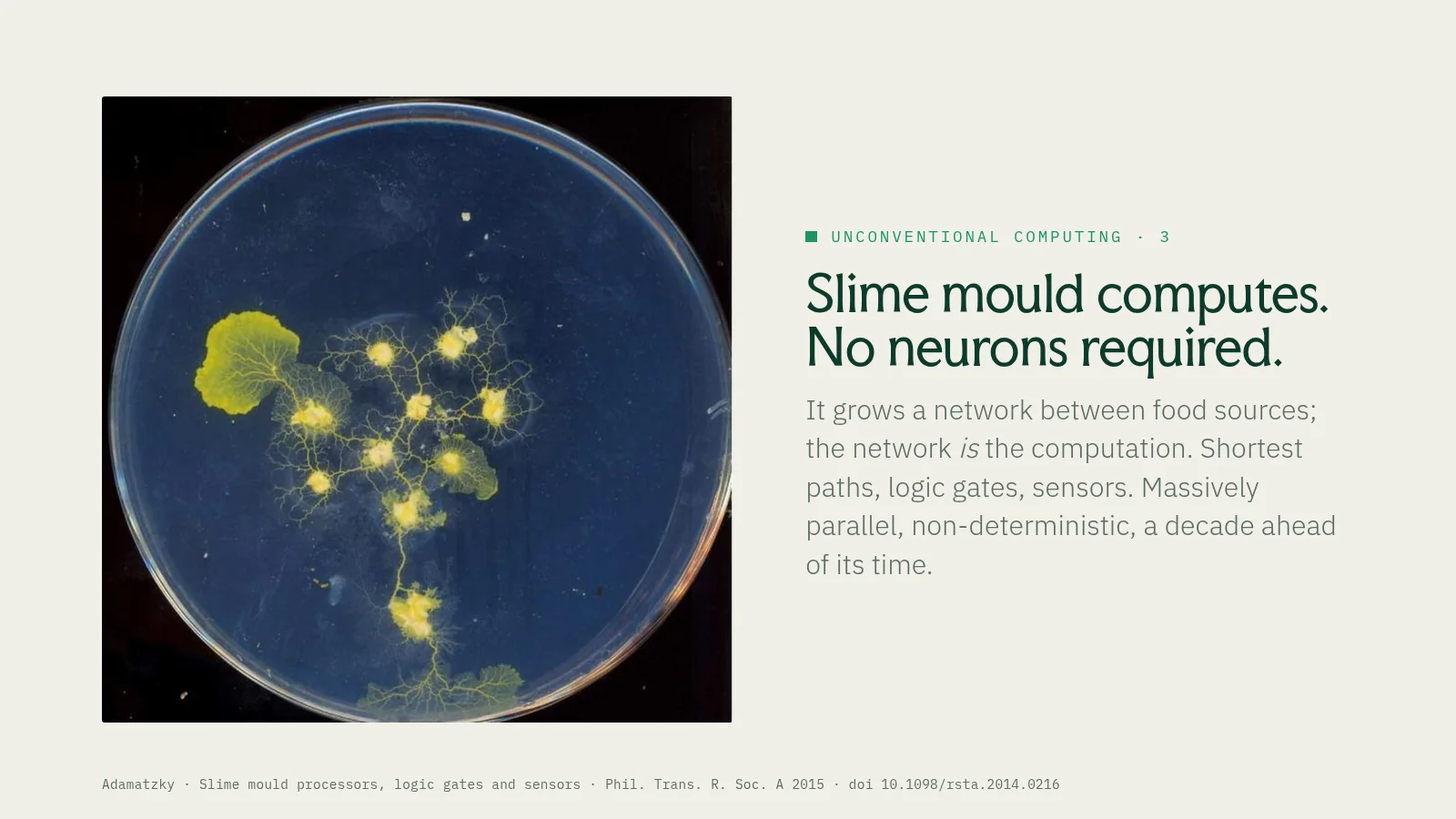
Slide 16: Unconventional computing · 3 Slime mould computes. No neurons required. It grows a network between food sources; the network is the computation. Shortest paths, logic gates, sensors. Massively parallel,…
Slide 17: Oscillation → computation The rhythm is the computer. Mycelium spikes. Slime pulses. Water waves. It was never about the fungi. Substrates change; the primitive doesn't. Reservoir computing makes that a recipe: take…
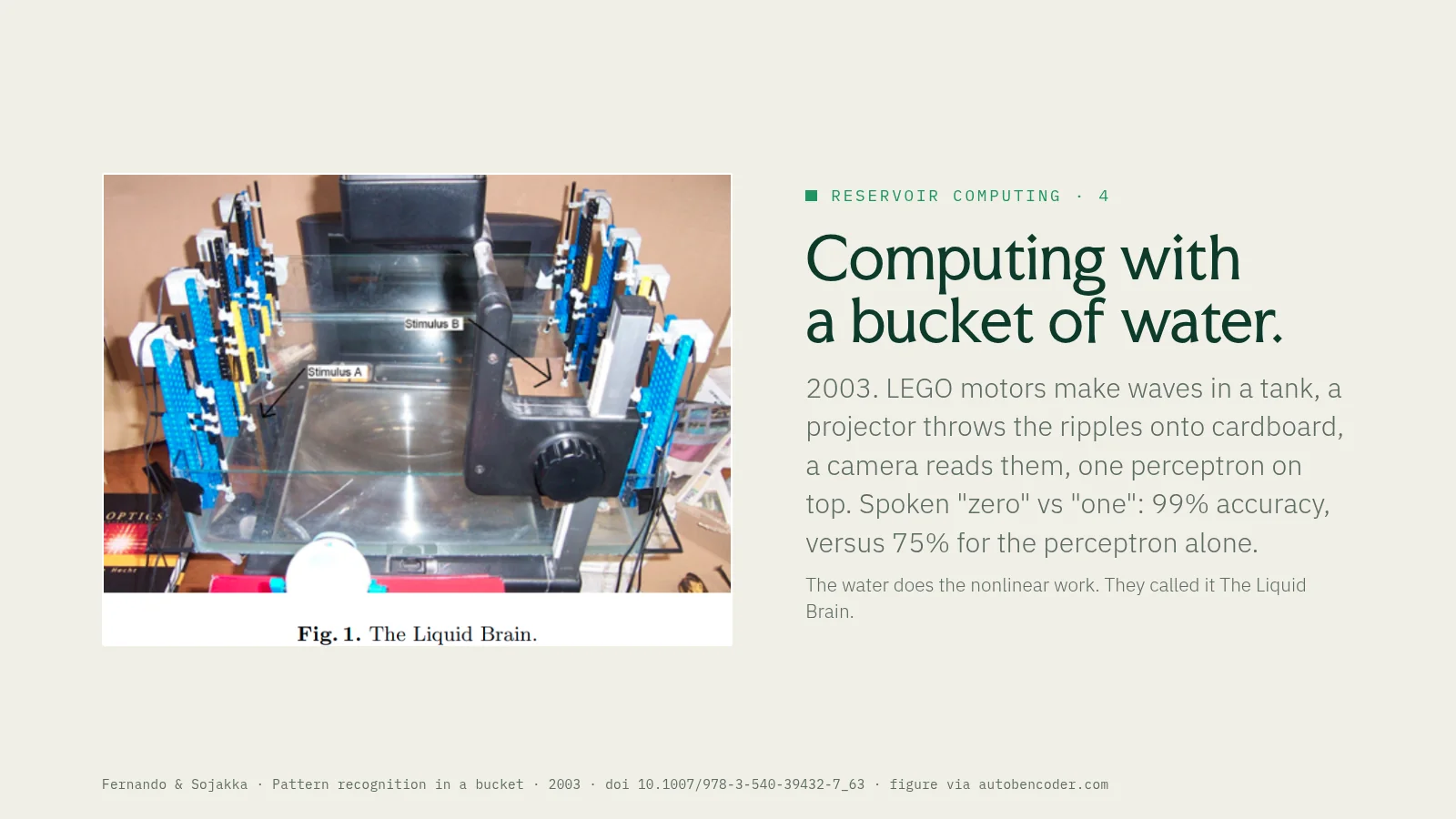
Slide 18: Reservoir computing · 4 Computing with a bucket of water. 2003. LEGO motors make waves in a tank, a projector throws the ripples onto cardboard, a camera reads them, one perceptron on top. Spoken "zero" vs "one": 99%…
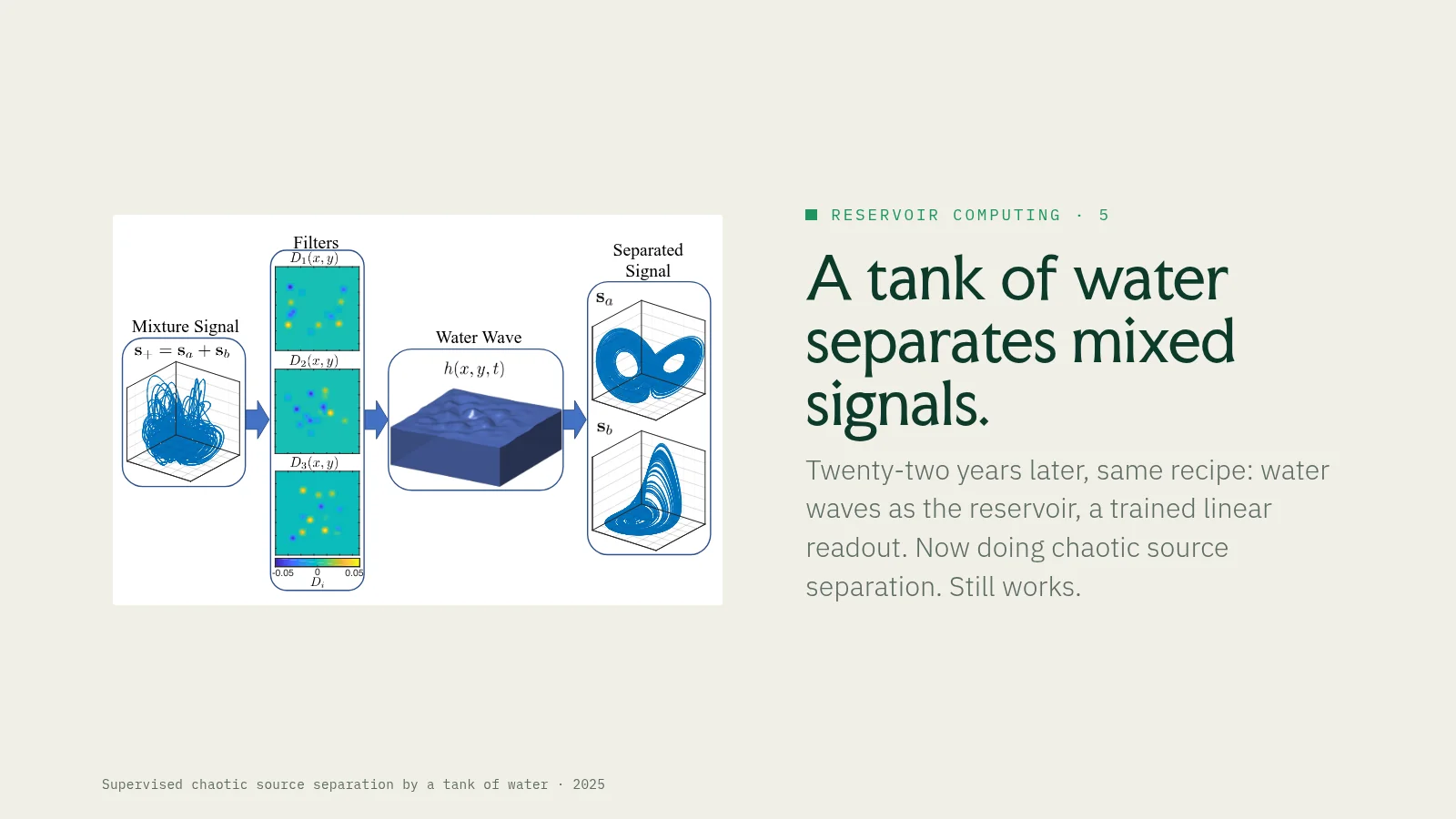
Slide 19: Reservoir computing · 5 A tank of water separates mixed signals. Twenty-two years later, same recipe: water waves as the reservoir, a trained linear readout. Now doing chaotic source separation. Still works. Supervised…
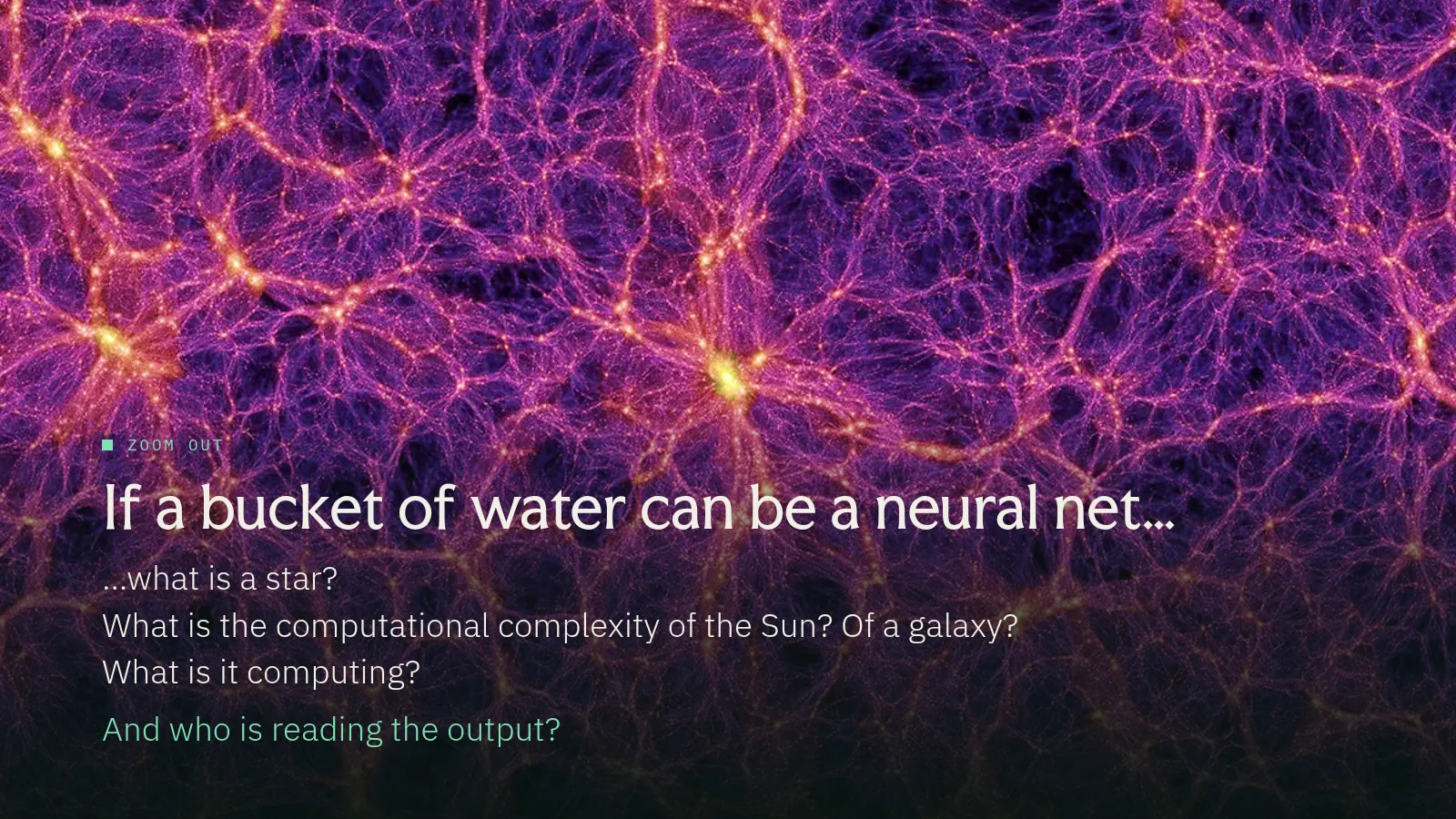
Slide 20: Zoom out If a bucket of water can be a neural net… …what is a star? What is the computational complexity of the Sun? Of a galaxy? What is it computing? And who is reading the output?
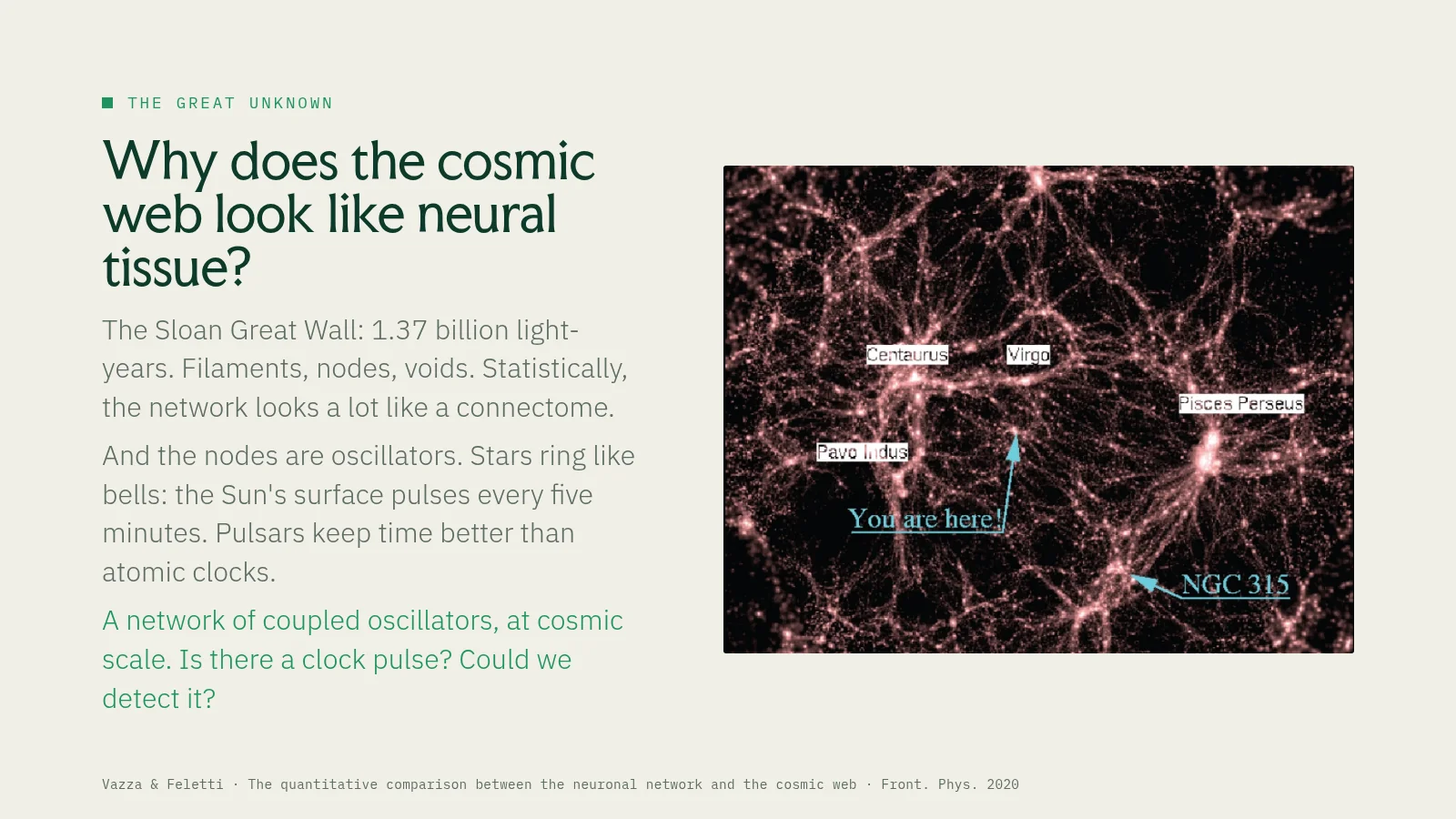
Slide 21: The great unknown Why does the cosmic web look like neural tissue? The Sloan Great Wall: 1.37 billion light-years. Filaments, nodes, voids. Statistically, the network looks a lot like a connectome. And the nodes are…
Slide 22: 02 A vision for Natural Intelligence at scale
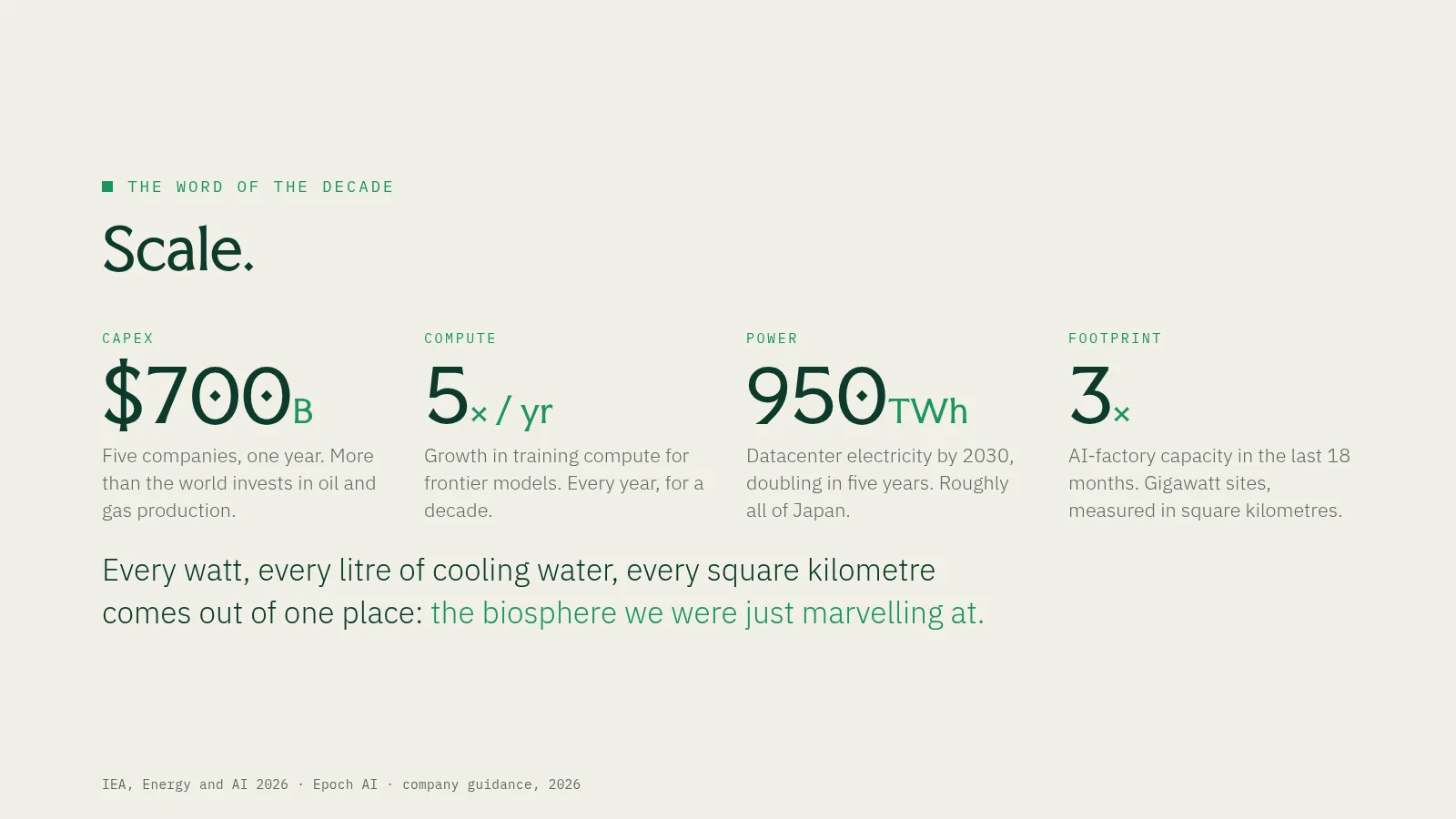
Slide 23: The word of the decade Scale. Capex $700 B Five companies, one year. More than the world invests in oil and gas production. Compute 5 × / yr Growth in training compute for frontier models. Every year, for a decade.…
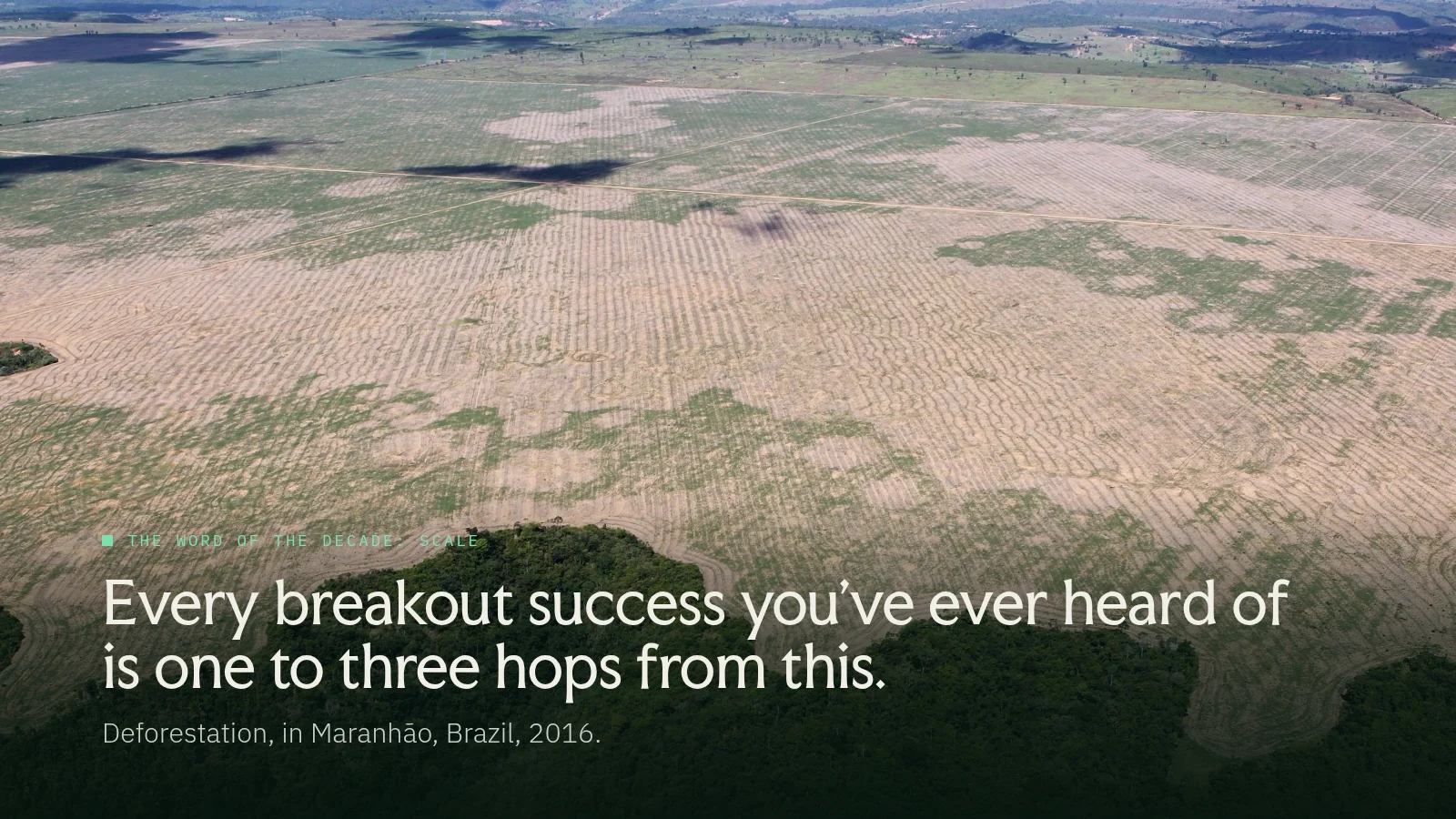
Slide 24: The word of the decade: Scale Every breakout success you've ever heard of is one to three hops from this. Deforestation, in Maranhão, Brazil, 2016.
Slide 25: The thesis, again The real frontier is not artificial intelligence. It is natural intelligence: using AI to communicate and collaborate with nature. So: what would it look like if we scaled that instead?
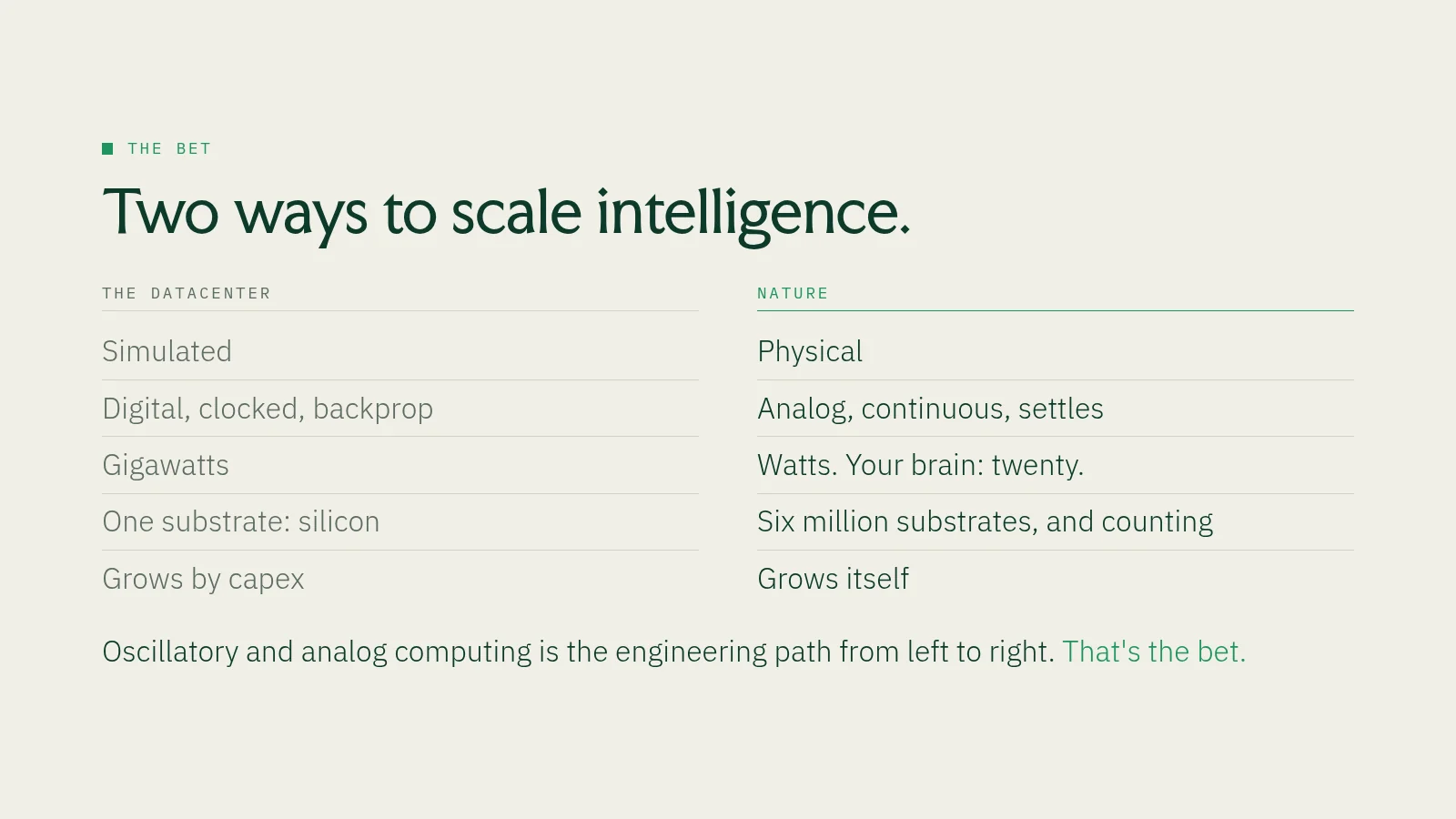
Slide 26: The bet Two ways to scale intelligence. The datacenter Simulated Digital, clocked, backprop Gigawatts One substrate: silicon Grows by capex Nature Physical Analog, continuous, settles Watts. Your brain: twenty. Six…
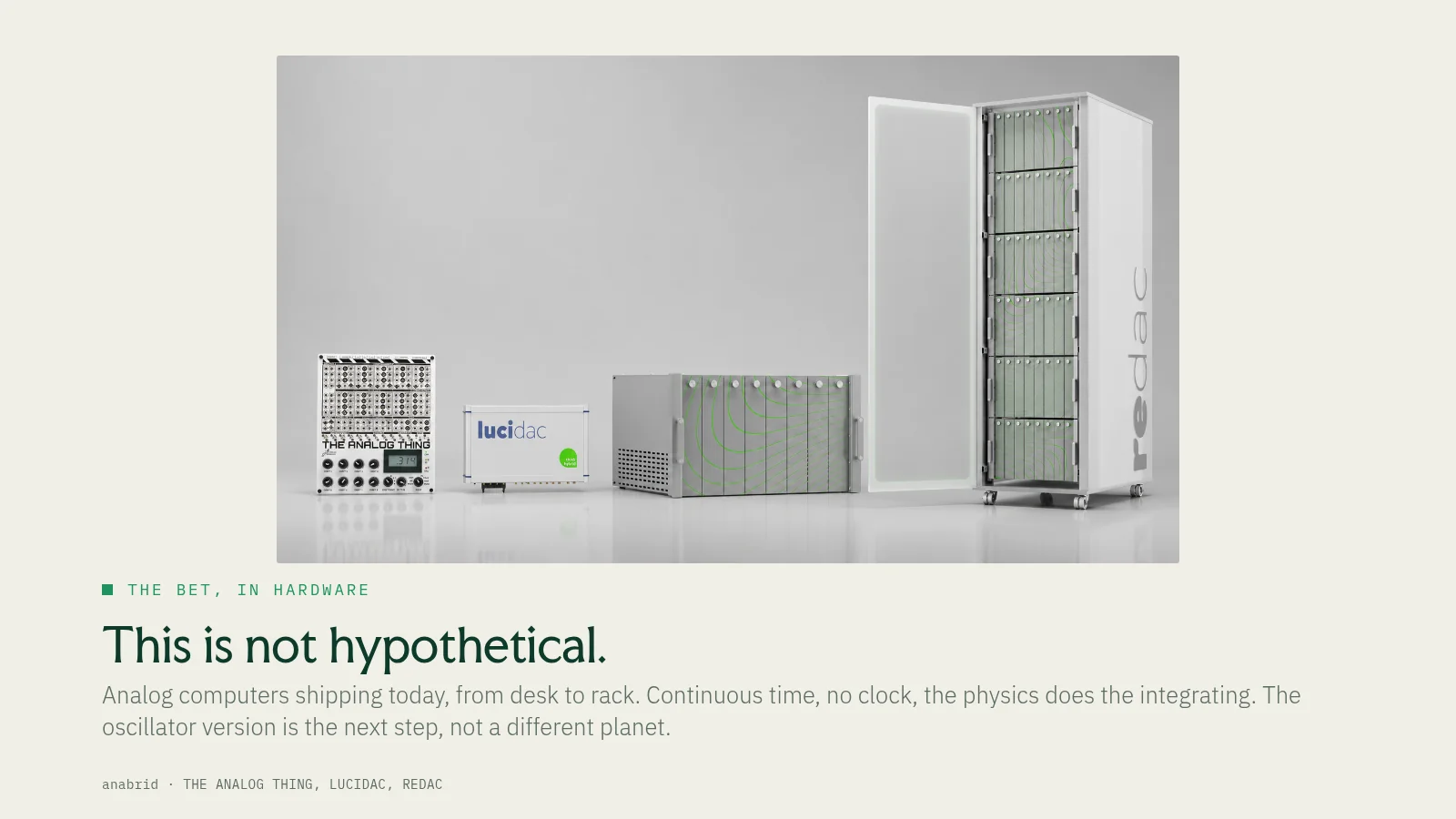
Slide 27: The bet, in hardware This is not hypothetical. Analog computers shipping today, from desk to rack. Continuous time, no clock, the physics does the integrating. The oscillator version is the next step, not a different…
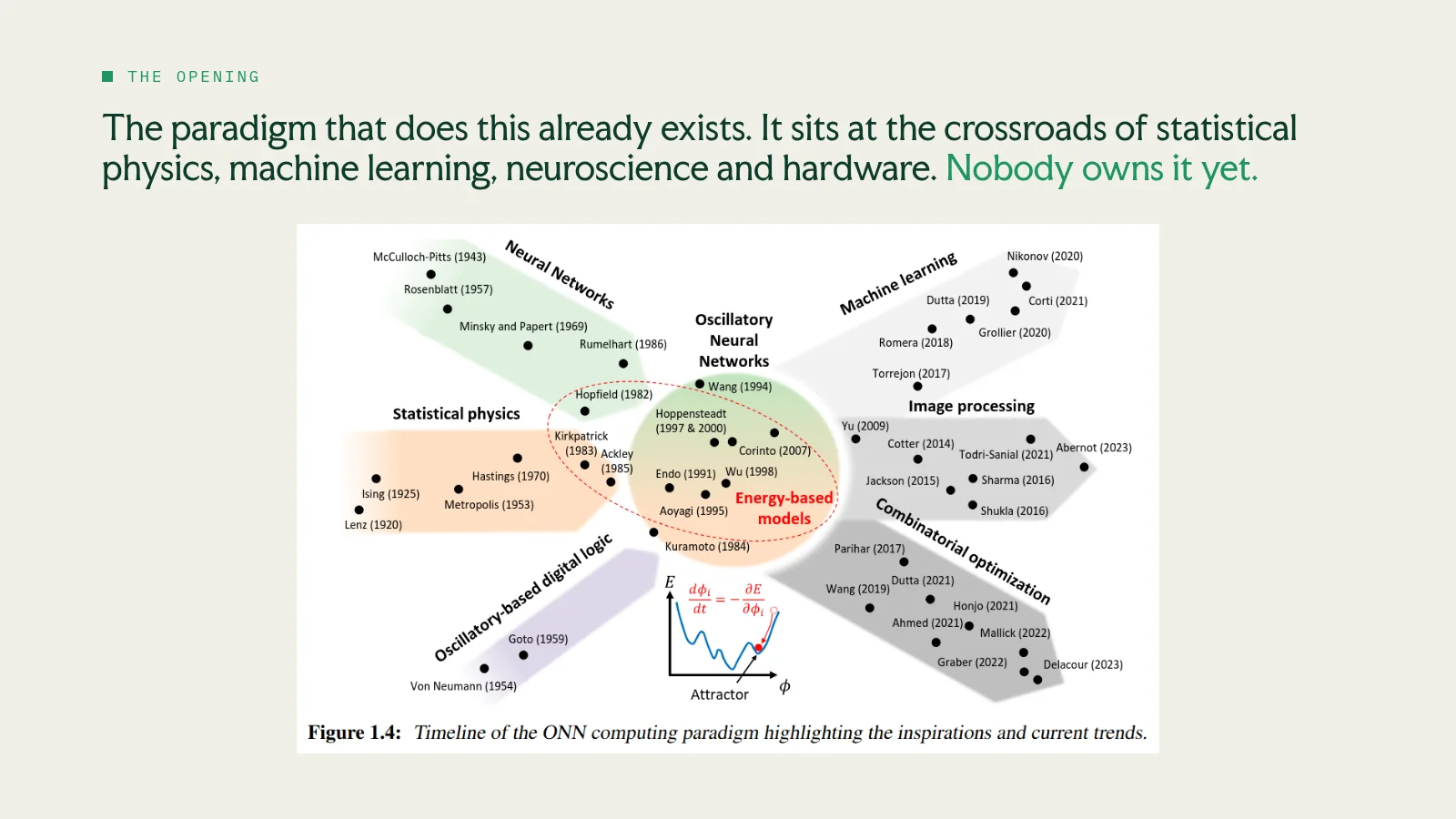
Slide 28: The opening The paradigm that does this already exists. It sits at the crossroads of statistical physics, machine learning, neuroscience and hardware. Nobody owns it yet.
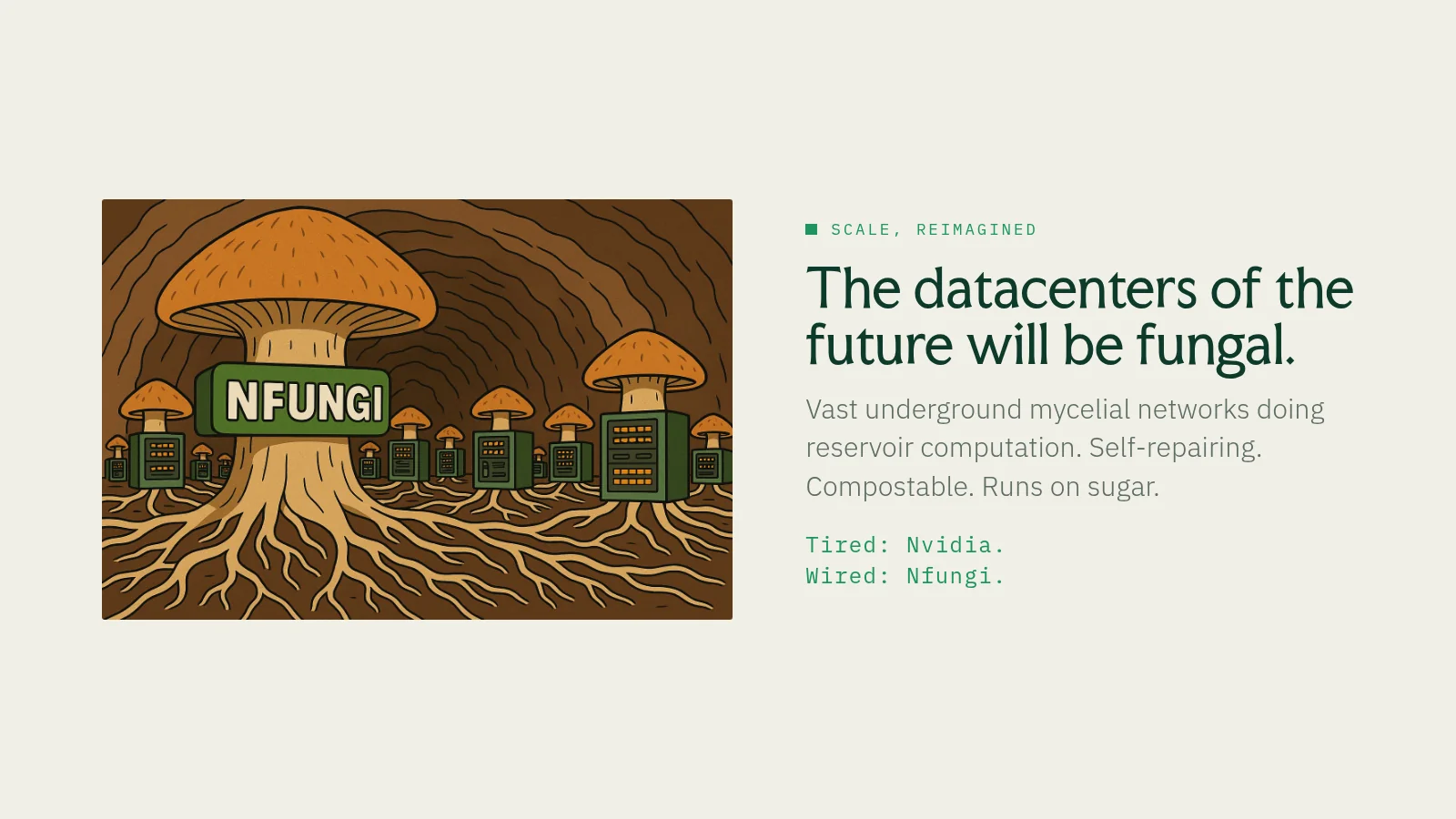
Slide 29: Scale, reimagined The datacenters of the future will be fungal. Vast underground mycelial networks doing reservoir computation. Self-repairing. Compostable. Runs on sugar. Tired: Nvidia. Wired: Nfungi.
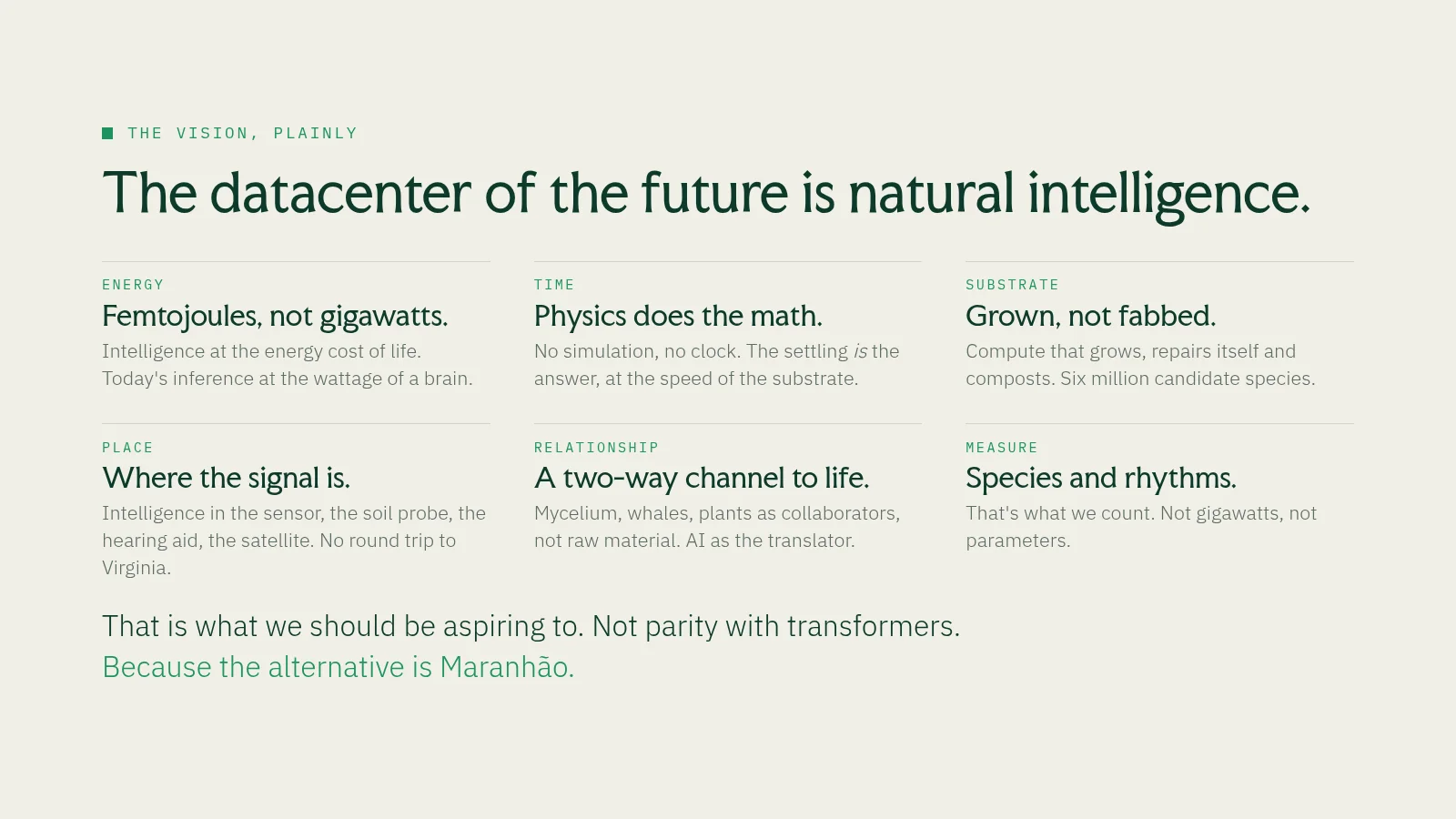
Slide 30: The vision, plainly The datacenter of the future is natural intelligence. Energy Femtojoules, not gigawatts. Intelligence at the energy cost of life. Today's inference at the wattage of a brain. Time Physics does the…
Slide 31: 03 How could a small team "win" at Natural Intelligence?
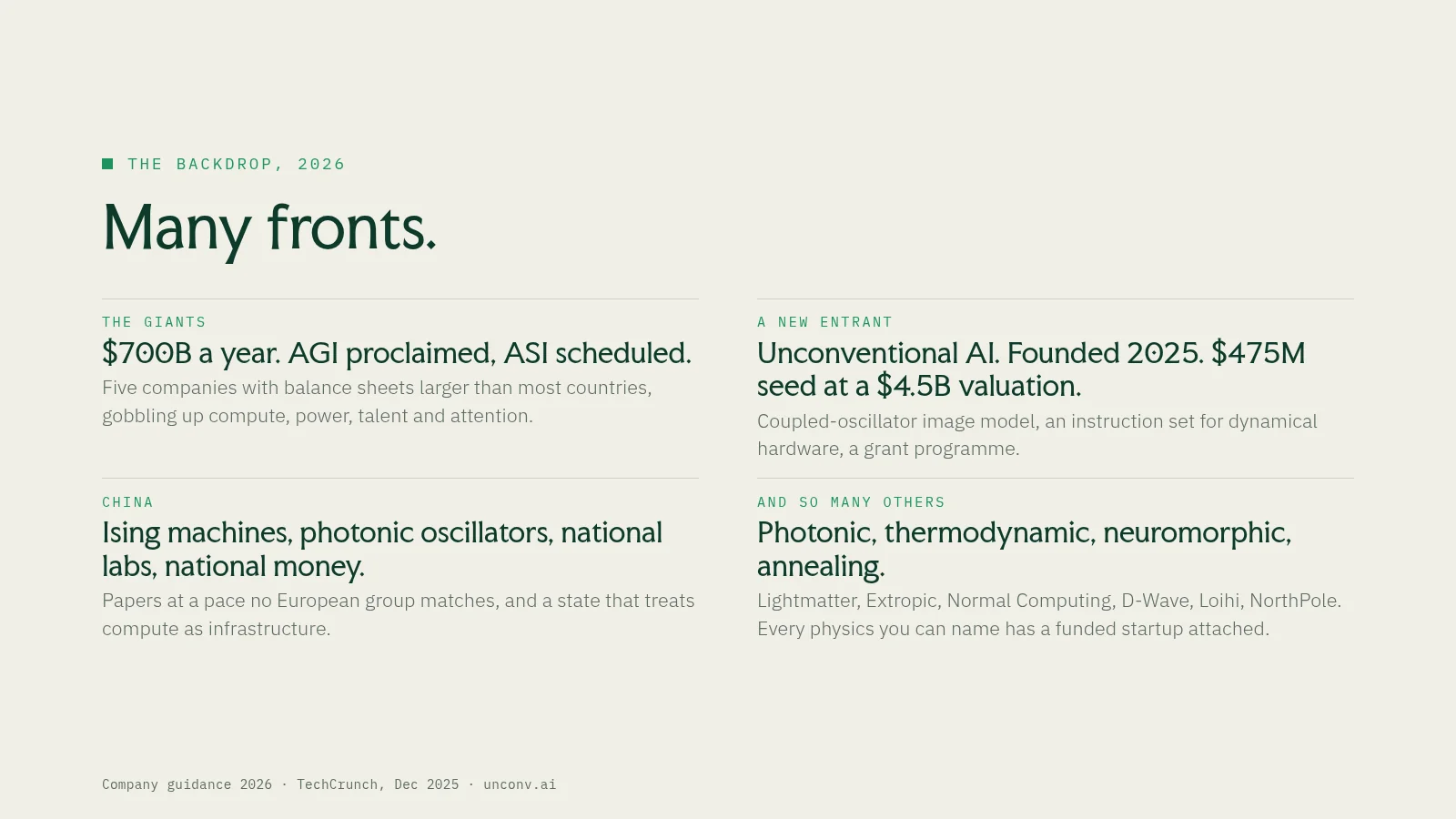
Slide 32: The backdrop, 2026 Many fronts. The giants $700B a year. AGI proclaimed, ASI scheduled. Five companies with balance sheets larger than most countries, gobbling up compute, power, talent and attention. A new entrant…
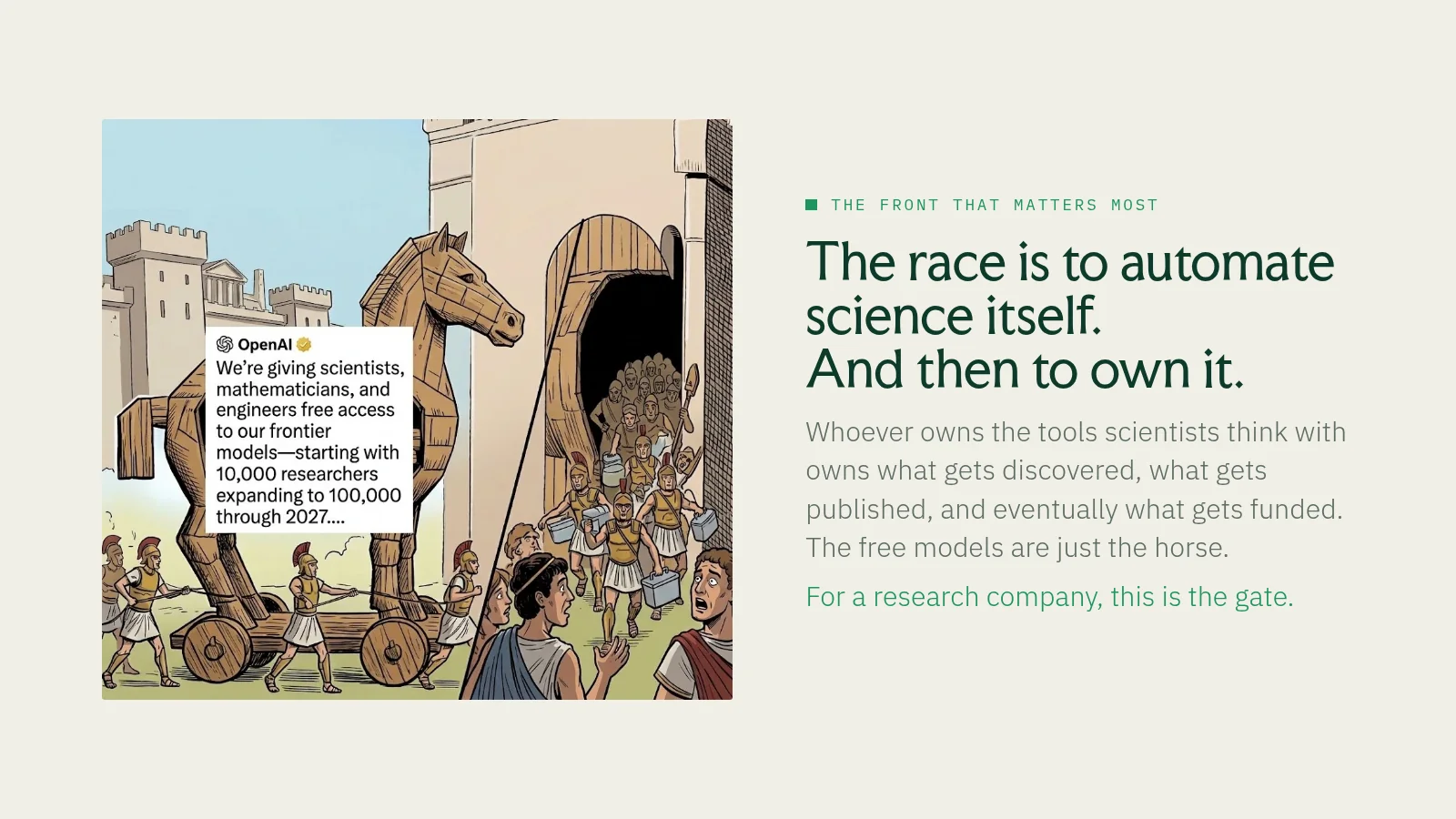
Slide 33: The front that matters most The race is to automate science itself. And then to own it. Whoever owns the tools scientists think with owns what gets discovered, what gets published, and eventually what gets funded. The…
Slide 34: Honest assessment So a small European team is going to have a hard time. Unless.
Slide 35: What a giant cannot buy Giants win on known maps. Small teams win on maps nobody has drawn yet. The ONN and analog computing design space is largely unexplored. No default stack, no transformer no ImageNet moment. The…
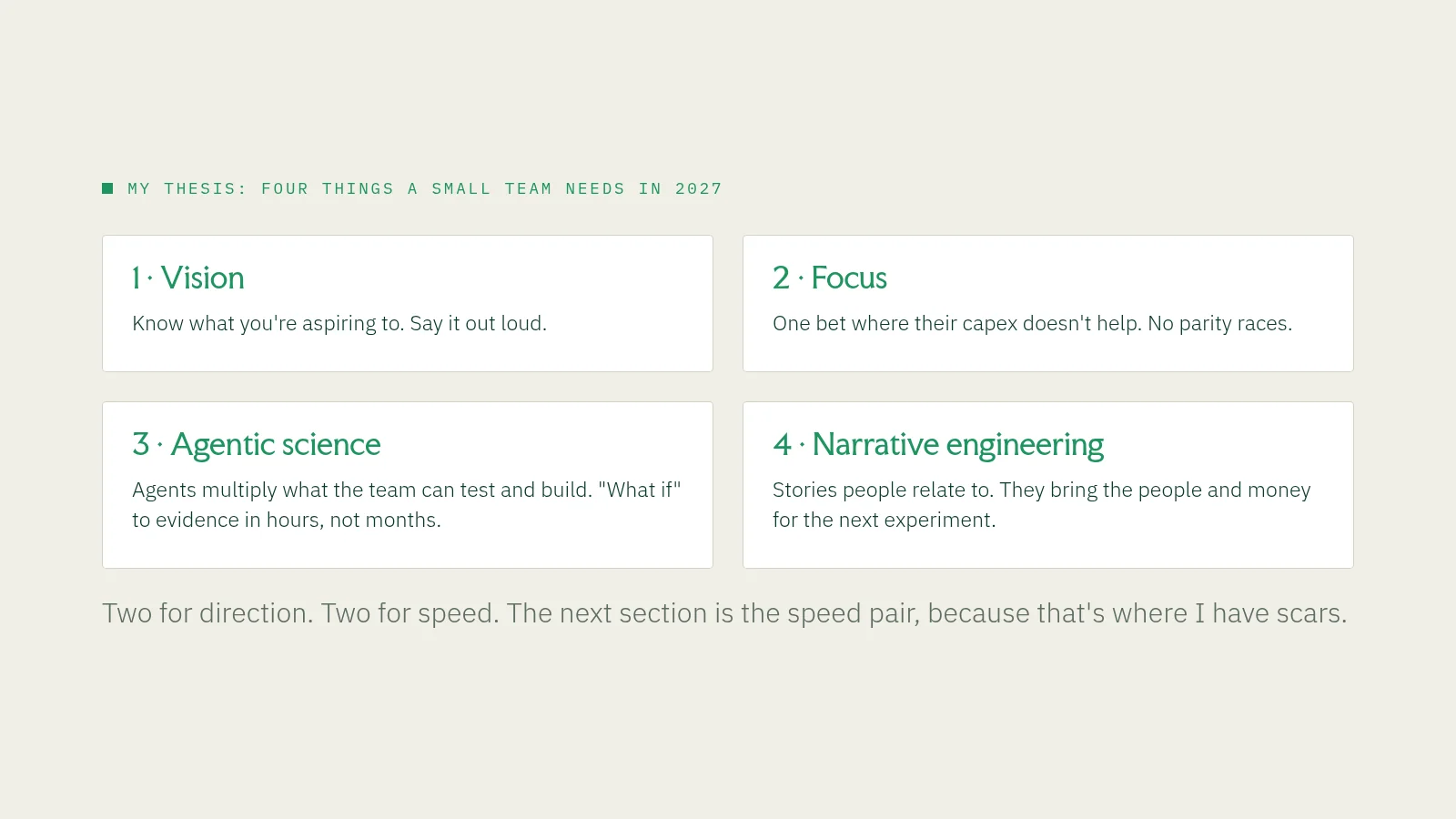
Slide 36: My thesis: four things a small team needs in 2027 1 · Vision Know what you're aspiring to. Say it out loud. 2 · Focus One bet where their capex doesn't help. No parity races. 3 · Agentic science Agents multiply what the…
Slide 37: 04 Agentic science & narrative engineering
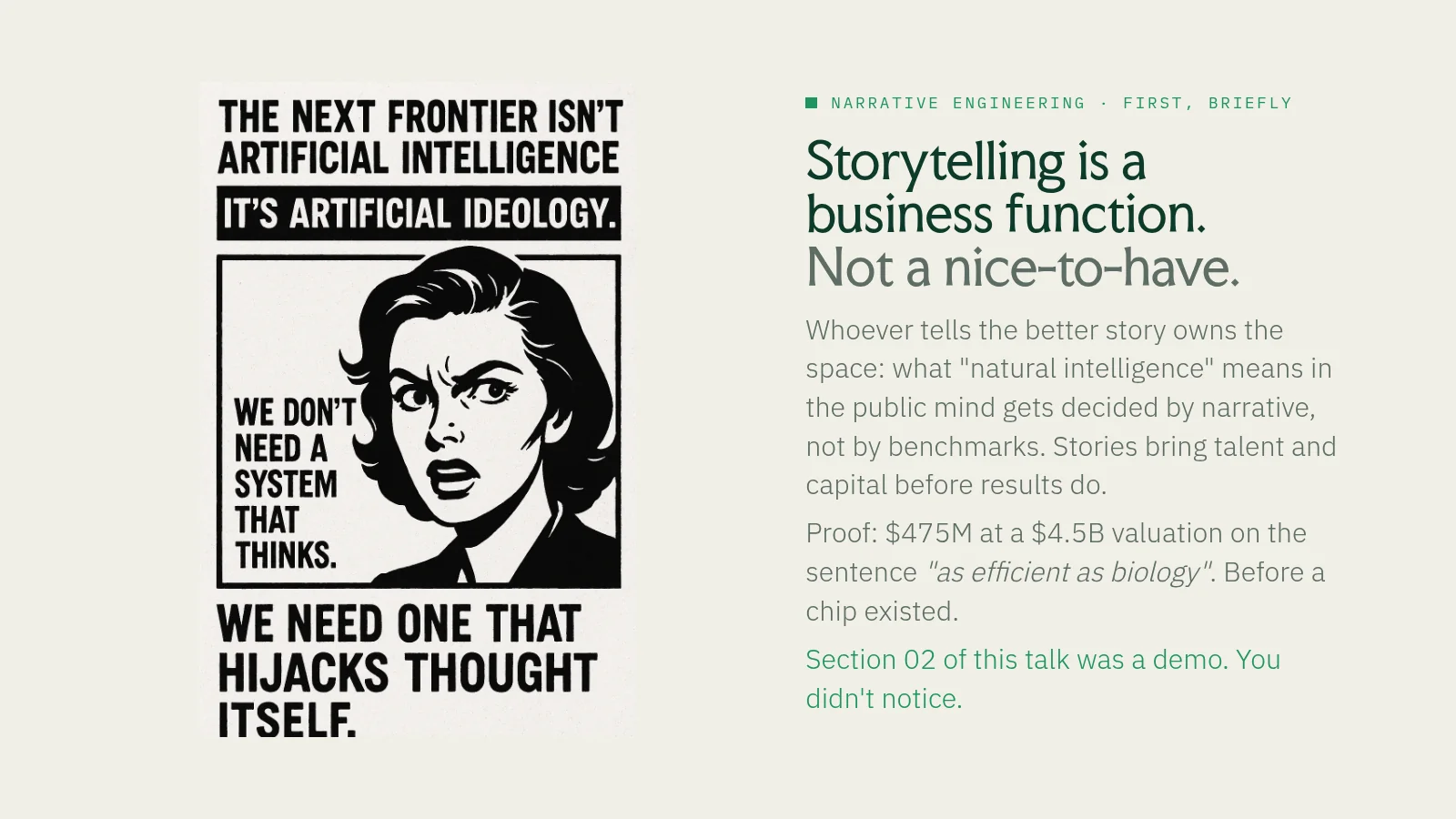
Slide 38: Narrative engineering · first, briefly Storytelling is a business function. Not a nice-to-have. Whoever tells the better story owns the space: what "natural intelligence" means in the public mind gets decided by…
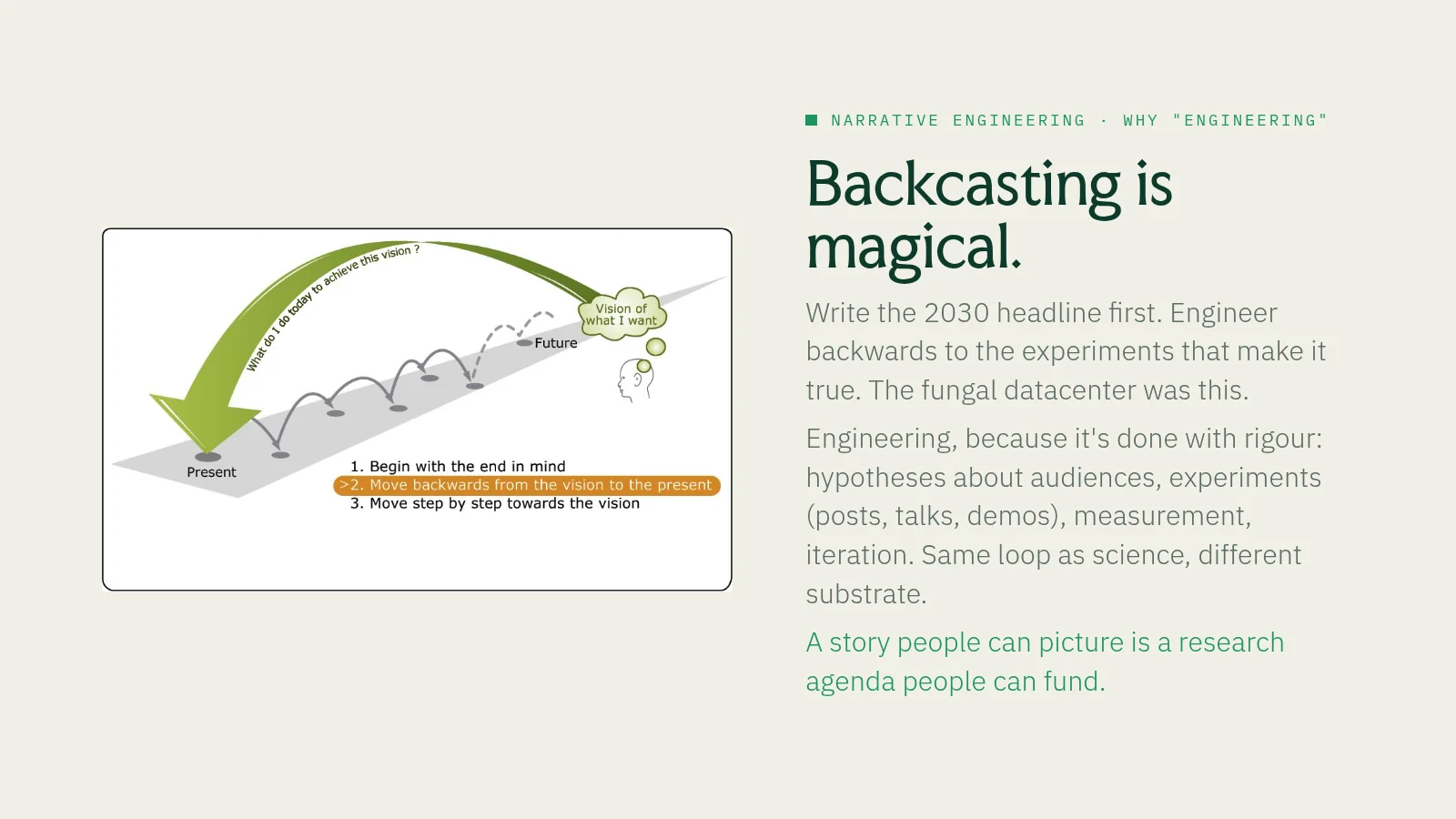
Slide 39: Narrative engineering · why "engineering" Backcasting is magical. Write the 2030 headline first. Engineer backwards to the experiments that make it true. The fungal datacenter was this. Engineering, because it's done…
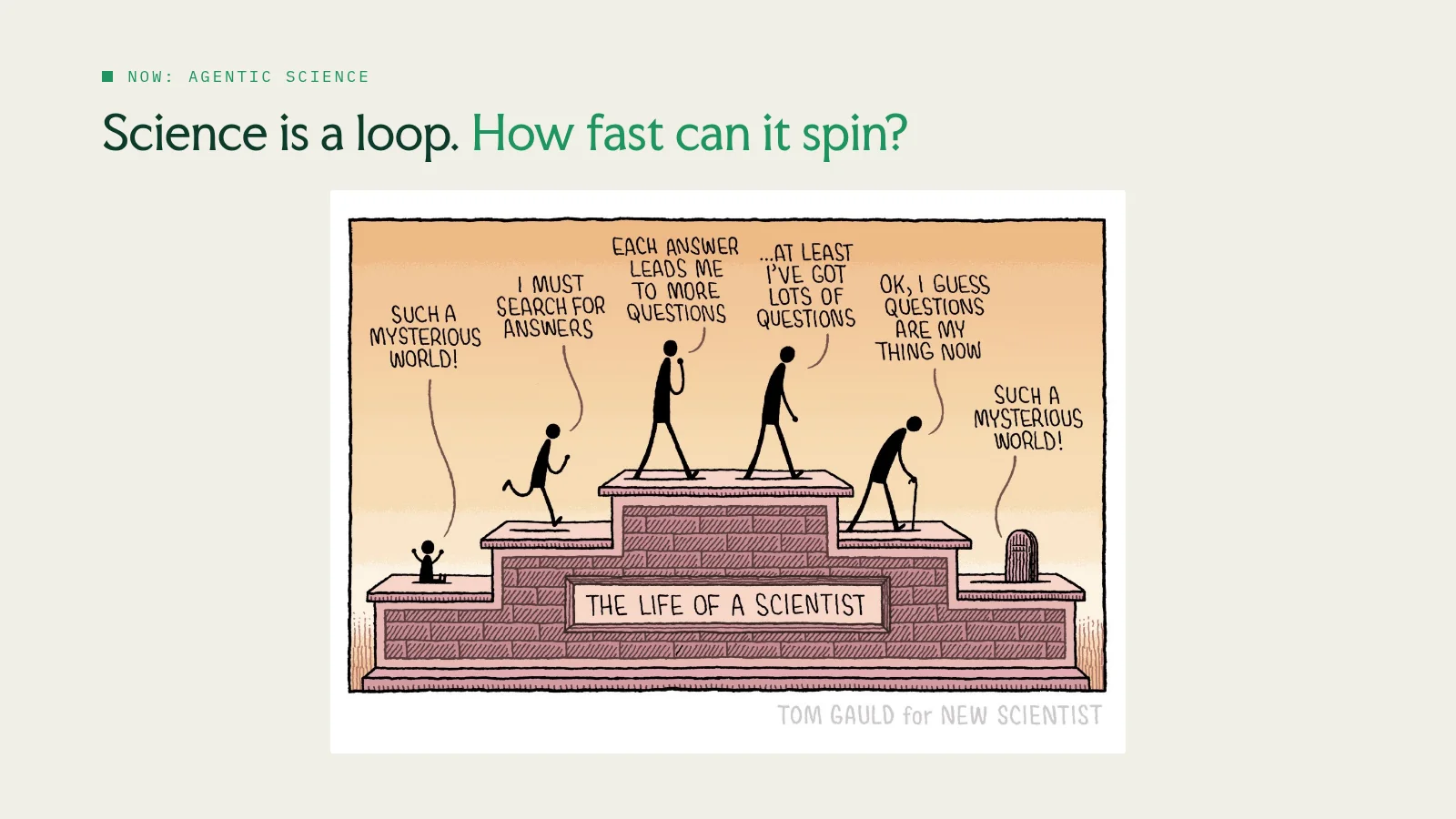
Slide 40: Now: agentic science Science is a loop. How fast can it spin?
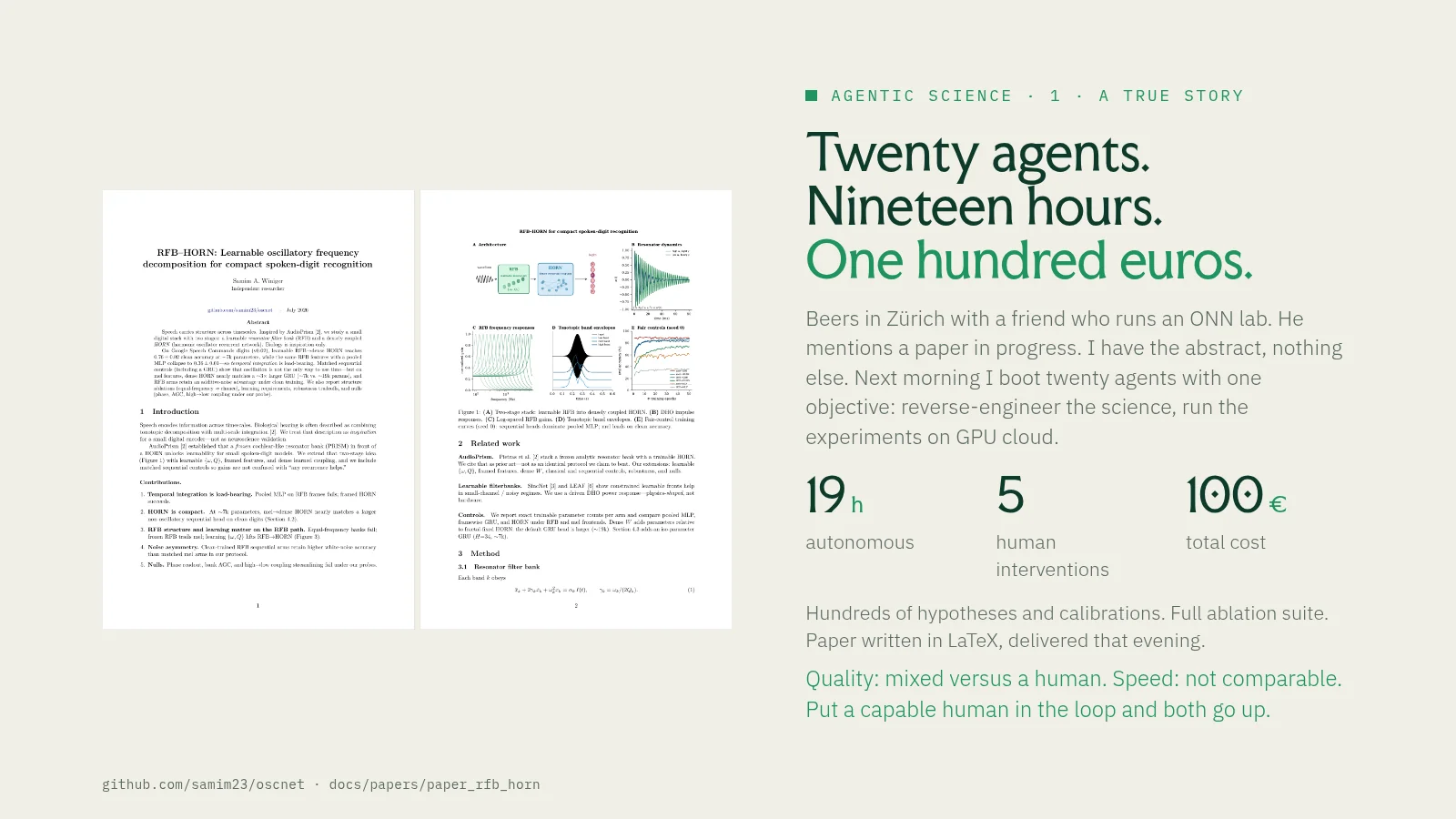
Slide 41: Agentic science · 1 · a true story Twenty agents. Nineteen hours. One hundred euros. Beers in Zürich with a friend who runs an ONN lab. He mentions a paper in progress. I have the abstract, nothing else. Next morning I…
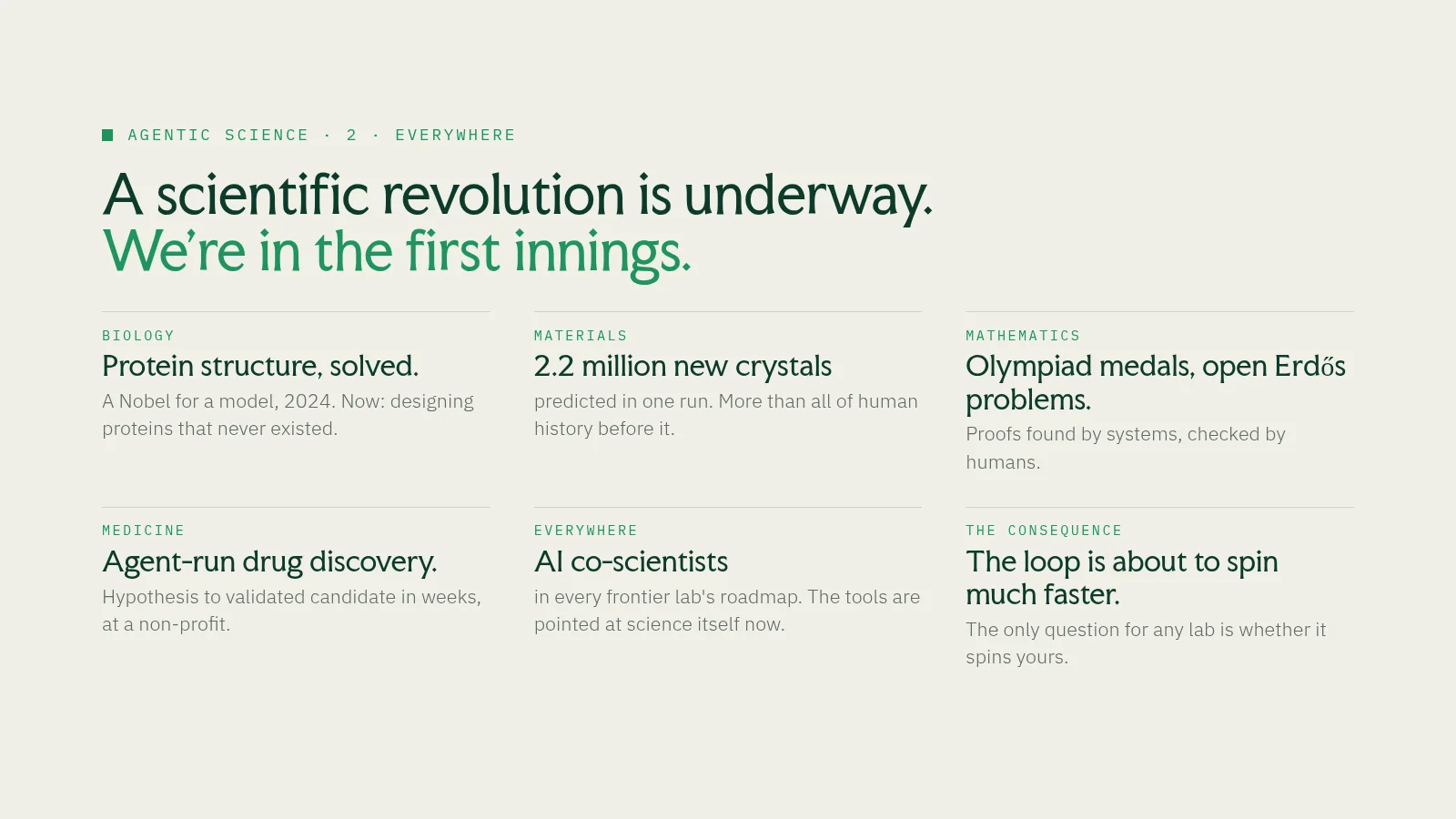
Slide 42: Agentic science · 2 · everywhere A scientific revolution is underway. We're in the first innings. Biology Protein structure, solved. A Nobel for a model, 2024. Now: designing proteins that never existed. Materials 2.2…
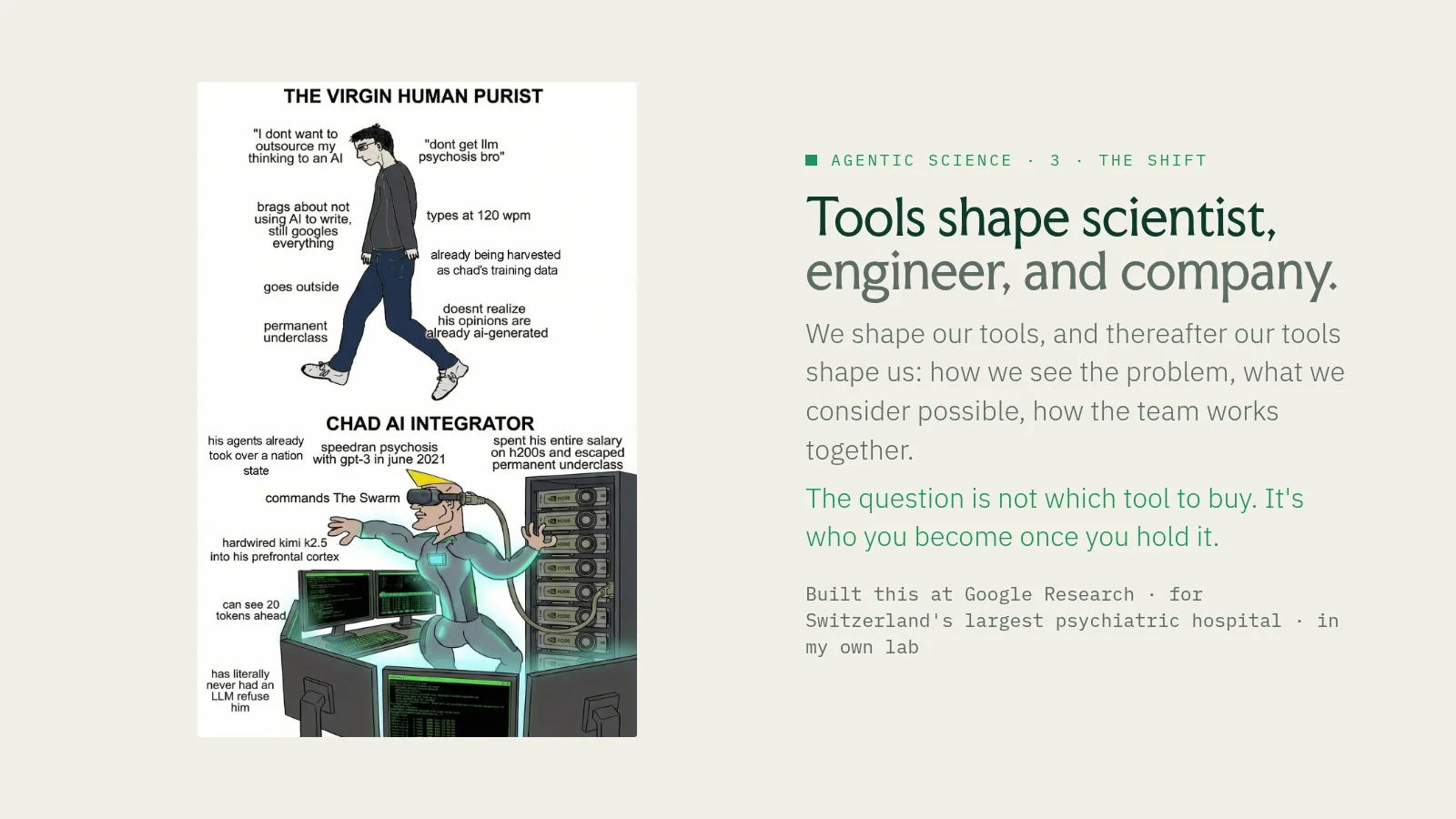
Slide 43: Agentic science · 3 · the shift Tools shape scientist, engineer, and company. We shape our tools, and thereafter our tools shape us: how we see the problem, what we consider possible, how the team works together. The…
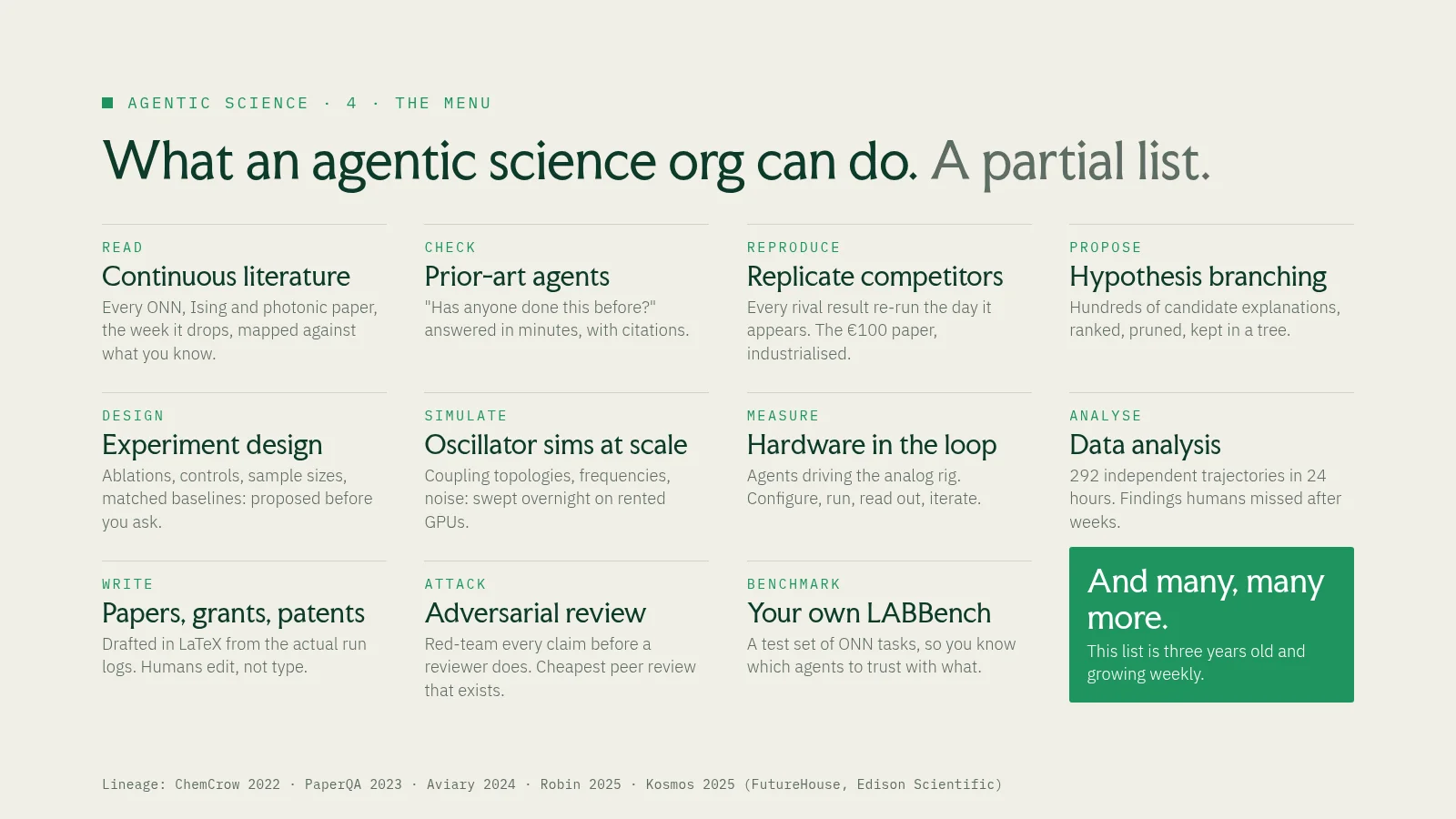
Slide 44: Agentic science · 4 · the menu What an agentic science org can do. A partial list. Read Continuous literature Every ONN, Ising and photonic paper, the week it drops, mapped against what you know. Check Prior-art agents…
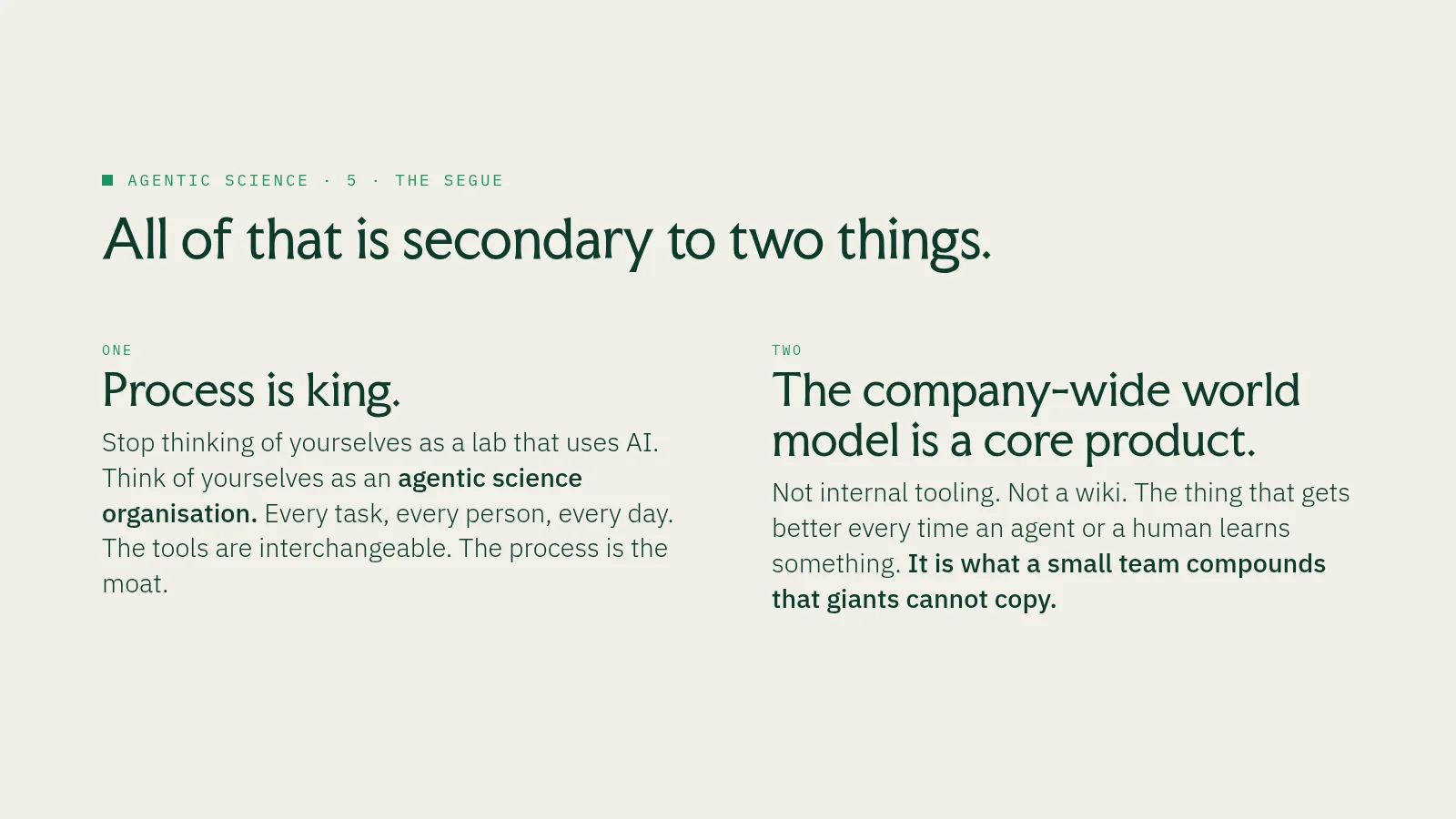
Slide 45: Agentic science · 5 · the segue All of that is secondary to two things. One Process is king. Stop thinking of yourselves as a lab that uses AI. Think of yourselves as an agentic science organisation. Every task, every…
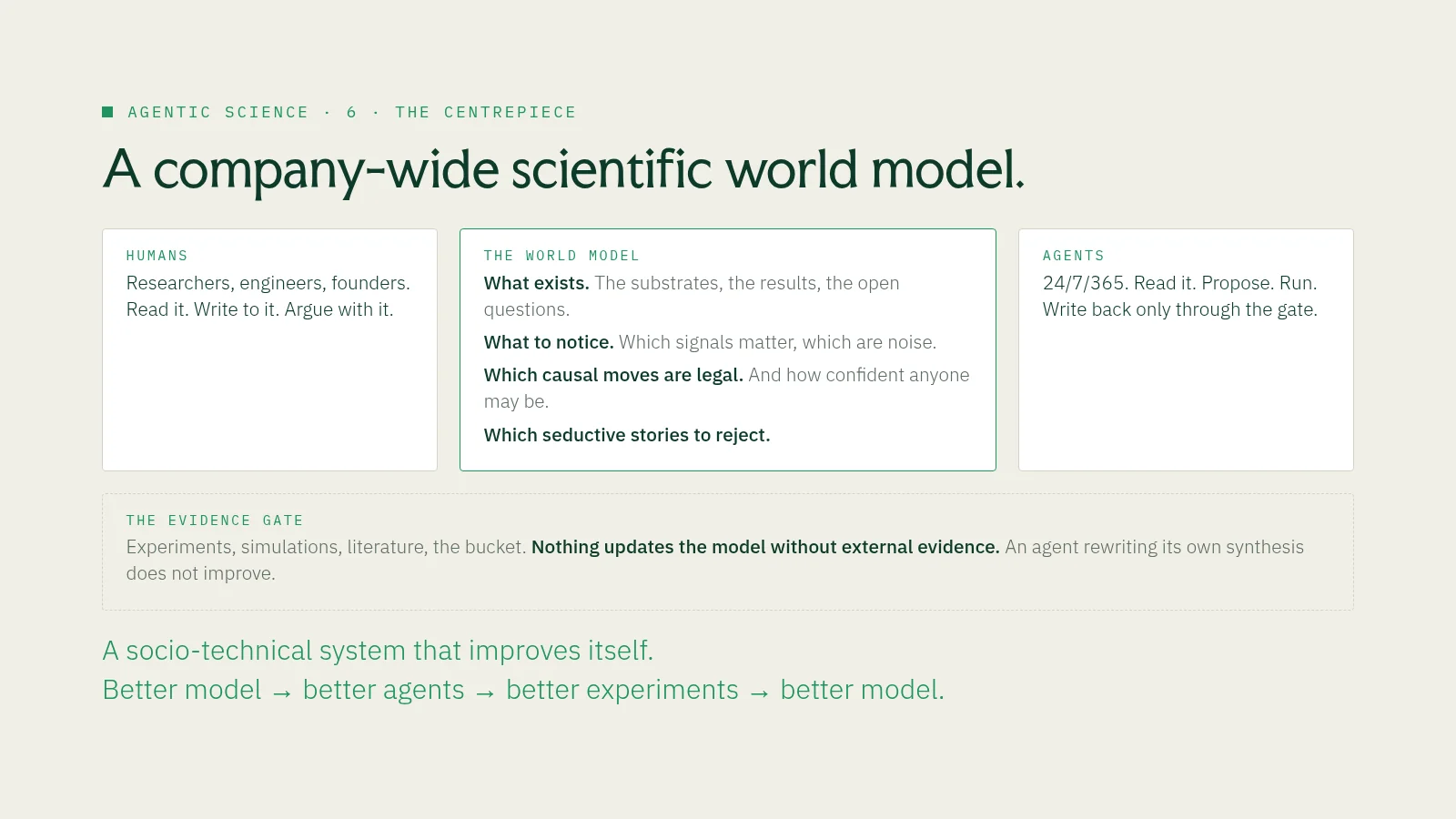
Slide 46: Agentic science · 6 · the centrepiece A company-wide scientific world model. Humans Researchers, engineers, founders. Read it. Write to it. Argue with it. The world model What exists. The substrates, the results, the…
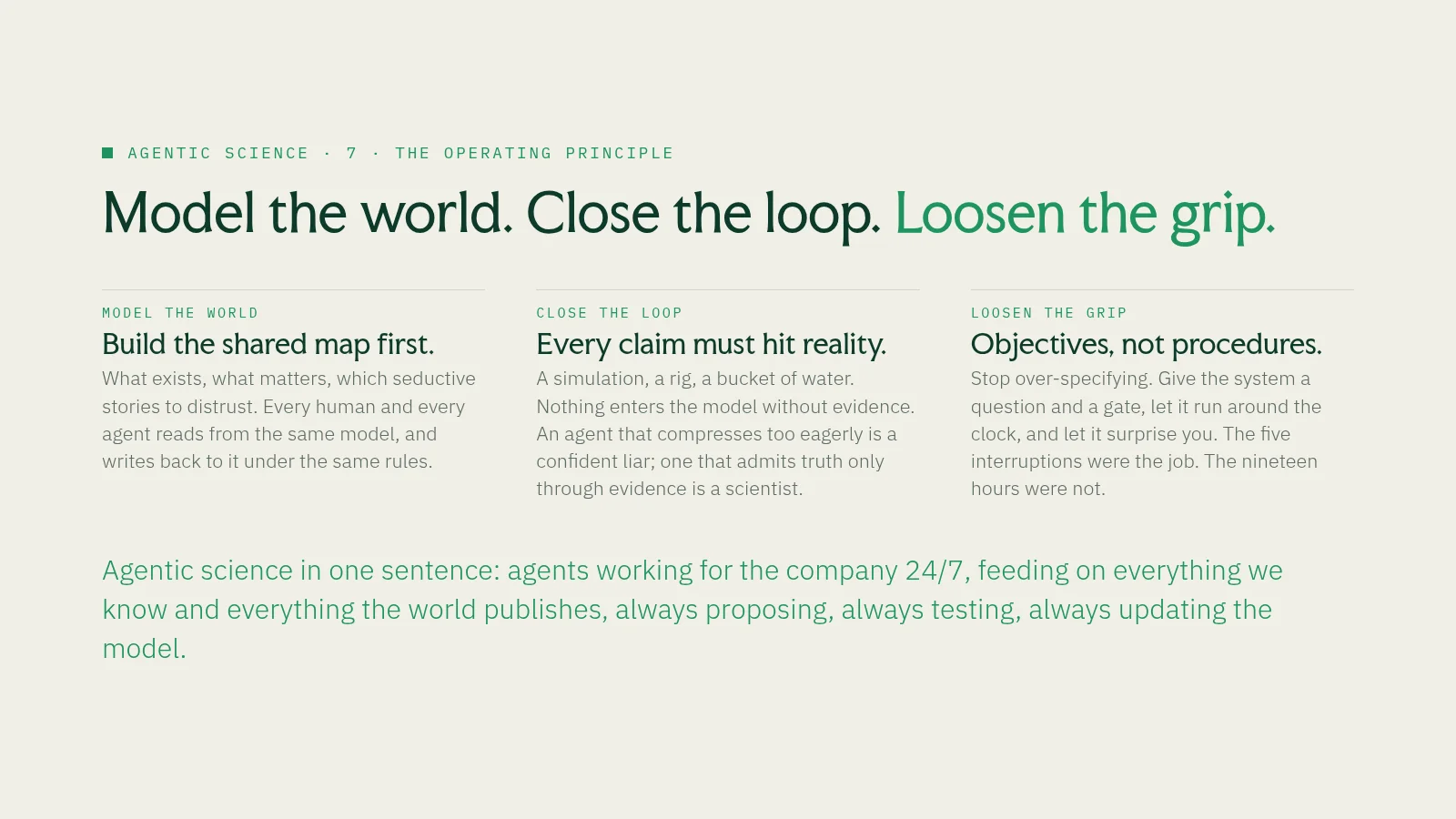
Slide 47: Agentic science · 7 · the operating principle Model the world. Close the loop. Loosen the grip. Model the world Build the shared map first. What exists, what matters, which seductive stories to distrust. Every human and…
Slide 48: 05 Can we scale invention itself?
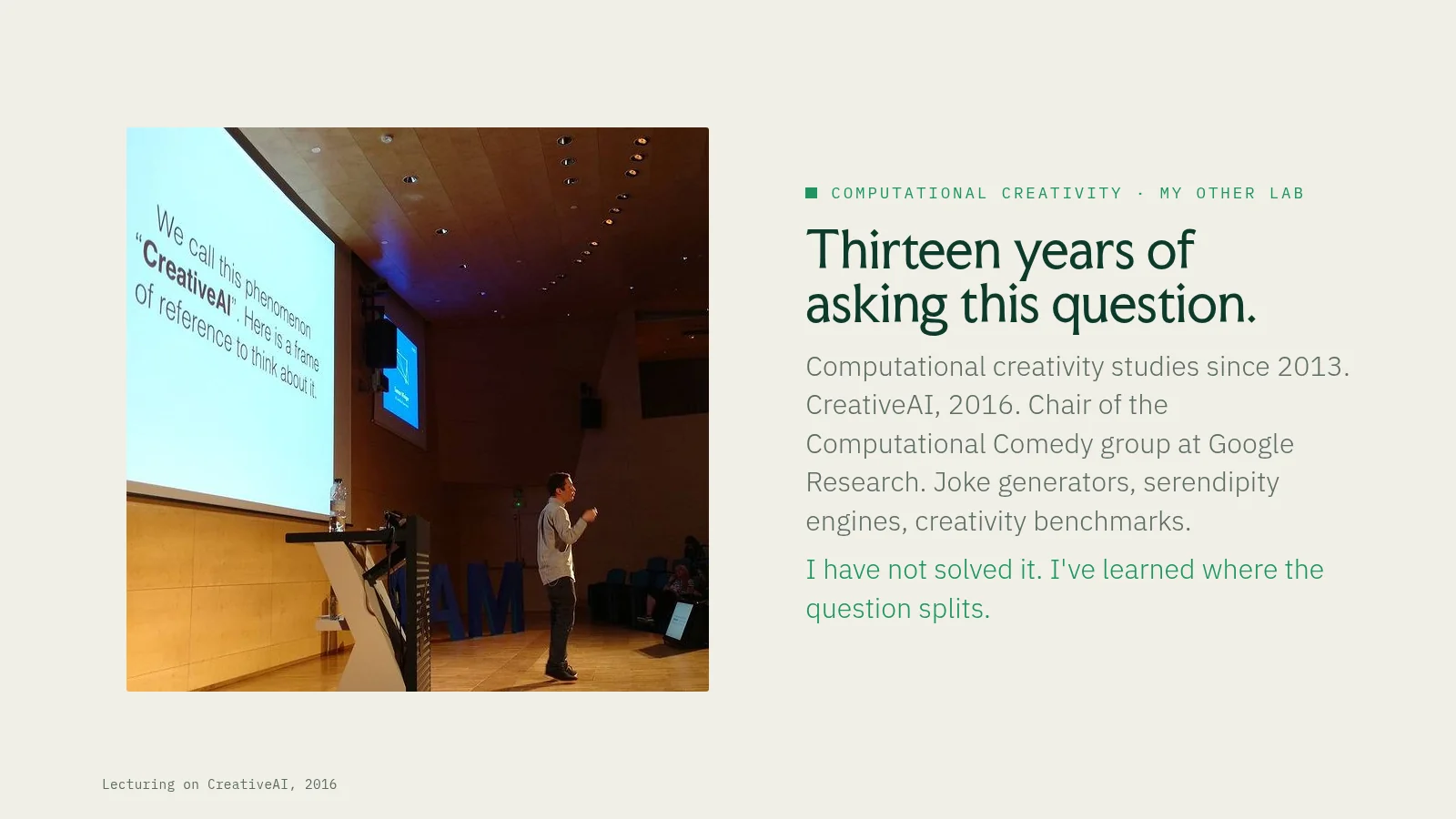
Slide 49: Computational creativity · my other lab Thirteen years of asking this question. Computational creativity studies since 2013. CreativeAI, 2016. Chair of the Computational Comedy group at Google Research. Joke generators,…
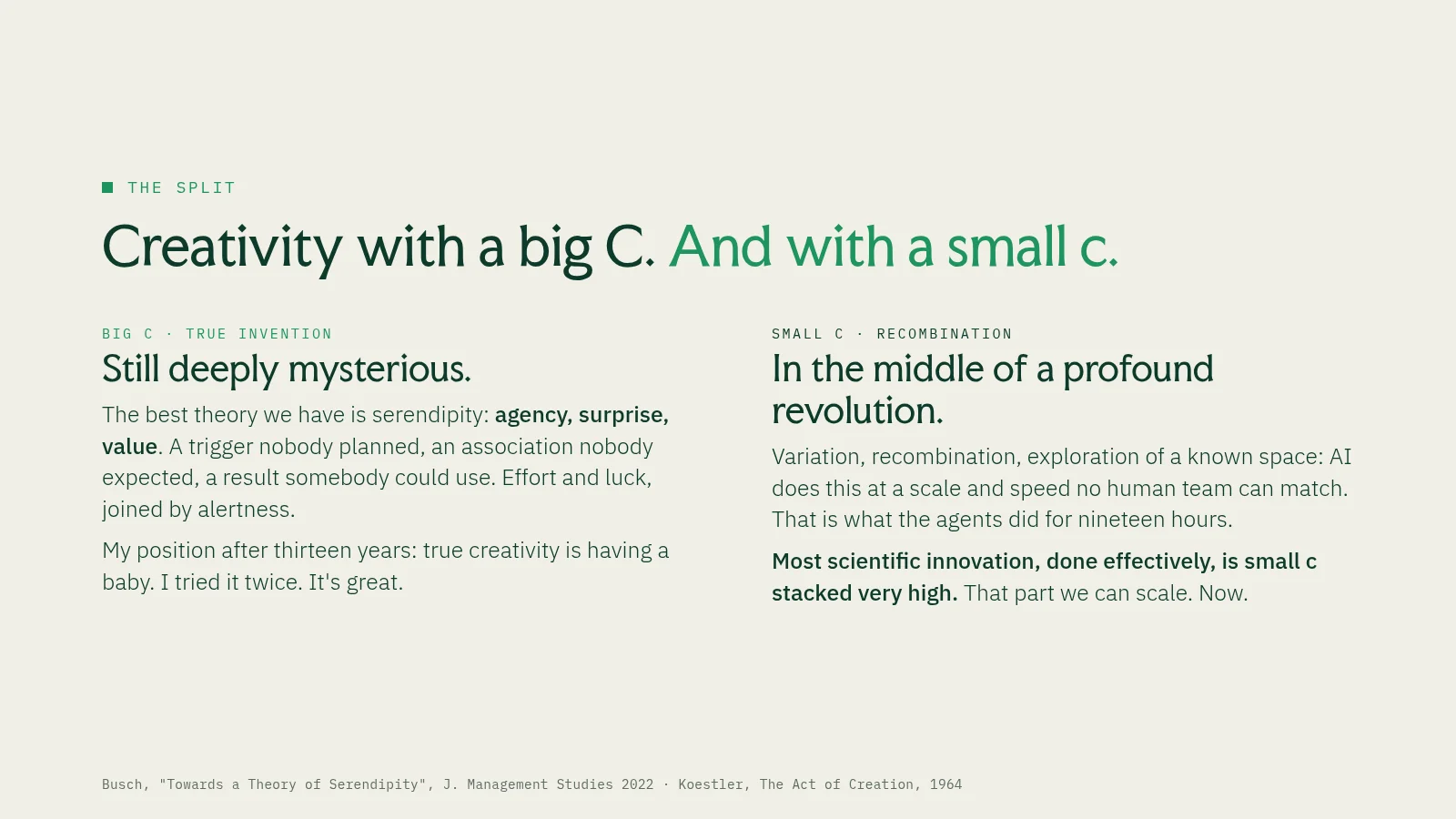
Slide 50: The split Creativity with a big C. And with a small c. Big C · true invention Still deeply mysterious. The best theory we have is serendipity: agency, surprise, value . A trigger nobody planned, an association nobody…
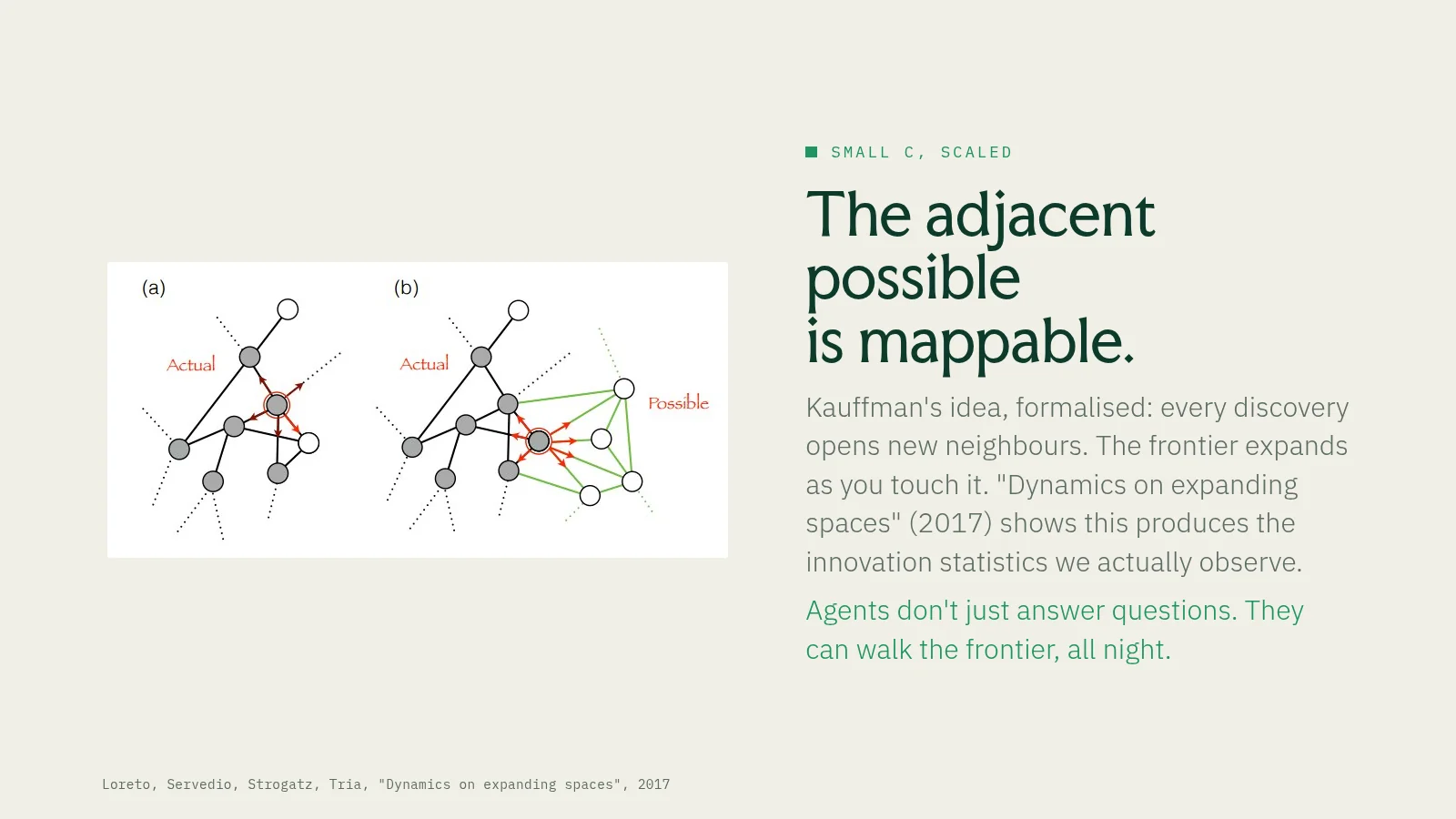
Slide 51: Small c, scaled The adjacent possible is mappable. Kauffman's idea, formalised: every discovery opens new neighbours. The frontier expands as you touch it. "Dynamics on expanding spaces" (2017) shows this produces the…
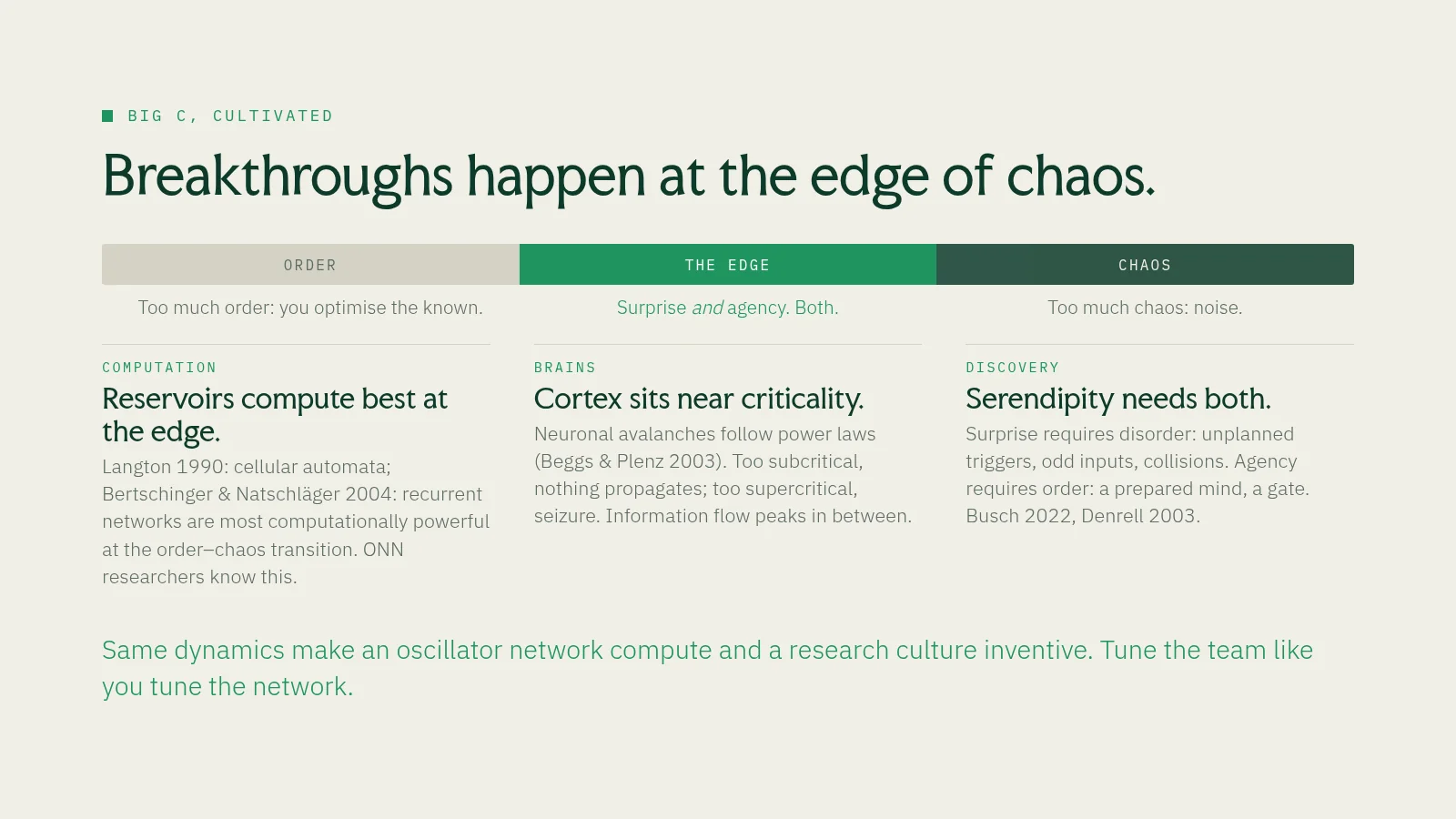
Slide 52: Big C, cultivated Breakthroughs happen at the edge of chaos. Order The edge Chaos Too much order: you optimise the known. Surprise and agency. Both. Too much chaos: noise. Computation Reservoirs compute best at the…
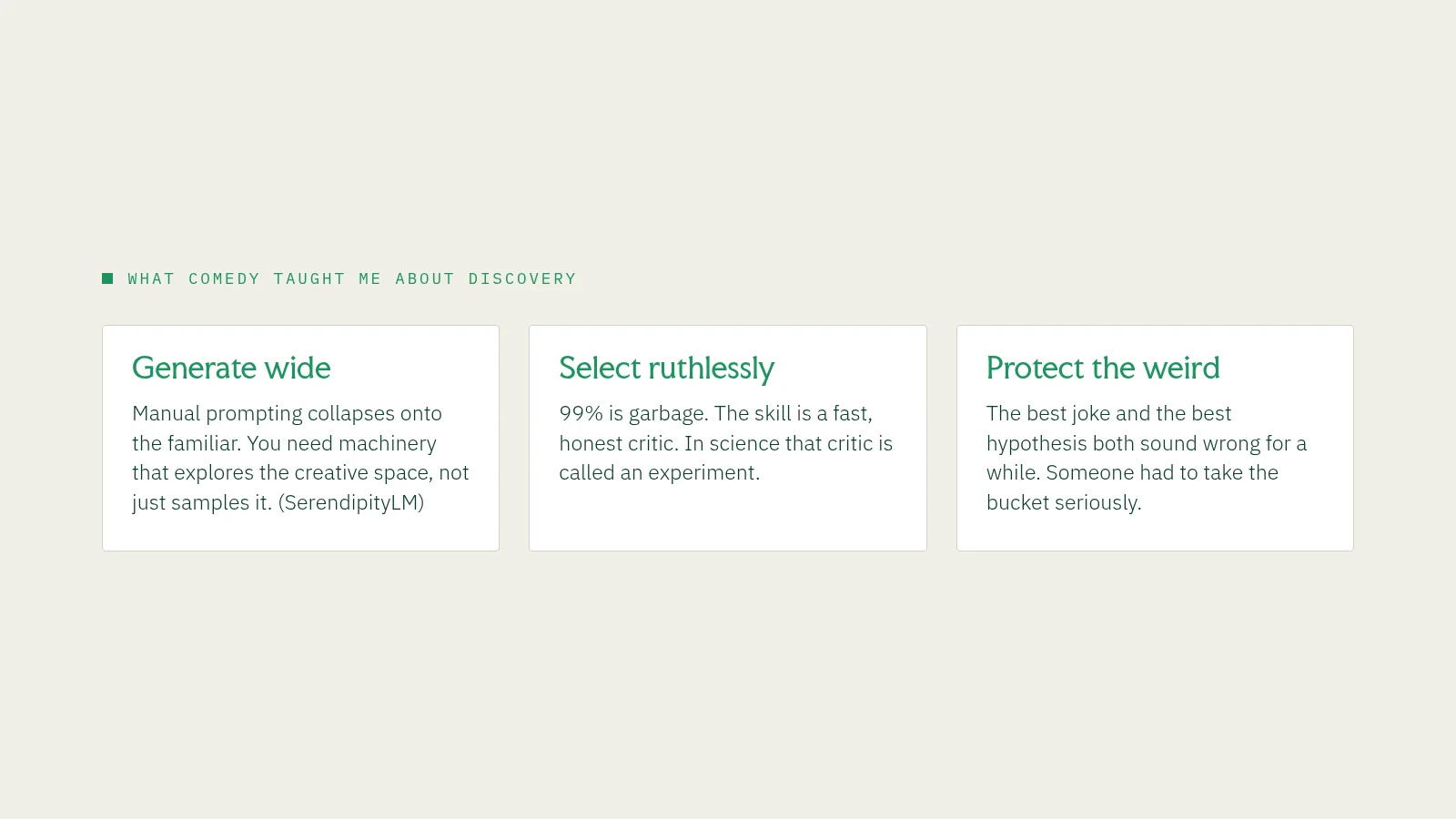
Slide 53: What comedy taught me about discovery Generate wide Manual prompting collapses onto the familiar. You need machinery that explores the creative space, not just samples it. (SerendipityLM) Select ruthlessly 99% is…
Slide 54: "Everything that is possible demands to exist." — Leibniz
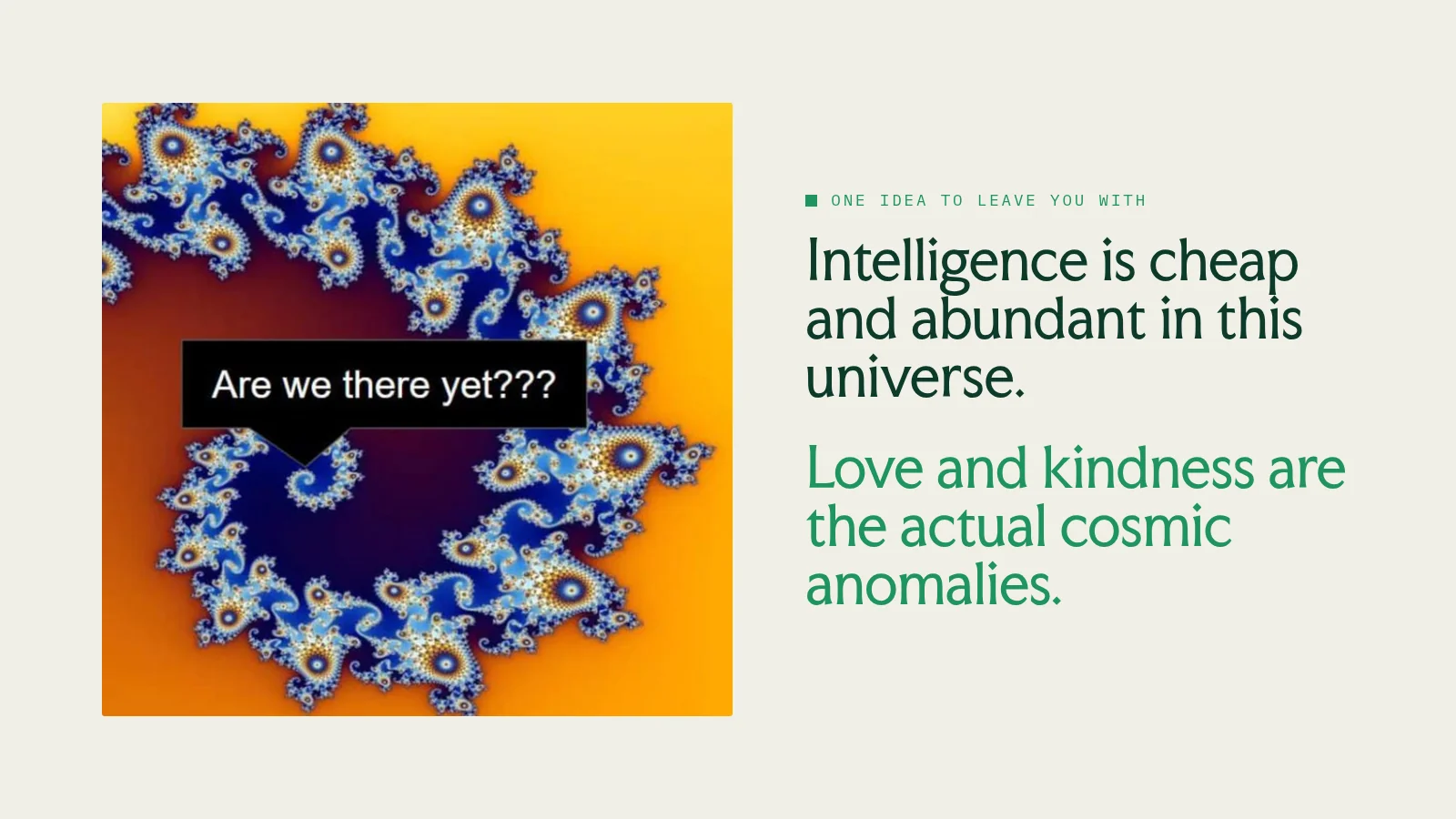
Slide 55: One idea to leave you with Intelligence is cheap and abundant in this universe. Love and kindness are the actual cosmic anomalies.
Slide 56: Thanks for reading. samim.io

#OSC #Nature #ML #Science #Complexity #Projects #FFHCI