What a Bit Can Unlock
What mycelium teaches about energy, matter and information.
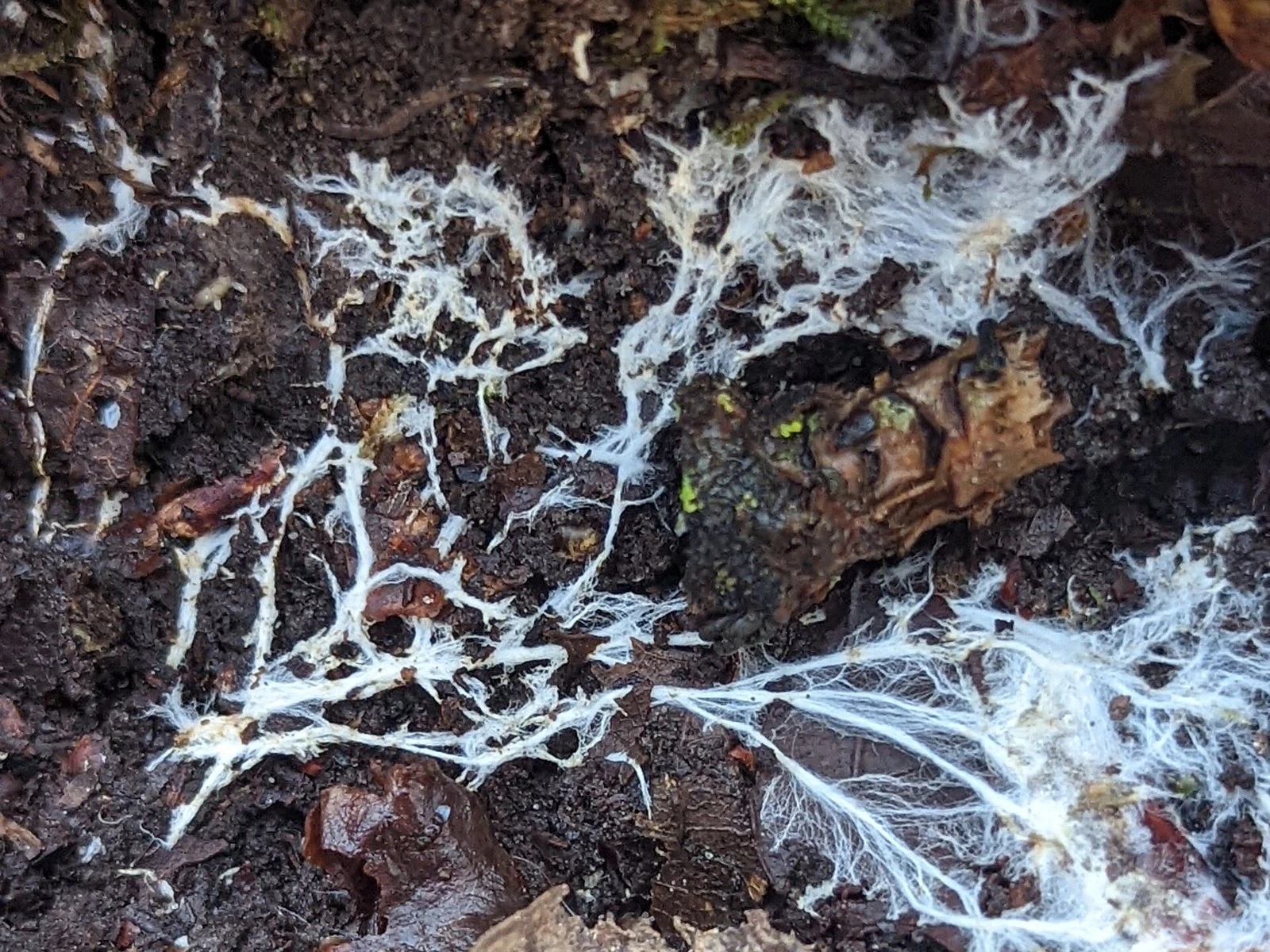
This started as a question about fungi: what does a mycelium run on? The answer is more than one thing. Living things deal in energy, in materials and in information, and these behave like separate currencies. Working out how they relate leads from the forest floor to the physics of a single bit, and to Leo Szilard, the man who also conceived the nuclear chain reaction. Along the way it turns up something about mycelium that’s easy to overlook.
Part oneThree currencies
Staying alive is work. A stone left alone stays a stone. A living thing left alone falls apart. Ilya Prigogine called such things dissipative structures: patterns, like a flame or a whirlpool, that exist only while energy flows through them. Humberto Maturana and Francisco Varela called life autopoiesis, self-making: a system that keeps rebuilding the parts that keep it going. Mycelium shows this plainly. Hyphae grow at their tips while older sections are broken down and recycled, so the network is less a thing than an ongoing process. Something has to pay for all that rebuilding, and life pays in more than one currency.
Energy is the universal one. Almost all of it starts as sunlight. Plants turn it into sugars, and every cell spends it as ATP. The exception is life at deep-sea vents, which runs on chemical energy.
Materials are separate currencies: nitrogen, phosphorus, water. Mycorrhizal fungi, the ones that partner with plant roots, mostly trade those. They give plants phosphorus and water, and get sugar (carbon) back. That trade exists because there are two currencies: each side has what the other lacks.
It’s a market, not a gift economy. Plants send more carbon to the fungi that deliver more phosphorus, and fungi send more phosphorus to the roots that pay more carbon (Kiers et al., Science 2011). Cheaters get cut off. The romantic “wood wide web”, where trees share through fungi like a family, is debated: a 2023 review (Karst et al.) found the field evidence much thinner than the popular story.
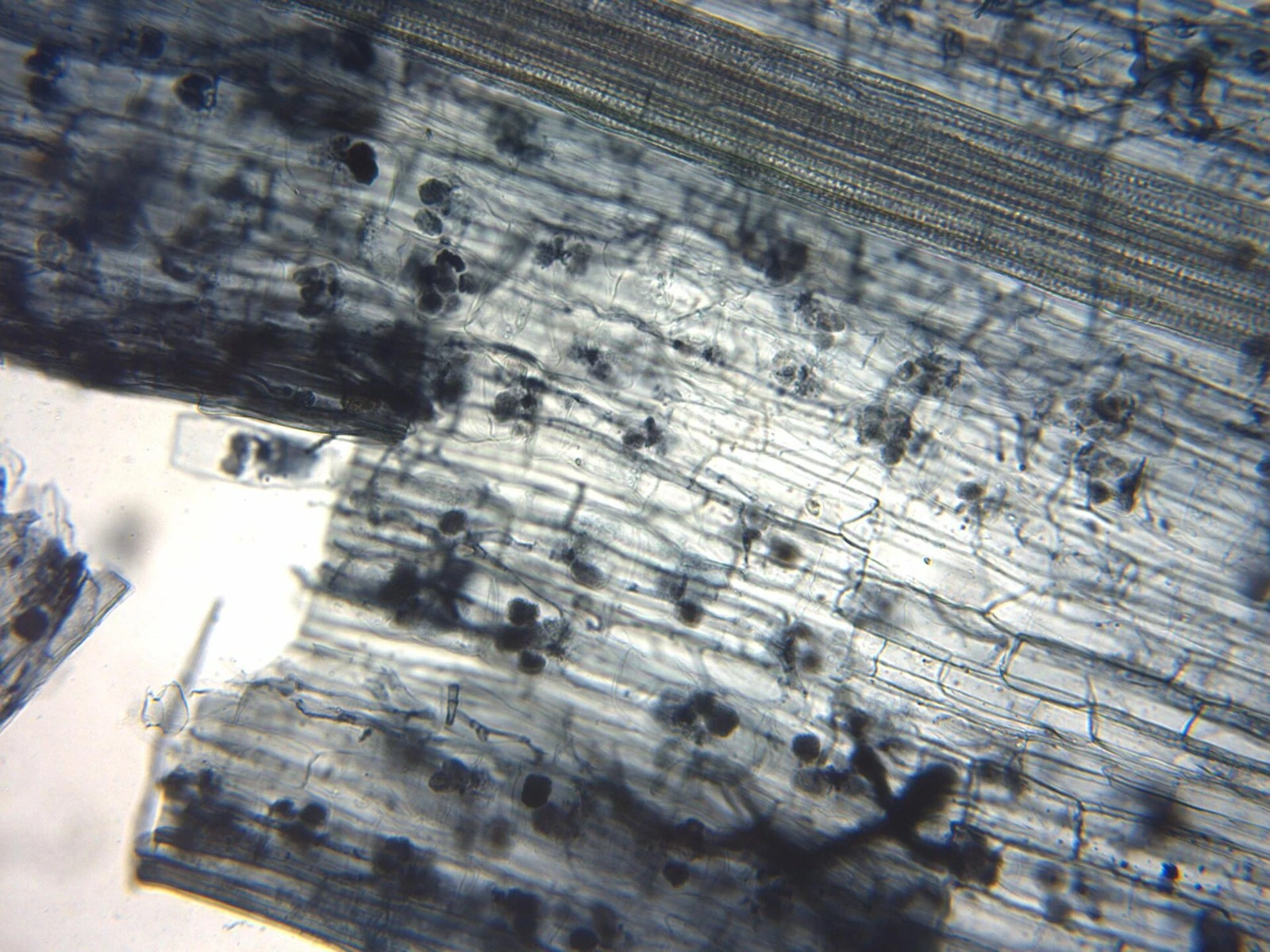
Signals cost energy but aren’t energy. Electrical spikes in mycelium run on ion gradients that ATP pumps maintain. So energy pays for the signal, but the signal’s value is information: what to do, where to grow. The information pays back in energy and survival. Information is a pattern, not energy itself, but the two trade against each other.
Part twoWhat is information, then?
It’s the arrangement, not the stuff. Rearrange the same letters and you get a different message, with the same ink and the same energy. Information lives in the relations between parts.
It always needs a host. No floating information exists. It’s cut into stone, held as voltage in silicon, written in DNA, kept as an ion gradient in a hypha. Rolf Landauer’s motto: “information is physical.” Take away the carrier and the information is gone.
Meaning needs a reader. In Shannon’s sense a crystal holds a pattern whether anyone looks or not. But a chemical trail means “food here” only to a fungus that can read it. To a rock it means nothing. And the reader pays: it burns ATP to keep its reading machinery alive.
Information trades against energy. Landauer’s principle: erasing one bit costs at least kT ln 2 of energy, about 3 × 10⁻²¹ joules at room temperature (Landauer, 1961). Szilard’s engine shows the reverse: knowing one bit lets you extract up to kT ln 2 of work (Szilard, 1929). Put one gas molecule in a box, slide in a wall, find out which side it’s on, and let it push the wall. So information isn’t merely carried by energy. It’s physical, and it trades against free energy: knowing something lowers entropy, which raises the work you can extract. There’s no free lunch. To repeat the trick you have to erase the bit, and erasing pays back what you gained (Bennett, 1982).
one bit ⇄ kT ln 2 ≈ 3 × 10⁻²¹ J
The exchange rate between information and energy at room temperature
1. One molecule in a box.
2. Slide in a wall.
3. Measure which side: one bit.
4. It pushes the wall: up to kT ln 2 of work.
Life pays far above that floor. kT ln 2 is tiny: splitting one ATP molecule releases about twenty times as much. And a cell is warm, wet and noisy. To send a signal that survives the thermal jiggling it has to shout, pumping thousands to millions of ions for one clear spike. Neurons, the best-measured case, spend between ten thousand and ten million ATP per bit (Laughlin et al., 1998). That puts living signalling a hundred thousand times or more above Landauer’s limit. The extra buys reliability and speed.
Energy per event, in multiples of the Landauer limit (log scale)
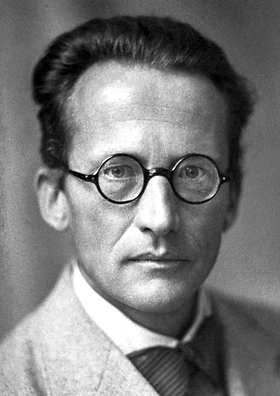
Information is leverage. A map can’t power a car, but the right map finds the well. So a cell’s information is worth something through behaviour, not through its own tiny thermodynamic value: knowing where the food is saves far more energy than the bit itself could ever pay out. The fungus spends a little ATP maintaining a pattern that maps the soil, and that pattern decides where its large budgets of energy and material go next. Schrödinger wrote in What Is Life? (1944) that “what an organism feeds upon is negative entropy.” Léon Brillouin later tied negative entropy to information. Seen that way, a living thing feeds on energy and on knowing where to spend it.
A bit has two prices. Landauer gives one exchange rate: a bit is worth at most kT ln 2 joules. There is a second, and it’s the one that matters for life. In 1956 John Kelly, working at Bell Labs, showed that a gambler with a private tip can grow their money faster, and that the extra growth rate is capped by how much information the tip carries about the outcome (Kelly, 1956). Matina Donaldson-Matasci, Carl Bergstrom and Michael Lachmann showed that, under comparable conditions, the same holds for organisms: a cue about the environment can raise a lineage’s growth rate by at most the information it carries (Donaldson-Matasci et al., 2010). So a bit has a tiny price in joules and a potentially large price in growth. Physics fixes the first. The second depends on what the bit lets you do.
Underneath, there’s only one currency. Strictly, physics counts information as a form of free energy: a system you know more about holds more extractable work (Parrondo, Horowitz and Sagawa, 2015). So the deepest currency is free energy. But in a living thing the bit’s own share is a rounding error, while what it steers is everything. That’s why, in practice, it pays to track information as its own currency.
Knowing has to pay for itself. Senses and brains are judged by one rule: they’re worth keeping only if what they tell you saves more energy than they cost. The human brain is about 2% of body weight and burns about 20% of the body’s energy. So evolution keeps nervous systems lean: sparse firing, cheap codes, no thinking without need. An eye that never finds food is a luxury, and luxuries get cut. Physics adds a sharper version: a system that keeps memories of its past which don’t help predict its future must waste energy because of them (Still et al., 2012). Useless memory has a heat bill, so being efficient and predicting well turn out to be closely linked.
Part threeWhat a bit can unlock
“… what hep humorists here are already calling ‘Critical Mass’ (get it? not too many did in 1945, the Cosmic Bomb was still trembling in its earliness, not yet revealed to the People, so you heard the term only in the very superhepcat-to-hepcat exchanges).”Thomas Pynchon, Gravity’s Rainbow (1973)
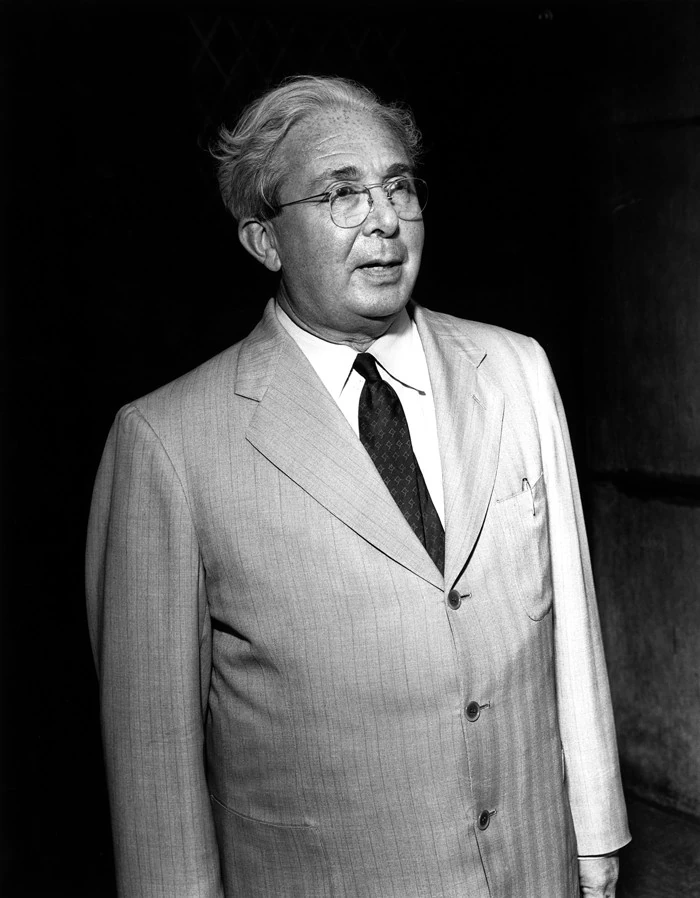
The same Szilard stands at both ends. In 1929 he showed that one bit is worth almost nothing: kT ln 2 of work, about 3 × 10⁻²¹ joules. In 1933, waiting at a traffic light in London, he saw that a neutron chain reaction could release enormous energy. He patented the idea in 1934, and in 1939 he drafted the letter Einstein signed to Roosevelt. By 1945 “critical mass” was the insiders’ joke in Pynchon’s novel. A bit on its own buys almost nothing. The right piece of knowledge, applied in the right place, released enough energy to destroy a city.
A bit doesn’t contain energy. It releases it. The bomb needs three things. A store: energy held in a metastable state, here in uranium nuclei. A trigger: one neutron, one “go”. And gain: each split has to set off at least one more. Critical mass is the amount of uranium at which that gain reaches one and the reaction sustains itself; a bomb pushes it well above one. The trigger’s own energy is irrelevant. What it can unlock depends on the size of the store and on the gain.
Life runs on the same pattern. ATP is a store waiting to be spent, enzymes are triggers, and signalling cascades supply the gain. A single photon can make a rod cell in your eye respond, because each step of the cascade multiplies the signal (Baylor, Lamb and Yau, 1979).
| Bomb | Cell | Mycelium | |
|---|---|---|---|
| Store | Uranium nuclei | ATP, sugars | Dead wood, soil carbon |
| Trigger | One neutron | An enzyme, a photon | An enzyme, a signal at a hyphal tip |
| Gain | Chain reaction | Signalling cascade | Growth that reinforces what pays |
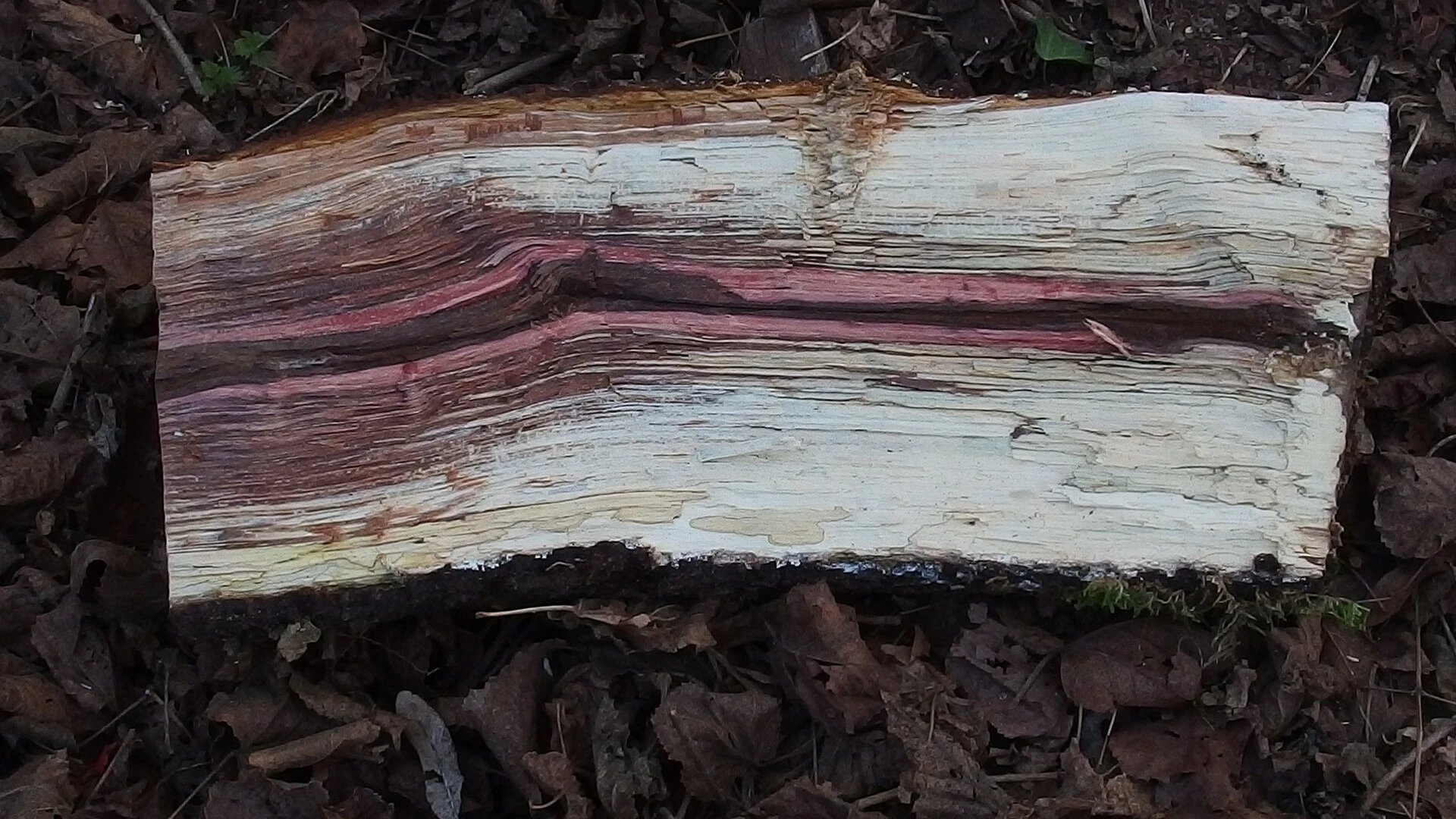
Mycelium sits on the largest store on land. Soils hold more carbon than the atmosphere and all plants combined, much of it from dead plant matter: stored sunlight. Decomposers decide whether that store stays locked or is released, and for wood the decomposers are mostly fungi. White-rot fungi are among the very few organisms that can break down lignin, the toughest part of wood. Some researchers argue that when fungi evolved lignin-cracking enzymes, less wood got buried, which helped end the great coal-forming era of the Carboniferous (Floudas et al., Science 2012). Others think climate and geology mattered more (Nelsen et al., PNAS 2016). That it’s a serious debate is the point: a handful of genes is a candidate for steering the planet’s carbon.
And it steers a flow measured in gigatonnes. Plants send an estimated 13 gigatonnes of CO₂-equivalent a year to their mycorrhizal fungi, roughly a third of annual fossil-fuel emissions (Hawkins et al., Current Biology 2023; the estimate is uncertain). Inside the network, paths that find food get more growth and more transport, so a small signal at a hyphal tip turns into a large reallocation. That’s gain.
A bomb wants gain above one. Life seems to want it near one. Below one, signals die out. Above one, they run away, and a bomb is built to run away. Living systems need to stay responsive without exploding, and there’s evidence that some sit close to the edge. In slices of rat cortex, bursts of activity spread as “neuronal avalanches” whose statistics look like a system poised at a gain of about one (Beggs and Plenz, 2003). When a system tunes itself to that edge, it’s called self-organised criticality. The idea is still debated for brains and untested for fungi. But it marks the real difference between a bomb and an organism. Both use a store, a trigger and gain. Life keeps the gain at the edge, where a small signal can matter and nothing blows up.
So what are we overlooking? We tend to see mycelium as a network that carries things. It’s better seen as a control system sitting on a vast reservoir of stored energy. Its information is cheap, and what it controls is measured in gigatonnes. That’s a way of seeing, not yet a measurement: nobody has worked out how much of that flow is steered by what fungi sense and signal, rather than by plain growth and chemistry. But it’s the right question to ask. Szilard found both ends of that within a few years. Fungi have been running the quiet version for over 400 million years.
Information is worth what it can unlock, not what it weighs.
In shortThe whole picture
Energy
pays
Free energy: sunlight, sugar, ATP. Every cell spends it.
Materials
trade
Nitrogen, phosphorus, water. Scarce in different places, so they get exchanged.
Information
steers
Patterns and signals. Cheap to hold, and they decide where the rest goes.
Why does having more than one currency matter? The material currencies are what make trade, specialists and coexistence possible. Ecology has a name for the alternative: competitive exclusion (Gause, 1934). When species compete for one limiting resource, the best competitor eventually wins and the rest disappear. With two or more, different species can specialise on different ones and live side by side (Tilman, 1982). The catch is that this only works where they actually compete: without competition, a second resource just favours generalists. Where they do, a second currency is the step from a single winner to an economy.
So, back to the question this started with: what does a mycelium run on? Sugar, from the plants it partners with or the dead wood it breaks down. Phosphorus and water, traded back and forth. And a web of signals that costs almost nothing to keep, and decides where all of it goes.