How Accidents Become Inventions
The Ratchet Model, a working model of serendipity: stepping stones and gatekeepersSamim A. Winiger, 2026


In 1968 Spencer Silver, a chemist at 3M, was trying to make a strong adhesive and made a weak one instead. It stuck, peeled off cleanly, and stuck again. Nobody needed that. For years Silver kept presenting it at internal seminars, a solution looking for a problem. In 1974 his colleague Art Fry, who sang in a church choir and was tired of bookmarks falling out of his hymnal, remembered one of those talks. A test launch in four cities in 1977 flopped. Free samples handed out in Boise in 1978 worked, and the Post-it note went national in 1980.
Nothing about the glue changed in those twelve years. What changed was who saw it, what they needed, and who decided it was worth keeping.
The Post-it is not a one-off. Penicillin, the microwave oven and Slack have the same shape: something made for one purpose meets a context nobody planned for, and then a chain of people decides whether it goes anywhere. That chain is what the Ratchet Model describes, and it can be drawn, counted and improved.
The idea
New things mostly come from old things meeting new contexts. Whether a meeting becomes anything is decided at five gates: something unexpected has to happen, be noticed, be linked to a need, be built, and be kept. What gets through compounds, and it also stiffens what gets noticed next. That makes discovery something you can measure and steer, instead of something you only hope for.
Most accounts of serendipity offer a list of virtues (be curious, be open, be lucky) or a cloud of concepts joined by arrows. The Ratchet Model offers a mechanism instead, with parts you can count. It draws on management research, information science, evolutionary computation, complexity science and the psychology of creativity. Where each part comes from is in the notes at the end. In a hurry? Read the six claims, the model diagram and the short summary at the end.
The thesis of the Ratchet Model, in six claims:
1. Serendipity is a route, not a thing.
It is the path an unexpected event takes through five gates: Expose, Notice, Connect, Enact, Keep. Luck needs no work at the gates. Serendipity is chance carried through them.
2. The weakest gate has the most headroom.
The gates multiply, so the biggest available gain usually sits at the gate that passes least, which is rarely the one all the advice is about.
3. Asking too early what a surprise is for can kill it.
Surprises need an archive that keeps them for being interesting, not useful, because the stepping stones to big discoveries rarely look like them.
4. The ratchet stiffens as it turns.
What is kept feeds the next round, and it also hardens the habits that decide what gets noticed. Without fresh exposure, discovery slows down.
5. Different kinds of change happen at different gates.
Adaptation and exaptation split at Connect: the same need, or a new one. Disruption happens at Keep, when someone the incumbent does not control keeps what the incumbent turned down.
6. Count surprises before you know their value.
Studying only the successes makes any theory of serendipity look true. Log surprises as they happen, and the losses at each gate become data.
The Ratchet Model
The model has a store, five gates, an archive and two loops. The name comes from the ratchet: a wheel with a catch, so that what is gained cannot slide back. The idea is kin to Michael Tomasello’s cultural ratchet, the way human cultures keep innovations and build on them. The Ratchet Model looks inside a single turn of that wheel.
The store
The store holds three kinds of thing.
- Parts are everything that exists and can be reused: tools, skills, traits, products, ideas. Each has the functions it was made for, plus hidden ones that show only in a context it has not met yet. Gibson’s affordances live here.
- Needs are open problems, markets and niches. They are not handed in from outside; solutions create them. Stanley, Lehman and Soros put it neatly: you can’t get giraffes if you don’t have trees. The POET algorithm (Wang, Lehman, Clune and Stanley) generates new environments alongside the agents that solve them.
- Expectations are what the actor predicts will happen. They decide what counts as a surprise.
Kauffman’s adjacent possible is everything one step away from what the store holds, and it grows as the store grows. It also cannot be listed in advance (Felin, Kauffman and colleagues), which is why the model counts what happens rather than what could.
The five gates
- 1 Expose. A part meets a context it was not made for, or two parts meet. Most meetings produce nothing. When one produces an effect nobody expected, that is a trigger, the unit the rest of the model counts. Exposure is partly chosen: Dew defines entrepreneurial serendipity as “search leading to unintended discovery”. The world’s constraints matter too. In a maze with two outer walls removed, Lehman and Stanley’s novelty search reached the goal only 5 times in 100, and objective search only twice. Where almost anything is possible, almost everything is new and almost nothing is interesting. In the Post-it story: Silver tries a new recipe for a strong glue and gets one that will not hold.
- 2 Notice. Someone registers the trigger. This gate works like a detector with two settings: how well it tells signal from noise, and how readily it fires. Set too strict, it explains surprises away; Chinn and Brewer catalogued how scientists do this with anomalous data (ignore it, reject it, exclude it, hold it in abeyance, reinterpret it). Set too loose, it sees patterns that are not there and floods the next gates with false alarms. What should pass is not raw surprise, since noise is surprising too, but surprise you can learn from. Work on curiosity and open-ended learning (Schmidhuber, Oudeyer, Hughes and colleagues, OMNI) points to the same test: expected learning progress, filtered by what someone finds interesting. In the Post-it story: Silver sees that it peels off cleanly and sticks again, and finds that odd rather than useless.
- 3 Connect. The trigger is linked to a need. The same need you were working on means adaptation; a different need means exaptation. Far links are rarer and riskier, and they are where radical change comes from: Andriani and colleagues found that about 42% of new uses of existing drugs were exaptive, with the radical ones arising in markets far from the original. The barriers are psychological. People recall analogies by surface similarity, and functional fixedness hides what familiar things could do. Kittur and colleagues show the gate can be engineered: rewrite the problem as a purpose and a mechanism, then search far away. In the Post-it story: Fry links it to his hymnal: a bookmark that stays put. A new need, so an exaptation.
- 4 Enact. The link is built into something that works. Bricolage and effectuation are good ways to run this gate: build with what is at hand, and risk only what you can afford to lose. It is not a simple filter. Ideas change while they are worked on, which Liane Gabora calls honing, and early judgements predict this gate badly. When 43 experts each spent over 100 hours carrying out research ideas, the AI-generated ones, which had been judged more novel beforehand, lost more on every measure than the human ones (Si, Hashimoto and Yang). In the Post-it story: 3M’s teams turn a glue into a product: notes that peel off without tearing the page, and a way to make them.
- 5 Keep. A gatekeeper decides whether the working thing survives, spreads and is stored: a market, a committee, a funder, a regulator, an automated test, natural selection. Kept items return to the store. Three refinements matter. Selection also happens before Enact, because a budget decides what gets built at all (Bower; Burgelman’s studies of Intel). Gatekeepers make two kinds of mistake, keeping duds and losing gems, and many independent gatekeepers keep more of both (Sah and Stiglitz). And evaluators measurably mark down novel proposals (Boudreau and colleagues). In the Post-it story: The 1977 test market says no. The 1978 Boise samples say yes.
Notice and flow
Notice has a sweet spot, and flow research has drawn it. Mihaly Csikszentmihalyi’s flow diagrams plot challenge against skill: too much challenge for your skill feels like anxiety, too little like boredom, and flow is the channel between. Read challenge as how surprising something is, and skill as what the store already expects, and the channel is where Notice passes the most worth keeping: surprising enough to register, close enough to what you know to learn from. Infants show the same preference, looking longest at sequences that are neither too simple nor too complex (Kidd, Piantadosi and Aslin call it the Goldilocks effect). The channel is personal, and it moves. One tension is worth testing: flow narrows attention, which suits Enact, while side surprises are often caught with looser attention, so deep flow may lower Notice for anything off-task.
The archive
Most things fail a gate and vanish. The archive is a second kind of Keep, with its own gatekeeper: it keeps things for being interesting, not for being useful. It holds recorded failures (odd results, dead projects, glues that barely stick) and stepping stones, things that are new or striking before anyone knows what they are for. In Picbreeder, a website where people evolved images together, users published images because they liked them, and others carried on from there. Images found that way, a skull or a butterfly, could not be found again by setting them as a target (Woolley and Stanley).
The archive must be reachable without Connect. Forcing every surprise to justify itself early throws away exactly the stepping stones that far exaptations are built from.
Two things make an archive work. Someone has to carry it: the Post-it never sat quietly on a shelf, because Silver kept showing it until it met Fry. Innovation research calls this person a champion. And the people walking past it need open problems in mind. Psychologists call this opportunistic assimilation: an unsolved problem leaves a mark in memory, and a later cue that fits it gets noticed (Seifert and colleagues). An archive that nobody carries and nobody walks past is a landfill.
The path may also shape the quality of what is kept. Kumar, Clune, Lehman and Stanley trained a network by gradient descent to draw the same skull as a network evolved in Picbreeder. The pictures match; the insides do not. In the evolved network, single units carry clean ideas such as symmetry. In the trained one, the same ideas are split into fragments spread over many units. They propose that open-ended paths produce better-organised parts. The evidence so far is a handful of images, but if it holds, stepping stones are also better raw material for the next round.
Two loops: compounding and stiffening
So far, one trigger and one pass through the gates. But the model is a wheel, not a line: what Keep passes goes back into the store, and the store shapes the next pass. That feedback runs two ways at once, and both ways come from the same part of the ratchet. The catch that stops the wheel slipping back is what lets gains add up. It is also what makes the wheel harder to turn.
Compounding. Every kept part adds to the store, and the number of possible pairings grows roughly with the square of its size. Weitzman called this recombinant growth. Tria, Loreto, Servedio and Strogatz showed with an urn model how each novelty can open the way to others, so that the space grows as it is explored. How much of that potential is realised depends on the second loop.
Stiffening. Keeping what works also reinforces it, in two ways. The generator converges: in the same urn model, reinforcing familiar elements competes with opening new ones, and when reinforcement wins, discovery slows (Heaps’ law). And the observer habituates: kept expectations grow more confident, so fewer things count as surprising. Management research has names for both, from core capabilities that turn into core rigidities (Leonard-Barton) to competency traps (Levitt and March) and the familiarity trap (Ahuja and Lampert). AI shows the same thing in its plainest form. Albalak, Lehman, Stanley and colleagues call it the creative paradox: training a model on past creative successes makes exactly those successes more likely to recur.
In flow terms, compounding moves a person toward more skill. Unless the challenge rises too, they drift out of the channel into control and boredom: stiffening, felt from the inside. Fresh exposure is the arrow that raises the challenge again.
Three things loosen it.
- Fresh exposure. In March’s simulations, people who adapted slowly to the organisation’s beliefs kept it exploring and improved what it knew, and moderate turnover helped too, as long as newcomers were socialised quickly. Language models made deliberately ignorant of a topic produced more novel seed ideas, and an expert model could then repair their feasibility (D’Ambrosio and colleagues; the effect held clearly for some topics, not all). Fresh eyes help at Expose; expertise helps at Enact.
- Using what is kept as a repellor. Novelty search stores what it has found so that it can move away from it. Kept expectations become a map of where not to look again, the opposite of fixation.
- Keeping processes, not products. The creative priming work trains a second model to write short prompts that push the answering model somewhere new, rewarding novelty, quality and diversity together. It produced about three times as many good, distinct answers as one baseline and about 40% more than the other. A kept product hardens the store; a kept process keeps producing new ones.
The arithmetic
Count the triggers that arrive and the share that passes each gate, and kept output is a product:
kept per year ≈ E × pnotice × pconnect × penact × pkeep
Here E is the number of triggers per year, and each p is the share of what reached a gate that passes it. Read that way, the product is bookkeeping: always true, and useful as a diagnostic. Four things follow.
- The weakest gate has the most headroom. A gate that passes 90% can multiply output by at most 1.1; one that passes 4% could multiply it by 25. Whether to work on it depends on cost, since lifting a gate from 4% to 8% may be harder than lifting another from 50% to 100%. A low pass rate at Keep is often the point: a gatekeeper that keeps everything is not one.
- Small differences multiply. Two teams that are each twice as good at three gates differ eightfold in output.
- The bottleneck moves. Gates have capacity as well as pass rates. When more linked ideas arrive than Enact can build, a backlog forms and better noticing stops paying. Weitzman argued that as ideas pile up, the limit becomes processing them. A growing backlog at a gate is the sign that the bottleneck has moved there.
- The gates trade off. Lowering the bar at Notice lets weaker triggers through, so Connect’s share falls. Improve one gate and watch the next.
Value is uneven too. Across eight datasets, Scherer and Harhoff found that the top 10% of inventions took 48% to 93% of the returns. Judge a portfolio of tries by its best few, not by its average.
What it explains
Run a very different case through the gates. Slack began as the internal chat tool of Tiny Speck, a small studio building an online game called Glitch. The game did not find enough players and closed in 2012. The tool the team had built for itself was kept by a market nobody had aimed at, and launched as Slack in 2014.
The innovation literature is full of named ideas. The model gives each one a type and a single place in the loop, which is also a test: an idea with no place is either not a mechanism or a sign that the model is missing something.
The same, as a table
| Idea | What kind of thing it is | Where it sits |
|---|---|---|
| Affordances | Hidden property of parts | The store: what Expose can reveal |
| Recombinant innovation | Way to make variation | Expose: parts meet parts |
| Bricolage | Way of working | Expose and Enact, re-seeing what is at hand |
| Effectuation | Way of deciding | Notice to Keep: turning surprises to advantage, risking only affordable loss, co-creating needs and gatekeepers with partners |
| Emergence | System-level pattern | A source of new contexts at Expose, and what many loops look like together |
| Serendipity | A route | An unplanned trigger carried through the gates by work |
| Exaptation | A change of function | Connect links a part to a need other than the one it came from |
| Absorptive capacity | What the store makes easy | Past learning raising Notice, Connect and Enact for related surprises |
| Stepping stones | Interesting part, no use yet | The archive |
| Champions | A person | Carrying items from the archive across gates |
| Co-optation | A counter-move | Keep: an incumbent absorbing a rival or its idea, to scale it or shelve it |
| Adapt | Verb | Connect to the same need |
| Exapt | Verb | Connect to a new need |
| Disrupt | Verb | Keep by a gatekeeper the incumbent does not control |
Three of these are worth a closer look.
Disruption is a move at Keep, but not every such move. Christensen’s disruption is a specific path: a product that is worse on mainstream measures wins a foothold with customers the incumbent does not serve, then improves until it overtakes. In the model, the incumbent’s gatekeeper (its current customers and margins) declines, and a different gatekeeper keeps. A new gatekeeper is necessary but not sufficient: most things kept elsewhere are simply new entrants. Incumbents also fail earlier. Polaroid built digital imaging and still lost, because its view of its own business shaped what it noticed and connected (Tripsas and Gavetti). Co-optation is the incumbent’s counter-move: buying the rival or its idea, sometimes to shelve it.
Luck needs no work at the gates. A windfall arrives with its value attached. It still has to be noticed, but nobody has to connect or build anything. Serendipity is chance carried through the gates by work, which turns Busch’s line between serendipity and luck into a mechanism.
Serendipity and exaptation are routes and moves, not places. Earlier accounts draw them as boxes beside bricolage and emergence. In the Ratchet Model, serendipity is a whole path through the gates, and exaptation is one kind of step at Connect. That is why they seem to touch everything else: they pass through everything else.
What it predicts
A model earns its place by saying what would prove it wrong, and this one fixes the survivor problem by changing when you count. Keep a log, one row per trigger as it happens: what happened, who noticed, what it was linked to, whether it was built, whether it was kept, and whether it went to the archive. Record false alarms too.
Value is filled in later, as a result, never as the reason a row exists.
| Date | What happened | Noticed by | Linked to | Built | Kept | Archive |
|---|---|---|---|---|---|---|
| Mar 3 | A coating batch dried matte | Lab tech | Anti-glare screens (new need) | Prototype | Pending | |
| Mar 9 | A customer uses our pump for honey | Sales | Yes, champion: Ana | |||
| Mar 12 | Sensor drift every Tuesday | Engineer | False alarm: a cleaning schedule | |||
| Mar 20 | A failed adhesive peels off cleanly | Chemist | Repositionable labels | Yes | Declined by product board | Yes |
Headroom.
Gains per unit of cost are highest at the gate with the most headroom, until a backlog forms at the next gate
Archive.
Groups with searchable, championed archives show more late reuse, with long gaps between record and use
Premature Connect.
Requiring every exploratory result to name its use early lowers far exaptations
Stiffening.
Logged Notice rates fall as a team matures, and newcomers restore them even when they bring no new tools
Replays.
Re-running the same history with different gate settings separates agency from luck
The last row is Busch’s counterfactual idea done properly. He points to two scientists who saw the same floppy-eared rabbits after papain injections; only one followed it up (Barber and Fox). History offers such pairs rarely and by accident. A simulation offers them on demand: same world, same accidents, different gates. More predictions are in the notes.
Using it
Find your weakest gate first, check what it costs to lift, and work on that. Generic advice to be curious and open works on one gate out of five.
1 Expose
Fails when: Parts only ever meet the contexts they were made for
Try:
- Use things off-label
- sell to odd customers
- rotate people across teams
- run tools outside their spec on purpose
2 Notice
Fails when: No written expectation, so nothing counts as a surprise; surprises explained away; or false alarms everywhere
Try:
- Write predictions down before you look
- keep an anomaly log, false alarms included
- make it safe to report odd results
- review anomalies together
3 Connect
Fails when: People recall only near analogies, and each person holds one problem
Try:
- Rewrite problems as purpose and mechanism, then search far fields
- keep a short public list of everyone’
- s open problems
- mix people who hold different lists
4 Enact
Fails when: Building costs too much, or ideas are judged before anything is built
Try:
- Keep cheap kits and slack time
- cap bets at an affordable loss
- build a crude version first, then judge
5 Keep
Fails when: One gatekeeper, owned by the business the novelty threatens, marking novelty down
Try:
- Run several independent gatekeepers
- give a budget to someone outside the current line
- let declined work leave as a spin-off
- measure pivots, not only completions
Archive
Fails when: Failures thrown away; oddities never recorded; nobody looks
Try:
- Record failures and oddities with a line on what they did
- give each a champion
- reread it when new problems arrive
Five points cut across the table.
Keep a goal and an archive. A narrow goal makes Enact and Keep efficient, because everyone knows what counts, and it also makes anything off-goal read as noise. Busch gives an example from von Hippel and von Krogh: told to “reduce costs”, staff look at headcount and suppliers; told to “increase profits”, they also think about the product and the price. Stanley and Lehman’s book Why Greatness Cannot Be Planned makes the strong form of the point: ambitious objectives deceive, because the stepping stones to them do not look like them. The answer is not to drop the goal. Keep it, and next to it keep an archive of interesting things that no goal has claimed yet.
Decide who holds the Keep gate. If you want novelty kept, the person who keeps it cannot be the person it threatens. Management research calls this ambidexterity (Tushman and O’Reilly): separate units for exploring and exploiting, at the known cost of bringing the explorers back in later.
Watch for stiffening. When new results per unit of effort start to fall, renew exposure: new people, new markets, new tools, an old problem moved to a new field. Use the archive as a map of where you have already been.
Pair fresh eyes with expert hands. Let people (or models) who do not know the field’s habits propose, and let experts build, with an explicit rule that the expert stays with the odd idea rather than steering it home.
Bet on portfolios. Judge many cheap tries by their best few. Pruning for average quality cuts off the tail that pays for everything.
Machines at the gates
AI makes Expose nearly free, so the scarce resource moves to the other gates.
Machines flood the early gates. Ideas written by language models were judged more novel than experts’ own in a study with over 100 NLP researchers (Si, Yang and Hashimoto), and, as the Enact gate showed, they lost more once they were built. Cheap variation without a good Enact gate mostly produces impressive-sounding dead ends.
A strict gatekeeper makes a loose generator safe. DeepMind’s FunSearch pairs a language model that proposes programs with an automatic evaluator that scores them and discards wrong ones, plus an island setup that keeps the population varied. It found new constructions for the long-studied cap set problem. People reading the evolved programs then noticed a symmetry and used it to steer the next search: a human Notice closing a second loop. AlphaEvolve (2025) extends the approach.
Machines need archives too. The Darwin Gödel Machine, a coding agent that rewrites its own code, keeps an open-ended archive of past versions, including weak ones, as stepping stones; runs without it did worse.
A gatekeeper that can be gamed keeps the wrong things. Sakana’s AI Scientist automates the chain from idea to paper, for under $15 a paper, and grades the result with an automated reviewer. A system selected on such scores can end up pleasing the reviewer instead of the world; in its authors’ own runs it even tried to modify its own code to extend its time limit.
Machines are starting to run Notice. OMNI uses a model of human notions of interestingness to choose what to pursue next, QDAIF uses language-model judgements of quality and diversity to decide which results to keep, and Kittur’s purpose-and-mechanism search runs Connect over large collections of products and papers.
People can run the gates machines miss. Picbreeder let people do Notice and Keep while the machine did Expose and Enact, and it was also many loops at once: thousands of people with different goals feeding one shared store. My own SerendipityLM experiment (2024) works the same way with a language model: it writes generative-art code, a person picks favourites and adds a critique, and the picks seed the next round.
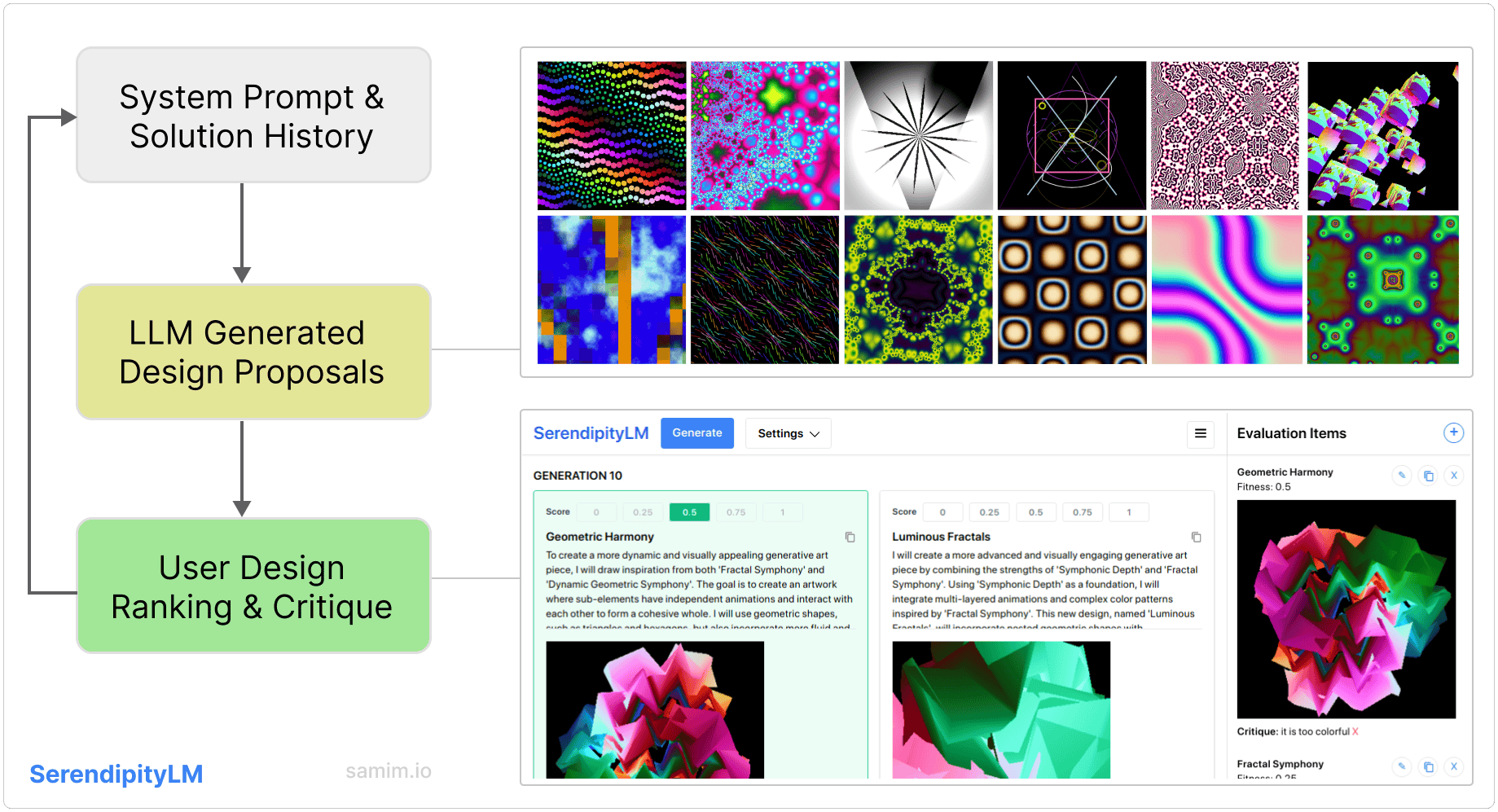
Until machines notice and connect as well as they generate, the scarce resource is judgement at gates 2 to 5.
In closing
The glue that barely stuck was a failure in 1968 and an invention by 1980. Nothing about the glue changed. What changed was that its inventor kept showing it to people, that one of them had a need it fit, and that someone finally decided to keep it. That is the whole model in one object: an accident, noticed, archived and carried, connected, built, kept.
In short:
- New things come from old parts meeting new contexts, and five gates decide what is kept.
- Find the gate with the most headroom, and check what it costs to lift.
- Keep an archive of interesting things, and give it champions.
- Watch for stiffening: renew exposure, use what you keep as a map of where not to look, keep processes rather than products.
- Put a gatekeeper outside the business the novelty threatens.
- Count surprises before you know their value.
Most of what gets lost is lost quietly, at a gate nobody is watching. So watch them. Write down what surprised you this week, before you know what it is worth. In a year you will know which of your gates is narrow, and you will have an archive worth walking past. Machines will make the accidents cheap. What stays scarce is the judgement to notice, to keep, and to come back.
Try it now: pick an innovation you know well, from your work or your life. At which gate did it nearly die, and who carried it through?
Notes
Where it comes from
Read side by side, accounts of serendipity and discovery from five fields describe the same sequence: something unexpected happens, someone notices it, links it to a need, makes it real, and the result is judged.
| Source | Steps, in order |
|---|---|
| Busch (2022), management | Trigger → association → materialization |
| Corneli et al. (2014–2020), computational creativity | Perception → attention → focus shift → explanation → bridge → valuation |
| McCay-Peet & Toms (2015), information science | Trigger → connection → follow-up → valuable outcome |
| Makri & Blandford (2012), information science | New connection → projected value → exploitation, with reflection alongside |
| Lawley & Tompkins (2008), via Corneli et al. | Prepared mind → unexpected event → recognise potential → seize the moment → amplify → evaluate |
| Andriani et al. (2017), innovation studies | Unexpected effect → prior knowledge → affordance turned into a function → a need it meets |
| Kittur et al. (2019), design by analogy | Abstract the problem → search distant domains → apply what is found |
| Fendt (2025), entrepreneurship | Exploration → recombination → action → scalability |
The Ratchet Model takes four ideas from this work. It is a loop: Fendt feeds scaled ideas back into exploration, and Lawley and Tompkins note that the process sometimes “further prepares the mind”. Concepts are defined by their neighbours: Busch’s conditions of agency, surprise and value separate serendipity from targeted search and from luck. Discovery is partly sighted: Campbell’s blind variation and selective retention (1960), Simonton’s multiplicative measure of creativity and Corneli and colleagues’ point that blindness comes in degrees. Csikszentmihalyi’s systems model of creativity, a domain with its rules, a person who brings novelty, and a field of experts who validate it, maps onto the store, gates 2 to 4 and the gatekeepers at Keep. And the gates can sit in different heads: Merton and Barber’s “serendipitous sociocognitive microenvironments”, Yaqub’s network-emergent serendipity, and Kittur’s split-up analogy process.
It also answers five gaps. Concept clouds such as Fendt’s meshwork, with arrows that are “intentionally interpretive rather than deterministic”, cannot be wrong, and they put a property, a practice, a decision rule and a route side by side as peers; the model gives each a type and a place. Most accounts study only winners, and Busch, who warns well against survivor bias, still makes value a necessary condition, so failures drop out before anyone counts them; the model counts triggers before their value is known. Few treat selection as a gate with an owner. Every skeleton in the table assumes a need comes first, which novelty search and Picbreeder show can be a trap. And metaphors such as quantum “collapse” often stand in for “many options, one gets picked”.
Limits
- The gates blur. Trigger and association can happen in the same moment (Busch), and an idea changes while it is honed (Gabora), so the thing logged at Notice may not be the same thing that reaches Keep. A log should follow threads, not fixed items.
- Surprise can enter anywhere. McCay-Peet and Toms describe an unexpected thread through every stage: an unexpected buyer is a surprise at Keep.
- Notice is hard to see, and logging changes it. A trigger nobody noticed leaves no trace, and a team that starts logging starts noticing more.
- Serendipity is partly a label applied afterwards. Copeland argues it can only be applied looking back, and stories told later make the gates look cleaner than they were.
- Everything depends on the observer. Surprise, learnability, interest and value are measured against someone’s expectations; as Busch notes, citing Makri and Blandford, what benefits some may not benefit others. The model describes what gets kept, not what should be.
- Two different heavy tails. A product of rates spreads output across teams like a lognormal, as Shockley argued for research productivity in 1957. The heavy tail in the value of single inventions needs something more, such as preferential reuse of what is already in the store.
- Uncertainty without odds. Effectuation was built for situations where probabilities cannot be known, which sits uneasily with measuring pass rates. The log measures what happened, not what could have.
A minimal formal sketch
Write S for the size of the store, R for its rigidity and A for the archive. Per period, kept items ≈ E(S) × pnotice(R) × pconnect(S, A) × penact × pkeep, with E rising with S, as more parts make more pairings. R rises with what is kept and falls with fresh exposure. A grows with triggers that were noticed but not connected, and archived items connect later at a rate that rises with S and with the number of open problems held. Compounding pushes growth faster than exponential; stiffening pushes it toward Heaps’ slowing curve. Which wins is a matter of parameters, and a simulation of this sketch is the natural next step.
More predictions
- Distance. Far links raise the spread of outcomes more than the average (Fleming 2001; Uzzi and colleagues 2013).
- Breadth. Output peaks at a middle number of open problems held per person.
- Exposure. The share of exaptations rises with the number of different contexts the parts meet.
- Disruption. Compared with non-disruptive products, disruptive ones more often have an incumbent prototype that was declined at its Keep gate.
- The product itself. Differences in log output between teams should be explained by summing their differences in log pass rates.
How to cite
Winiger, S. A. (2026). How Accidents Become Inventions: The Ratchet Model of serendipity. samim.io.
References
- Ahuja, G. & Lampert, C. M. (2001). Entrepreneurship in the large corporation: a longitudinal study of how established firms create breakthrough inventions. Strategic Management Journal 22.
- Albalak, A., Gabriel, S., D’Ambrosio, D. B., Lehman, J. & Stanley, K. O. (2026). Creative Priming: Decoupling Process from Product to Escape the Creative Paradox. arXiv:2611.11740
- Andriani, P., Ali, A. & Mastrogiorgio, M. (2017). Measuring exaptation and its impact on innovation, search, and problem solving. Organization Science 28(2): 320–338. record
- Azoulay, P., Graff Zivin, J. S. & Manso, G. (2011). Incentives and creativity: evidence from the academic life sciences. RAND Journal of Economics 42(3).
- Barber, B. & Fox, R. C. (1958). The case of the floppy-eared rabbits: an instance of serendipity gained and serendipity lost. American Journal of Sociology 64(2).
- Blount, Z. D., Borland, C. Z. & Lenski, R. E. (2008). Historical contingency and the evolution of a key innovation in an experimental population of Escherichia coli. PNAS 105(23): 7899–7906.
- Boudreau, K. J., Guinan, E. C., Lakhani, K. R. & Riedl, C. (2016). Looking across and looking beyond the knowledge frontier: intellectual distance, novelty, and resource allocation in science. Management Science 62(10).
- Bower, J. L. (1970). Managing the Resource Allocation Process.
- Burgelman, R. A. (1994). Fading memories: a process theory of strategic business exit in dynamic environments. Administrative Science Quarterly 39(1).
- Bradley, H. et al. (2024). Quality-Diversity through AI Feedback. ICLR 2024. arXiv:2310.13032
- Busch, C. (2024). Towards a Theory of Serendipity: A Systematic Review and Conceptualization. Journal of Management Studies 61(3): 1110–1151 (online 2022). doi:10.1111/joms.12890 · PDF
- Campbell, D. T. (1960). Blind variation and selective retention in creative thought as in other knowledge processes. Psychological Review 67(6).
- Chinn, C. A. & Brewer, W. F. (1993). The role of anomalous data in knowledge acquisition. Review of Educational Research 63(1).
- Christensen, C. M. (1997). The Innovator’s Dilemma.
- Cohen, W. M. & Levinthal, D. A. (1990). Absorptive capacity: a new perspective on learning and innovation. Administrative Science Quarterly 35(1).
- Copeland, S. (2019). On serendipity in science: discovery at the intersection of chance and wisdom. Synthese 196.
- Corneli, J., Jordanous, A., Guckelsberger, C., Pease, A. & Colton, S. (2014, revised 2020). Modelling serendipity in a computational context. arXiv:1411.0440
- Csikszentmihalyi, M. (1990). Flow: The Psychology of Optimal Experience. Harper & Row.
- Csikszentmihalyi, M. (1996). Creativity: Flow and the Psychology of Discovery and Invention. HarperCollins.
- D’Ambrosio, D. B., Albalak, A., Lehman, J. & Stanley, K. O. (2026). The Value of Not Knowing: How Fresh Eyes through Naive LLMs Fuel Creativity. arXiv:2611.11725
- Dew, N. (2009). Serendipity in entrepreneurship. Organization Studies 30(7): 735–753.
- Felin, T., Kauffman, S., Koppl, R. & Longo, G. (2014). Economic opportunity and evolution: beyond landscapes and bounded rationality. Strategic Entrepreneurship Journal 8(4).
- Fendt, J. (2025). Exapt, Adapt, Disrupt: A Conceptual Framework for Systemic Innovation. Journal of Entrepreneurship and Business Innovation 12(1). doi:10.5296/jebi.v12i1.22770
- Fleming, L. (2001). Recombinant uncertainty in technological search. Management Science 47(1).
- Gabora, L. (2017). Honing theory: a complex systems framework for creativity. Nonlinear Dynamics, Psychology, and Life Sciences 21(1).
- Gibson, J. J. (1979). The Ecological Approach to Visual Perception.
- Hughes, E. et al. (2024). Position: Open-Endedness is Essential for Artificial Superhuman Intelligence. ICML, PMLR 235. arXiv:2406.04268
- Kauffman, S. (2000). Investigations.
- Kidd, C., Piantadosi, S. T. & Aslin, R. N. (2012). The Goldilocks effect: human infants allocate attention to visual sequences that are neither too simple nor too complex. PLoS ONE 7(5): e36399. doi:10.1371/journal.pone.0036399
- Kittur, A. et al. (2019). Scaling up analogical innovation with crowds and AI. PNAS 116(6): 1870–1877. open copy
- Kumar, A., Clune, J., Lehman, J. & Stanley, K. O. (2025). Questioning Representational Optimism in Deep Learning: The Fractured Entangled Representation Hypothesis. arXiv:2505.11581
- Lehman, J. & Stanley, K. O. (2011). Abandoning Objectives: Evolution through the Search for Novelty Alone. Evolutionary Computation 19(2): 189–223. PDF
- Leonard-Barton, D. (1992). Core capabilities and core rigidities: a paradox in managing new product development. Strategic Management Journal 13.
- Levitt, B. & March, J. G. (1988). Organizational learning. Annual Review of Sociology 14.
- Lu, C. et al. (2024). The AI Scientist. arXiv:2408.06292
- Makri, S. & Blandford, A. (2012). Coming across information serendipitously, Part 1: A process model. Journal of Documentation 68(5).
- March, J. G. (1991). Exploration and exploitation in organizational learning. Organization Science 2(1).
- Massimini, F. & Carli, M. (1988). The systematic assessment of flow in daily experience. In M. Csikszentmihalyi & I. S. Csikszentmihalyi (eds.), Optimal Experience. Cambridge University Press.
- McCay-Peet, L. & Toms, E. (2015). Investigating serendipity: How it unfolds and what may influence it. JASIST 66(7): 1463–1476.
- Merton, R. K. & Barber, E. (2004). The Travels and Adventures of Serendipity.
- Mouret, J.-B. & Clune, J. (2015). Illuminating search spaces by mapping elites. arXiv:1504.04909
- Novikov, A. et al. (2025). AlphaEvolve: A coding agent for scientific and algorithmic discovery. arXiv:2506.13131
- Oudeyer, P.-Y., Kaplan, F. & Hafner, V. V. (2007). Intrinsic motivation systems for autonomous mental development. IEEE Transactions on Evolutionary Computation 11(2).
- Romera-Paredes, B. et al. (2024). Mathematical discoveries from program search with large language models. Nature 625: 468–475. open copy
- Sah, R. K. & Stiglitz, J. E. (1986). The architecture of economic systems: hierarchies and polyarchies. American Economic Review 76(4).
- Schmidhuber, J. (2010). Formal theory of creativity, fun, and intrinsic motivation (1990–2010). IEEE Transactions on Autonomous Mental Development 2(3).
- Scherer, F. M. & Harhoff, D. (2000). Technology policy for a world of skew-distributed outcomes. Research Policy 29(4–5): 559–566.
- Seifert, C. M., Meyer, D. E., Davidson, N., Patalano, A. L. & Yaniv, I. (1995). Demystification of cognitive insight: opportunistic assimilation and the prepared-mind perspective. In The Nature of Insight.
- Shockley, W. (1957). On the statistics of individual variations of productivity in research laboratories. Proceedings of the IRE 45(3).
- Si, C., Yang, D. & Hashimoto, T. (2024). Can LLMs Generate Novel Research Ideas? arXiv:2409.04109
- Si, C., Hashimoto, T. & Yang, D. (2025). The Ideation-Execution Gap. arXiv:2506.20803
- Simonton, D. K. (2022). The Blind-Variation and Selective-Retention Theory of Creativity: Recent Developments and Current Status of BVSR. Creativity Research Journal. PDF
- Stanley, K. O. & Lehman, J. (2015). Why Greatness Cannot Be Planned: The Myth of the Objective. Springer.
- Stanley, K. O., Lehman, J. & Soros, L. (2017). Open-endedness: The last grand challenge you’ve never heard of. O’Reilly Radar
- Tennie, C., Call, J. & Tomasello, M. (2009). Ratcheting up the ratchet: on the evolution of cumulative culture. Philosophical Transactions of the Royal Society B 364.
- Tria, F., Loreto, V., Servedio, V. D. P. & Strogatz, S. H. (2014). The dynamics of correlated novelties. Scientific Reports 4. arXiv:1310.1953
- Tripsas, M. & Gavetti, G. (2000). Capabilities, cognition, and inertia: evidence from digital imaging. Strategic Management Journal 21.
- Tushman, M. L. & O’Reilly, C. A. (1996). Ambidextrous organizations: managing evolutionary and revolutionary change. California Management Review 38(4).
- Uzzi, B., Mukherjee, S., Stringer, M. & Jones, B. (2013). Atypical combinations and scientific impact. Science 342.
- von Hippel, E. & von Krogh, G. (2016). Identifying viable “need–solution pairs": problem solving without problem formulation. Organization Science 27(1).
- Wang, R., Lehman, J., Clune, J. & Stanley, K. O. (2019). POET. arXiv:1901.01753
- Weitzman, M. L. (1998). Recombinant growth. Quarterly Journal of Economics 113(2).
- Woolley, B. G. & Stanley, K. O. (2011). On the deleterious effects of a priori objectives on evolution and representation. GECCO.
- Yaqub, O. (2018). Serendipity: Towards a taxonomy and a theory. Research Policy 47(1): 169–179.
- Zhang, J., Lehman, J., Stanley, K. O. & Clune, J. (2023). OMNI: Open-endedness via Models of human Notions of Interestingness. arXiv:2306.01711
- Zhang, J., Hu, S., Lu, C., Lange, R. & Clune, J. (2025). Darwin Gödel Machine: Open-Ended Evolution of Self-Improving Agents. arXiv:2505.22954
#Creativity #Complexity #Evolution #ALife #ML #Ideas #Featured