-
SustainableBrands: "The bridge to better brands": http://www.sustainablebrands.com/
Sustainable Brands is home for the global community of business innovators who are shaping the future of commerce world wide. Since 2006, our goal has been to inspire, engage and equip today's business and brand leaders to prosper for the near and long term by leading the way to a sustainably abundant future.
-
Deep Time Walk: "a mobile app that enables anyone, anywhere to experience a walking audio history of the living Earth": https://www.deeptimewalk.org/kit/app/
The idea of the Deep Time Walk is simple but incredibly powerful: When dealing with the vast dimensions of time and space, we are often unable to grasp the magnitude quantitatively, just through studying the numbers. A Deep Time Walk allows us to walk the timeline of the history of the Earth and also universe, and thus for example, on a walk of 4.6km, if we start with the birth of Earth, each one-metre step represents one million years. Read more...
-
"Microsoft tests Project Natick, self-sustaining underwater datacenter":
-
A Conversation With Hal Varian, Chief Economist at Google. A truly fascinating glimpse into the logic behind Google. This talk is a bizarre mix of somewhat interesting and rather boring. I'm ultimately disappointed at the naive, at times crass over-simplistic worldview outlined here - all using smart sounding concepts, of course.
"You want to focus on skills that complement, that which inevitability is becoming abundant" ~ @nikete channelling @halvarian
"It used to be gardeners you would have to do now different plants and what characteristic those plants had - well that's gone away to. Now thats low-level jobs. They have been augmented by machines"
-
"The Pricing of Everything" - talk by @GeorgeMonbiot:
"This is a pursuit of what could be called the natural capital agenda. The pricing & valuation, monetisation and financialization of nature - in the name of saving it. Nature is now called Natural Capital. Ecological processes are called Ecosystem services. And hills, forests and oceans - are now called green infrastructure. Bio-diversity, we now call asset classes in an eco-system market" - @GeorgeMonbiot.
-
"You want to focus on skills that complement, that which inevitability is becoming abundant" ~ @nikete channelling @halvarian
-
Project Oasis - "A plant ecosystem you can talk to":
https://experiments.withgoogle.com/oasisThey had me really interested until I read this: "A plant ecosystem inside a box. You can talk to it using the Google Assistant and ask it to create certain conditions". << very wrong symbolism for me!
-
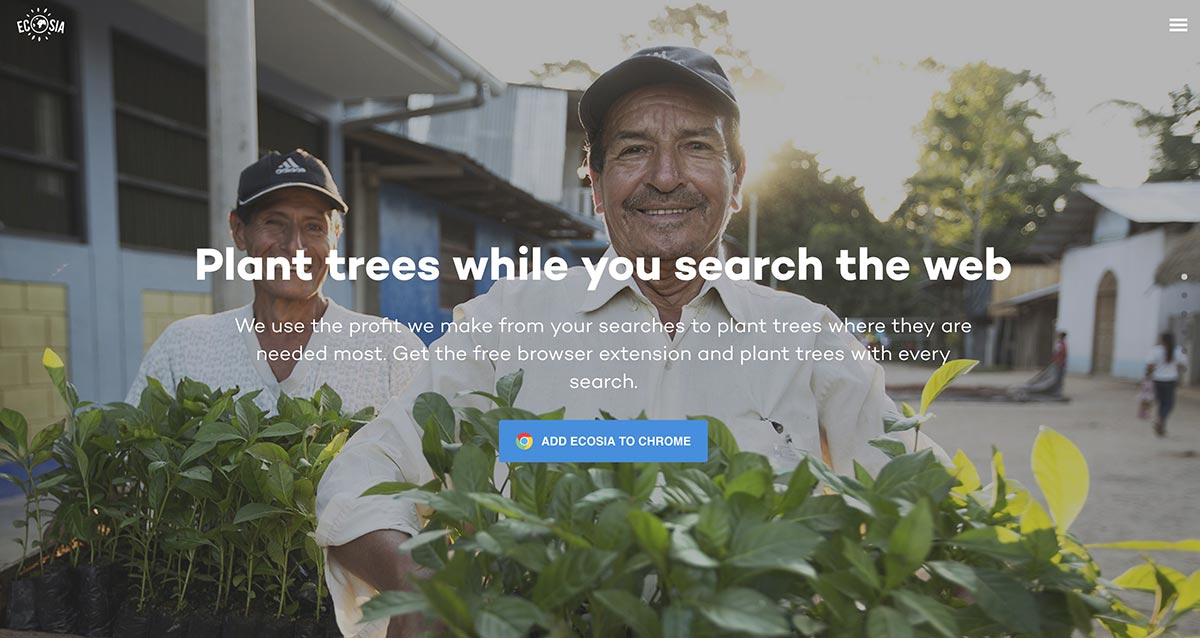
Ecosia - "a search engine that plants trees. Search the web, save the environment": https://info.ecosia.org/what #FFHCI #ClimateChange
-
Flora - "The talking plant. An interactive bio-hybrid organism" - by @florarobotica:
In the project flora robotica we investigate how humans, robots, and plants can interact. In this video we show the possibilities of sophisticated sensor technology to make plants interact with you. The technology used is electrophysiology. You see cables attached to the plant that are used to measure electrical signals.
-
Is the rate at which we drive real insects into extinction (after millions of years on earth) and the rate at which we create primitive/crude emulations of those very insects related?
http://ascii.jp/elem/000/001/687/1687200/

-
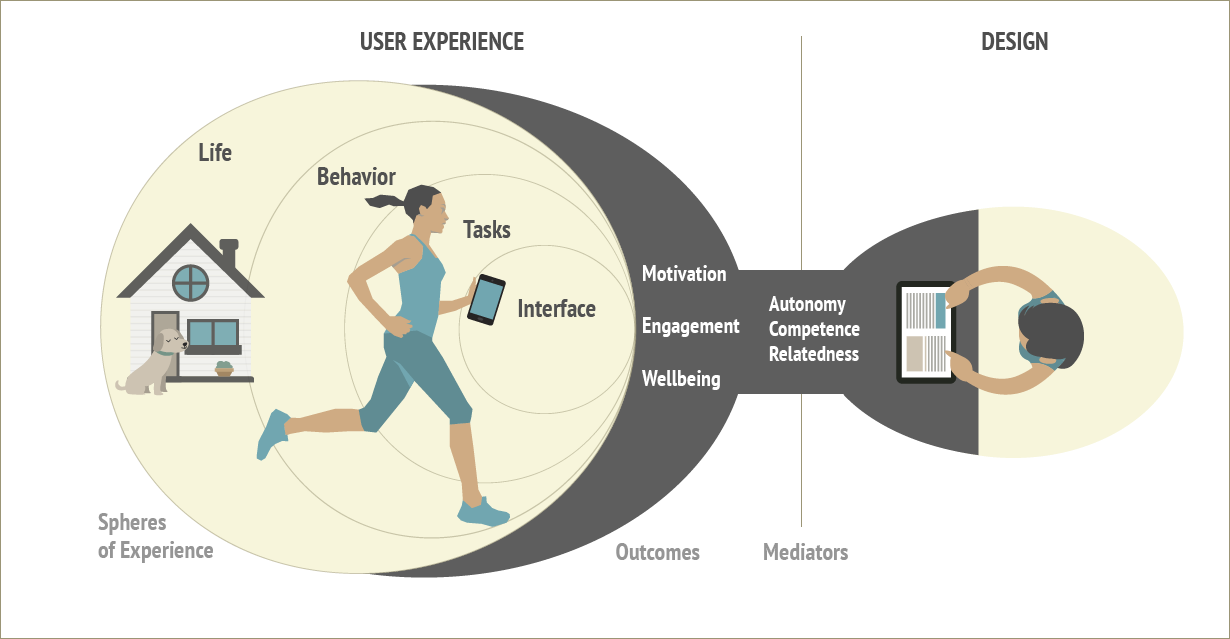
"Motivation, Engagement and Thriving in User Experience (METUX)" - A Wellbeing Design Framework for Practice: https://www.frontiersin.org/articles/10.3389/fpsyg.2018.00797/full
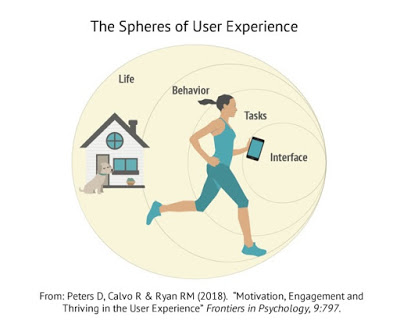
There is a great need for practical tools to help designers and researchers incorporate wellbeing research into practice. The model provides a framework grounded in psychological research that allows HCI researchers and practitioners to form actionable insights with respect to how technology designs support or undermine basic psychological needs, thereby increasing motivation and engagement, and ultimately, improving user wellbeing.
We propose that in order to address wellbeing, psychological needs must be considered within at least five different spheres of analysis including: at the point of technology adoption, during interaction with the interface, as a result of engagement with technology-specific tasks, as part of the technology-supported behavior, and as part of an individual's life overall. Otherwise, important contradictory effects can be missed. After all, a technology can appear to support wellbeing at one level but severely hinder it at another level (think of tech addiction that provides momentary need-satisfaction at the moment of use but disrupts psychological need satisfaction at the life level.)
-
"50,000 Las Vegas Workers Are Ready to Go on Strike Over Fears of Robots Taking Their Jobs": https://gizmodo.com/50-000-las-vegas-workers-are-ready-to-go-on-strike-over-1826474028
Translation: In a city that is rapidly turning into a desert, the owners have weaponised automation against its already struggling citizens & call it "progress".
-
Practical solutions to move towards more positive outcomes in the unfolding climate change catastrophe - by @Plinz (tweet)
Shift population centers above future sea levels and in different climates, focus on sustainable development, indoor agriculture, solar thermal, desalination, fix governance, end culture wars, protect civilization at almost all costs, leave messages to future intelligent species
-
David Talbot interviews Peter Dale Scott upon the publication of Scott's book "The American Deep State". #Politics
-
The Architecture of Cooperation - talk by Richard Sennett:
-
A primary problem with the startup movement (a system to facilitate large-scale collaboration) of the past 20y, has been this: its full of implicit politics (growth, technocratic, disruption, consumerism) & totally void of explicit politics (ethics, diversity, ecology, etc.)
-
"You can not take away someone's story, without giving them a new one"
- @GeorgeMonbiot -
An Introduction to Slow Computing:
Paper: https://osf.io/preprints/socarxiv/rmxfk/
Project: http://progcity.maynoothuniversity.ie/2017/12/new-paper-slow-computing/Abstract: "In this short position paper we examine some of the dimensions and dynamics of the algorithmic age by considering three broad questions. First, what are the problematic consequences of life mediated by ‘algorithm machines’? Second, how are individuals or groups and associations resisting the problems they encounter? Third, how might the algorithmic age be re-envisioned and re-made in more normative terms? We focus on two key aspects of living with ubiquitous computing, ‘acceleration’ and ‘data grabbing,’ which we contend are two of the most prominent and problematic features of the algorithmic age. We then begin to shed light on the sorts of practices that constitute slow computing responses to these issues. In the conclusion, we make the case for a wide-scale embrace of slow computing, which we propose is a necessary step for society to make the most of the undeniable opportunities for radical social change emerging from contemporary technological developments"
SLOW COMPUTING
- How to practice resistance in the algorithmic age?
- Slowing down one's rate of participation in processes of acceleration and temporal reconfiguration
- Performing intricate 'dances' around and within data grabbing infrastructures
- Using technology on our own terms
ACCELERATION
- Networked technologies ore creating a faster and busier world
- Acceleration of the pace of life; technological acceleration; acceleration of social change
- People being 'always-everywhere available'
- Time shifting of activities to formerly unavailable times (*dead time mode 'productive time)
- More flexible scheduling of activities • Simultaneous occurrences, multitasking, and the interleaving of Wit/tiles
- Shortening In the time log between action and event - immediate, distanciated response and real time systems
- Compression, densification and fragmentation of time
SLOWING DOWN
- Deciding to participate in tool processes at a slower rate than might be otherwise expected
- Aim is to reduce time compression, fragmentation, densification and stresses.
- Tactics include:
- Switching off Wifi routers for set periods each day
- less frequent 'checking in' on social media or only pursuing one or two email sessions per day
- reserving computational free leisure time
- maintaining scheduled, no device-ing meal times
- organising pro-arranged meetings rather than doing so on-the-fly
- choosing to buy and use non-smart or analogue electrical goods
- collecting goods purchased online in-store rather than having them delivered
- In other words, re-build one's life around social and clock time rather than network time, and older, slower practices rather than accelerated ones.
- Not to abandon technology, but use it differently
CONCLUSION
- Algorithmic age poses a number of personal challenges
- Slow computing is about trying to negotiate these challenges as much as possible on one's own terms
- As well as practical interventions, slow computing requires normative and political thinking concerning the land of algorithmic future we wont to create and live in
- How should society and states respond collectively through regulation, legislation, education, and training?
- Need to elaborate an ethics of acceleration and grabbing; an ethics of big data, algorithmic governance, machine learning, artificial intelligence, automation and the diverse technologies and practices that increasingly shape everyday life
- Plus map out moral contours and actions and more just alternatives