Recent developments in Recognition-Primed Decision (RPD)
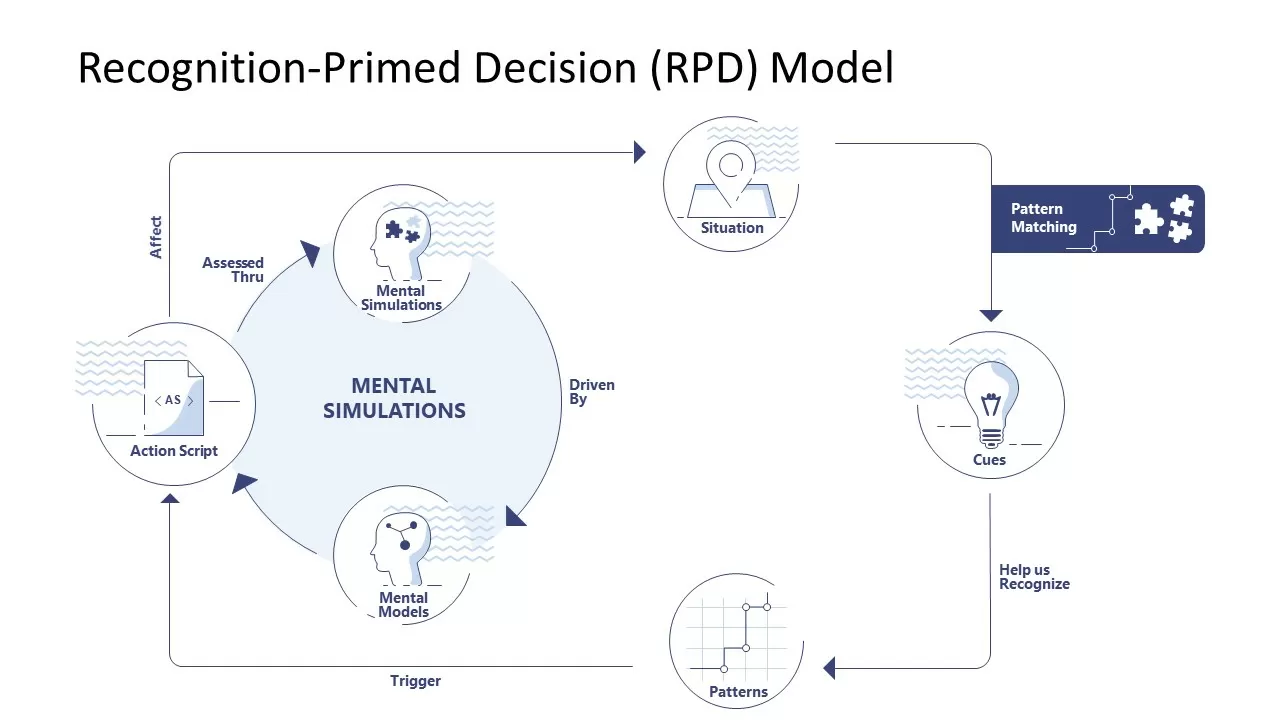
In 2026, the Recognition-Primed Decision (RPD) model has evolved from a tool for emergency responders into a cross-disciplinary framework for high-stakes decision-making in digital and automated environments. The current evolution focuses on the following key areas:
1. Integration with Artificial Intelligence (AI): As of 2026, RPD is increasingly used to design and evaluate AI systems, moving beyond simple automation to "Human-AI Teaming".
- AI Explainability: Researchers are using RPD to help AI systems explain their "decisions" in ways that align with human mental models, making it easier for human operators to trust or override AI recommendations.
- AIQ (Artificial Intelligence Quotient): Gary Klein and colleagues have developed the AIQ toolkit to help humans better understand and manage the specific AI systems they interact with, applying NDM principles to complex tech stacks.
2. Computational & Probabilistic Models: Advancements in 2025 and 2026 have led to the creation of Probabilistic Memory-Enhanced RPD (PRPD) models.
- Dynamic Information Processing: These newer models, such as those used in mid-air collision avoidance for pilots, can process continuous real-time data automatically without human-defined categories.
- Pattern Maturity: PRPD models show how "prototypes" or mental patterns automatically strengthen as an agent (human or machine) gains more experience.