The Book of Change
On time, and the place where every attempt to explain it runs out.
A cup of tea cools and never warms itself again. A footprint in wet sand holds its shape for a while, then fills in. Energy, information and life all depend on this one fact: the world runs one way. Without that asymmetry nothing could be stored, learned or used. So what is time? This essay follows the question until it runs out. It runs out in the same place every time, and the oldest book about change seems to have begun there.
Part oneWhat physics knows
Start with what is solid. In 1908 Hermann Minkowski told a meeting of scientists: “Henceforth space by itself, and time by itself, are doomed to fade away into mere shadows, and only a kind of union of the two will preserve an independent reality.” Relativity made the two a single fabric, spacetime, and how you cut it into space and time depends on how you are moving. This is not abstract. A clock on a GPS satellite gains about 38 microseconds a day on a clock on the ground, because of the satellite’s speed and its height. A blink lasts thousands of times longer. Still, the system has to correct for it, or positions would drift by kilometres a day.
Yet the time direction keeps rules that no direction in space has. You can walk back to where you were. You can’t walk back to when you were. Take two events. If a signal could travel from one to the other, every observer agrees which came first. If not even light could cover the distance in the time between them, observers can disagree about their order. The light cone draws that boundary, and it is the same for everyone.
Then there is a stranger fact. The basic laws of physics work the same forwards and backwards. A film of two billiard balls colliding looks right played either way. A film of an egg breaking does not. The arrow we feel, eggs that break and don’t unbreak, memories of the past and none of the future, comes from somewhere else: the universe began in a state of very low entropy, and everything since has been running downhill from it. The philosopher David Albert called this the past hypothesis (2000). It explains the arrow. Nobody knows why it is true.
Now take the slope away and look at what is left. A universe at equilibrium, the heat death physicists expect at the very end, still obeys the same laws. But it has no gradients, so no work can be drawn from it, not even by the one-bit engine Leo Szilard imagined in 1929. It holds no records, because a record is a mark that hasn’t yet been smoothed away, and marks form only on a slope. And it has no direction: nothing comes before anything else in any way that matters. Directed time, usable energy and useful information disappear together. They look like one asymmetry seen from three sides. Where there is no slope, there is nothing to know and no one to know it.
Part twoThe timeless theories
Several serious theories go further. They say time is not fundamental at all.
- In the block universe, the picture many physicists take from relativity, past, present and future all exist together. Nothing flows. We are inside a four-dimensional shape, and “now” is only the place in it where we happen to be, as every frame of a film sits on the reel at once. Einstein seems to have believed this. When his friend Michele Besso died in 1955, he wrote to Besso’s family: “For us believing physicists the distinction between past, present, and future only has the meaning of an illusion, though a persistent one.” He died a month later.
- When Bryce DeWitt wrote down an equation for the quantum state of the whole universe (DeWitt, 1967), time dropped out of it. The universe taken as a whole does not change.
- Don Page and William Wootters then asked how anything happens at all (Page and Wootters, 1983). Their answer was to split the universe in two: a clock, and everything else. Each part on its own is static. But the two are correlated, and change is what the rest looks like when it is read against the clock. A tabletop experiment with entangled photons later showed a small version of this (Moreva et al., 2014).
- Julian Barbour (The End of Time, 1999) argues that the universe is a collection of “nows”, each complete in itself. Some of them he calls time capsules: arrangements so full of records that they look like a history, the way the layers in a cliff look like a story of floods. On this view a memory, or a fungus’s chemical map of the soil, isn’t a trace left by time. It is what gives the impression of time. Alain Connes and Carlo Rovelli proposed that the flow of time comes from incomplete information: a being that saw every detail would see no flow at all (Connes and Rovelli, 1994). If that is right, it closes a loop. Living things keep a compressed record of the past in order to predict the future. Here the compressing, the not seeing everything, may be what produces a past and a future in the first place.
Look at how much survives in the block. Energy becomes gradients across its regions. Information becomes correlation: one region, the chemical map inside a hypha, matches another, the place where the sugar is. Prediction becomes correlation that points up the entropy slope. And life becomes a shape that holds itself together along that slope, like a whirlpool in a photograph: still on the paper, but there only because water was running through it. What all of this needed was never the flow of time. It was the slope.
These ideas don’t stand on equal ground. The block universe is mainstream. Page and Wootters is respected but debated. Barbour’s nows and thermal time are serious ideas that no one has yet tested.
The argument is much older than physics. Twenty-five centuries ago Parmenides argued that change is impossible and that reality is one, unchanging and timeless. Heraclitus answered that everything flows, and that no one steps into the same river twice. In 1908, the same year as Minkowski’s lecture, the philosopher J. M. E. McTaggart gave the debate its modern terms (The Unreality of Time). Time can be described as a flow, with events moving from future through present into past, or as a fixed order of earlier and later. The block universe keeps the order and drops the flow. The question is whether anything is lost.
Each of them relocates change instead of removing it. The block turns “first this, then that” into “here this, there that”, along one more axis. Page and Wootters put time inside a clock, and the clock still ticks. Barbour’s records still have to be read in order. Thermal time explains the flow by our ignorance, but an ignorance that unfolds how? Henri Bergson raised this objection in 1889 (Time and Free Will): physics draws time as a line, then forgets that the drawing isn’t the thing, the way a map of a river is dry. Lee Smolin raises it from inside physics in Time Reborn (2013). The block view answers that becoming is simply what it is like to be inside a slope. Bergson and Smolin answer that becoming is real and the geometry is a map of it. No experiment has settled it. That is why every timeless theory feels as if it is dodging something. It might be.
Part threeWhere the flow shows up
If physics keeps the order and drops the flow, the flow must come from somewhere. The nearest place to look is whoever is doing the perceiving. Here, for once, there are experiments and not only arguments.
The present is assembled. The “now” you experience isn’t an instant. William James called it the specious present (The Principles of Psychology, 1890): a short window that holds a few moments together, long enough to hear a melody rather than separate notes. Ernst Pöppel put the window at about three seconds (Pöppel, 1997). Inside that window the brain doesn’t only record; it edits. In the flash-lag effect, a flash shown level with a moving object seems to trail behind it, because the brain decides what happened at a moment using information from the following eighty milliseconds or so (Eagleman and Sejnowski, 2000). Your present is partly written after the fact, like a letter dated in the morning and finished at night.
Felt duration is a reconstruction. In one experiment, volunteers fell backwards 31 metres into a net. Afterwards they judged their own fall to have lasted about a third longer than other people’s. Strapped to each forearm was a small display flashing digits just too fast to read. During the fall the digits stayed unreadable. The fallers had not perceived more. They had remembered more densely (Stetson, Fiesta and Eagleman, 2007).
Different bodies, different nows. Smaller animals with faster metabolisms resolve finer slices of time. Many flies can see flicker several times faster than we can, which is part of why they are so hard to swat (Healy et al., 2013). The hand that seems quick to us arrives slowly to the fly. There is no single rate at which the present arrives.
None of this settles whether time flows. A brain that builds its present from a short, edited window would feel flow in a block universe, and it would feel the same in a world where becoming is real. But it moves the question. The flow we experience is at least partly made by the perceiver, from a compressed record stitched together slightly late. That fits the thermal-time idea above: a being that sees only part of the picture, and compresses it, is exactly the kind of being that feels time pass.
Part fourThe circle
So try to go underneath. Every definition of time leans on space, or on time itself. “Geometry” means extension across something. “Slope” means change along something. The attempts to build spacetime out of something more basic all meet the same wall:
- Causal sets start from points and an order: this precedes that. Rafael Sorkin’s slogan is “order plus number equals geometry”. But order is already time-like.
- Building space out of quantum entanglement (Van Raamsdonk, 2010) starts from correlations between parts. But “parts” already means a distinction: this, not that.
- Rewriting systems, like the Wolfram physics project, build space from networks of relations, but the rewriting goes in steps. Steps are time again.
What survives every attempt is two things: difference (this is not that) and relation (this connects to that). Put simply, space is relation without direction: A is next to B, and B is next to A. Time is relation with direction: A comes before B, and B does not come before A. That would make space and time neither one thing nor two, but the symmetric and the asymmetric form of the same relating.
This also tells us exactly how much survives without time. Gregory Bateson defined information as “a difference which makes a difference”. So there are three cases. With no distinctions at all, nothing holds: no information, no gradient, no life. With distinctions but no order, pattern and correlation survive (this part matches that part), but prediction, value and cost don’t, because each of them needs a before and an after. With distinctions and an asymmetry, everything works. That last case is the one physics actually supports.
But this only moves the circle back one step. “Difference” and “relation” can’t be defined without using them. Immanuel Kant thought this was unavoidable: space and time are the forms through which we think anything at all (Critique of Pure Reason, 1781), so we can’t think our way outside them, any more than an eye can see itself.
Part fiveWhere the old traditions start
Some traditions didn’t try to get underneath that floor. They began there.
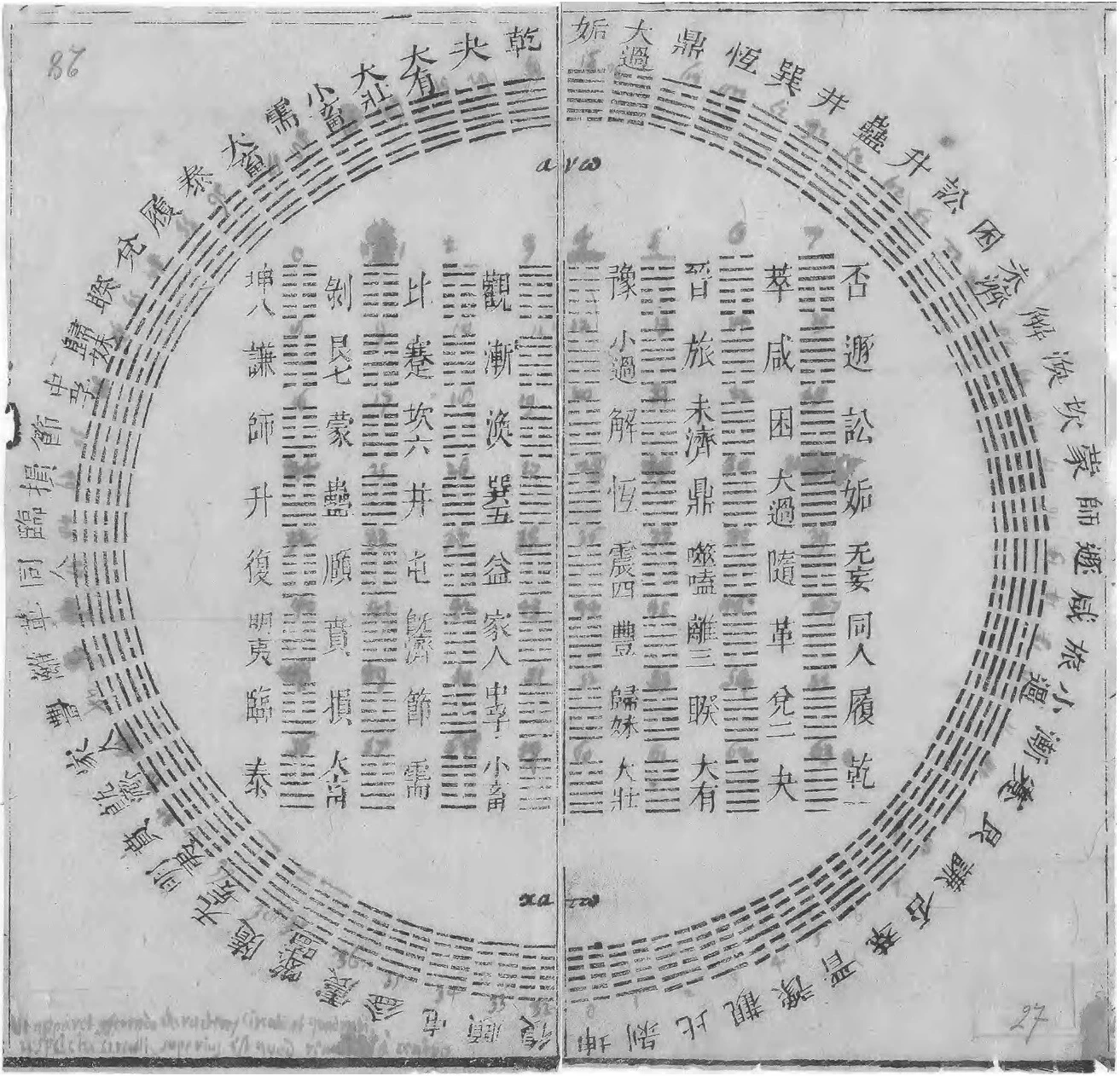
The I Ching starts from change, not things. The Book of Change goes back, in its oldest layers, to around 1000 BC. Its unit is a single line, broken or unbroken: one difference, the smallest mark a brush can make. Six lines make a hexagram, and the 64 hexagrams are situations, each in the middle of turning into another. Things are passing states of change, not the other way round.
In 1701 the Jesuit Joachim Bouvet, writing from Beijing, sent Gottfried Leibniz a diagram of the hexagrams (the letter). Leibniz had already worked out binary arithmetic. Bouvet pointed out that if you read broken lines as 0 and unbroken lines as 1, the diagram counts from 0 to 63. The letter took seventeen months to arrive. Leibniz published his paper on binary in 1703, the year it reached him, and included the match. The bit and the Book of Change met three centuries ago, on paper that had crossed the world by ship.
0
000000
Kun
1
000001
Bo
2
000010
Bi
3
000011
Guan
63
111111
Qian
Jain logic gives truth an address. Jain philosophers developed syādvāda, a logic of seven qualified claims: in some respect it is; in some respect it is not; in some respect it is and is not; in some respect it can’t be expressed; and combinations of these. Every truth is tied to a standpoint. “True and not true” is not a contradiction, because each holds from somewhere. The block universe does the same with places in spacetime. Physics doesn’t need real contradictions either. Quantum superposition is often described as something being true and not true at once, but that is a misreading: a superposed state has no definite value for that property, which is different from having both.
Nāgārjuna empties the floor. The second-century Buddhist philosopher Nāgārjuna argued that nothing exists in itself: everything exists only through its dependence on something else. He called this absence of own-being emptiness, śūnyatā. That is relation all the way down. Then he refused to make relation the new foundation: emptiness is empty too. In the Mūlamadhyamakakārikā he lists four answers to an ultimate question (it is, it is not, both, neither) and rejects all four. Not out of confusion, but because the question assumes a thing with fixed properties to ask about.
The Dao won’t be named. In Daoist cosmology the limitless, wuji, comes before the first split into yin and yang. The Dao De Jing opens: “The Dao that can be spoken is not the eternal Dao.” It says in one line what Kant needed a book for.
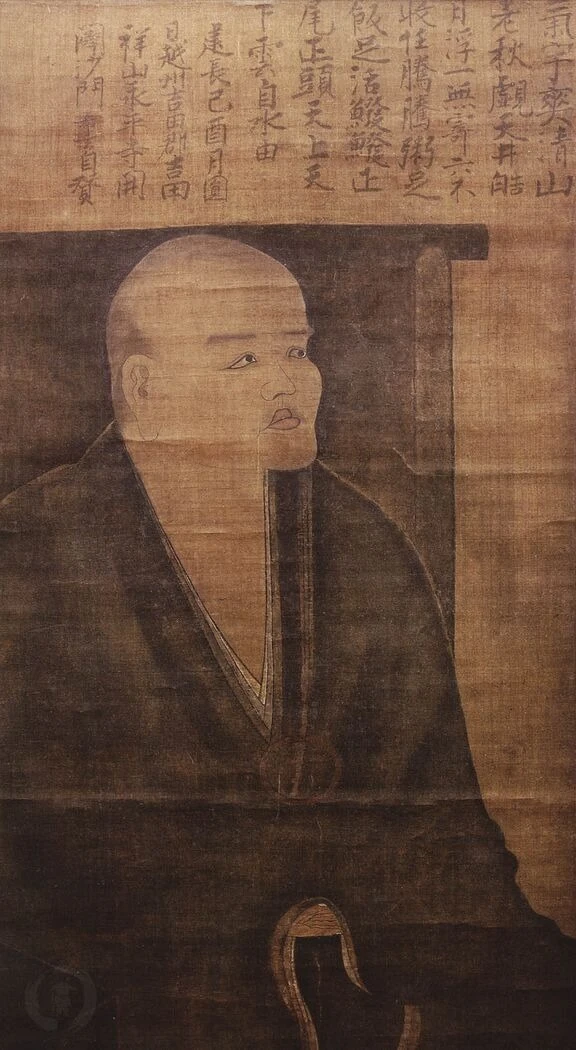
Dōgen makes time and being one. The Japanese Zen master Dōgen wrote an essay in 1240 called Uji, usually translated as “Being-Time”, collected in the Shōbōgenzō. Its claim is that time isn’t a container things pass through: things are time, and time is things. Seven years earlier, in Genjōkōan, he gave an image that reads like the block universe written seven centuries early. Firewood burns to ash, and ash doesn’t turn back into firewood. But don’t think of the ash as after and the firewood as before, he says. Firewood stays in its own place as firewood, with its own before and after, and ash stays in its place as ash. Each moment is complete where it is, and the order still holds.
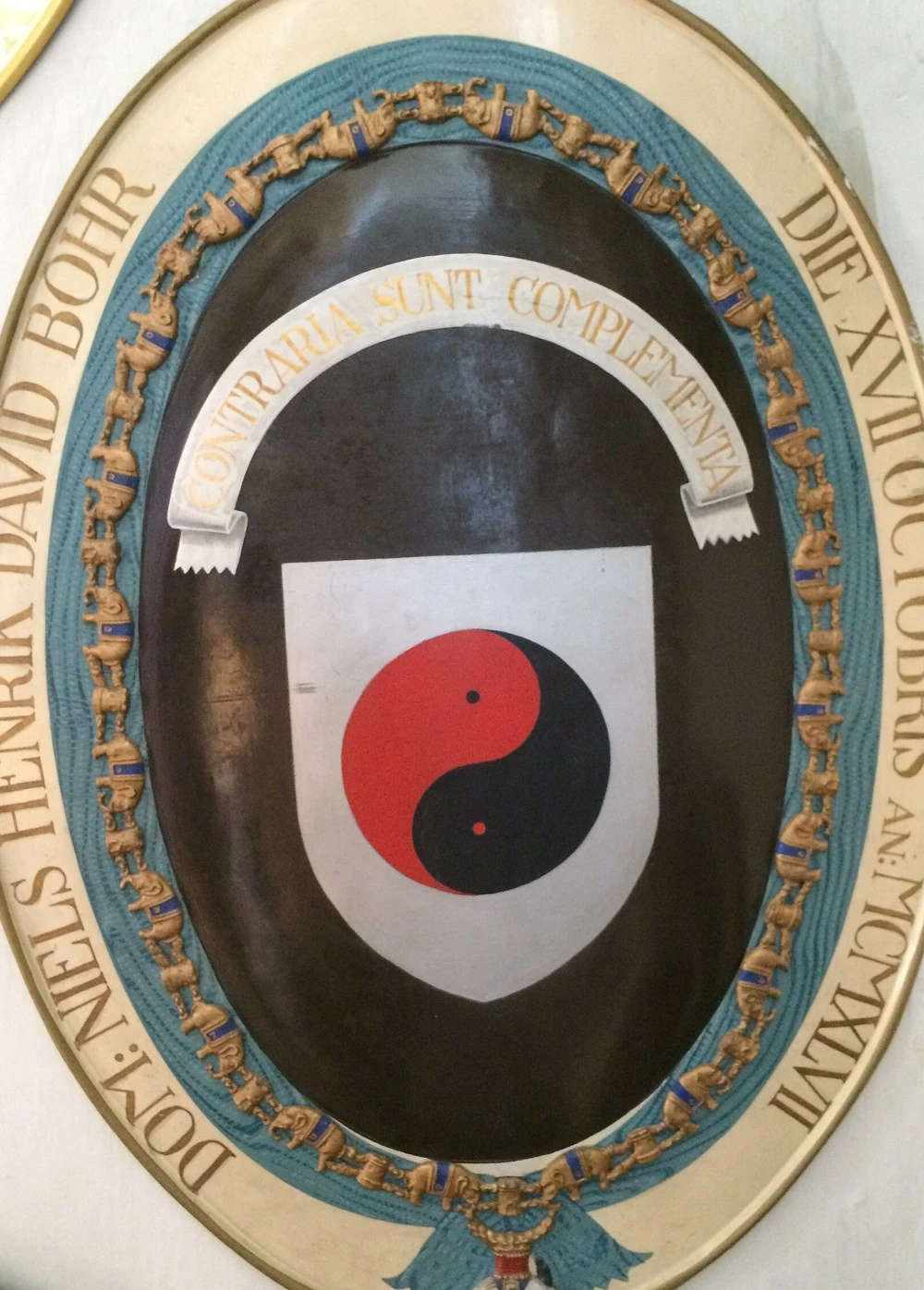
Physics has brushed against all of these. When Niels Bohr received the Order of the Elephant in 1947, he designed his coat of arms around the yin-yang symbol, with the motto contraria sunt complementa: opposites are complementary. It still hangs in a Danish castle church, among the painted shields of the order’s other knights. Carlo Rovelli’s relational reading of quantum mechanics says objects have properties only relative to other objects. In Helgoland (2020) he gives a chapter to Nāgārjuna.
These are parallels in structure, not evidence. Nobody in ancient China or India derived quantum theory, and the traditions don’t need physics to be taken seriously. What they share with the best modern thinking is a refusal to treat things as the bottom layer.
CodaBefore completion
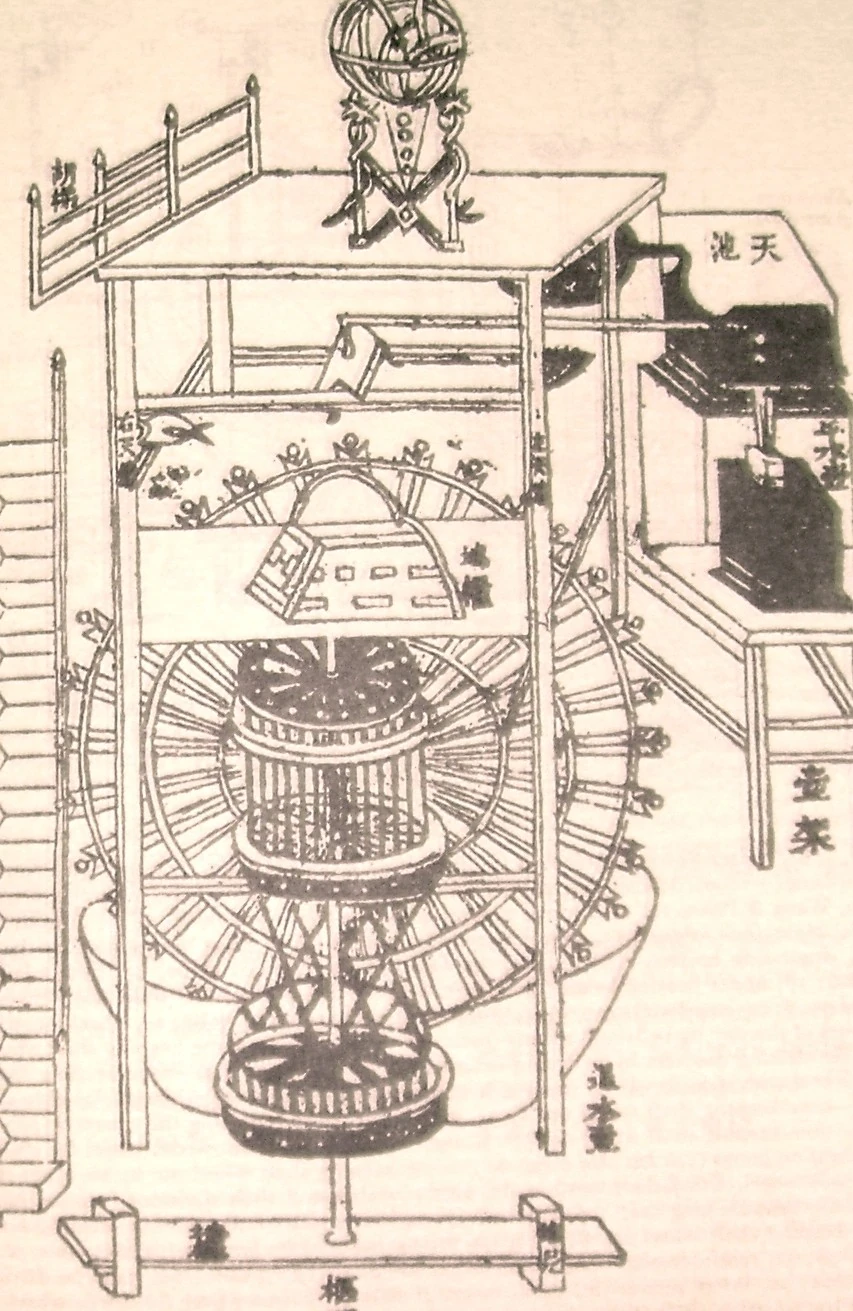
We measure time better than anything else. For a thousand years people have built ever better clocks, from Su Song’s water-driven clock tower in 11th-century China to today’s optical clocks, which run so evenly that they would drift by less than a second over the age of the universe. Su Song’s tower is long gone; the woodblock drawings of it survive. And we still can’t say what time is. Augustine put it this way around the year 400:
“What then is time? If no one asks me, I know; if I wish to explain it to one who asks, I know not.”Augustine, Confessions, Book XI
That isn’t a gap the next theory will close. Every attempt runs into the same place: difference and relation, which can’t be defined without themselves. Physics relocates change, into a dimension, a clock or our ignorance. The older traditions treat the limit as the finding. The I Ching makes it motion, the Jains make it perspective, Nāgārjuna says the floor is empty, Dōgen says time and being are one, and the Dao says it can’t be named.
The Book of Change doesn’t end on an answer either. Its 63rd hexagram is called After Completion. The 64th, the last, is Before Completion.
“Things cannot be exhausted; therefore the sequence closes with Before Completion.”
物不可窮也,故受之以未濟終焉 — Xugua, the traditional commentary on the order of the hexagrams