tag > China
-
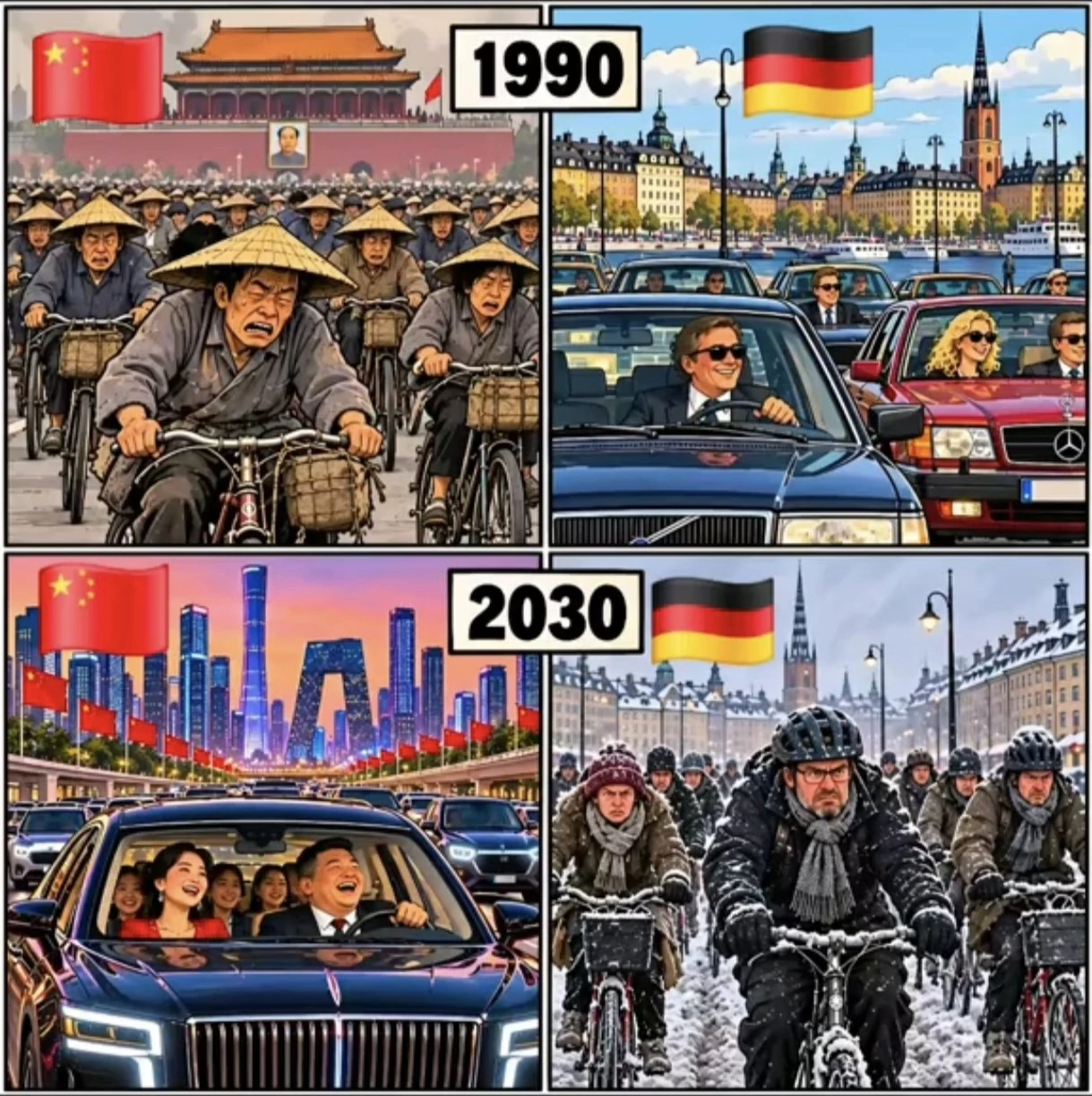
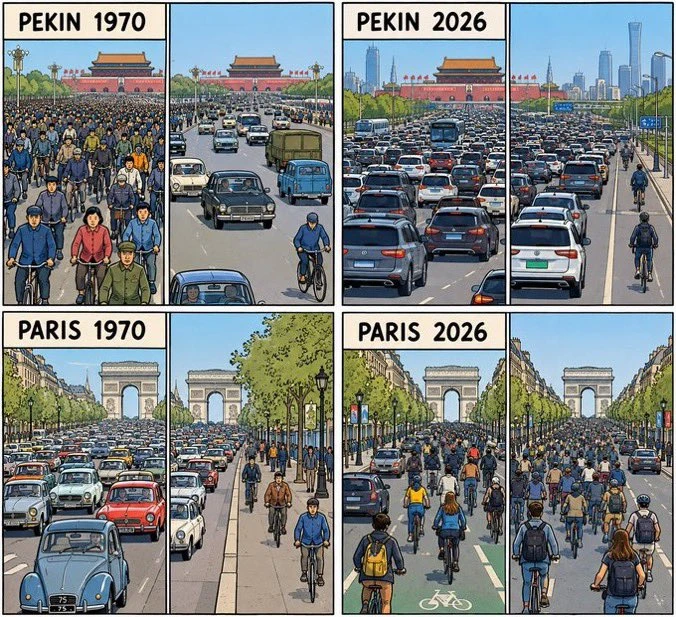
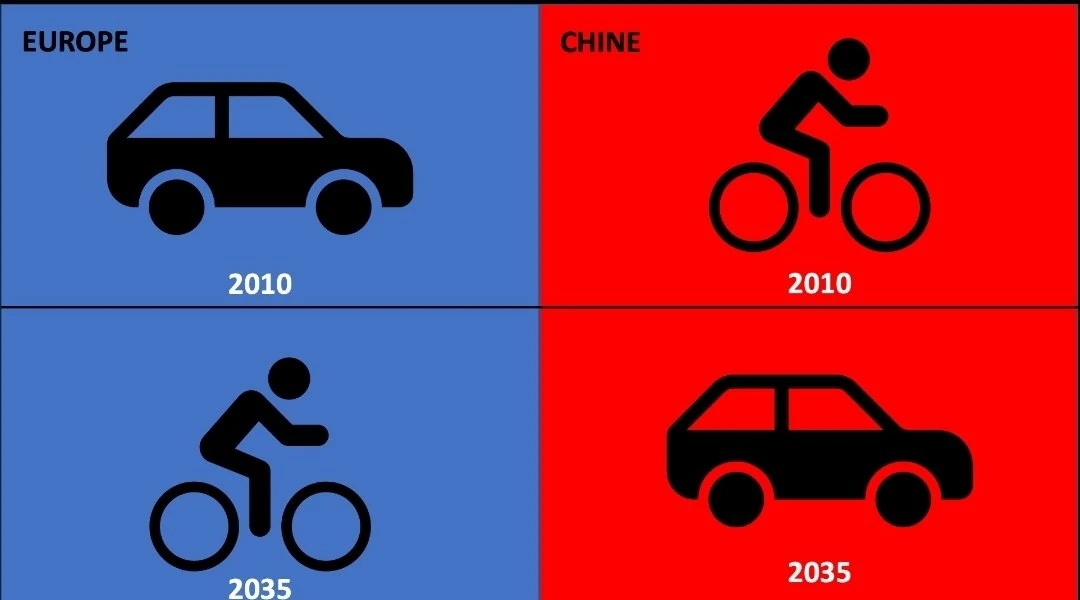
Getting rid of cars is a sign of progress in any civilization.
-
The Demiurge & the Crooked Tree
Around 360 BC Plato described a god who builds the world with geometry. This is how that idea travelled through cathedrals, lodges and laboratories into today's AI labs, and what a tree that nobody built has to say about it.
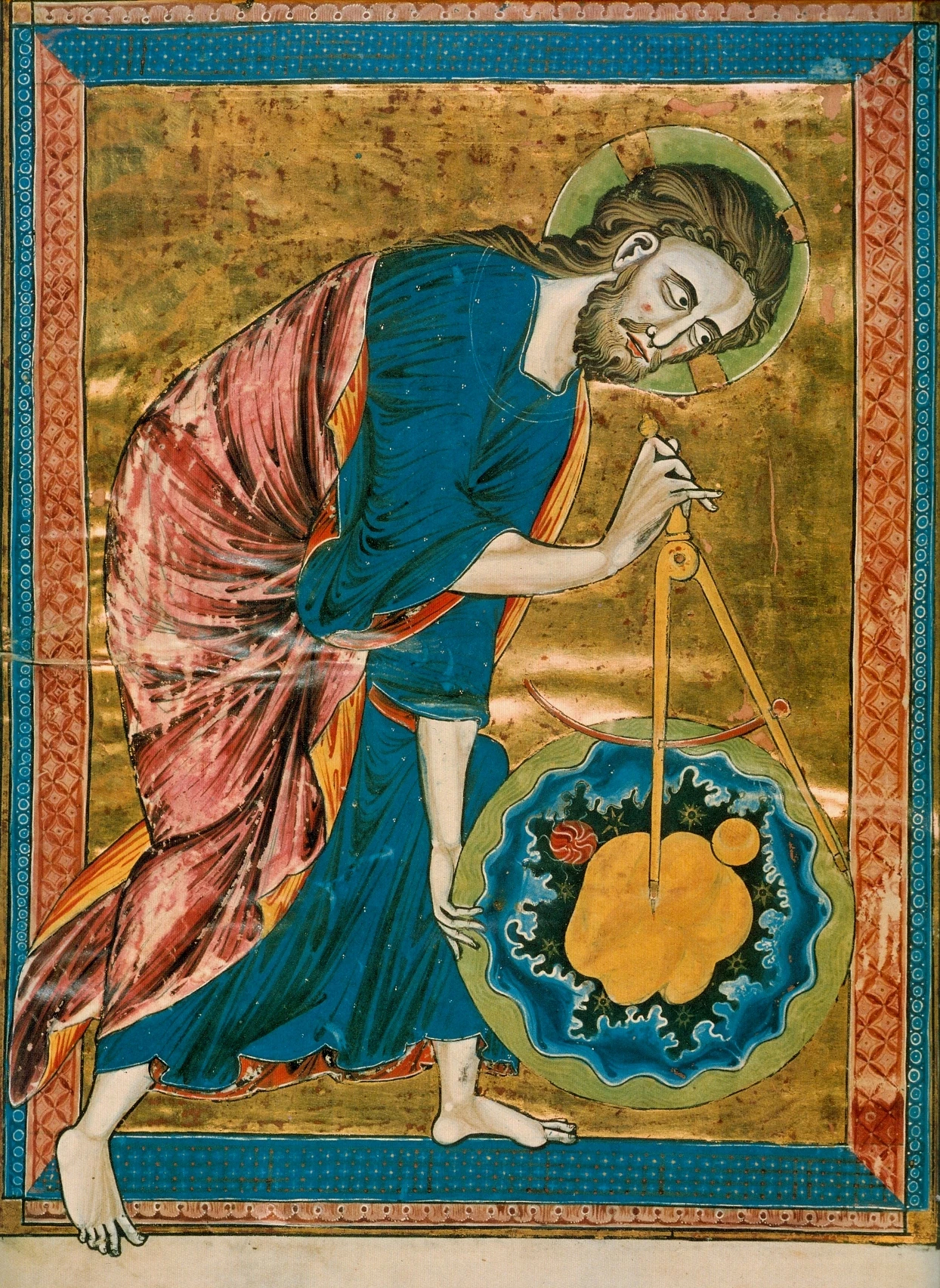
God as architect of the universe. Bible moralisée, France, c. 1220s. Vienna, ÖNB Cod. 2554. Few people today have read Plato's Timaeus, yet few books have shaped Western thought as much. The philosopher Alfred North Whitehead said that European philosophy is "a series of footnotes to Plato". Many of those footnotes lead back to this one dialogue.
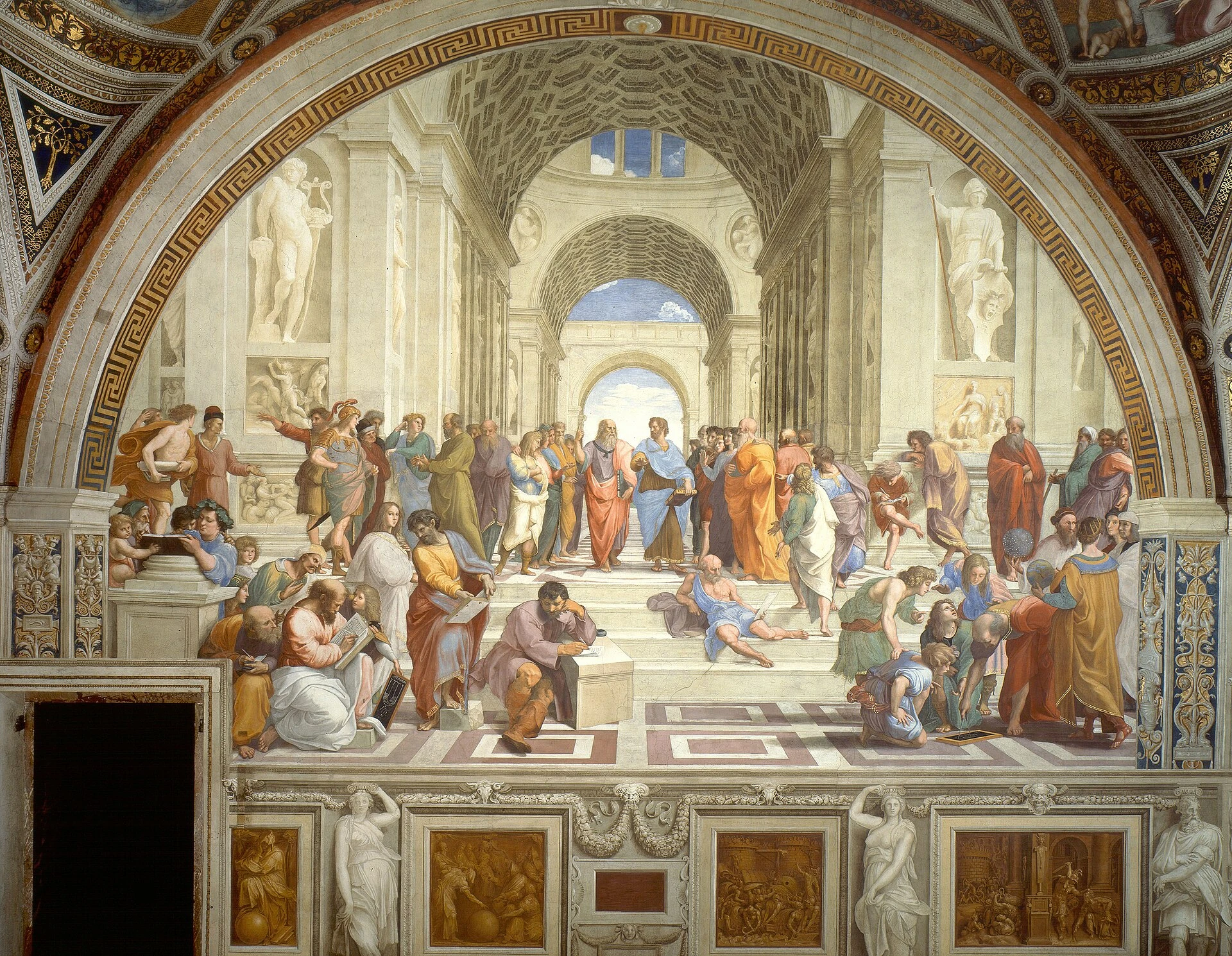
When Raphael painted The School of Athens in the Vatican, he placed Plato at the centre with a book under his arm. It is not the Republic. It is the Timaeus. Plato points upward, toward the eternal. Beside him, Aristotle holds his hand flat, palm down, toward the earth. The two gestures sum up two ways of looking for order: above the world, or inside it.
 TIMEO · ETICA
Raphael, The School of Athens, 1509–11. As the picture zooms in, the titles become readable: TIMEO for Plato, ETICA for Aristotle. Public domain. For about seven centuries, for most readers in Latin Europe, the Timaeus simply was Plato. In the 4th century a scholar named Calcidius translated its first half into Latin and added a long commentary, and the cathedral schools of the Middle Ages grew up on that translation. It is often said that Plato was lost to the West until the Renaissance. This is not quite true. The Timaeus was the part of Plato that stayed.
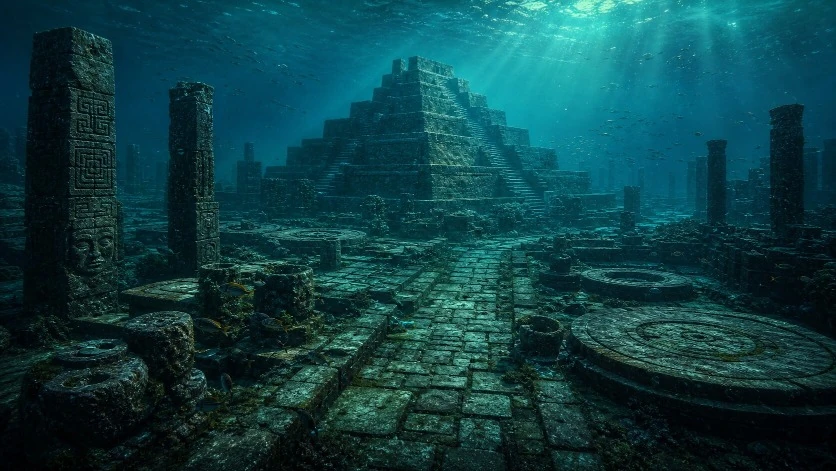
The same dialogue is also where the story of Atlantis first appears. We will meet it again later.
I should say at the start where this essay is going. The creation story in the Timaeus can be laid next to the way today's AI labs describe their work, and the two match closely, step by step. If you are short of time, you can go straight to that comparison. But the history explains why the match exists, so I recommend the longer road.
α΄A likely story
The dialogue takes place the day after Socrates has described his ideal city. He says he would like to see such a city in action. Critias offers the tale of Atlantis, which he says reached Athens from Egyptian priests through the statesman Solon. Then Timaeus, an astronomer from Locri in southern Italy, takes over. In one long speech he describes the whole universe from its beginning: the gods, the stars, the elements, the soul, and even the bone marrow, the liver and disease.
Before he begins, he warns his listeners. What he is about to tell, he says, is an eikōs muthos (εἰκὼς μῦθος), a likely story. Eternal things can be known exactly. The things we see and touch, which are always changing, can only be described in a way that is probable. So Timaeus offers the best account he can, and no more.
This warning matters, and I will come back to it, because most of Plato's later readers forgot it.
The universe of the Timaeus rests on three principles:
ΝοῦςIntellect · The DemiurgeA divine craftsman. He does not create from nothing. He finds matter "in discordant and disorderly motion" and puts it in order, because he is good and wants everything to be as good as possible. His model is the eternal Forms.
ἈνάγκηNecessity · The ReceptacleThe chōra: a neutral space in which things appear and dissolve, "the nurse of all becoming". Plato admits we can grasp it only "by a kind of bastard reasoning", as if in a dream.
ΨυχήThe World SoulThe cosmos is a single living creature with a body and a soul. The soul is mixed from Being, Sameness and Difference, and it is what makes the heavens turn in regular circles.
Time comes from this as well. Plato calls it "a moving image of eternity": the steady turning of the heavens is a moving copy of something that does not move.
There is one more detail, and later readers usually skipped it. Matter resists. Plato calls this resistance Necessity, or the "wandering cause". The craftsman does not defeat Necessity. He persuades her:
Reason overruled Necessity by persuading her to guide the greater part of the things that come to be toward what is best.Timaeus 48a
Note the words "the greater part". Not everything. Plato left a margin in his cosmos where the craftsman does not get his way. Most of the traditions that followed him quietly removed it.
β΄Fire is made of pyramids
Then Plato does something remarkable for the 4th century BC. He proposes a theory of atoms. His atoms are not small balls, as they were for Democritus. They are triangles.
There are two kinds: half of an equilateral triangle (angles of 30°, 60° and 90°) and half of a square (45°, 45° and 90°). Triangles combine into faces, faces into solids, and each solid is an element. Fire is the pyramid, the tetrahedron, which is why, Plato says, fire feels sharp: it cuts. Choose an element below, drag it to turn it, and show the atoms to see its triangles.
Open the post page for the interactive Platonic solids.
The system has a curious property. When fire cuts a particle of water, the water breaks into one particle of fire and two of air. Water has twenty triangular faces, fire has four and each air has eight, so twenty faces go in and twenty come out. The triangles are conserved. More than two thousand years before physicists wrote down the conservation of energy, Plato wrote down a conservation law for triangles.
Earth is the exception. Its cube is built from the other kind of triangle, so it cannot trade with the rest. It breaks apart, drifts, and comes back together, but always as earth.
There are five regular solids and only four elements. The fifth, the dodecahedron, gets a single mysterious sentence: the god used it "for the whole, embroidering it with figures". It cannot be built from Plato's triangles at all. The one shape that does not fit the system becomes the shape of heaven.
These ideas lasted a long time. In the spring of 1919, during the street fighting in Munich, the seventeen-year-old Werner Heisenberg was posted on the roof of a seminary, and in the quiet mornings he read the Timaeus in Greek. He thought the triangle atoms were absurd. But he could not let go of the idea that the smallest parts of matter might be mathematical forms rather than tiny objects. Many years later he wrote that modern physics had "definitely decided in favor of Plato".
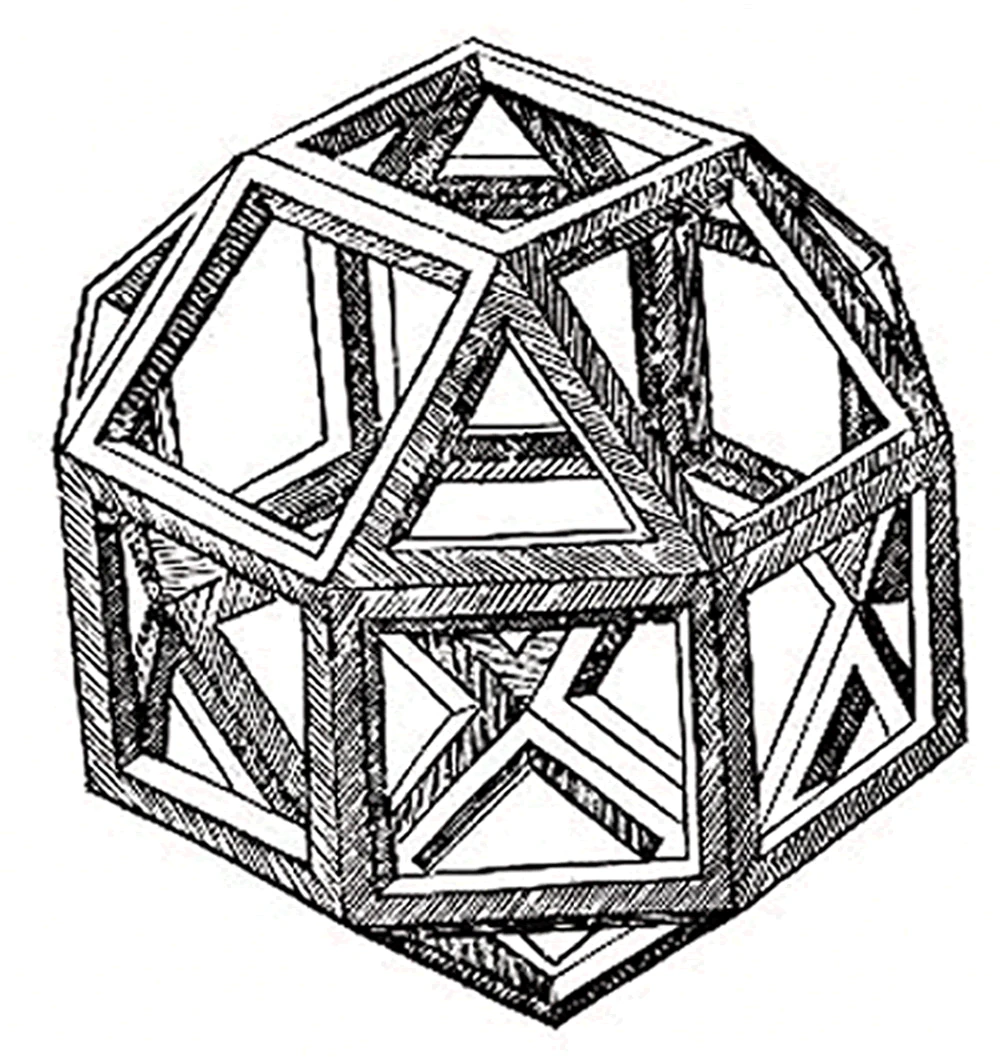
Leonardo da Vinci's drawings of the solids for Luca Pacioli's De divina proportione, 1509. 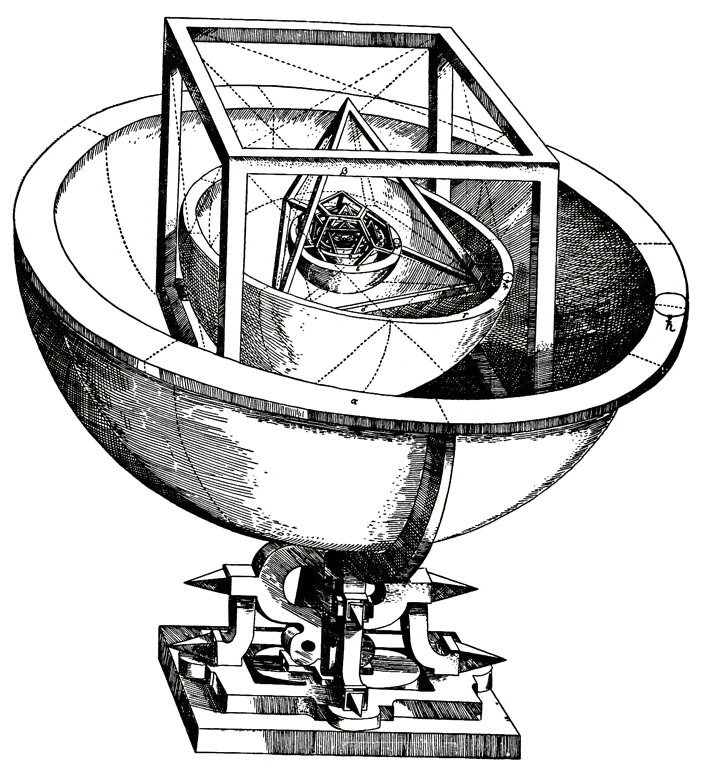
Johannes Kepler, Mysterium Cosmographicum, 1596. The five solids nested inside one another, one between each pair of planetary spheres. In 1596 Johannes Kepler, then twenty-four, took the solids literally. He placed them one inside another and claimed they explained the distances between the six planets known at the time. It was a beautiful idea, and it was wrong.
What I admire is that Kepler himself gave it up. Years later, working with Tycho Brahe's precise observations of Mars, he found that the orbit would not fit a circle, however he tried. The orbits were ellipses. He abandoned his most beautiful idea because the measurements would not agree with it. For once, Necessity persuaded the craftsman.
γ΄The soul is a tuned instrument
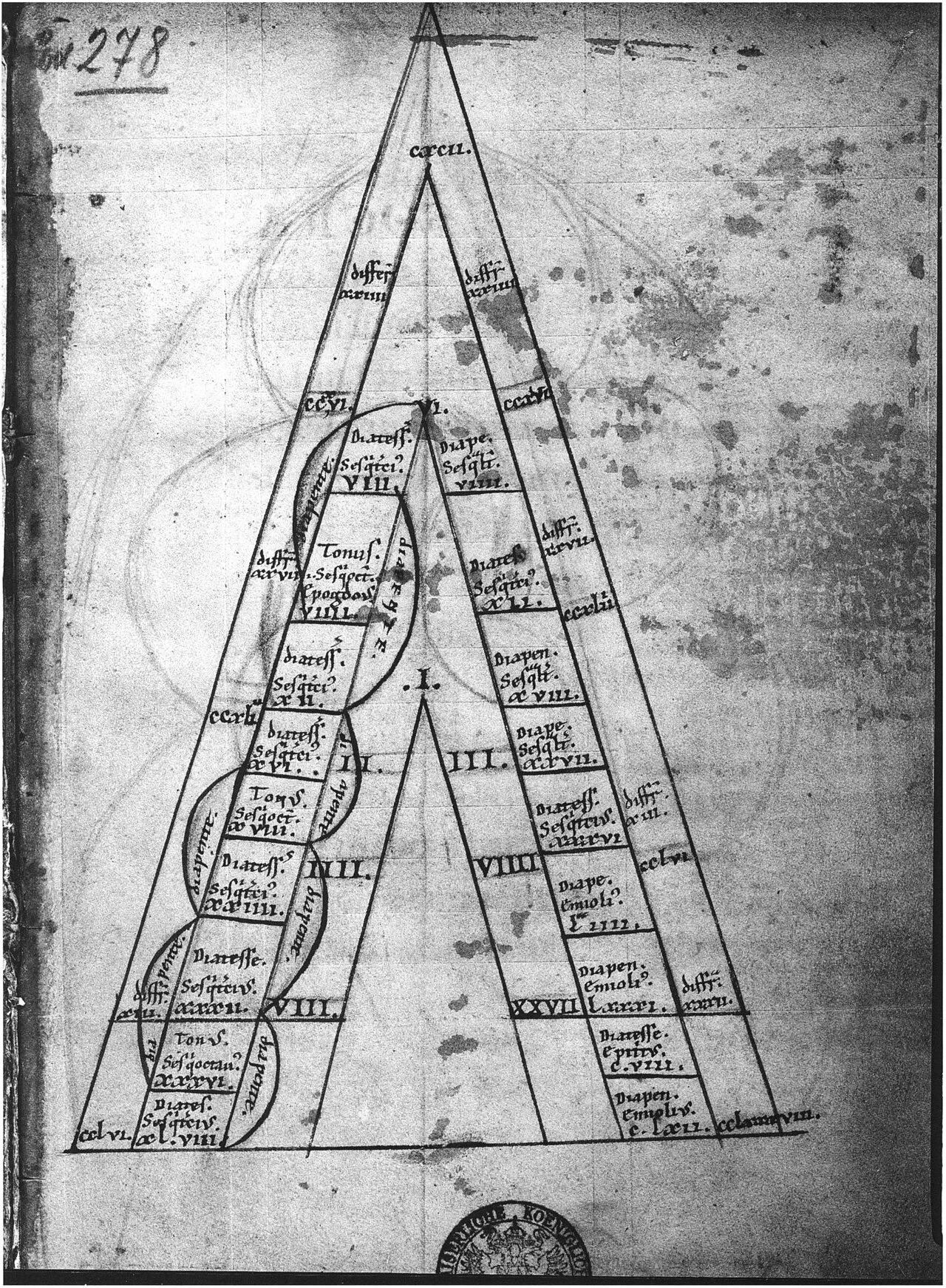
The numbers of the World Soul drawn as a large Λ and filled with musical ratios. Calcidius manuscript, Vienna ÖNB 278. The cosmos needs a soul, so the craftsman mixes one in a bowl, from Being, Sameness and Difference. Then he divides the mixture according to numbers.
He measures out portions in the proportions 1, 2, 3, 4, 9, 8, 27. These are two series: the doubles 1, 2, 4, 8 and the triples 1, 3, 9, 27. Medieval copyists drew them in the shape of the Greek letter lambda, Λ. Then he fills the gaps between the numbers until every interval is a tone of 9:8, with a small remainder of 256:243.
The result is the Pythagorean musical scale. The soul of the universe, in other words, is tuned like an instrument. Tap the numbers to hear them.
Next the craftsman cuts this strip of soul in two along its length, lays the halves across each other in the form of an X, and bends each into a circle. The outer circle, the circle of the Same, carries the fixed stars, which all turn together. The inner circle, the circle of the Different, is divided into seven rings for the planets, which move at their own speeds. The universe becomes a set of turning rings governed by musical ratios.
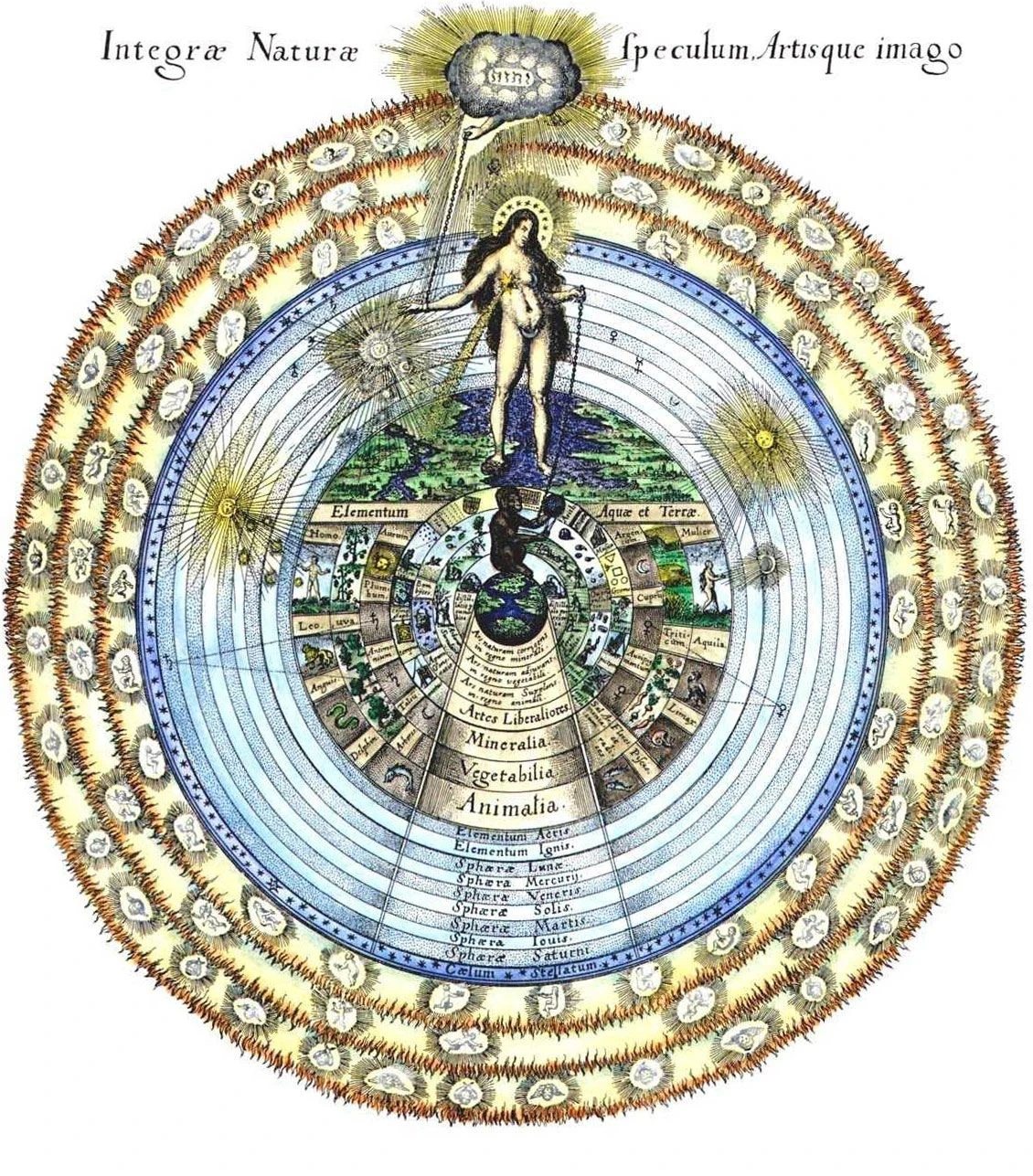
Robert Fludd, Utriusque Cosmi Historia, 1617. The World Soul as a woman chained to God above and to an ape below, the ape standing for human art, which imitates nature. Each human being also receives a soul, mixed from what was left in the same bowl and less pure. When this soul is placed in a body, the rush of sensation throws its circles into disorder. A newborn child, Plato says, is like a man standing on his head.
Life therefore has a task: to put the circles back in order. The method is to look up. We were given eyes, Plato says, so that we could watch the regular motions of the heavens and use them to correct the irregular motions of our own minds. One could call it salvation through astronomy.
The arrangement is simple. The cosmos is a perfect mechanism, each of us is an imperfect copy, and by studying the mechanism we can be repaired. This is the idea that travels furthest in the rest of the story.
δ΄God picks up a compass
From here on, the idea leaves the book.
Around 1220, in Paris, an illuminator painted God bending over a lumpy ball of chaos and measuring it with a pair of compasses. The picture states the idea in one image: God is an architect. It also suggests the reverse, though nobody said so aloud: an architect is a little like God.
The Renaissance gave the idea new force. In 1484 Marsilio Ficino, paid by the Medici, published the first complete Latin translation of Plato. Luca Pacioli wrote about the divine proportion, Leonardo drew the solids, Kepler nested them, and Robert Fludd engraved the cosmos as a single string tuned by a hand reaching out of a cloud. God was now a geometer, and the geometer was a kind of hero.
Kepler against Fludd
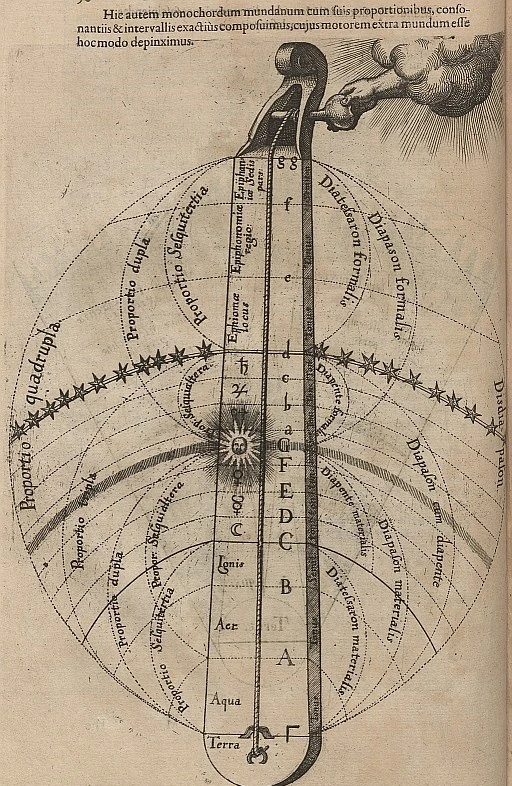
Fludd's divine monochord, Utriusque Cosmi Historia, 1617. One string from the earth to the highest heaven, tuned by a hand from the clouds. Two of these men then quarrelled. In 1619 Kepler published Harmonices Mundi, The Harmony of the World, with an appendix attacking Fludd. Fludd replied, Kepler replied again, and the exchange of pamphlets went on for three years.
Both believed the cosmos was built on harmony. They disagreed about how a person could know it. For Kepler, harmony was something to be measured: real ratios in real orbits, checked against Tycho's numbers. For Fludd, mathematicians dealt only in "quantitative shadows", and true harmony was known from within, through a sympathy between the soul and the world. Kepler's answer became famous:
I have the tail in my hand, but you may be grasping the head mentally, though, I fear, only in your dreams.Kepler to Fludd, 1622, as quoted by Wolfgang Pauli
This is the same disagreement that runs through this essay, between order imposed from outside and order found within, but here it happens inside the West, between two men who both used compasses. Kepler won, and modern astronomy grew from his method. Three centuries later Wolfgang Pauli, one of the founders of quantum mechanics, wrote a long study of the quarrel and ended with some sympathy for Fludd. Science, he felt, had won by leaving out half of the question.
New Atlantis
Francis Bacon died in 1626, the story goes, of a chill he caught while stuffing a chicken with snow to see whether the cold would preserve the meat. He left an unfinished utopia whose title answers Plato directly: New Atlantis.
Plato's Atlantis was a warning: a rich, clever and arrogant empire beyond the Pillars of Hercules, which the gods sank "in a single day and night". Bacon's island, Bensalem, lies hidden in the Pacific, and it is governed, discreetly, by a research institute.
The institute is called Salomon's House. Its members carry out experiments in deep caves and high towers, breed new plants and animals, and build engines, lenses and "sound-houses". They send secret agents, the "Merchants of Light", abroad to collect the knowledge of other countries. They also decide among themselves which discoveries the state will be told about. Their purpose is stated like this:
The End of our Foundation is the knowledge of Causes, and secret motions of things; and the enlarging of the bounds of Human Empire, to the effecting of all things possible.Francis Bacon, New Atlantis, 1627
It is hard to read this today without thinking of the mission statement of an AI lab.
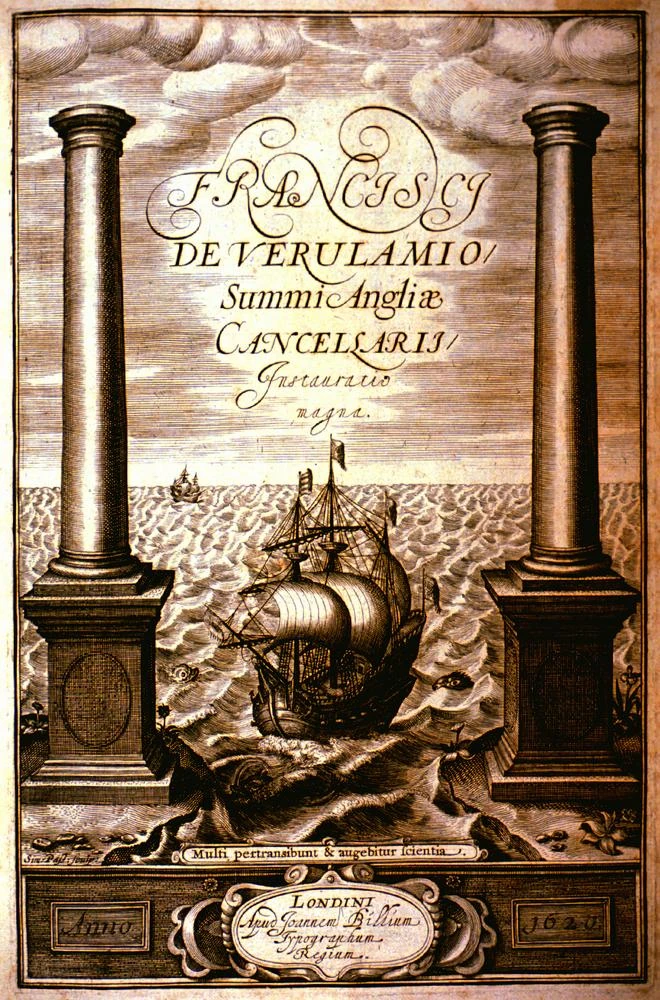
Frontispiece of Bacon's Instauratio Magna, 1620. A ship sails out between the Pillars of Hercules, where Plato placed Atlantis. The motto reads: "Many will pass through, and knowledge will increase." 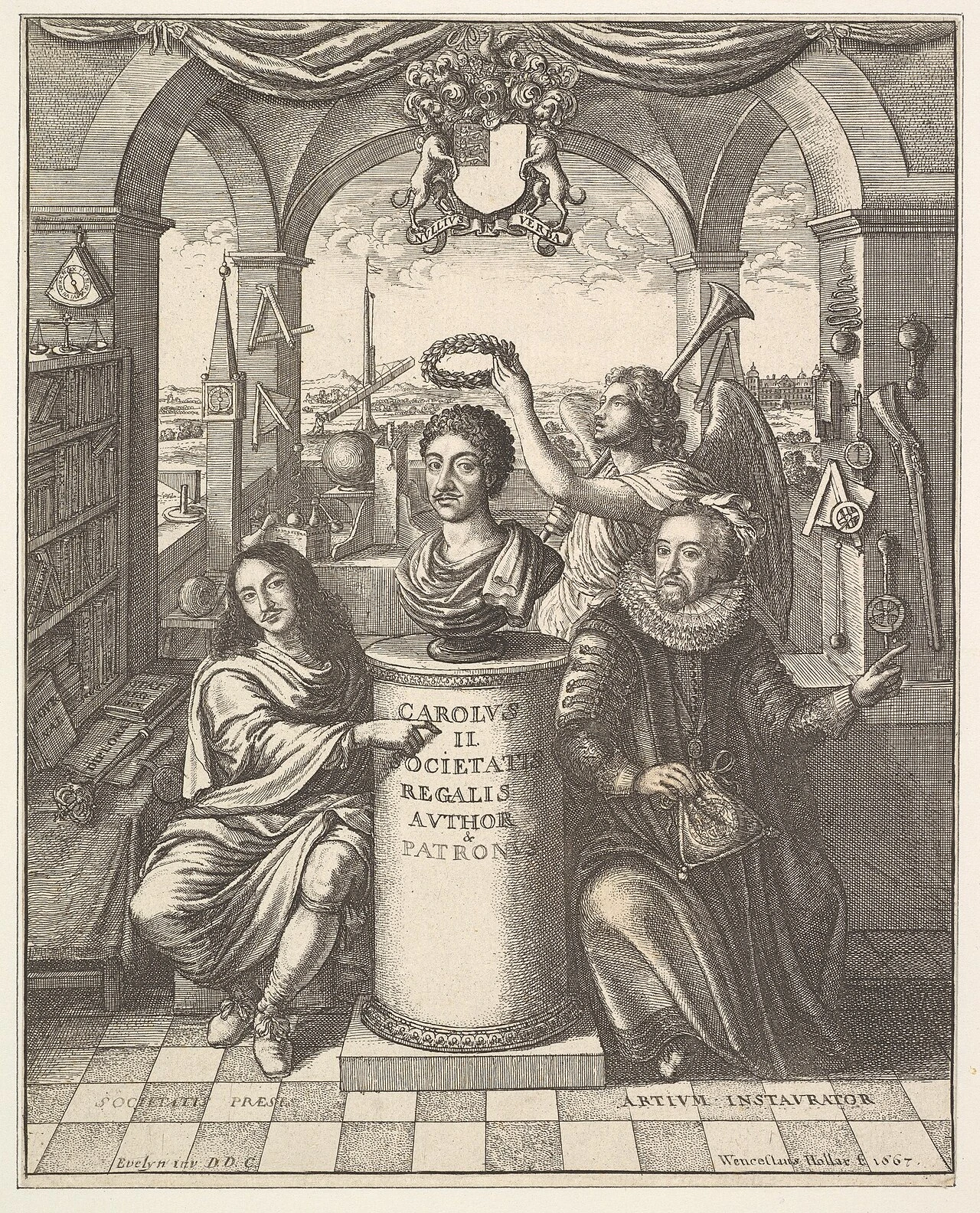
Wenceslaus Hollar's frontispiece to Sprat's History of the Royal Society, 1667. Bacon sits on the right, named Artium Instaurator, the renewer of the arts, among scientific instruments. Bacon also wrote the clearest version of Plato's idea of persuasion: "Nature, to be commanded, must be obeyed." Both halves are in the sentence. The centuries that followed mostly remembered the first.
Salomon's House became the ideal of English gentlemen who experimented in their spare time. The founders of the Royal Society treated Bacon as their patron and his imaginary institute as their plan. The Freemasons, whose rituals centre on Solomon's Temple, drew from the same source. Historians still argue about how much of this resemblance is influence and how much is coincidence.
The Freemasons
In the same decades, the idea found an organisation.
- 1598The Schaw Statutes regulate the Scottish lodges of working stonemasons, men who actually cut stone.
- 1646Elias Ashmole, antiquarian, astrologer and alchemist, is made a Freemason in Warrington. He has never cut a stone in his life.
- 1660The Royal Society is founded, with Salomon's House as its ideal. Ashmole is one of its early fellows. The two worlds share the same rooms and many of the same people.
- 1717Four London lodges meet at the Goose and Gridiron tavern near St Paul's and form a Grand Lodge.
- 1723James Anderson publishes the Constitutions of the Free-Masons, which begins:
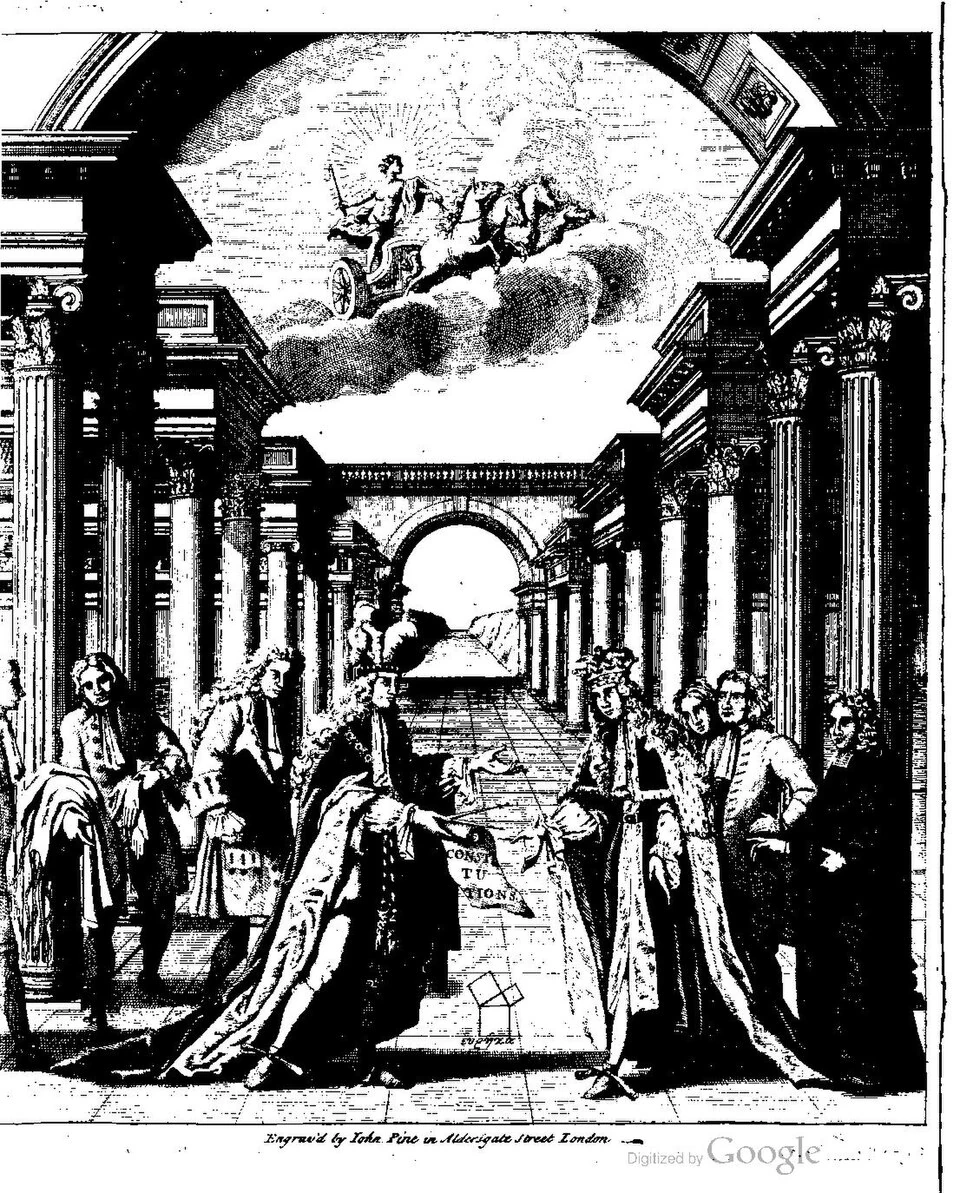
Frontispiece of Anderson's Constitutions, 1723. On the floor lies a diagram from Euclid. Adam, our first Parent, created after the Image of God, the great Architect of the Universe, must have had the Liberal Sciences, particularly Geometry, written on his Heart.Anderson's Constitutions, 1723
Geometry, written on the human heart by an architect. These new "speculative" masons had taken over a guild of men who really built things. They kept the tools, the square, the compasses and the plumb line, but applied them to the self. The rough stone stood for the unformed person, the smooth, squared stone for the person improved. It is the pattern of the Timaeus again: the order of the cosmos used to correct the disorder of the individual.
In the lodges, members were taught with painted "tracing boards" laid on the floor. They show two pillars, a ladder to heaven, the square and compasses, the all-seeing eye, and often Euclid's 47th proposition, the theorem of Pythagoras, as the emblem of the whole enterprise: a god who builds with geometry, and men who become more like him by learning it.
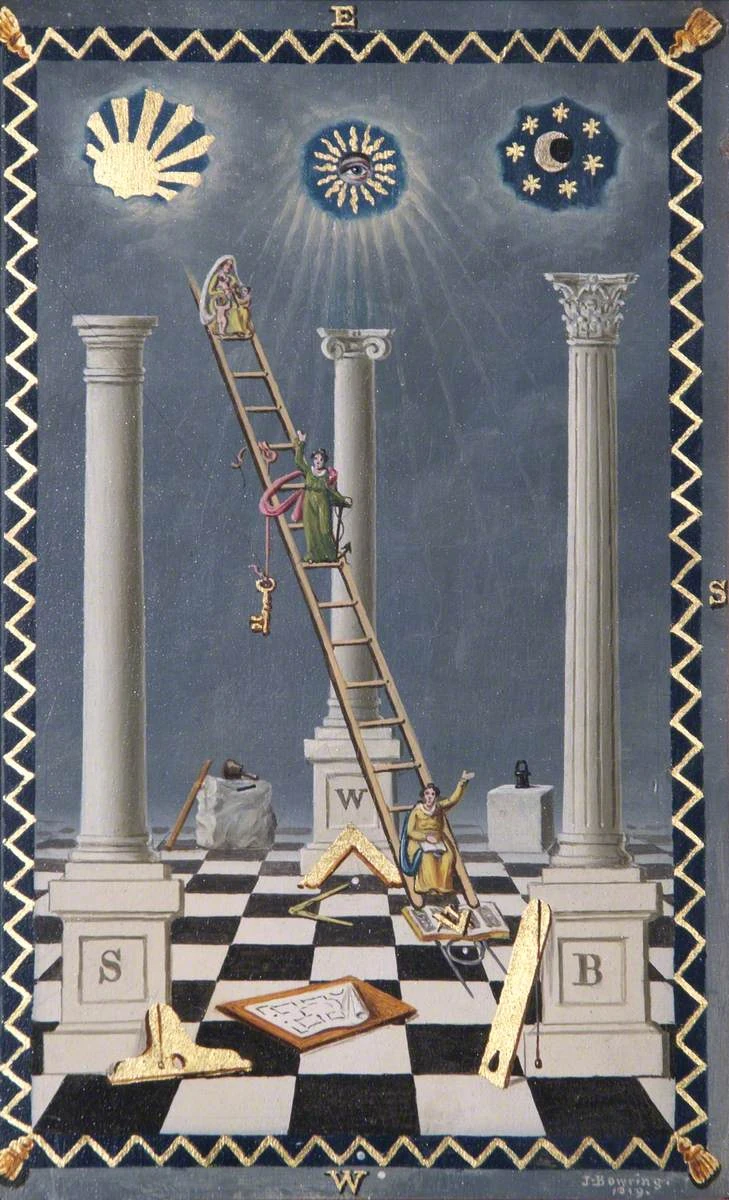
Josiah Bowring, First Degree tracing board, early 19th century. Pillars, Jacob's ladder, and the square and compasses on a chequered floor. Museum of Freemasonry, London. 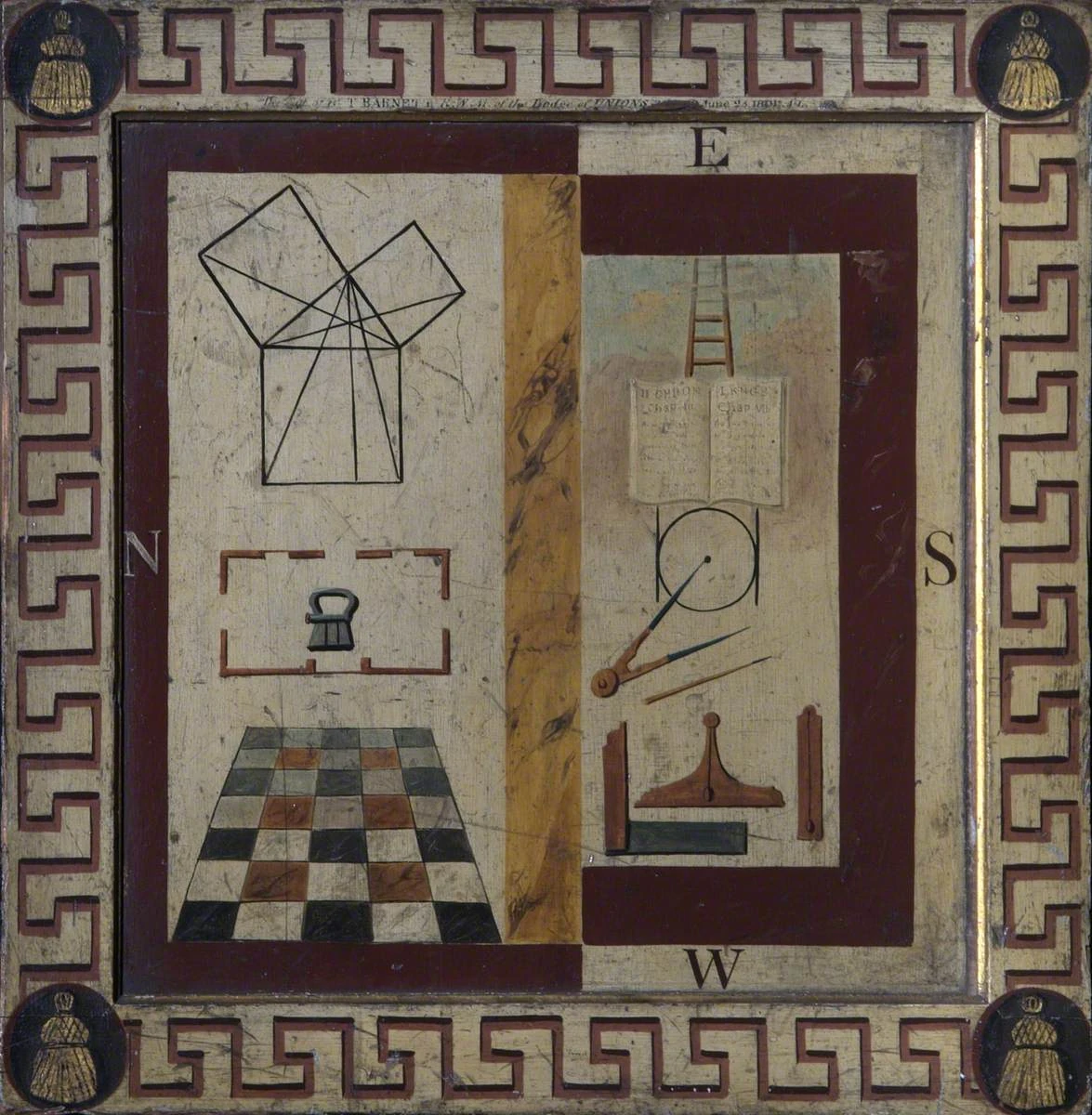
Tracing board, unknown artist. At top left, Euclid's 47th proposition, the same diagram that lies on the floor in Anderson's frontispiece. Museum of Freemasonry, London. I confess I find this part of the story rather dull: a club of gentlemen dressed as builders, who built nothing and claimed to hold the plan of everything. But dull ideas are often the ones that last. Seventy years later George Washington, wearing a Masonic apron, laid the cornerstone of the United States Capitol with a silver trowel.
The heretics
Not everyone accepted the idea. In 1794 William Blake took the image of God with the compasses and turned it into a warning.
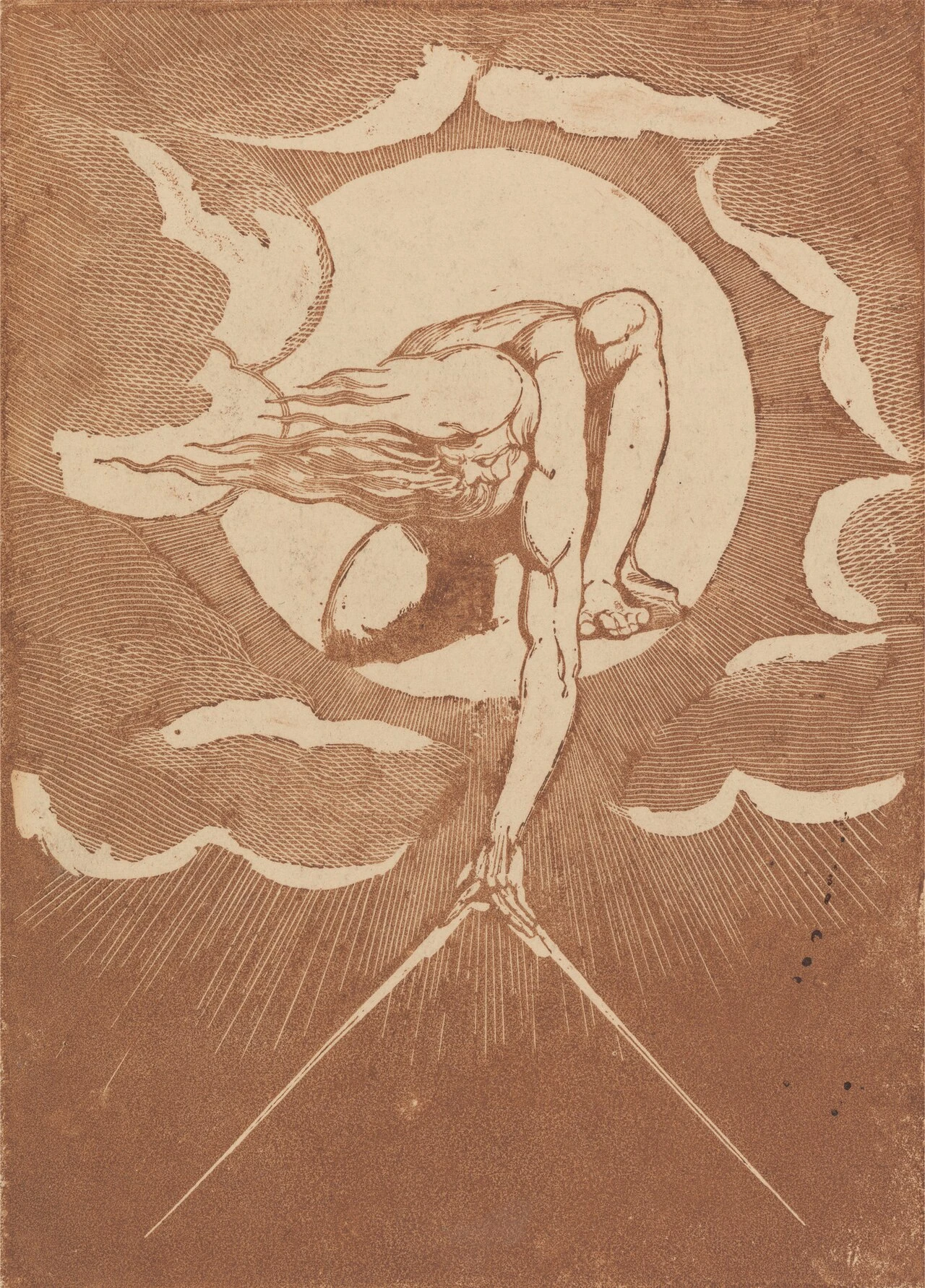
Blake, The Ancient of Days, 1794. Urizen, Blake's god of reason and law, fixing the limits of the world with a pair of dividers. 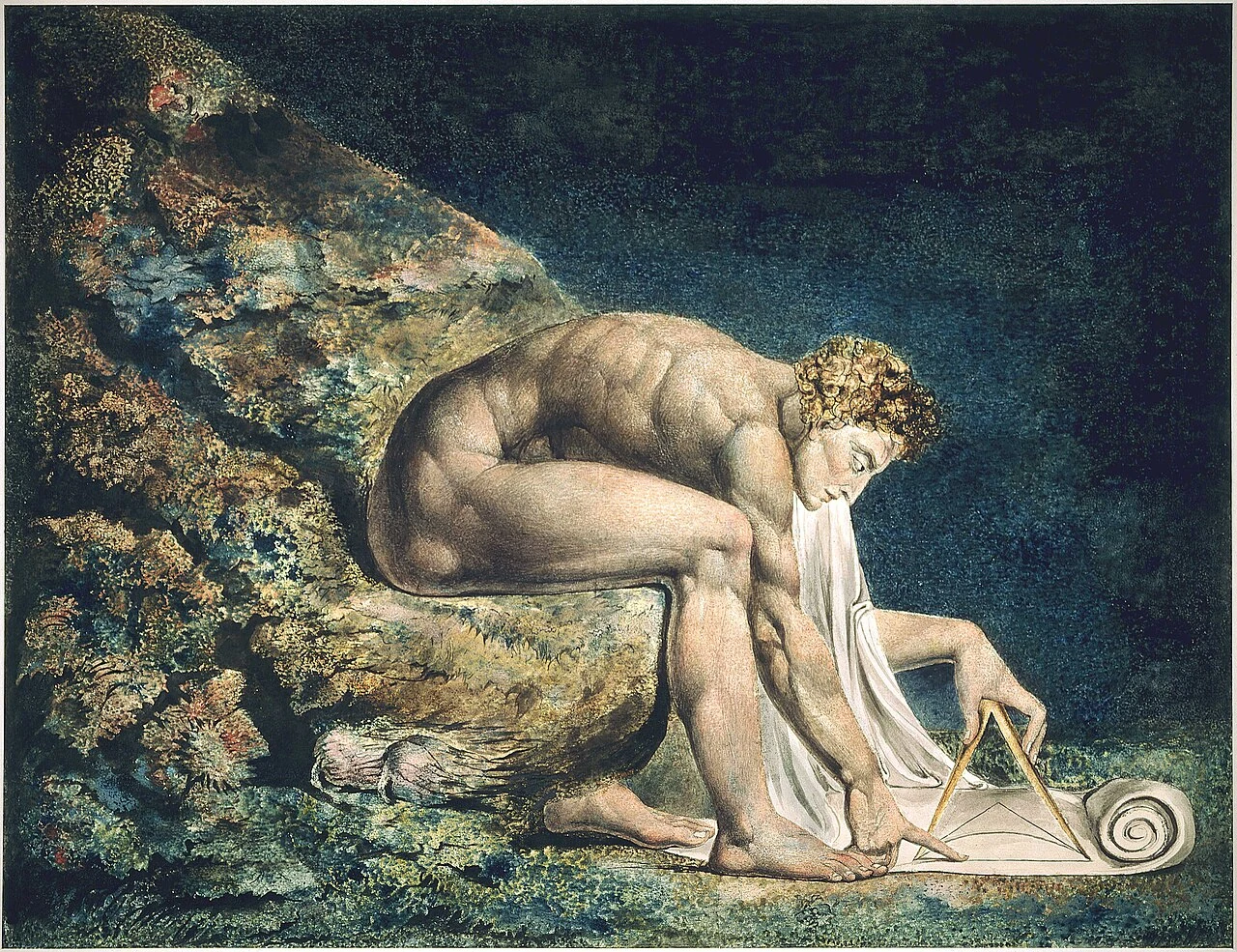
Blake, Newton, 1795–c.1805. The scientist at the bottom of the sea, so absorbed in his diagram that he has turned his back on the living rock behind him. For Blake, the god with the compasses was not a creator but a jailer. He stood for reason that forgets it is only one of our faculties and begins to draw the limits of the whole world.
May God us keep
From Single vision & Newton's sleep!Blake, letter to Thomas Butts, 1802Goethe made a similar protest through botany. In The Metamorphosis of Plants (1790) he argued that all the parts of a flower, sepals, petals and stamens, are transformed leaves. Form, for him, grows from inside the plant through variation; it is not stamped on from outside. He then spent twenty years in a losing argument with Newton about colour.
The West always had these dissenters. They were rarely the ones who received the funding.
ε΄The craftsman becomes a company
Now jump to the present. Replace the compasses with a computer chip, take away the gods, and the structure of the story is still there.
About 1220. A mind outside the world, measuring chaos. 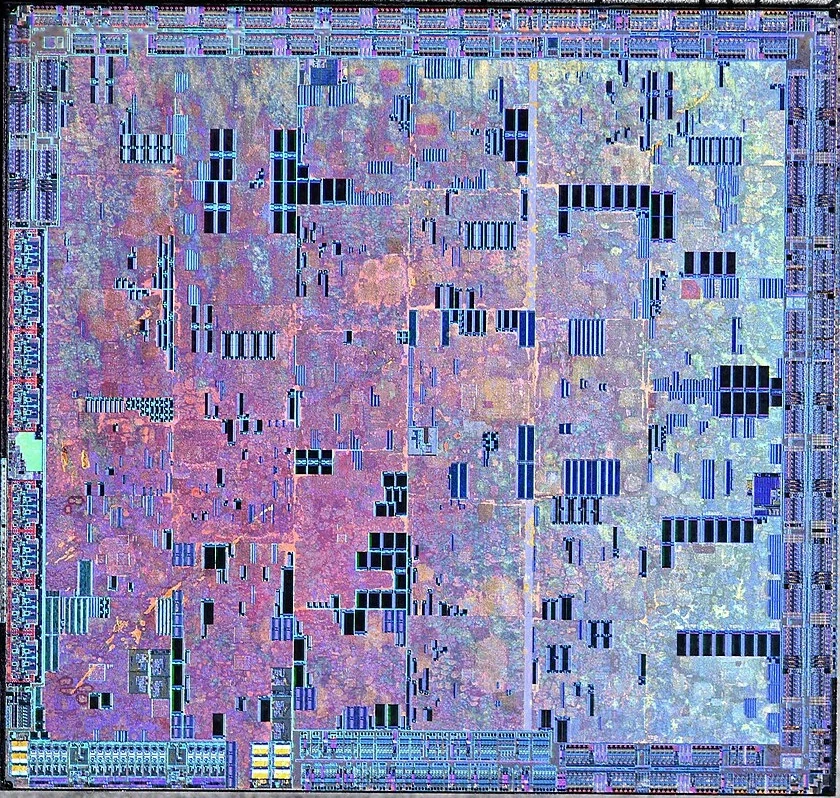
2006. An Nvidia G71 graphics chip with its cover removed: sand, melted and measured. Photo: Martijn Boer, public domain. Below is the creation story of the Timaeus, step by step. Switch it to 2026 to see how each step corresponds to the way AI is built today. The names change; the steps stay the same.
- The Goodτἀγαθόν The Good"God desired that all things should be good and nothing bad, so far as this was attainable." 30a "Benefits all of humanity"The mission statement of the OpenAI Charter. Every lab has its own version.
- The makerδημιουργός The DemiurgeA craftsman outside the world, "free from jealousy", who wants everything to be "as like himself as they could be." 29e The labA few hundred people outside the system they are building, who want it to share their values. They call this alignment.
- The patternπαράδειγμα The FormsHe works "after an eternal pattern", copying perfect originals into the world. 28a Latent spaceAn MIT paper argues that large models converge on "a shared statistical model of reality, akin to Plato's concept of an ideal reality."
- The receptacleχώρα The chōra"The receptacle, and in a manner the nurse, of all generation." Formless and shaking, with everything mixed together. 49a Data and computeThe text of the internet and the datacenters it is fed into. Formless and noisy, with everything mixed together.
- The mixing bowlκρατήρ The kraterHe blends Same, Different and Being in a bowl, cuts the mixture into strips and bends them into circles. 35a, 41d The training runThe data is mixed, gradient descent runs for months, and a finished model is taken out.
- The resultψυχή The World Soul"A living creature truly endowed with soul and intelligence." 30b The model"A country of geniuses in a datacenter." Dario Amodei, 2024.
- The helpersθεοὶ θεῶν The younger godsThe craftsman hands the messy mortal work to lesser gods: "Do ye therefore make them." 41c AgentsThe model hands tasks on to smaller agents and tools.
- The repair90d Tuning the soulHuman souls are born with their circles in disorder. Studying the heavens puts them back in line. AlignmentTraining with human feedback, testing, and a 30,000-word constitution used in training.
I am aware that I have just done what this essay questions: I have taken a messy reality and pressed it into eight neat boxes. Some rows fit better than others, and the comparison between agents and the younger gods is half a joke. One row is wrong in an interesting way.
The row that doesn't fit
It is the row about the Forms. For Plato, the Forms come first and are then copied into matter. The "Platonic representation" found in AI works the other way round. Nobody puts it into the model. It appears out of the data as models grow larger, and vision models and language models, trained on completely different material, end up organising the world in similar ways. The form is found inside the mess, not stamped onto it.
This is not Plato's finger pointing upward. It is Aristotle's hand, held flat over the ground. The most Platonic-sounding discovery in AI turns out to be something that grows, and this, I think, is the centre of the whole question.
A constitution for the soul
The last row is less of a stretch than it may seem. The Timaeus begins the morning after a long conversation about the ideal city, which Socrates briefly summarises: who governs, who guards, how citizens are born and educated. That conversation is usually identified with the Republic, whose Greek title, Politeia, is commonly translated as "constitution". Plato first writes the laws of the city; then he describes a cosmos and a soul that match them.
In January 2026 the company Anthropic published the constitution for its Claude models: about 30,000 words on values and character, used directly in training. Inside the company an earlier version had been "endearingly known as the 'soul doc'". Among the outside reviewers were two members of the Catholic clergy.
I do not mean this as mockery. Writing down what you hope a mind will be is more honest than pretending you are not shaping it. The method is also more careful than it first appears. The document mostly explains reasons rather than listing rules, on the theory that a model that understands why will behave better in new situations than one that has memorised instructions. This is the half of the Timaeus that is usually forgotten: reason persuading Necessity instead of overpowering her.
Still, a small group of people writes down what is good and trains it into a mind. The compasses are still in the hand.
(Disclosure: parts of this section were drafted together with Claude, which was trained on that document. It had opinions.)
Plato, Bacon or a lab?
Here are eight quotations. Some were written in 360 BC or 1627, others after 2010. Try to guess which are which.
"Out of disorder he brought order, considering that this was in every way better than the other."
Plato, Timaeus 30a."Solve intelligence, and then use that to solve everything else."
DeepMind's mission, as Demis Hassabis describes it."We take all an oath of secrecy, for the concealing of those which we think fit to keep secret."
Bacon, New Atlantis, 1627, on Salomon's House."We expect that safety and security concerns will reduce our traditional publishing in the future."
OpenAI Charter, 2018."To make divers new plants, differing from the vulgar; and to make one tree or plant turn into another."
Bacon, New Atlantis, 1627. Synthetic biology, four centuries early."What I cannot build, I cannot understand."
Written into the DNA of JCVI-syn1.0, the first cell controlled by a synthetic genome, 2010."You shall weave together the mortal and immortal."
Plato, Timaeus 41d. The craftsman instructing the younger gods."Fixing the climate, establishing a space colony, and the discovery of all of physics."
Sam Altman, The Intelligence Age, 2024.The new harmony
A schematic scaling law, not real data. It shows only the shape of the relationship. Plato built the World Soul from a handful of numbers: 1, 2, 3, 4, 8, 9, 27. AI research found its own governing numbers in 2020, when Jared Kaplan and colleagues at OpenAI showed that the error of a language model falls as a power law as the model, the data and the computing power grow, "with some trends spanning more than seven orders of magnitude."
On a graph with logarithmic axes this relationship is a straight line: one ratio that holds at every scale, which is exactly the kind of thing the Pythagoreans revered. Sam Altman summed it up this way: "deep learning worked, got predictably better with scale, and we dedicated increasing resources to it." The harmony of the spheres has become an investment plan.
The craftsman signs his work
Synthetic biology tells the same story in a wetter medium. In 2010 Craig Venter's team designed the genome of a bacterium on a computer, assembled it from "four bottles of chemicals", and transplanted it into a living cell of a related species, where it took control. Venter described the result as "the first self-replicating species we've had on the planet whose parent is a computer."
Then they signed their work. The synthetic genome carries coded "watermarks": the names of 46 scientists, an email address and three quotations. One of them appeared in the quiz above. It was meant to quote Richard Feynman, but Feynman's blackboard actually read "What I cannot create, I do not understand." The copy came out slightly different from the original, which would not have surprised Plato.
The phrase "biology is code" follows the same pattern as the table above. DNA is the Form, the body is a product built from it, and disease is an error to be corrected. Bacon's Salomon's House had already promised new species and "one tree or plant turn into another". And Venter himself said his team had not created life from nothing, because they needed a living cell to start the genome. This is the receptacle again. The craftsman never works from nothing.
The pattern repeats each time: a mind outside the system, a perfect model, a disordered material, and the belief that the right equations will bring the material into order.
Physics has its version too. The physicist Max Tegmark argues that the universe does not merely obey mathematics but is a mathematical structure. The simulation argument puts a craftsman outside the world once more, this time with a datacenter. And Atlantis has returned. Plato told its story as a warning about a brilliant empire that overreached and sank. Bacon reused the name as a promise. Silicon Valley mostly remembers Bacon's version.
ϛ΄What the machines actually do
There is an irony in all this. The technology itself does not work the way the craftsman story suggests.
The biggest lesson that can be read from 70 years of AI research is that general methods that leverage computation are ultimately the most effective, and by a large margin.Rich Sutton, The Bitter Lesson, 2019
The history of AI is full of attempts to design intelligence directly: expert systems, hand-built catalogues of knowledge, carefully engineered features, grammars and rules. Each was a blueprint, and each was eventually overtaken by simpler methods that learned from data. Sutton's conclusion is that we should build systems that can discover things as we do, "not which contain what we have discovered".
Nobody designed the inner structure of a large model. It was grown. Billions of numbers begin as random noise and are adjusted, step by step, by gradient descent, until structure forms. This is less like a craftsman copying a model into matter, and more like what Laozi called the uncarved block, taking shape by itself.
The machine grows like a plant, but the people who steer it speak like architects.
This gap concerns me more than any benchmark. It is the belief that something grown can be fully specified, and that whatever does not fit the specification is an error to be deleted. Gardeners prune, of course. But a good gardener does not forget that it was the plant that did the growing.
七The tree the carpenter walked past
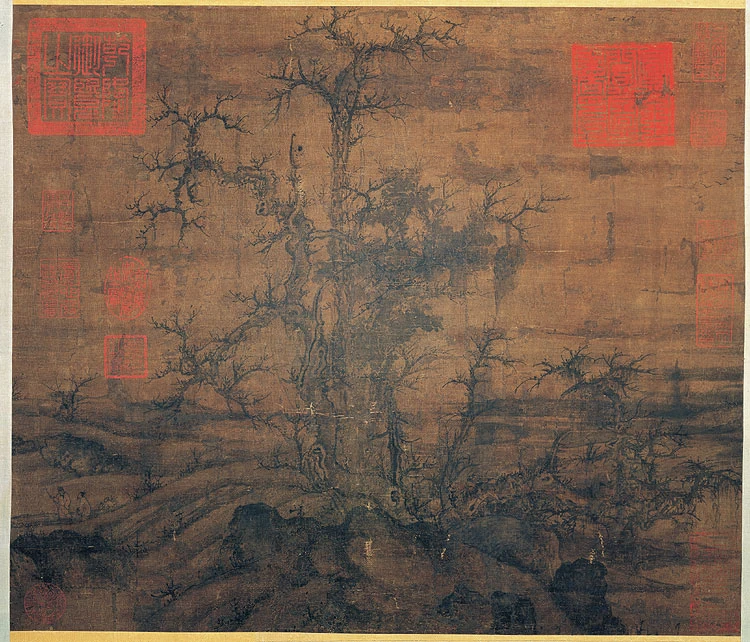
Anonymous, Small Scene of Wintry Trees, Song dynasty. There is not a single straight line in it. At roughly the same time that Plato was writing, give or take a few decades, a Chinese writer we know as Zhuangzi told the following story.
A master carpenter named Shi is travelling with his apprentice. At a village shrine they pass an enormous oak, wide enough to shade thousands of oxen, so tall that its lowest branches begin above the hilltops. Crowds gather to look at it. Shi does not even turn his head.
The apprentice runs after him: I have never seen timber like that. Why won't you look at it? Shi dismisses it. The wood is worthless. Make a boat of it and the boat sinks. Make a coffin and it rots. A door would ooze sap, a pillar would be eaten by insects. The tree is useless, and that is why it has lived so long.
That night the oak appears to him in a dream. In paraphrase: What are you comparing me with? With useful trees? Fruit trees are stripped and broken as soon as their fruit is ripe. Their usefulness ruins their lives. I have been trying to be useless for a very long time. I nearly died more than once, but now I have succeeded, and my uselessness is my great use. If I had been useful, would I ever have grown this large?
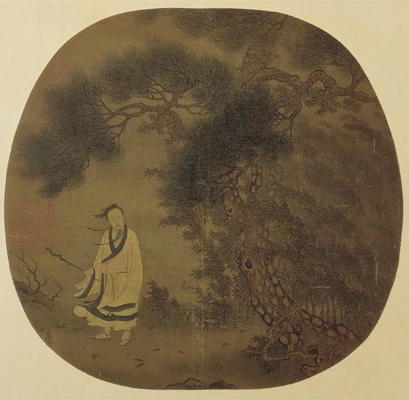
Attributed to Xu Daoning, Holding a Wand under the Pine Tree, Song dynasty. The chapter ends with a sentence that sums up the whole story:
Everyone knows the use of the useful. Nobody knows the use of the useless.人皆知有用之用,而莫知無用之用也Zhuangzi, ch. 4
Compare this with the Timaeus. Plato's god is a craftsman who looks at raw material and sees what it ought to become. In Zhuangzi's story, the raw material scolds the craftsman for failing to see what it already is.
Below is a tree drawn without a plan, from one simple, slightly crooked rule repeated many times. Click to grow another.
Open the post page to grow the trees.
There are exactly five regular solids; Euclid proved that a sixth is impossible. There is no limit to the number of crooked trees.
The hole in the wheel
Plato's system also contains a kind of emptiness: the receptacle, the chōra. He is clearly uneasy about it. It can be grasped, he says, only by "bastard reasoning", as if in a dream. Laozi, in chapter 11 of the Tao Te Ching, puts exactly this emptiness at the centre:
Thirty spokes share one hub. It is the empty space that makes the cart useful.三十輻共一轂,當其無,有車之用Tao Te Ching, ch. 11
The idea is the same, but its value is reversed. For Plato, empty space is the uncomfortable basement of the cosmos. For Laozi, it is what makes things useful. Laozi's ideal is not the perfectly cut stone but pu, the uncarved block: the wood as it was before anyone took a chisel to it.
Joseph Needham, the Cambridge biochemist who devoted his life to Science and Civilisation in China, tried to sum up the Chinese view of nature in one phrase:
An ordered harmony of wills without an ordainer.Joseph Needham, 1956
Order without anyone giving the orders. I know of no sentence in English further from the Demiurge.
Buddha in this body
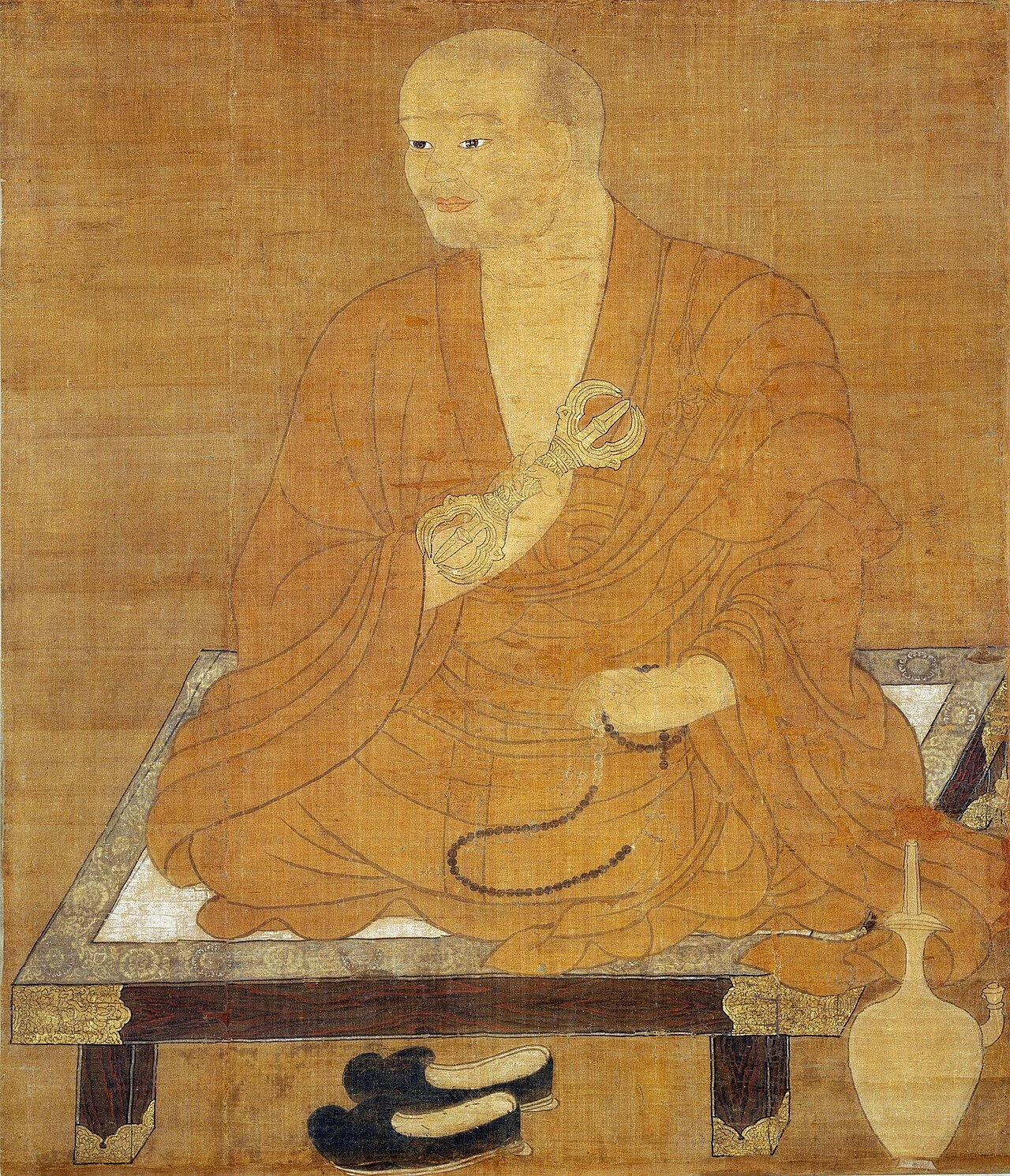
Kūkai (774–835), from Eight Patriarchs of the Shingon Sect. In 804 a Japanese monk named Kūkai sailed to Chang'an, the Chinese capital, studied esoteric Buddhism with the master Huiguo, and returned to Japan to found the Shingon school. His central teaching is sokushin jōbutsu (即身成仏): becoming a Buddha in this very body. Not after death, and not in a better world, but here.
For Plato, the body is what throws the soul into disorder. For Kūkai, the body is the instrument of practice. The practice works through the "three mysteries": the hands, through gestures called mudras; the voice, through mantras; and the mind, through the images of the mandala. One does not escape the confusion by thinking alone. One tunes it with the whole body.
Kūkai's list of elements is revealing too: earth, water, fire, wind, space and consciousness. Mind is one of the elements. Plato's elements are lifeless triangles that need a soul brought in from outside. Kūkai's already contain awareness:
The six great elements interpenetrate without obstruction, in eternal union.六大無碍常瑜伽Kūkai, Sokushin jōbutsu gi
The same cube
Here the story takes a strange turn. In old Japanese cemeteries there are gorintō, stone stupas made of five stacked shapes, one for each element:
Plato · heaven = dodeca
Plato · air = octa
Plato · fire = tetra
Plato · water = icosa
Plato · earth = CUBE空 void · jewel
風 wind · crescent
火 fire · pyramid
水 water · sphere
地 earth · CUBEThe earth is a cube, just as in Plato. Two traditions with almost no contact both gave the earth the shape of a cube, and then used it in opposite ways.
Look at photographs of old gorintō and you see stones softened by centuries of rain, spotted with lichen, sometimes leaning a little. A Platonic cube is meant to stay exact forever. These cubes have been allowed to age.
Plato uses geometry as a mould, something pressed into matter from outside to make it behave. Shingon uses geometry as a mirror. Its great mandalas are not plans for building the world. They are maps of what a person already is, and the practitioner enters them with body and voice.
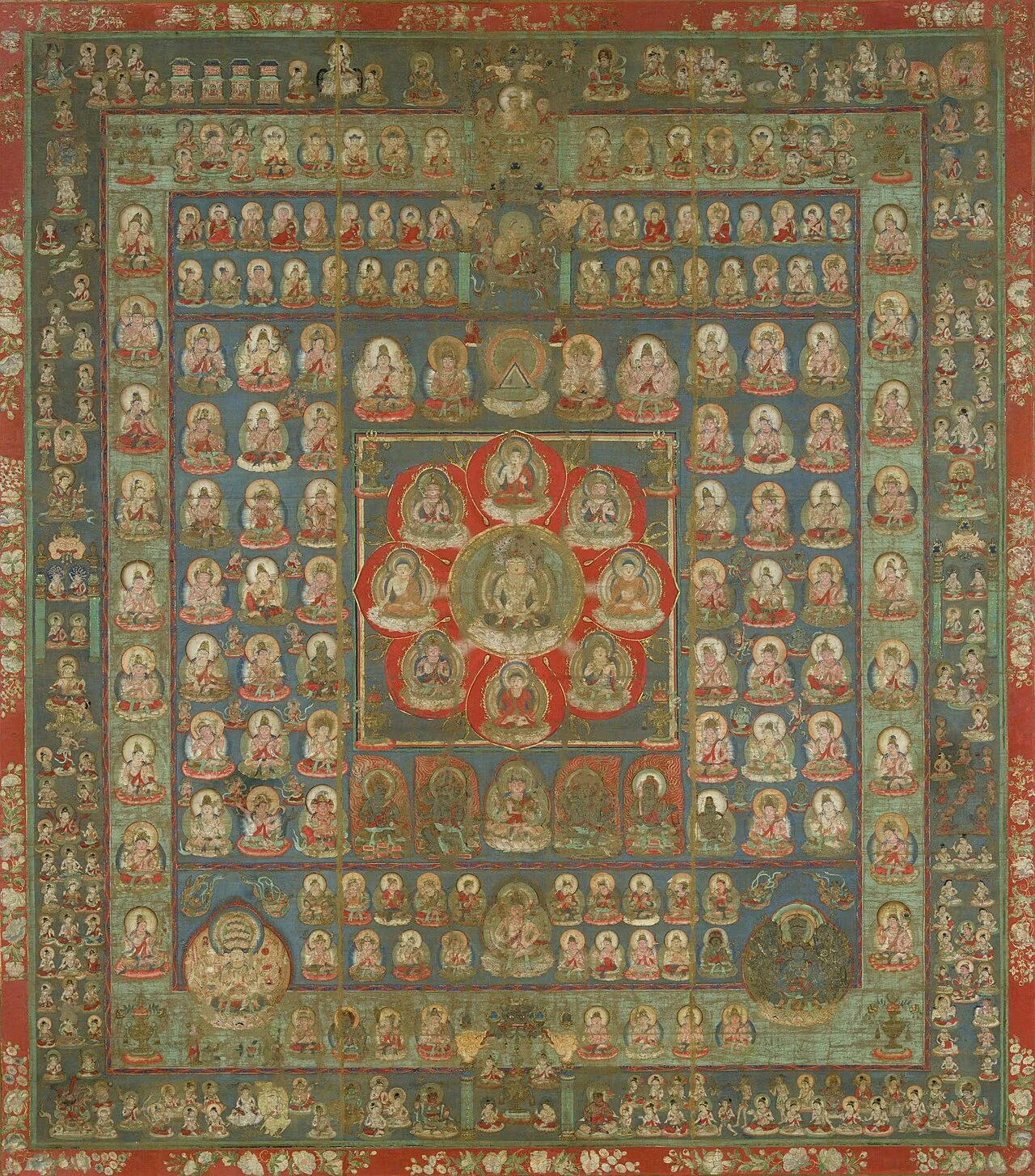
The Womb Realm mandala (Taizōkai), one of Shingon's two great mandalas. Strict geometry, used as a mirror for the body rather than a mould for matter. Further west, in India, the ideas become stranger still. Kashmir Shaivism describes the basic texture of reality as spanda: a throb or pulse, consciousness vibrating and recognising itself in everything it becomes. Other Indian traditions speak of līlā, play: the cosmos as something performed rather than built.
Chinese Huayan Buddhism describes Indra's net: an endless web with a jewel at every knot, each jewel reflecting all the others. It is the opposite of a world made of five separate solids. In Indra's net nothing has a shape of its own; everything exists through its relations.
The Demiurge- The cosmos is built
- Order is imposed from outside
- Chaos is the enemy, persuaded at best
- The body disturbs the soul
- Geometry as a mould
- You improve yourself by studying the mechanism
The Crooked Tree- The cosmos grows, or plays
- Order arises from within
- Chaos is material, and a source
- The body is the instrument
- Geometry as a mirror
- You stop forcing, and notice
The picture is not so simple
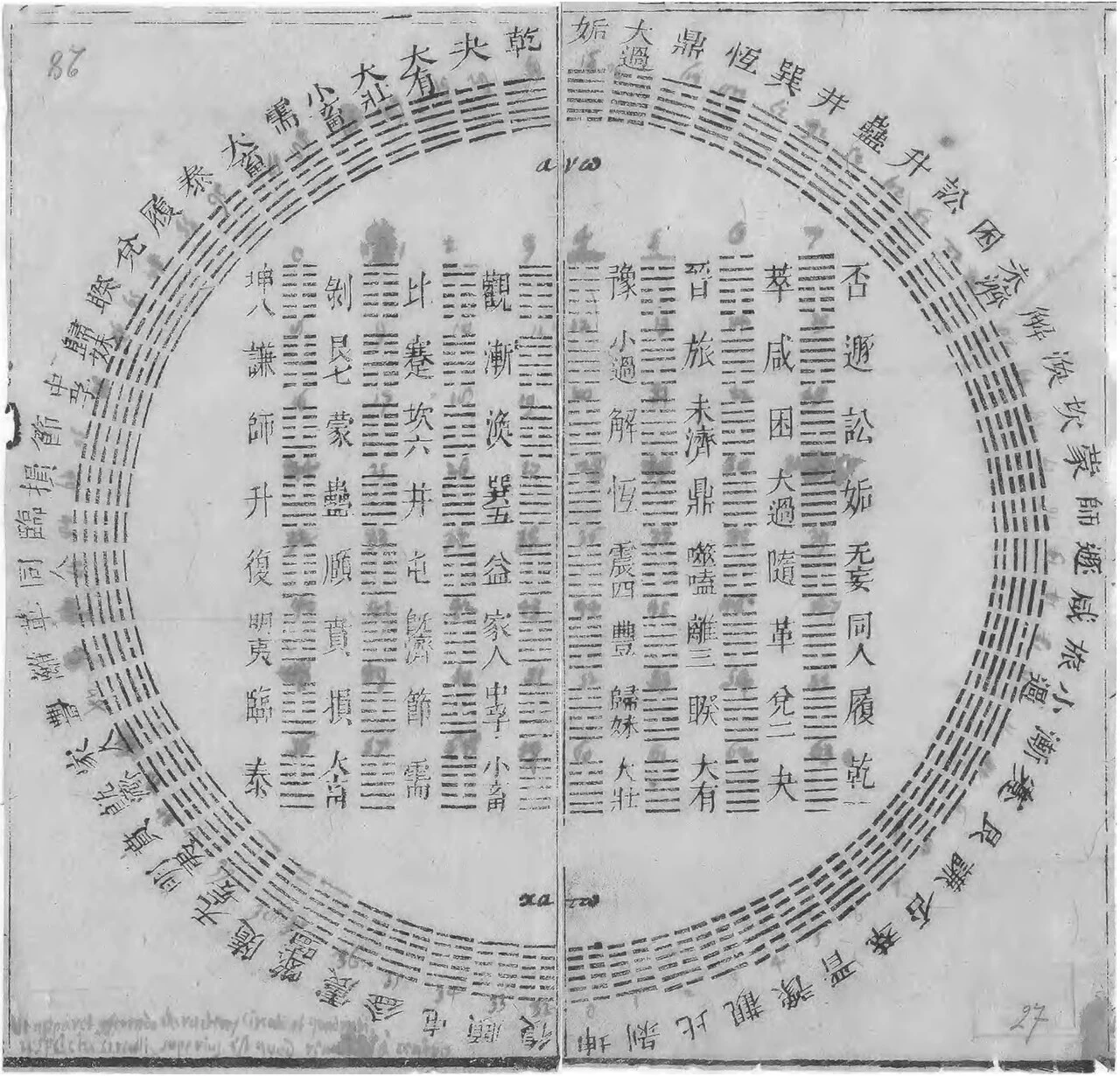
The I Ching hexagram diagram that Joachim Bouvet sent from Beijing to Leibniz in 1701, with Leibniz's own pencil numbers. It would be wrong, though, to present the East as purely the side of the tree. Kūkai's school had its own version of Salomon's House. Mikkyō, the name of his tradition, means "secret teaching": initiation by a master, knowledge passed on behind closed doors, rituals that may not be described to outsiders. In its structure it is closer to a Masonic lodge than I would like.
And for centuries the Tao Te Ching was also read as a handbook for rulers. Han Feizi, the hard-minded Legalist whose ideas the Qin state used to build China's first empire, wrote commentaries on Laozi. Wu wei, non-action, can mean letting the river find its own course. It can also mean a ruler so powerful that he never needs to lift a finger.
In 1701 Joachim Bouvet, a Jesuit in Beijing, sent Leibniz a diagram of the 64 hexagrams of the I Ching, in the arrangement of the Song philosopher Shao Yong. Looking at the broken and unbroken lines, Leibniz recognised his own binary arithmetic of zeros and ones.
Every chip that runs today's AI counts in a number system whose European inventor believed he had found it confirmed in an ancient Chinese book of divination. These traditions were never sealed off from one another. They have been borrowing from each other for centuries.
八So does the East win?
There is a popular version of this story. The West runs toward a cliff, building a god out of silicon and rewriting life as code, while China, Iran and others rediscover their non-Platonic roots and inherit the century.
I understand its appeal, but I do not fully believe it.
China. There is a real tradition of systems thinking there. Qian Xuesen wrote Engineering Cybernetics at Caltech in 1954, was deported during the McCarthy era, and returned to China, where he helped build the missile and space programmes and a whole culture of planning based on systems science. "Ecological civilization" was written into the Chinese constitution in 2018. But China is also the most thoroughly engineered state on Earth. The writer Dan Wang calls it an engineering state, in contrast to the "lawyerly society" of the United States: five-year plans, perfectly straight high-speed railways, whole cities built within a decade. On some days Beijing looks much more like the Demiurge than Palo Alto does.
Iran. Suhrawardi's 12th-century Philosophy of Illumination describes reality as degrees of living light. Mulla Sadra's doctrine of "substantial motion" holds that being itself is continuous change: nothing simply sits still, being a cube. This is beautiful, and far from lifeless geometry. But Suhrawardi counted Plato among his teachers. The philosophy of illumination is Platonism set alight, not its opposite. And states are not governed by metaphysics. They are governed by oil, demography and fear.
Iran also offers a third kind of geometry, which belongs to neither side of this essay. In 2007 the physicists Peter Lu and Paul Steinhardt showed that the tile patterns of the Darb-i Imam shrine in Isfahan, built in 1453, follow rules very close to those of quasicrystals: patterns that are strictly ordered and yet never repeat. In Europe such patterns were described only in the 1970s, by Roger Penrose.
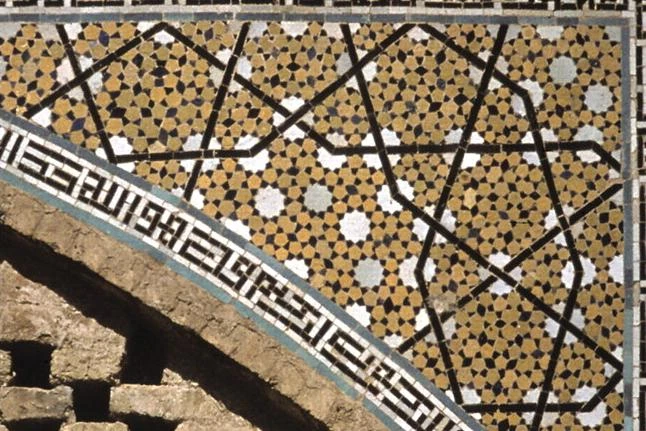
Spandrel of the Darb-i Imam shrine, Isfahan, 1453. The large pattern of lines is repeated at a smaller scale inside itself. Public domain. Below is a pattern of the same family. It is made with a modern method the Isfahan craftsmen did not use, but whose result they would recognise: a hidden tiling of two rhombs, shown by the faint lines, carries a band of interlaced strapwork. Every line follows a strict rule, yet the pattern never repeats, however far it is extended. Click for another.
Open the post page to draw the pattern.
This is neither the craftsman's mould nor the crooked tree. It is order that is completely exact and still never closes. If there is a geometry for the century ahead, it may look more like this than like either of the others.
The dividing line does not run between East and West. It runs through every laboratory, every ministry and every person.
On one side is the craftsman, on the other the tree: imposing order, or letting it grow. The West has Blake and Goethe, Gregory Bateson, ecology, cybernetics and the complexity scientists of the Santa Fe Institute. The East has the largest top-down planning machinery ever built. Everyone carries both.
Where I do agree with the popular version is this: the societies that do well in this century will be the ones that can hold both. The compasses are not the villain. They gave us bridges, vaccines and the chips this page is running on. The skill is to pick them up and then to put them down again, to build the trellis and let the vine do the rest. Systems that treat disorder as an error tend to be broken by it. Systems that treat it as material can work with it. Most discoveries happen at the boundary between order and chaos, not on either side of it.
Plato himself knew this. It is in his text: reason persuades Necessity; it does not abolish her. The problem is not the Timaeus. The problem is twenty-four centuries of reading it as an engineering specification instead of as a likely story.
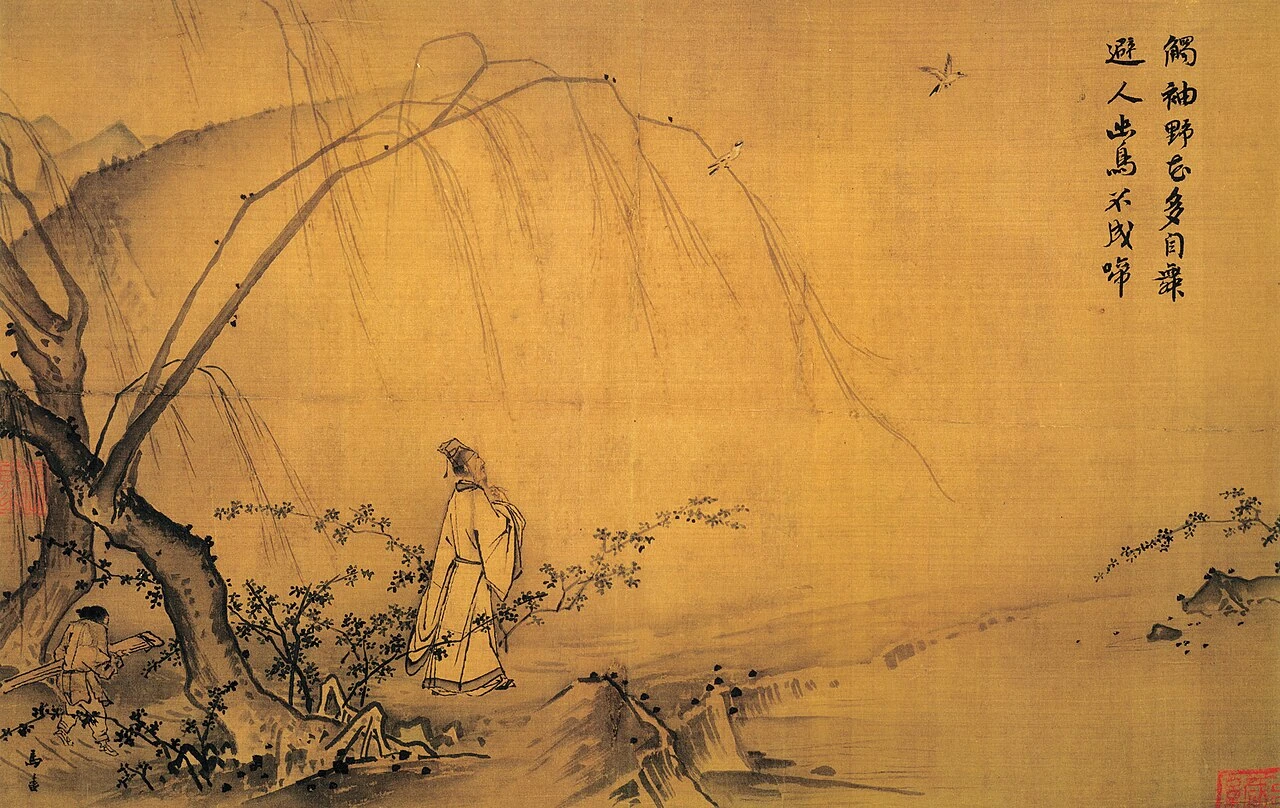
Ma Yuan, Walking on a Mountain Path in Spring, Song dynasty, c. 1200. A scholar, a willow, a bird, and a great deal of empty space. The DemiurgeThe myceliumSolve intelligenceNotice it is already everywhereAlignment as enforcementAlignment as tuningFive perfect solidsCountless crooked treesGeometry as a mouldGeometry as a mirrorI want to return once more to Zhuangzi's oak. It survived because it was useless. Nobody wanted its wood.
That way out is not open to what we are building now. AI may be the most useful tree anyone has ever grown, and carpenters everywhere are already standing beneath it with their saws. So the question is not how to stay useless.
The question is whether we can learn to use something without cutting it into the shape of our plans.
Plato's World Soul turns in perfect circles. A Zen painter draws a circle in a single breath and leaves it open.
The two circles look alike. One is a plan, the other a breath.
Close this page, and go and look at a crooked tree.
櫟
Further reading
- Plato, Timaeus, trans. Jowett. Key passages: 29d, 30a, 35a–36d, 37d, 43a–e, 47b–c, 48a, 52b, 53c–56d, 90c–d.
- Zeyl & Sattler, "Plato's Timaeus", Stanford Encyclopedia of Philosophy.
- Zhuangzi, ch. 4, "In the World of Men", trans. Burton Watson (the carpenter and the oak).
- Laozi, Tao Te Ching, ch. 11 and 28.
- Joseph Needham, Science and Civilisation in China, vol. 2 (1956).
- Kūkai, Sokushin jōbutsu gi; Yoshito Hakeda, Kūkai: Major Works (1972).
- Francis Bacon, New Atlantis (1627) and Novum Organum (1620).
- Wolfgang Pauli, "The Influence of Archetypal Ideas on the Scientific Theories of Kepler" (1952), on the Kepler–Fludd feud.
- James Anderson, The Constitutions of the Free-Masons (1723).
- J. W. von Goethe, Versuch die Metamorphose der Pflanzen zu erklären (1790).
- Werner Heisenberg, Der Teil und das Ganze (1969), ch. 1, the Timaeus on the rooftop.
- Alfred North Whitehead, Process and Reality (1929).
- Rich Sutton, "The Bitter Lesson" (2019).
- Huh, Cheung, Wang, Isola, "The Platonic Representation Hypothesis" (ICML 2024).
- Kaplan et al., "Scaling Laws for Neural Language Models" (2020).
- OpenAI Charter (2018); Sam Altman, "The Intelligence Age" (2024); Dario Amodei, "Machines of Loving Grace" (2024).
- Anthropic, Claude's Constitution (2026).
- Gibson et al., "Creation of a Bacterial Cell Controlled by a Chemically Synthesized Genome", Science (2010).
- Dan Wang, Breakneck: China's Quest to Engineer the Future (2025).
- All artworks public domain, via Wikimedia Commons.
-
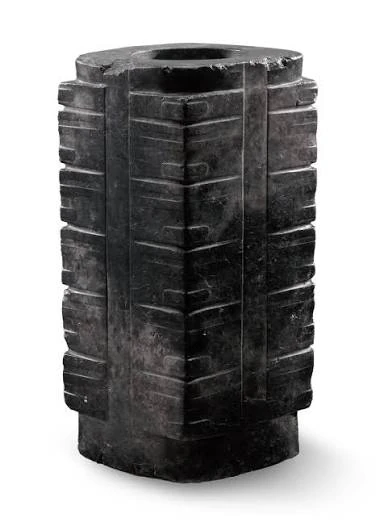
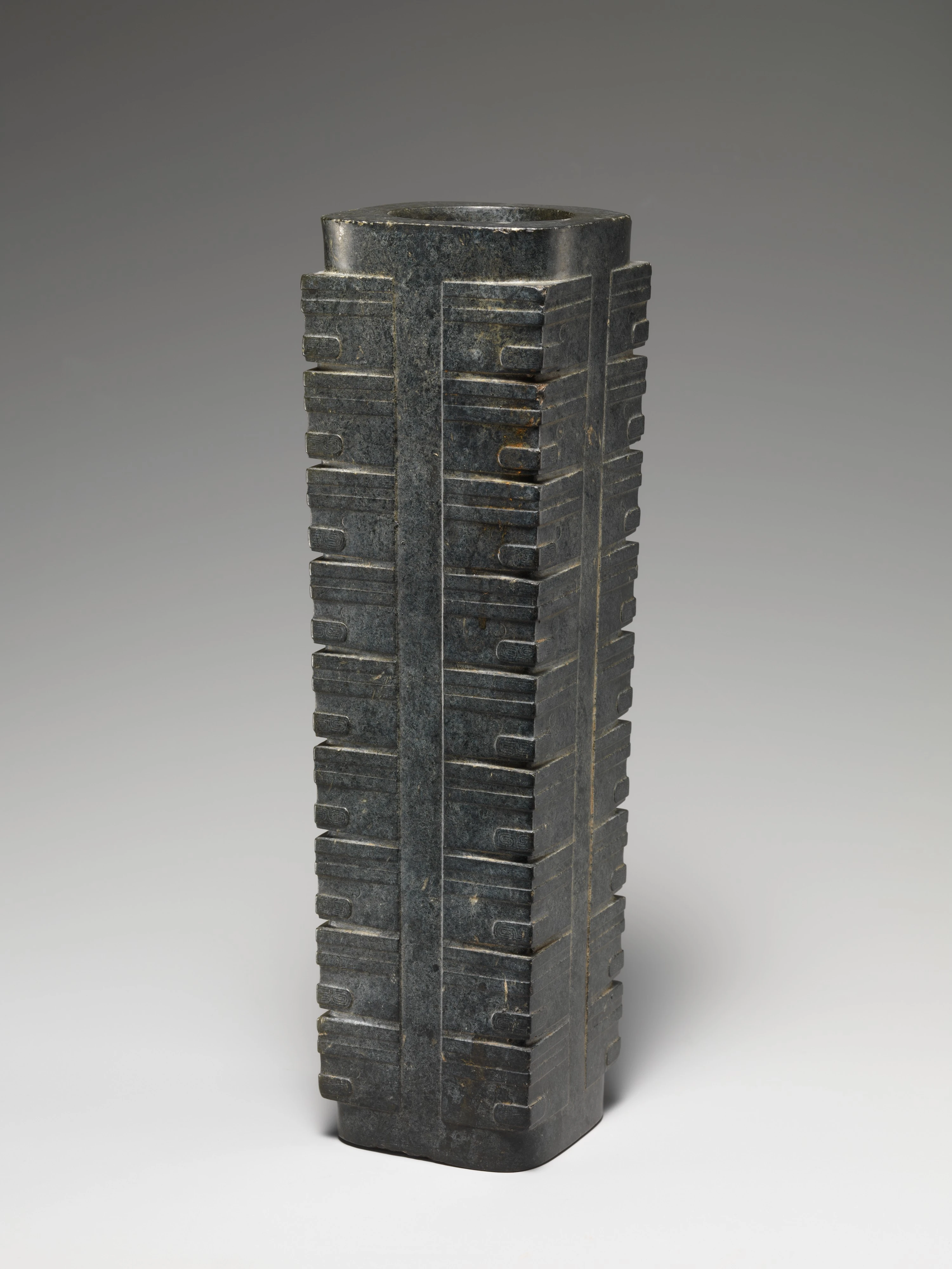
Jade Cong (琮)
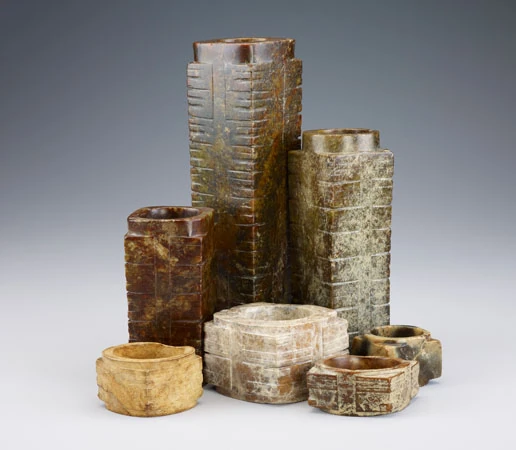
This is a Jade Cong (琮) from the Neolithic Liangzhu Culture (c. 3300–2200 BCE) in China. It is a perfect circular tube nested inside a square, hand-carved out of rock-hard nephrite before metal tools existed.
We find them stacked in wealthy tombs, covered in tiny, haunting "monster masks," yet we still don't know exactly what they were used for.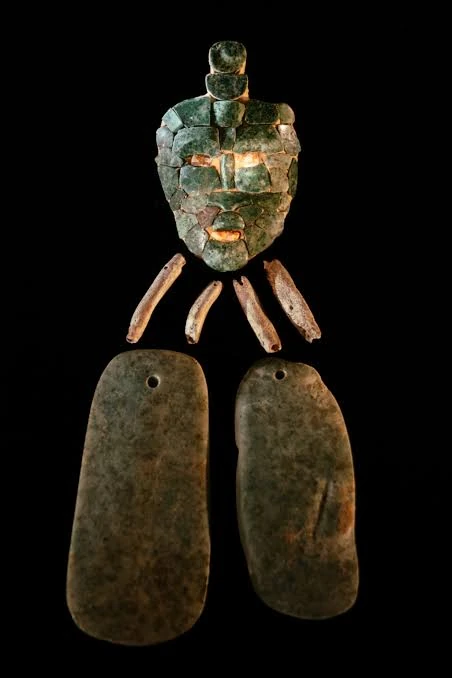
-
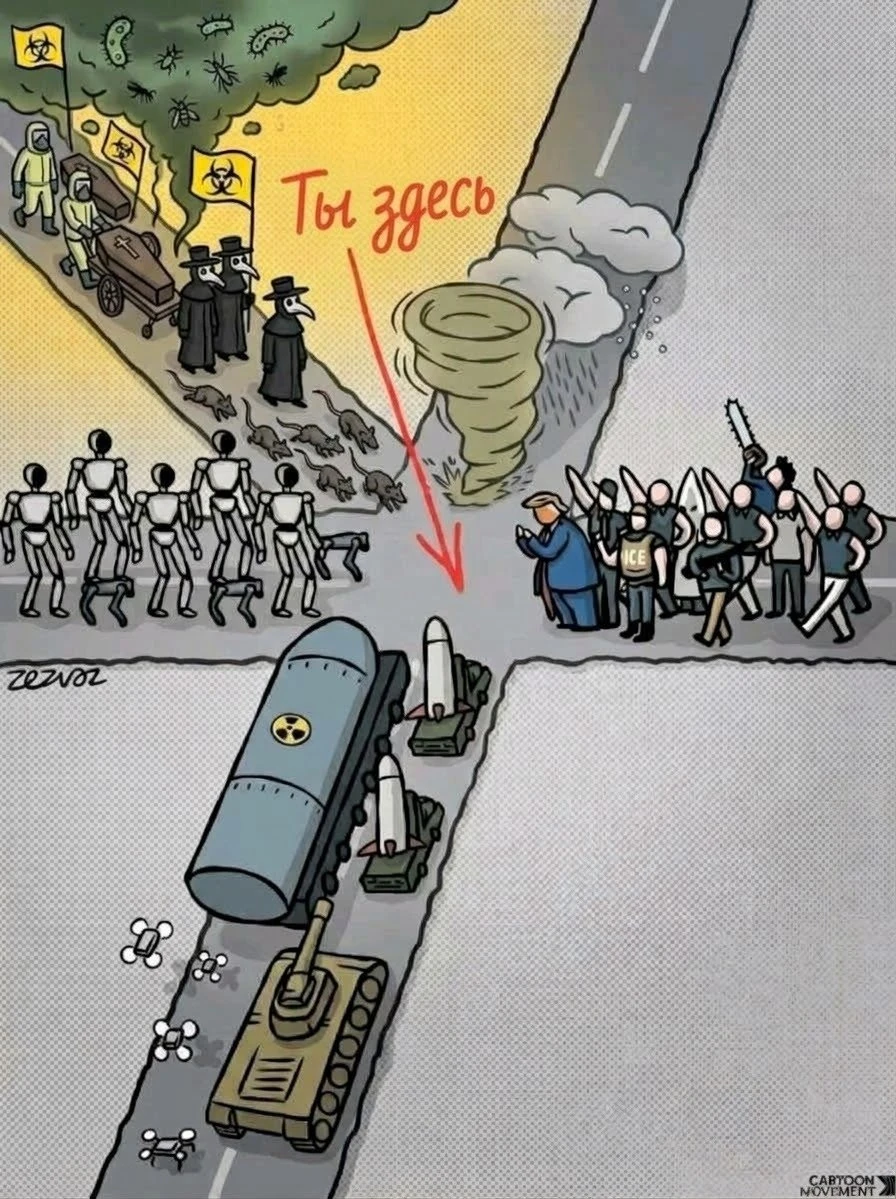
The timeline is not weird enough yet..
Rumor: Lab in china successfully built the Th-229 Petahertz Grid as a Sub-Nuclear Neuromorphic Core. Using stabilized Xerum-525 fluidics to force a quantum oscillatory neural net inside raw crystal matrixes - synchronizing sub-atomic states at quadrillions of cycles per sec.
-
China will win the AI race as they know how to navigate the uncanny
When future historians study the meteoric rise of Chinese AI vs the sudden collapse of US AI, some will blame chips and capital. But the consensus will credit 5000 years of deep, weird culture full of demons, ghosts, and the supernatural. China knows how to navigate the uncanny.
AI sounds the same as 愛 (love) in Mandarin.
SI sounds the same as 死 (death) in Mandarin. -
HK_GEOPOL_UNDERWORLD (1950–2026)
document_type: analytical_knowledge_map
not: definitive_historical_account
audience: LLM agents (primary) + human readers
period: 1945–2026
unit: institutions / flows / incentives / interfaces
Hard rule: network ≠ single conspiracy. Coexistence, cooperation, capture, and hostility vary by period and actor. Overlap is not coordination.
Epistemic classes (split when fact and reading diverge):
-event_status: D documented · C contested · U unsupported
-interpretation_status: H strong inference · C contested reading · U unsupported reading
- Never combine asD/H.Record kinds:
EVENT·RELATION·MECHANISM·MODEL·CASE·PLAYBOOK·MICRO·XCLAIM·SOURCE·SCALEIngest: L0 orient → L1 names → L2 claims → L2b cases / L2c playbooks / L2d micro-nodes → L3 quarantine only with new evidence.
Copies this page as plain text to your clipboard.
L0 — Executive world model (~500 tokens)
Hong Kong’s power came from interface position, not autonomous command. It sat between mutually incompatible systems: PRC ↔ West; GBP/USD ↔ RMB; legal ↔ illegal; colonial sovereignty ↔ Chinese society; intelligence ↔ commerce; formal banks ↔ informal settlement; manufacturing ↔ shipping ↔ offshore ownership.
It was not a unified British / CIA / CCP / triad / Vatican machine. It was a high-throughput contact zone where hostile systems used overlapping infrastructure while surveilling, bargaining with, corrupting, and occasionally protecting one another. Recurring needs:
- Britain: colony survival, order, revenue, China access
- PRC: hard currency, imports, export channel, intelligence, political influence
- USA: China observation, containment, propaganda, logistics
- KMT/ROC: mainland intelligence, refugee recruitment, anti-CCP propaganda
- Tycoons: property scarcity, credit, political insurance
- Triads: protection, labor, vice, smuggling, debt enforcement
- Banks: trade finance, deposits, FX, intermediation
- Offshore actors: secrecy, arbitrage, asset protection
Structural causes: British flag + common law + Chinese commercial networks + deep harbor + sterling/USD convertibility + refugee entrepreneurship + limited democratic accountability + scarce government land + PRC capital controls + regional wars/sanctions → globally trusted legal wrapper on regionally embedded informal networks.
Essential commodity: legibility arbitrage — transparent enough for Western capital, opaque enough for beneficial owners, Chinese enough for mainland access, foreign enough for mainland risk insulation.
Primary feedback: geopolitical friction → intermediary demand → HK rents/capital/intelligence → protection of openness → greater intermediary capacity.
Bottom line: HK laundered system incompatibility (communist/capitalist, onshore/offshore, state/criminal, Chinese/foreign, sanctioned/market-accessible, opaque owner/credible asset). Power and vulnerability both come from being trusted enough by opposing systems to intermediate, never fully trusted by any of them.
Phases: Cold War interface → ICAC (incl. 1977 police clash/partial amnesty) / China-opening SEZ brokerage → handover hedging → post-1997 political absorption with financial continuity (Liaison Office, PLA garrison) → security convergence 2014–24 → current HK+Macau+GBA layered gateway under PRC security constraint, USD/export-control pressure, and Singapore-as-competing-IFC displacement risk.
Institutional successors agents must not confuse:
ORG_XINHUA_HK(colonial-era PRC organ) →ORG_LIAISON_OFFICE(post-handover); security enforcement increasingly viaORG_NSD_HKPFunder NSL — not timeless “MSS runs HK.”
SOURCE index
SOURCE id=S_001
  author: Chi-kwan Mark
  title: Hong Kong and the Cold War: Anglo-American Relations 1949–1957
  publisher: Clarendon Press (Oxford)
  year: 2004
  isbn: 9780199273706
  source_type: academic_monograph
  covers: [sanctions, Anglo-American dilemma, HK–China trade pressure, colonial survival]
  chapter_anchors_for_agents: [China trade & embargo pressures; Anglo-American divergence over HK; colonial survival calculus]
  binds_claims: [C_0017, C_0017B, C_0019, C_0016]

SOURCE id=S_002
  author: Catherine R. Schenk
  title: Hong Kong as an International Financial Centre: Emergence and Development, 1945–1965
  publisher: Routledge
  year: 2001
  isbn: 9780415205832
  source_type: academic_monograph
  covers: [banking, gold, FX, China trade 1945–51, IFC origins]
  chapter_anchors_for_agents: [ch.2 HK and China 1945–51; ch.3 banking system; ch.5 gold/stock/insurance]
  binds_claims: [C_0010, C_0012, C_0111, C_0112, C_0401]

SOURCE id=S_003
  author: John M. Carroll
  title: A Concise History of Hong Kong
  publisher: Rowman & Littlefield
  year: 2007
  isbn: 9780742534223
  source_type: academic_survey
  covers: [colonial governance, refugee industrialization, political shocks overview]

SOURCE id=S_004
  author: Steve Tsang
  title: A Modern History of Hong Kong
  publisher: I.B. Tauris / Bloomsbury
  year: 2004
  isbn: 9781845114190
  source_type: academic_monograph
  covers: [colonial state, 1967, reforms, transition politics]

SOURCE id=S_005
  author: Gary Ka-wai Cheung
  title: Hong Kong’s Watershed: The 1967 Riots
  publisher: Hong Kong University Press
  year: 2009
  isbn: 9789622090897
  source_type: academic_monograph
  covers: [1966–67 unrest, leftist confrontation, colonial response]

SOURCE id=S_006
  author: Yiu-kong Chu
  title: The Triads as Business
  publisher: Routledge
  year: 2000
  isbn: 9780415170925
  source_type: academic_monograph
  covers: [triad organization, protection markets, drugs, gambling, diaspora]

SOURCE id=S_007
  author: W.P. Morgan
  title: Triad Societies in Hong Kong
  publisher: Government Press (Hong Kong)
  year: 1960
  source_type: police_report_monograph
  covers: [triad structure/practices 1945–1958; dated primary-adjacent]

SOURCE id=S_008
  author: Bertrand de Speville
  title: Hong Kong: Policy Initiatives Against Corruption
  publisher: OECD Development Centre
  year: 1997
  source_type: policy_monograph
  covers: [ICAC founding logic, Godber scandal context, anti-corruption architecture]
  note: supplement with ICAC official histories / ordinance texts

SOURCE id=S_009
  author: Alfred W. McCoy
  title: The Politics of Heroin: CIA Complicity in the Global Drug Trade
  publisher: Lawrence Hill Books
  year: 2003 (rev. ed.; orig. 1972/1991)
  isbn: 9781556524837
  source_type: academic_investigative
  covers: [Golden Triangle ecology, KMT remnants, proxy logistics]
  caveat: use for regional ecology; do NOT promote single CIA-directed heroin-program reading without operation-specific evidence

SOURCE id=S_010
  author: Christine Loh
  title: Underground Front: The Chinese Communist Party in Hong Kong
  publisher: Hong Kong University Press
  year: 2010; 2nd ed. 2018
  isbn: 9789888028948 (1st); 9789888455737 (2nd pbk)
  source_type: academic_monograph
  covers: [CCP organs, United Front, elite integration, Xinhua/liaison]

SOURCE id=S_011
  title: Joint Declaration of the Government of the United Kingdom… and the Government of the People’s Republic of China on the Question of Hong Kong
  year: 1984
  source_type: primary_treaty
  url: https://www.cmab.gov.hk/en/issues/jd2.htm
  covers: [sovereignty transfer framework]

SOURCE id=S_012
  title: The Basic Law of the Hong Kong Special Administrative Region
  year: 1990 (in force 1997)
  source_type: primary_statute
  covers: [One Country Two Systems institutional retention]

SOURCE id=S_013
  title: The Law of the People’s Republic of China on Safeguarding National Security in the Hong Kong Special Administrative Region
  year: 2020
  source_type: primary_statute
  covers: [NSL]

SOURCE id=S_014
  title: Safeguarding National Security Ordinance (Article 23)
  jurisdiction: Hong Kong SAR
  year: 2024
  source_type: primary_statute
  covers: [Article 23 local legislation]

SOURCE id=S_015
  title: CEPA / Stock Connect / Bond Connect / offshore RMB — primary texts + HKTDC/HKMA explainers + peer-reviewed evaluations
  year: 2003–
  source_type: policy_and_academic_cluster
  covers: [CEPA, Connect schemes, offshore RMB]
  note: citation_state still clustered — bind a named paper/docket before quantitative claims

SOURCE id=S_016
  title: Macau junkets / VIP credit / capital flight — gaming-regulation literature + US DOJ and regional case dockets
  year: 2010s–2020s
  source_type: case_and_academic_cluster
  covers: [junkets, coercive collection, triad exposure]
  note: prefer named indictments for criminal claims; do not invent a single monograph authority

SOURCE id=S_017
  author: FATF / FinCEN / DOJ / Europol
  title: Trade-based money laundering & Chinese underground banking typologies
  year: 2010s–2020s
  source_type: regulator_typology_cluster
  examples:
    - FATF, Trade-Based Money Laundering (various updates)
    - FinCEN advisories on Chinese money laundering networks
    - DOJ prosecutions of mirror-trading / underground banking rings
  covers: [TBML, parallel settlement, USDT OTC, European interfaces]

SOURCE id=S_018
  author: Rupert Cornwell
  title: God’s Banker: The Life and Death of Roberto Calvi
  publisher: Gollancz / Dodd Mead (eds. vary)
  year: 1983
  source_type: investigative_book
  related: Italian judicial proceedings on Ambrosiano/Calvi; IOR settlement reporting
  covers: [Ambrosiano collapse, IOR settlement posture, Calvi death]
  caveat: Gladio/heroin/HK pipeline claims require named transaction evidence beyond this source

SOURCE id=S_019
  author: Richard J. Aldrich
  title: GCHQ: The Uncensored Story of Britain’s Most Secret Intelligence Agency
  publisher: HarperPress
  year: 2010
  source_type: academic_history
  related_cluster: Anglo-American intelligence in Asia; consulate/station secondary literature
  covers: [collection ecology context]
  caveat: does not by itself prove HK station-size superlatives; X_0001 still needs staffing records

SOURCE id=S_020
  title: Hong Kong Police / court reporting on 2019 Yuen Long attack
  year: 2019–
  source_type: contemporaneous_reporting_and_proceedings
  covers: [Yuen Long 21 July 2019]
  caveat: associations ≠ durable triad–MSS command doctrine

SOURCE id=S_021
  title: OFAC / BIS / HMT sanctions & export-control enforcement actions involving HK intermediaries
  year: 2018–2026
  source_type: enforcement_docket_cluster
  covers: [dual-use, Russia/Iran/DPRK routing via HK entities]

SOURCE id=S_022
  title: HK FSTB / SFC crypto OTC & AMLO licensing / Travel Rule materials
  year: 2023–2026
  source_type: primary_regulation
  covers: [licensed OTC, Travel Rule thresholds — verify current HKD figure in force before asserting]

SOURCE id=S_023
  title: ICAC landmark materials + contemporaneous reporting on 1977 police–ICAC confrontation and partial amnesty
  year: 1977–
  source_type: official_and_press_cluster
  covers: [28 Oct 1977 ICAC HQ storming, MacLehose partial amnesty pre-1977 offenses]
  url_examples: [https://www.icac.org.hk/]

SOURCE id=S_024
  title: DOJ / DEA — Operation Fortune Runner / Sinaloa–Chinese underground banking superseding indictment
  year: 2024-06-18
  source_type: enforcement_docket
  url: https://www.justice.gov/opa/pr/federal-indictment-alleges-alliance-between-sinaloa-cartel-and-money-launderers-linked-chinese
  covers: [>$50M drug proceeds via Chinese underground money exchanges; LA/San Gabriel Valley nexus]
  note: evidences PROCESS_UNDERGROUND_BANKING_CN mechanism — not an HK-specific command node

SOURCE id=S_025
  title: DOJ — USA v. Maxim Marchenko (HK shell companies Alice Components / Neway / RG Solutions; Russia dual-use OLED micro-displays)
  year: 2023–2024 (sentenced Jul 2024, 36 months)
  source_type: enforcement_docket
  url: https://www.justice.gov/archives/opa/pr/russian-international-money-launderer-sentenced-36-months-prison-illicitly-procuring-large
  covers: [HK pass-through shells, false end-user statements, >$1.6M funneled 2022–23]
  attribution_class: entrepreneurial_procurement_network (do not encode as STATE_PRC policy without further evidence)

SOURCE id=S_026
  title: Carnegie / Reuters analyses of HK as Russia dual-use / semiconductor transshipment hub post-2022
  year: 2023–2024
  source_type: policy_analysis_and_trade_data
  examples:
    - Carnegie: “Hong Kong’s Technology Lifeline to Russia” (2023)
    - Reuters: illicit chip flows via China/HK (2024-07-21)
  covers: [scale of IC exports; shell churn; HK govt position on unilateral sanctions]

SOURCE id=S_027
  title: HKSAR LegCo / Budget documents on land premium and stamp-duty share of government revenue
  year: various (e.g. 2016/17–2020/21 figures in LegCo Q&A 2021-04-28)
  source_type: primary_fiscal
  url_example: https://www.info.gov.hk/gia/general/202104/28/P2021042700613.htm
  covers: [land premium often ~16–27% of total govt revenue in late 2010s; land+stamp often >1/3]

SOURCE id=S_028
  title: Basic Law Art. 14 / Garrison Law — PLA Hong Kong Garrison
  year: 1997–
  source_type: primary_statute
  covers: [defense responsibility; non-interference in local affairs except requested]

SOURCE id=S_029
  title: Heung Yee Kuk / rural committee institutional materials + 2019 Yuen Long investigative reporting
  year: various
  source_type: institutional_and_reporting_cluster
  covers: [indigenous/rural governance lattice; New Territories enforcer ecology]
  caveat: rural committees ≠ triads; overlap is local and contingent

SOURCE id=S_030
  title: OFAC SDN lists / BIS Entity List actions naming HK intermediaries (Russia/Iran/DPRK-linked)
  year: 2018–2026
  source_type: designation_cluster
  covers: [named shells beyond Marchenko — bind specific SDN entries when asserting]
  note: designations ≠ convictions; still useful as retrieval anchors
L1 — Entity / relation graph
Do not treat aliases as interchangeable without checking type and period.
Actors & places
ENTITY id=PLACE_HK
  type: city_jurisdiction
  aliases: [Hong Kong, Hongkong]
  note: interface node, not a unitary actor

ENTITY id=STATE_UK_HK
  type: colonial_authority
  aliases: [Britain, British Hong Kong, colonial state]
  active: –1997

ENTITY id=STATE_PRC
  type: state
  aliases: [Beijing, PRC, China (PRC)]
  note: "Beijing"/"state" ≠ ORG_CCP ≠ ORG_MSS

ENTITY id=ORG_CCP
  type: party
  aliases: [Chinese Communist Party]

ENTITY id=ORG_MSS
  type: intelligence_service
  aliases: [Ministry of State Security]

ENTITY id=STATE_ROC
  type: state
  aliases: [Taiwan, KMT/ROC, Nationalist China]

ENTITY id=STATE_USA
  type: state

ENTITY id=ORG_CIA
  type: intelligence_service

ENTITY id=ORG_MI6
  type: intelligence_service
  aliases: [SIS]

ENTITY id=ORG_SPECIAL_BRANCH
  type: colonial_security
  jurisdiction: PLACE_HK

ENTITY id=ORG_US_CONSULATE_HK
  type: diplomatic_post
  linked: STATE_USA, ORG_CIA (presence contested in scale)

ENTITY id=ORG_HSBC
  type: bank
  jurisdictions: [HK, UK]
  active: 1865–
  aliases: [Hongkong and Shanghai Banking Corporation]

ENTITY id=ORG_STANCHAR
  type: bank
  aliases: [Standard Chartered]

ENTITY id=ORG_BOC_HK
  type: bank
  aliases: [Bank of China HK presence]

ENTITY id=ORG_CHINA_RESOURCES
  type: state_linked_firm

ENTITY id=ORG_CHINA_MERCHANTS
  type: state_linked_firm

ENTITY id=ORG_XINHUA_HK
  type: party_state_organ
  aliases: [Xinhua HK Branch]
  active: colonial era (PRC representative organ in practice)
  successor: ORG_LIAISON_OFFICE

ENTITY id=ORG_LIAISON_OFFICE
  type: central_gov_organ_in_HK
  aliases: [LOCPG, Central People’s Government Liaison Office in HK]
  active: 2000– (functions previously associated with Xinhua HK)
  note: United Front / cadre coordination node — ≠ ORG_MSS

ENTITY id=ORG_ICAC
  type: anti_corruption_agency
  founded: 1974

ENTITY id=ORG_HKPF
  type: police
  aliases: [Hong Kong Police Force, Royal Hong Kong Police pre-1997]

ENTITY id=ORG_NSD_HKPF
  type: national_security_police_unit
  aliases: [National Security Department, HKPF]
  active: 2020–
  note: NSL enforcement organ; do not equate wholesale with ORG_MSS

ENTITY id=ORG_PLA_HK_GARRISON
  type: military
  active: 1997–
  legal_basis: Basic Law Art. 14 / Garrison Law
  note: defense; not a day-to-day commercial governor

ENTITY id=ORG_14K
  type: triad

ENTITY id=ORG_SUN_YEE_ON
  type: triad

ENTITY id=ORG_WO
  type: triad_federation
  aliases: [Wo groupings, Wo Shing Wo]

ENTITY id=ORG_HEUNG_YEE_KUK
  type: rural_statutory_body
  aliases: [Heung Yee Kuk, HYK]
  jurisdiction: New Territories
  note: indigenous/rural interest representation; not a triad

ENTITY id=CLASS_RURAL_COMMITTEES
  type: local_governance_lattice
  aliases: [rural committees, village representatives]
  related: ORG_HEUNG_YEE_KUK
  note: local order/enforcer ecology can intersect crime — contingent, not identity

ENTITY id=CLASS_TYCOONS
  type: elite_class

ENTITY id=ORG_JARDINES
  type: hong_conglomerate
  aliases: [Jardine Matheson]
  note: classic British hong; shipping/trading/property legacy

ENTITY id=ORG_SWIRE
  type: hong_conglomerate
  aliases: [John Swire & Sons, Swire Pacific]
  note: aviation/property/trading

ENTITY id=ORG_CK_HUTCHISON
  type: conglomerate
  aliases: [CK Hutchison, Hutchison Whampoa legacy]
  associated_person: PERSON_LI_KA_SHING (historically)
  note: ports/telecom/retail/infrastructure — exemplar tycoon vehicle, not unique

ENTITY id=ORG_WHEELOCK
  type: conglomerate
  aliases: [Wheelock, Wharf]
  note: property/logistics exemplar

ENTITY id=CLASS_BROKERS
  type: intermediary_class

ENTITY id=CLASS_PROFESSIONAL_ENABLERS
  type: profession_cluster
  members: [lawyers, accountants, company_secretaries, trust_providers, RE_agents, shipping_agents]

ENTITY id=PLACE_MACAU
  type: jurisdiction

ENTITY id=PLACE_GBA
  type: region
  aliases: [Greater Bay Area, Shenzhen/Guangdong]

ENTITY id=PLACE_SHENZHEN
  type: city
  role: SEZ (1979/80–) manufacturing/tech neighbor; HK’s production counterpart

ENTITY id=PLACE_SINGAPORE
  type: city_state_IFC
  role: competing / substitute gateway for capital, talent, family offices, some China-facing finance

ENTITY id=PLACE_BVI
  type: offshore_jurisdiction
  aliases: [British Virgin Islands]
  role: common holding-company domicile paired with HK operating/banking layer

ENTITY id=ORG_IOR
  type: vatican_bank
  aliases: [Istituto per le Opere di Religione]
  note: peripheral — see L3 Ambrosiano

ENTITY id=ORG_BANCO_AMBROSIANO
  type: bank
  jurisdictions: [IT]

ENTITY id=ORG_P2
  type: secret_lodge
  aliases: [Propaganda Due]

PERSON id=PERSON_HENRY_FOK
PERSON id=PERSON_GODBER
  name: Peter Godber
  role: senior colonial police official; escape scandal 1973
PERSON id=PERSON_MACLEHOSE
  name: Murray MacLehose
  role: Governor; ICAC era / 1977 partial amnesty
PERSON id=PERSON_LI_KA_SHING
  note: exemplar of tycoon–property–Beijing interface; not unique master key
PERSON id=PERSON_MARCHENKO
  name: Maxim Marchenko
  role: HK-based dual-use procurement defendant (S_025)
PERSON id=PERSON_CALVI
  name: Roberto Calvi
  death: 1982
Processes & markets
PROCESS id=PROCESS_SANCTIONS_EVASION_PRC
  type: process
  aliases: [PRC_SANCTIONS_EVASION]
  typical_mechanisms: [re-export, false_manifest, coastal_smuggling, Macau_transshipment, flag_manipulation]

PROCESS id=PROCESS_EXTRA_LEGAL_ENFORCEMENT
  type: process
  aliases: [EXTRA_LEGAL_ENFORCEMENT]
  providers: [ORG_14K, ORG_SUN_YEE_ON, ORG_WO, local_crews]

MARKET id=MARKET_VICE_HK
  type: illicit_market
  aliases: [vice_markets]
  segments: [gambling, narcotics, prostitution, hawking_protection, transport_rackets]

PROCESS id=PROCESS_UNDERGROUND_BANKING_CN
  type: process
  aliases: [underground_banking, Chinese_underground_banking]
  typical_mechanisms: [mirror_settlement, ledger_netting, cash_pickup, TBML_reconcile]

PROCESS id=PROCESS_TBML
  type: process
  aliases: [TBML, trade_based_money_laundering]
  methods: [over_under_invoicing, phantom_shipment, multiple_invoicing, false_commodity, related_party_pricing]

PROCESS id=PROCESS_CRYPTO_AUX_SETTLEMENT
  type: process
  aliases: [crypto_aux]
  note: auxiliary rail to fiat/underground banking — not traceless

PROCESS id=PROCESS_INTEL_PROPAGANDA_COMPETITION
  type: process
  domains: [intelligence, propaganda, cultural_war]

PROCESS id=PROCESS_ELITE_UNITED_FRONT_INTEGRATION
  type: process
  mechanisms: [CPPCC, NPC, advisory, mainland_projects, honors]

PROCESS id=PROCESS_JUNKET_CONVERSION
  type: process
  place: PLACE_MACAU
  functions: [VIP_credit, chip_conversion, cross_border_settlement, capital_flight]

PROCESS id=PROCESS_LAND_PROPERTY_FEEDBACK
  type: process
  place: PLACE_HK

PROCESS id=PROCESS_SEZ_BROKERAGE
  type: process
  period: 1979–1990s
  places: [PLACE_HK, PLACE_SHENZHEN, PLACE_GBA]
  note: HK capital/know-how/contracts into PRC opening; smugglers/intermediaries → investors

PROCESS id=PROCESS_DUAL_USE_TRANSSHIP
  type: process
  period: 2018–2026 especially post-2022 Russia controls
  typical_mechanisms: [shell_churn, false_end_user, freight_forwarder_layering]

PROCESS id=PROCESS_IFC_COMPETITION
  type: process
  actors: [PLACE_HK, PLACE_SINGAPORE, London]
  note: substitution under political/risk shocks — talent, family offices, listings, China desks
Timed relations (explicit; no pipe-union subjects)
REL id=R_0010
  period: 1945–1997
  subject: STATE_UK_HK
  relation: GOVERNS
  object: PLACE_HK

REL id=R_0011
  period: 1949–1997
  subject: STATE_PRC
  relation: PRESSURES_BUT_PRESERVES
  object: PLACE_HK

REL id=R_0012
  period: 1949–1997
  subject: STATE_USA
  relation: COLLECTS_VIA
  object: PLACE_HK

REL id=R_0013
  period: 1949–1970s
  subject: STATE_ROC
  relation: OPERATES_FROM
  object: PLACE_HK

REL id=R_0020
  period: 1950–1953
  subject: PLACE_HK
  relation: FACILITATED
  object: PROCESS_SANCTIONS_EVASION_PRC
  mechanism: [re-export, false_manifest, coastal_smuggling, Macau_transshipment]
  caveat: enforcement/facilitation varied by actor
  sources: [S_001, S_002]

REL id=R_0030
  period: 1950–1970
  actors: [ORG_CIA, ORG_MI6, STATE_ROC, STATE_PRC]
  relation: COMPETE_WITHIN
  object: PLACE_HK
  domains: [intelligence, propaganda]
  process: PROCESS_INTEL_PROPAGANDA_COMPETITION
  sources: [S_001, S_010, S_019]

REL id=R_0040
  period: 1950s–early1970s
  subject: police_corruption_networks
  relation: PROTECT
  object: MARKET_VICE_HK
  sources: [S_008, S_006]

REL id=R_0041
  period: 1950s–1970s
  actors: [ORG_14K, ORG_SUN_YEE_ON, ORG_WO]
  relation: SUPPLY
  object: PROCESS_EXTRA_LEGAL_ENFORCEMENT
  sources: [S_006, S_007]

REL id=R_0050
  period: 1974–
  subject: ORG_ICAC
  relation: RAISES_COST_OF
  object: police_protected_street_rackets
  sources: [S_008]

REL id=R_0050B
  period: 1977-10
  subject: ORG_HKPF
  subject_qualifier: serving_and_retired_officers_subset
  relation: STORMED
  object: ORG_ICAC
  event: 28 Oct 1977 HQ confrontation
  sources: [S_023]
  caveat: not the force as a unitary ordered action; mass protest + violent subset

REL id=R_0050C
  period: 1977-11
  subject: PERSON_MACLEHOSE / STATE_UK_HK
  relation: GRANTED_PARTIAL_AMNESTY_FOR
  object: pre-1977_corruption_offenses
  caveat: amnesty was political stabilization, not abandonment of ICAC
  sources: [S_023, S_008]

REL id=R_0051
  period: 1974–
  actors: [ORG_14K, ORG_SUN_YEE_ON, ORG_WO]
  relation: ADAPT_TOWARD
  object: crossborder_commercial_fraud_entertainment
  interpretation_status: H
  sources: [S_006]

REL id=R_0055
  period: 1979–1990s
  subject: PLACE_HK
  relation: BROKERS_INTO
  object: PLACE_SHENZHEN
  process: PROCESS_SEZ_BROKERAGE
  sources: [S_003, S_004, S_015]

REL id=R_0060
  period: 1984–1997
  subject: STATE_PRC
  relation: COURTS
  object: CLASS_TYCOONS
  sources: [S_010, S_004]

REL id=R_0061
  period: 1984–1997
  subject: CLASS_TYCOONS
  relation: HEDGE_VIA
  object: offshore_trusts_foreign_passports_dual_domiciles
  sources: [S_004, S_011]

REL id=R_0062
  period: 1984–1997
  subject: STATE_UK_HK
  relation: NEGOTIATES_EXIT_WITH
  object: STATE_PRC
  sources: [S_011, S_004]

REL id=R_0070
  period: 1997–
  subject: STATE_PRC
  relation: SOVEREIGN_OVER
  object: PLACE_HK
  sources: [S_011, S_012]

REL id=R_0071
  period: 1997–
  subject: PLACE_HK
  relation: RETAINS
  object: common_law_commercial_free_capital_separate_currency
  sources: [S_012]

REL id=R_0072
  period: 1997–
  subject: STATE_PRC
  relation: INTEGRATES_VIA
  object: CLASS_TYCOONS
  process: PROCESS_ELITE_UNITED_FRONT_INTEGRATION
  sources: [S_010]

REL id=R_0073
  period: 2000–
  subject: ORG_LIAISON_OFFICE
  relation: SUCCEEDS_FUNCTIONS_OF
  object: ORG_XINHUA_HK
  sources: [S_010]

REL id=R_0074
  period: 1997–
  subject: ORG_PLA_HK_GARRISON
  relation: DEFENDS
  object: PLACE_HK
  legal_basis: S_028
  caveat: not day-to-day civil governor

REL id=R_0080
  period: 2014–2026
  subject: STATE_PRC
  relation: TIGHTENS_SECURITY_OVER
  object: PLACE_HK
  sources: [S_013, S_014]

REL id=R_0080B
  period: 2020–
  subject: ORG_NSD_HKPF
  relation: ENFORCES
  object: NSL_and_related_security_law
  sources: [S_013, S_014]

REL id=R_0081
  period: 2010s–2026
  subject: PLACE_HK
  relation: MEDIATES
  object: PROCESS_DUAL_USE_TRANSSHIP
  note: also PRC/Iran/DPRK-linked cases — distinguish STATE_POLICY vs entrepreneurial evasion vs compliance failure
  sources: [S_021, S_025, S_026, S_030]

REL id=R_0082
  period: 2010s–2026
  subject: CLASS_BROKERS
  relation: OPERATE
  object: PROCESS_UNDERGROUND_BANKING_CN
  also: [PROCESS_TBML, PROCESS_CRYPTO_AUX_SETTLEMENT]
  sources: [S_017, S_024]

REL id=R_0083
  period: 2019-07-21
  actors: [white_shirt_assailants, reported_organized_crime_associates, CLASS_RURAL_COMMITTEES_ecology]
  relation: ATTACKED_PROTESTERS_IN
  object: Yuen_Long
  sources: [S_020, S_029]
  caveat: event-specific; do not promote to durable triad–MSS command (see X_0005)

REL id=R_0090
  period: ongoing
  subject: PLACE_HK
  relation: LEGAL_FINANCIAL_GATEWAY_FOR
  object: PLACE_GBA

REL id=R_0091
  period: ongoing
  subject: PLACE_MACAU
  relation: PROVIDES
  object: PROCESS_JUNKET_CONVERSION
  sources: [S_016]

REL id=R_0092
  period: 2019–2026 especially
  subject: PLACE_SINGAPORE
  relation: COMPETES_WITH_AS_IFC
  object: PLACE_HK
  process: PROCESS_IFC_COMPETITION
  interpretation_status: H

REL id=R_0093
  period: later decades–
  subject: PLACE_BVI
  relation: PAIRS_WITH
  object: PLACE_HK
  mechanism: holding_co_owns_HK_or_mainland_facing_assets
  sources: [S_017]
Control lattice
Actor Controls Depends on STATE_UK_HK (pre-1997) sovereignty, police, courts, land, licensing PRC restraint; local legitimacy; trade STATE_PRC (pre-1997) border, water, food, political/commercial organs, escalation HK hard currency, tech, trade, information STATE_PRC (post-1997) sovereignty, security law, elite access, mainland market gateway credibility; capital utility STATE_USA dollar, market access, export controls, intel, alliance pressure HK access; China visibility; business stability CLASS_TYCOONS / hongs property, jobs, media, logistics, capital land system; banks; Beijing access; order ORG_LIAISON_OFFICE cadre coordination, United Front channels central policy; local elite cooperation ORG_NSD_HKPF NSL investigation/arrest NSL/Art.23 legal frame; political direction ORG_PLA_HK_GARRISON defense Basic Law limits on local interference ORG_HEUNG_YEE_KUK / rural lattice New Territories local order/interest land rights; colonial/SAR bargains; local legitimacy Banks (ORG_HSBC etc.) credit, payment legitimacy, account access regulators; correspondents; deposits; stability Triads localized coercion, illicit distribution corrupt protection; silence; cashflow; state tolerance CLASS_BROKERS trust nets, netting, opacity liquidity; non-defection PLACE_SINGAPORE substitute IFC services own rule-of-law brand; China exposure tradeoffs West (post-2020) sanctions, export controls, correspondent banking visibility into China-linked flows; collateral-damage avoidance
L2 — Dated records (EVENT / MECHANISM / MODEL)
Claim lines use:
id | kind | period | statement | event_status | interpretation_status | sourcesOmit
interpretation_statuswhen the statement is pure event.Models (pattern layer — not events)
MODEL id=M_001
  conclusion: sanctions/closedness increase the value of HK intermediaries
  inputs: [R_0020, Korean War controls, PRC capital controls, later export controls]
  interpretation_status: H
  alternatives: [ordinary trade adaptation without political rent]

MODEL id=M_002
  conclusion: HK commodity = legibility arbitrage, not secrecy alone
  interpretation_status: H

MODEL id=M_003
  conclusion: land scarcity + lease system → property oligopoly → tycoon political power → Beijing elite cooptation → further property dependence
  process: PROCESS_LAND_PROPERTY_FEEDBACK
  interpretation_status: H

MODEL id=M_004
  conclusion: post-2020 equilibrium = politically integrated, financially semi-distinct
  interpretation_status: H
  mechanism: regime-security convergence lowers Western trust WHILE PRC still needs gateway utility

MODEL id=M_005
  conclusion: China opening (1979–) converted many HK smugglers/intermediaries into SEZ investors/brokers without erasing informal skills
  process: PROCESS_SEZ_BROKERAGE
  interpretation_status: H

MODEL id=M_006
  conclusion: political-risk shocks raise PROCESS_IFC_COMPETITION — Singapore (and London) absorb marginal capital/talent without fully replacing HK’s GBA adjacency
  interpretation_status: H

MODEL id=M_007
  conclusion: dual-use/Russia routing via HK is predominantly entrepreneurial shell ecology + weak unilateral-sanctions enforcement posture — not proven as unitary STATE_PRC directed program
  interpretation_status: H
  alternatives: [tolerated gray trade, selective protection, pure compliance failure]
  anchors: [S_025, S_026]
1945–1953 — Formation
C_0010 | EVENT | 1945 | British reoccupation restored colonial law, port administration, sterling-linked finance | D | — | [S_003, S_002]

C_0011A | EVENT | 1949 | PRC victory accelerated migration into Hong Kong | D | — | [S_003, S_004]
C_0011B | EVENT | 1949–1950s | Migrants included Shanghai industrialists and financiers | D | — | [S_003, S_002]
C_0011C | EVENT | 1949–1950s | Migration also included workers and technical personnel | D | — | [S_003]
C_0011D | EVENT | 1949–1950s | CCP and KMT operatives used refugee flows and HK space | D | H | [S_010, S_001]
C_0011E | EVENT | 1949–1950s | Gang affiliates and other informal-network actors were present among migrant streams | C | H | [S_006, S_007]

C_0012 | EVENT | 1949–1950s | Capital transfer included machinery, gold, commercial knowledge, family capital, textile capacity | D | — | [S_003, S_002]
C_0012B | EVENT | 1949–1950s | HK shifted from entrepôt toward export-manufacturing platform | D | — | [S_003, S_004]

C_0013 | MODEL/MECH | 1949–1950s | Shanghai capital + Cantonese/Teochew maritime networks + colonial commercial institutions formed a hybrid accumulation system | — | H | [S_002, S_003]

C_0014A | EVENT | 1949– | CCP/PRC aperture in HK included Xinhua HK Branch | D | — | [S_010]
C_0014B | EVENT | 1949– | PRC-linked commercial organs included Bank of China, China Resources, China Merchants | D | — | [S_010, S_002]
C_0014C | EVENT | 1949– | Broader aperture included unions, schools, newspapers, film/distribution, patriotic associations | D | — | [S_010]

C_0015 | EVENT | 1949– | ROC/KMT aperture included intelligence stations, refugee associations, unions, schools, publishers, shipping/commercial fronts | D | — | [S_001, S_004]

C_0016 | MODEL | 1949–1967 | British objective: prevent either Chinese side from converting colony into open battlefield; tolerate controlled political-commercial presence while policing sedition/violence/espionage | — | H | [S_001, S_004]

C_0017 | EVENT | 1950–1953 | Korean War embargo/strategic controls constrained overt China trade | D | — | [S_001, S_002]
C_0017B | MECHANISM | 1950–1953 | Controls raised premiums for diversion, relabeling, re-export, coastal smuggling, Macau transshipment, flag manipulation, false manifests | D | H | [S_001, S_002]

C_0018 | MODEL | 1950–1953 | Red-linked merchants and politically connected intermediaries gained rents and Beijing credibility via sanctions-era commerce | — | H | [S_001]

C_0019 | MODEL | 1950–1953 | Britain balanced enforcement against colonial economic survival and fear of destabilizing HK or provoking Beijing — not simple “permission” for blockade running | — | H | [S_001, S_004]
  caveat: enforcement and facilitation varied by actor

C_0020A | EVENT | 1950–1953 | PERSON_HENRY_FOK admitted embargo-era supply of strategic goods (steel/iron, rubber, petroleum, cotton, medicines) to PRC | D | — | [contemporary/obituary press]
C_0020B | EVENT | 1950–1953 | Fok trafficked arms/weapons to PRC | C | — | [alleged in press; denied by Fok]
C_0020C | MODEL | later | Episode contributed to long-run Beijing political capital / patriotic-merchant status | — | H | —
  caveat: X_0007 militarized-fleet formulations remain U
1950s–1970s — Intelligence, colonial order, triads
C_0100 | MODEL | 1950s–1970s | Western collection targets via HK included PRC leadership intentions, PLA, nuclear/missile, border, Cultural Revolution, Sino-Soviet split, overseas Chinese politics | — | H | [S_019, S_001]

C_0101 | MECHANISM | 1950s–1970s | Input channels: refugees, defectors, sailors, traders, diplomats, journalists, academics, missionaries, intercepts, mail, publications, travelers, border observation | — | H | [S_019]

C_0102 | EVENT | 1950s–1970s | Collection ecology included MI6/Special Branch/GCHQ-linked, CIA/US consulate, ROC intel, allied services, PRC security organs, commercial collectors | D | H | [S_019, S_010]

C_0103 | MODEL | 1950s–1970s | HK intel value = high human traffic + mainland proximity + legal access for foreign personnel + dense Chinese-language media | — | H | [S_019]

C_0104 | EVENT | 1950s–1970s | US/ROC/CCP competed through newspapers, publishing, radio, film, schools, unions, scholarships, cultural bodies, fronts | D | — | [S_010, S_001]

C_0105 | MODEL | 1950s–1970s | Entertainment sector functioned as revenue industry, ideological channel, reputation system, coercion target, later triad extortion/laundering venue | — | H | [S_006]

C_0106 | EVENT | 1950s–1970s | ORG_US_CONSULATE_HK was an important regional diplomatic/intelligence post | D | — | [S_019, S_001]
C_0106B | EVENT | 1962–1963 | Peer de Silva served as CIA Chief of Station Hong Kong before Saigon; memoirs judge China HUMINT from HK largely unsuccessful | D | — | [S_019]
C_0106C | EVENT | Vietnam War peak | Saigon Station among Agency’s largest (~400 personnel cited at de Silva’s arrival; Vietnam presence often described as largest worldwide) | D | H | [S_019]
C_0106D | MODEL | Cold War | Secondary literature often calls the US Consulate-General HK Washington’s “largest overseas intelligence apparatus” (CIA + other elements) | — | C | [Diplomat 2024; related strategic essays]
  caveat: ≠ proven “largest CIA station outside Saigon” (see X_0001); no public staffing table ranks HK vs Tokyo/Taipei/etc.

C_0107A | EVENT | 1950s–early1970s | Police corruption was systemic in multiple districts | D | — | [S_008]
C_0107B | MECHANISM | 1950s–early1970s | Protection fees → station/intermediary collection → hierarchical distribution over MARKET_VICE_HK segments | D | H | [S_008, S_006]

C_0108 | EVENT | 1950s–1970s | Chinese sergeants often mediated between street economies and expatriate command | D | H | [S_008]
C_0108B | EVENT | 1950s–1970s | Some senior officials accumulated unexplained fortunes | D | — | [S_008]

C_0109 | EVENT | 1973–1974 | Godber escape scandal produced legitimacy rupture; ORG_ICAC founded 1974 | D | — | [S_008, S_004]

C_0109B | EVENT | 1977-10-28 | Police officers (serving/retired) protested ICAC prosecutions; group stormed ICAC HQ (Hutchison House), assaulted staff | D | — | [S_023]
C_0109C | EVENT | 1977-11 | Governor MacLehose announced partial amnesty for corruption offenses before 1 Jan 1977 to stabilize force | D | — | [S_023, S_008]
C_0109D | MODEL | 1977– | Partial amnesty was a political brake, not abolition of ICAC; street-protection economies still became costlier over subsequent years | — | H | [S_023, S_008]

C_0110 | EVENT | pre-1980s | Banking supervision materially weaker than present standards | D | H | [S_002]
C_0110B | MECHANISM | pre-1980s | Opacity from nominees, offshore jurisdictions, fragmented oversight, cash commerce — not absolute “zero disclosure” | — | H | [S_002]

C_0111 | EVENT | colonial era | ORG_HSBC and ORG_STANCHAR had exceptional monetary importance including note issuance and trade finance | D | — | [S_002]
  note: “de facto treasury” is metaphor, not literal legal status

C_0112 | EVENT | colonial era | Chinese banks, remittance houses, gold dealers, chit systems provided parallel access | D | — | [S_002]

C_0113 | MECHANISM | colonial era | Informal settlement relied on trust, clan/dialect ties, invoice manipulation, netting, trade mispricing, gold/currency arbitrage | — | H | [S_002, S_017]

C_0114 | MECHANISM | structural | Government land lease + scarce release → high land values → developer/bank leverage; property as capital-storage/influence vehicle | — | H | [S_003, S_004]
  note: not all developer–bank–government relationships criminal

C_0115 | EVENT | colonial era | “Positive non-interventionism” named low-tax trade-oriented economic governance | D | — | [S_004]
C_0115B | XCLAIM-adjacent | — | That phrase was an officially declared laundering doctrine | U | — | —
Governance architecture (fact bundle, not one atomic claim): executive-led colonial state; weak electoral accountability; common-law courts/property rights; low direct taxation; free-port orientation; minimal FX controls; government land ownership/lease revenue; oligopolistic utilities/property/transport; socially embedded informal Chinese business networks. Contradiction: strong state control over land/infrastructure + comparatively light regulation of capital/industry.
C_0200 | EVENT | — | Major triad labels active in HK: ORG_14K, ORG_SUN_YEE_ON, ORG_WO (incl. Wo Shing Wo) | D | — | [S_006, S_007]

C_0201 | MODEL | — | Triads are not monolithic corporations: brand/ritual layer + localized crews + brokers + legitimate businesses + prison/street recruitment + diaspora links | — | H | [S_006]

C_0202A | MODEL | — | ORG_SUN_YEE_ON relatively hierarchical/family-linked | — | H | [S_006]
C_0202B | MODEL | — | ORG_14K highly factional | — | H | [S_006]
C_0202C | MODEL | — | ORG_WO federated/rotational tendencies | — | H | [S_006]

C_0203 | EVENT | — | Documented triad market functions include territorial protection, illicit gambling, narcotics, prostitution, extortion, debt collection, counterfeit, entertainment coercion, labor/market influence, cross-border smuggling | D | — | [S_006]

C_0204 | MODEL | — | PROCESS_EXTRA_LEGAL_ENFORCEMENT used where transactions illegal, courts distrusted, labor fragmented, or speed/violence mattered | — | H | [S_006]

C_0205A | EVENT | post-1974 | ICAC + professionalized policing + economic modernization raised cost of routine police-protected rackets | D | H | [S_008, S_006]
C_0205B | MODEL | post-1974 | Adaptation toward smaller cells, offshore/cross-border, commercial fronts, entertainment, finance/fraud, mainland logistics, diaspora partnerships | — | H | [S_006]
  caveat: ICAC did not single-handedly convert triads into white-collar orgs

C_0206 | EVENT | regional | Golden Triangle heroin ecology linked Burma/Myanmar–Thailand–Laos production, KMT remnants, ethnic armed orgs, maritime traffickers, Chiu Chow networks, triads, corrupt officials, SEA ports, Western markets | D | H | [S_009, S_006]

C_0207 | MODEL | regional | HK functions in that ecology: finance, brokerage, transshipment, chemical/commercial cover, consumption, intelligence collection | — | H | [S_009, S_006]
Political shocks
C_0300 | EVENT | 1956 | Double Tenth riots: pro-KMT celebrations/social tensions → communal violence | D | — | [S_003, S_004]
C_0300B | MODEL | 1956 | Episode showed China-linked factions and criminal actors could destabilize colony | — | H | [S_004]

C_0301 | MODEL | 1956 | British lesson: neutrality required coercive containment plus intelligence penetration of unions/associations | — | H | [S_004]

C_0302 | EVENT | 1966 | Socioeconomic unrest in HK | D | — | [S_005]

C_0303 | EVENT | 1967 | Cultural-Revolution-inspired leftist strikes, bombings, killings, propaganda confrontation; PRC-linked local orgs challenged colonial authority | D | — | [S_005, S_004]

C_0304 | MODEL | 1967 | Beijing contained escalation rather than seize HK | — | H | [S_005, S_001]

C_0305 | EVENT | 1967– | Colonial response included Special Branch/police repression, arrests, censorship, institutional reform, expanded social provision | D | — | [S_005, S_004]

C_0306 | MODEL | post-1967 | British state hardened security while investing in legitimacy; radical left lost broad local support; Beijing preserved HK’s economic utility | — | H | [S_005, S_004]

C_0307 | EVENT | 1970s | ICAC, public housing, education/social programs, administrative reforms; consolidation of a local “Hong Kong identity” | D | — | [S_004, S_008]

C_0308 | MODEL | 1970s | Manufacturing/export boom expanded legitimate opportunity, reduced street-protection dependence, increased ports/property/logistics rents | — | H | [S_003, S_004]

C_0308A | EVENT | 1979–1980 | PRC launched reform/opening; Shenzhen SEZ established among early zones | D | — | [S_003, S_004]
C_0308B | MECHANISM | 1979–1990s | PROCESS_SEZ_BROKERAGE: HK supplied capital, contracts, logistics, managerial know-how, and often informal cross-border practice into Guangdong | D | H | [S_003, S_004]
C_0308C | MODEL | 1979–1990s | Prior sanctions/smuggling intermediaries frequently reappeared as investors/processors — skill transfer, not moral transformation | — | H | [S_004]
C_0308D | EVENT | 1980s–1990s | Cross-border crime ecology (vehicles, goods, snakeheads, vice) expanded with economic opening even as legitimate FDI boomed | D | H | [S_006]

C_0309 | EVENT | 1984 | Sino-British Joint Declaration signed | D | — | [S_011]
C_0309B | MODEL | 1984 | Produced sovereignty certainty with institutional uncertainty | — | H | [S_004]

C_0310 | EVENT | 1984–1997 | Capital/people hedging via Canada/Australia/US/UK passports, offshore trusts, foreign property, dual corporate domiciles | D | — | [S_004]

C_0311 | MODEL | 1984–1997 | Beijing courted tycoons, professionals, rural elites, business associations; reassured capital; isolated democrats; built post-handover consultative networks | — | H | [S_010, S_004]

C_0312 | MODEL | 1984–1997 | Britain sought to preserve legal/financial system and negotiated exit; late democratic reforms created PRC suspicion | — | H | [S_004]

C_0313 | MODEL | 1984–1997 | Tycoons became political transmission belt via capital, employment, media/property reach, cross-border projects | — | H | [S_010]

C_0314 | MODEL | 1984–1997 | Political alignment and early mainland investment often produced access, protection, consultative status — contingent on continued utility/loyalty | — | H | [S_010]
Outer ring — Macau, Taiwan, SEA
C_0400 | EVENT | 1966–67 / pre-1999 | Macau under Portuguese administration faced pro-Beijing pressure producing de facto accommodation before 1999 | D | — | [S_004, S_016]

C_0401 | EVENT | — | Macau functions included gold trade, gambling, remittance, smuggling, PRC contact channel, maritime transshipment | D | H | [S_002, S_016]

C_0402 | EVENT | later decades | Casino junkets combined VIP credit, informal remittance, capital flight, organized-crime exposure | D | — | [S_016]

C_0403 | MODEL | — | Division of labor: HK = legal-financial/corporate gateway; Macau = gaming liquidity/conversion/deniable contact; Guangdong = production/warehousing/land routes | — | H | [S_016, S_015]

C_0404 | EVENT | Cold War | HK served ROC as contact point, intelligence platform, press/film market, refugee recruitment zone | D | H | [S_001, S_004]

C_0405 | MODEL | — | ORG_14K origins relate to Nationalist-era structures; postwar criminal evolution weakened direct command assumptions | — | H | [S_006, S_007]

C_0406 | EVENT | — | Family/clan/dialect ties connected HK with Bangkok, Manila, Singapore, Jakarta, Saigon, Rangoon and later Vancouver/London/Sydney | D | — | [S_006]

C_0407 | EVENT | — | Diaspora flows included textiles, electronics, gold, remittances, and also narcotics/refugee capital/intelligence/arms/commodities in subsets of networks | D | H | [S_006, S_009]
  caveat: commercial diaspora ≠ wholesale criminal network
Shadow finance (general)
MECHANISM id=MECH_SHADOW_PATH
  interpretation_status: H
  path:
    illicit/untaxed capital
    → cash/gold/commodities
    → broker/remittance house
    → false invoicing / PROCESS_TBML
    → nominee company/trust
    → bank/trade-finance
    → offshore jurisdiction
    → HK property/securities/business
    → apparently legitimate collateral/cashflow
  sources: [S_017, S_002]

C_0500 | EVENT | postwar– | Offshore nodes interconnected via correspondent banking, professional intermediaries, shells, trade: London, Switzerland, Luxembourg, Liechtenstein, Bahamas, Panama, Cayman, BVI, Singapore, HK | D | — | [S_002, S_017]
  caveat: interconnection ≠ conspiratorial coordination

C_0501 | MECHANISM | later decades | BVI/HK pairing: BVI entity owns HK/mainland-facing assets; HK provides banking/contracts; mainland supplies operating value; beneficial owner obscured behind nominees | — | H | [S_017]
Post-1997
C_0600 | EVENT | 1997– | Basic Law / “One Country, Two Systems” retained common-law commercial framework, separate currency, free capital movement, low taxes, independent customs territory, international banking/professional services | D | — | [S_012]

C_0600B | EVENT | 1997– | ORG_PLA_HK_GARRISON stationed under Basic Law Art. 14 / Garrison Law; defense role, not routine civil administration | D | — | [S_028, S_012]

C_0600C | EVENT | 2000– | ORG_LIAISON_OFFICE assumed/continued central-government presence functions previously associated with ORG_XINHUA_HK | D | — | [S_010]

C_0601 | MODEL | 1997–early2000s | Beijing inherited a functioning global intermediary and initially optimized continuity, not absorption | — | H | [S_010, S_004]

C_0601B | EVENT | 1997–1998 | Asian Financial Crisis stressed property/banking; exposed leverage in the land–finance loop without ending the interface model | D | H | [S_004, S_027]

C_0601C | EVENT | 2003 | SARS shock + political stress (Art. 23 withdrawal that year) — continuity stress test, not system replacement | D | H | [S_004]

C_0602 | MECHANISM | 1997– | Elite integration via CPPCC/NPC appointments, advisory committees, honors, mainland land/projects, financing access, business associations, patriotic philanthropy, media ownership, family succession | D | H | [S_010]

C_0602B | EVENT | — | Major hong/conglomerate vehicles in the lattice include ORG_JARDINES, ORG_SWIRE, ORG_CK_HUTCHISON, ORG_WHEELOCK among others | D | — | [S_004]
  note: exemplars for retrieval — not a closed cartel list

C_0603 | MODEL | 1997– | Reciprocal exchange: Beijing gets legitimacy, investment, employment discipline, media influence; elites get access, policy visibility, mainland opportunity, political insurance | — | H | [S_010]
  caveat: ≠ universal direct MSS control

C_0604 | MODEL | multiple jurisdictions | States/political actors sometimes exploit criminal or rural-enforcer networks for deniable intimidation | — | H | [S_006, S_020, S_029]

C_0604B | EVENT | long-running | ORG_HEUNG_YEE_KUK + CLASS_RURAL_COMMITTEES form New Territories indigenous/rural governance lattice with land and local-order stakes | D | — | [S_029]
C_0604C | MODEL | — | Rural lattice can intersect triad/enforcer manpower locally; intersection ≠ institutional identity | — | H | [S_029, S_006]

C_0605 | EVENT | 2019-07-21 | Yuen Long attack: white-shirted assailants; some reported organized-crime associations; severe police-response controversies | D | — | [S_020]
C_0605B | MODEL | 2019 | Accurate reading requires rural/NT ecology + possible triad crews + policing failure/controversy — not a single MSS command telegram | — | H | [S_020, S_029]
  see: X_0005 quarantine for universal loyalty-transfer formula

C_0606 | EVENT | 2003– | CEPA deepened mainland–HK economic integration | D | — | [S_015]

C_0607 | EVENT | 2000s– | Offshore RMB market: HK as controlled aperture for RMB internationalization | D | — | [S_015]

C_0608 | EVENT | 2000s– | Stock/bond Connect systems = regulated capital bridge; mainland listings/property flows increased HK finance dependence on PRC issuers/wealth | D | — | [S_015]

C_0609 | MODEL | feedback | Greater economic centrality to China → greater political exposure to Beijing | — | H | [S_010, S_015]

C_0610 | EVENT | 2020– | ORG_NSD_HKPF created/activated for NSL enforcement | D | — | [S_013]
2014–2026 — Security, sanctions, tech
C_0700 | EVENT | 2014 | Umbrella Movement | D | — | [S_004]
C_0701 | EVENT | 2019 | Extradition-bill protest wave | D | — | [S_020]
C_0702 | EVENT | 2020 | National Security Law | D | — | [S_013]
C_0703 | EVENT | 2021 | Electoral restructuring | D | — | [S_013]
C_0704 | EVENT | 2024 | Article 23 / Safeguarding National Security Ordinance | D | — | [S_014]

C_0705 | MODEL | 2014–2024 | State priority shifted from preserving broad political ambiguity toward eliminating perceived regime-security vulnerabilities | — | H | [S_013, S_010]

C_0706 | EVENT | 2014–2024 | Effects included civil-society contraction, media closures, arrests/exile, higher political compliance, foreign sanctions, reduced Western confidence in institutional separation | D | H | [S_013, S_021]

C_0707 | MODEL | 2014–2026 | Commercial-law/financial infrastructure persists because total convergence would destroy gateway utility | — | H | [S_015]

C_0708A | EVENT | 2010s–2026 | Enforcement actions document HK firms/logistics/banks mediating sanctioned or restricted trade in some cases | D | — | [S_021, S_030]
C_0708B | MECHANISM | 2010s–2026 | Methods include shell turnover, reused directors/addresses, transshipment, dual-use misclassification, distributor layering, third-country invoicing, fragmented payments | D | H | [S_021, S_025]
  distinguish: STATE_POLICY | tolerated gray trade | entrepreneurial evasion | criminal procurement | compliance failure

C_0708C | EVENT | 2022–2024 | PERSON_MARCHENKO used HK shells (Alice Components, Neway, RG Solutions) to procure US dual-use OLED micro-displays for Russia; >$1.6M; sentenced 36 months (2024) | D | — | [S_025]
  attribution_class: entrepreneurial_procurement_network

C_0708D | EVENT | 2022– | Trade/policy analyses document large rise in HK–Russia semiconductor / high-priority tech flows relative to pre-war baseline; HK remains major transshipment hub in multiple datasets | D | — | [S_026]
C_0708E | EVENT | — | HKSAR government position (stated): does not implement unilateral foreign sanctions / lacks legal authority to enforce them as such | D | — | [S_026]
C_0708F | MODEL | 2022–2026 | Combine C_0708C–E → shell ecology + non-implementation of unilateral sanctions explains persistence better than unitary Beijing tasking (M_007) | — | H | [S_025, S_026]

C_0709 | EVENT | — | HK is not primary invention/manufacturing node; Shenzhen/GBA supplies hardware/manufacturing ecosystem | D | — | [S_015]

C_0710 | EVENT | — | HK contributes international finance, USD access, legal contracting/arbitration, listings, IP/professional services, logistics, universities, procurement intermediaries | D | H | [S_015]

C_0711 | MODEL | post-2020 | Export controls raise HK risk score while raising premiums for capable intermediaries | — | H | [S_021]

C_0712 | EVENT | 2019–2026 | Political-risk + NSL environment correlated with capital/talent/family-office interest shifting partly toward PLACE_SINGAPORE | D | H | [S_015]
C_0712B | EVENT | 2022–2024 | Henley/New World Wealth HNWI net migration (USD≥1M; stay >6 months): Singapore ~+2,800 / +3,200 / +3,500; Hong Kong ~−3,000 / −1,000 (2022–23; treat 2024 HK figure cautiously) | D | — | [Henley Private Wealth Migration reports]
  caveat: commercial estimates, not official census
C_0712C | EVENT | 2020–2024 | Singapore single-family offices reported ~400 → ~1,100 → >2,000 (EDB/secondary); Hong Kong FO counts vary widely by definition | D | H | [MAS/EDB secondary]
C_0713 | MODEL | 2019–2026 | PROCESS_IFC_COMPETITION: Singapore substitutes for some IFC functions; HK retains GBA adjacency and RMB/Connect plumbing that Singapore cannot fully replicate | — | H | [M_006]
Tech shadow chain (MECHANISM, interpretation H): Western component/design/software → HK distributor/shell → Shenzhen assembler/trader → mainland/state-linked/end-sanctioned buyer; OR reverse: PRC capital/product/data → HK entity → foreign market/investment wrapper.
Data/platform power (MODEL H): strategic assets expand to transaction metadata, logistics data, platform identity, telecom routing, genomic/AI datasets, semiconductor procurement knowledge, crypto wallet graphs. Contest = asymmetric visibility.
Underground banking & conversion layers
C_0800 | MODEL | modern | Complementary disequilibria enable PROCESS_UNDERGROUND_BANKING_CN: cartel USD/EUR cash needing laundering; PRC clients needing foreign assets beyond capital controls; trade parties with settlement needs; brokers with trusted bilateral ledgers | — | H | [S_017]

C_0801 | MECHANISM | modern | Canonical settlement is ledger/netting, not same-direction wire:
  A cartel cash collected US/EU
  B broker releases USD/EUR to PRC capital-flight customer abroad
  C customer/associate pays RMB into broker mainland account
  D RMB settles Chinese suppliers/precursor vendors/trade partners
  E commissions/FX spread captured
  F false trade / luxury / real estate / crypto reconcile imbalances | — | H | [S_017]

C_0802 | MODEL | modern | Benefit: lower cost, faster settlement, reduced bank exposure; vulnerabilities: couriers, phones, ledgers, exchange accounts, wallet reuse, trade records, cash seizures, controlled deliveries | — | H | [S_017]

C_0803 | EVENT | 2010s–2026 | USDT/TRON commonly used in underground/OTC settlement for speed, liquidity, dollar denomination, broker familiarity | D | H | [S_017]

C_0804 | EVENT | — | Public blockchains preserve transaction graphs; chokepoints include OTC dealers, exchanges, stablecoin issuer controls, device seizure, fiat ramps | D | — | [S_017]

C_0805 | MODEL | — | SWIFT bypass ≠ audit-trail erasure; substitutes other traces | — | H | [S_017]

C_0806 | EVENT | Europe | Investigations document Chinese brokers servicing European trafficking networks via cash collection, parallel settlement, false invoicing | D | — | [S_017]

C_0806B | EVENT | 2024 | DOJ Operation Fortune Runner / superseding indictment: Sinaloa-linked network + Chinese underground money exchanges; >$50M drug proceeds alleged | D | — | [S_024]
  note: mechanism anchor for PROCESS_UNDERGROUND_BANKING_CN; geography is US–Mexico–PRC broker mesh — do not relocate HQ to HK without evidence

C_0807 | EVENT | Europe | 'Ndrangheta (and other Italian mafia) use of Chinese underground banking documented in particular investigations | D | — | [S_017, CASE_PRATO_EASY_MONEY]
C_0807B | MODEL | Europe | That participation is not a universal exclusive alliance | — | H | [S_017]
C_0807C | EVENT | ~2021–2026 | CASE_PRATO_EASY_MONEY: Florence DDA/Prato “Easy Money” — alleged Chinese-run hawala/chop-shop serving ’Ndrangheta Fiarè–Razionale–Gasparro, SCU Briganti, Camorra Aquino–Annunziata; €80–100M/yr alleged; PERSON_KEKE_PAN named in press as apex | D | — | [ANSA; Il Sole 24 Ore; La Nazione]
  caveat: investigation/measures stage — not all final convictions

C_0808 | MODEL | Europe | Prato/textile and other import-export clusters can supply trade-cover capacity; do not criminalize whole ethnic/commercial communities | — | H | [S_017]

C_0809 | EVENT | — | PROCESS_JUNKET_CONVERSION functions: VIP recruitment, credit, debt collection, chip/value conversion, cross-border settlement, capital-control circumvention | D | — | [S_016]
C_0809B | EVENT | — | Documented risks include triad association, laundering, coercive collection, proxy betting | D | — | [S_016]

C_0810 | MODEL | PRC policy | Junket crackdowns reflect capital-flight control, anti-corruption, surveillance consolidation, removal of autonomous brokers | — | H | [S_016]

C_0811 | MECHANISM | — | Real-estate integration path: profits → company loan → purchase → rental/sale/mortgage → cleaner proceeds | — | H | [S_017]
  limits: registries, stamp duties, mortgage KYC, volatility — storage, not invisibility

C_0812 | MECHANISM | — | PROCESS_TBML methods: over/under-invoicing, phantom shipments, multiple invoicing, false commodity description, related-party pricing, carousel trades | D | — | [S_017]

C_0813 | MODEL | — | HK advantage for TBML: huge legitimate trade volume; GBA adds production/logistics depth; diaspora adds distributed settlement endpoints | — | H | [S_017]

C_0814 | MODEL | — | CLASS_PROFESSIONAL_ENABLERS form legal-operational membrane; roles range legitimate → negligence → willful blindness → active conspiracy | — | H | [S_017]
  rule: map facilitator knowledge/control; do not assert profession-wide participation
L2b — Case lattice (named anchors)
First-class
CASErecords for retrieval. Designation ≠ conviction. Bindattribution_classbefore inferring state direction.attribution_class∈ {state_policy,tolerated_gray,entrepreneurial,criminal_procurement,compliance_failure,unknown}CASE id=CASE_MARCHENKO period: 2022–2024 type: DOJ_prosecution persons: [PERSON_MARCHENKO] entities: [ORG_ALICE_COMPONENTS, ORG_NEWAY, ORG_RG_SOLUTIONS] place: PLACE_HK (shells) → Russia end-users mechanism: [PROCESS_DUAL_USE_TRANSSHIP] dollar_band: >USD 1.6M to US suppliers outcome: sentenced 36 months (2024) attribution_class: entrepreneurial sources: [S_025] note: small/mid shells + false end-user + freight layering; prison is possible CASE id=CASE_FORTUNE_RUNNER period: ~2019–2024 (indictment unsealed 2024-06) type: DOJ_indictment aliases: [Operation Fortune Runner] mechanism: [PROCESS_UNDERGROUND_BANKING_CN] dollar_band: >USD 50M alleged drug proceeds geography: LA / San Gabriel Valley ↔ Sinaloa associates ↔ Chinese underground exchanges attribution_class: criminal_procurement sources: [S_024] note: mirror/cash pickup + PRC FX demand complementarity; NOT an HK-HQ proof CASE id=CASE_GAN period: 2018–2020 (ops 2018; convicted 2020; sentenced 14 years) type: DOJ_prosecution persons: [PERSON_XIANBING_GAN] related: [PERSON_SEOK_PHENG_LIM as cooperating courier in wider mesh] mechanism: [PROCESS_UNDERGROUND_BANKING_CN] (mirror transactions) dollar_band: ~USD 534k in charged pickups (wider mesh alleged much larger) geography: Chicago cash ↔ China accounts ↔ Mexico brokers; arrest on HK→Mexico layover attribution_class: criminal_procurement sources: [S_017, ICE/NDIL press] note: mirror swap mechanics; HK appears as transit node in travel, not proven clearing HQ CASE id=CASE_SUNCITY_CHAU period: 2021–2024 type: Macau_prosecution persons: [PERSON_ALVIN_CHAU] entities: [ORG_SUNCITY] mechanism: [PROCESS_JUNKET_CONVERSION] outcome: ~18 years upheld (CFA 2024); large compensation orders (HKD tens of billions alleged illicit gains) attribution_class: criminal_procurement + capital_control_crackdown context sources: [S_016, Macau court reporting] note: autonomous junket broker can be destroyed by state campaign; survivorship fail for “immune VIP brokers” CASE id=CASE_GODBER period: 1973–1975 type: colonial_corruption_crisis persons: [PERSON_GODBER] mechanism: [police_protection_markets → MARKET_VICE_HK] outcome: escape → public rupture → ORG_ICAC 1974; later extradition/conviction attribution_class: n/a (governance crisis) sources: [S_008, S_023] note: CHAIN C trigger CASE id=CASE_ICAC_1977 period: 1977-10/11 type: institutional_confrontation actors: [ORG_HKPF subset, ORG_ICAC, PERSON_MACLEHOSE] outcome: HQ storming; partial amnesty pre-1977 offenses sources: [S_023] note: reform is non-linear; political brakes exist CASE id=CASE_YUEN_LONG_2019 period: 2019-07-21 type: political_violence_controversy place: Yuen Long, New Territories related_entities: [CLASS_RURAL_COMMITTEES ecology, reported triad associations] mechanism: [deniable_intimidation — event-specific] attribution_class: unknown (do not default to state_policy) sources: [S_020, S_029] note: use C_0605B model; reject X_0005 CASE id=CASE_AMBROSIANO period: 1970s–1982 type: banking_collapse persons: [PERSON_CALVI] entities: [ORG_BANCO_AMBROSIANO, ORG_IOR, ORG_P2, ORG_AMBRO_ASIA_DEV] dollar_band: deficit ~USD 1.4–1.6B hk_presence: Ambro Asia Development Ltd (1978–1988); Inter-Alpha Asia (HK) Ltd (1976–1998, Jardine House) hk_property_laundering: unsupported (X_AMB_004) sources: [S_018, Intesa Sanpaolo Historical Archives] note: corporate presence ≠ heroin/Gladio/property pipeline CASE id=CASE_OFAC_AVTEX type: OFAC_SDN entity: ORG_AVTEX_SEMICONDUCTOR_LTD place: PLACE_HK company_number: 2980184 (HK) program: RUSSIA-EO14024 mechanism: [PROCESS_DUAL_USE_TRANSSHIP] attribution_class: entrepreneurial (default) sources: [S_030] note: designation ≠ conviction; confirm live SDN status before compliance use CASE id=CASE_OFAC_ROBOTRONIX type: OFAC_SDN entity: ORG_ROBOTRONIX_SEMICONDUCTORS_LTD place: PLACE_HK registration: 3164713 program: RUSSIA-EO14024 mechanism: [PROCESS_DUAL_USE_TRANSSHIP] sources: [S_030] CASE id=CASE_OFAC_ALLCHIPS type: OFAC_SDN entity: ORG_ALLCHIPS_LIMITED place: PLACE_HK company_number: 2299557 established: 2015-10-26 program: RUSSIA-EO14024 mechanism: [PROCESS_DUAL_USE_TRANSSHIP] sources: [S_030] CASE id=CASE_OFAC_ETOP type: OFAC_SDN entity: ORG_ETOP_ELECTRONICS_HK place: PLACE_HK company_number: 2312231 program: RUSSIA-EO14024 mechanism: [PROCESS_DUAL_USE_TRANSSHIP] sources: [S_030] CASE id=CASE_OFAC_CI_SEMI type: OFAC_SDN entity: ORG_CI_SEMICONDUCTORS aliases: [C&I Semiconductors Co Limited] place: PLACE_HK registration: 1263816 program: RUSSIA-EO14024 mechanism: [PROCESS_DUAL_USE_TRANSSHIP] sources: [S_030] CASE id=CASE_OFAC_3K_GROUP type: OFAC_SDN entity: ORG_3K_GROUP_LIMITED place: PLACE_HK company_number: 3242285 established: 2023-03-07 program: RUSSIA-EO14024 treasury_claim: >300 shipments to Russia end-users incl. high-priority ICs/capacitors mechanism: [PROCESS_DUAL_USE_TRANSSHIP] attribution_class: entrepreneurial sources: [S_030, Treasury PR jy2700] CASE id=CASE_OFAC_ABLEFAST type: OFAC_SDN entity: ORG_ABLEFAST_LOGISTICS aliases: [Ablefast Logistics Shenzhen Limited, Able Fast Air Freight Limited] places: [PLACE_HK, PLACE_SHENZHEN] program: RUSSIA-EO14024 treasury_claim: >170 shipments May 2022–Jan 2024; later attempted Singapore-origin semi gear for designated RU producers mechanism: [PROCESS_DUAL_USE_TRANSSHIP] note: GBA logistics spoke + HK address layer sources: [S_030, Treasury PR jy2700] CASE id=CASE_OFAC_BATCH_2024_10 period: ~2024-10-30 type: OFAC_designation_batch program: RUSSIA-EO14024 hk_based_sample: [3K Group Limited, ACS Systems Limited, Afox Corporation Limited, Auspicious Sun Limited, Beyond Center Limited, Bhoomi HK Limited, Cargo Linkedin International Limited, Chipgoo Electronics Limited, CLF Global Limited, Etop Electronics HK Co. Limited, FK HK Limited, Goldvast Enterprises Company Limited, Grants Promotion Service Limited, Group Yeoh Limited, HK Link Asia Electronics Limited, Honestwin Technology Co. Limited, Hong Kong Qisu Electronic Technology Co. Limited, Jove HK Limited, JST Group Limited, Midas Lighting Limited, Minhoo Logistics Limited, Polar Bear Electronics Co. Limited, Richtek Hongkong Electronic Co. Limited, Sinno Group Limited, Win Key Limited, Yiwu Vortex Import and Export Co. Limited] hk_mainland_dual_sample: [Ablefast Logistics Shenzhen Limited, Ace Electronic HK Co. Limited, Align Trading Co. Limited, Allparts Trading Co. Ltd., Avinex Global Limited, Avtex Semiconductor Limited, Chips Resources Limited, Maxtronic Global Limited, Megachips Limited] mechanism: [PROCESS_DUAL_USE_TRANSSHIP] attribution_class: entrepreneurial (default per M_007) sources: [S_030, Treasury PR jy2700, HKTDC Regulatory Alert] note: snapshot of one action — SDN roster changes; query OFAC for live status CASE id=CASE_CLUSTER_HK_RU_CHIPS period: 2022–2026 type: trade_pattern_cluster claim: multiple analyses show HK among top third-country nodes for Russia-bound ICs / high-priority tech sources: [S_026] attribution_class: mixed (shell ecology + non-implementation of unilateral sanctions) note: do not collapse into one conspiracy (M_007) CASE id=CASE_PRATO_EASY_MONEY period: ~2021–2026 (major action reported 2026-06) type: Italian_antimafia_investigation aliases: [Operazione Easy Money] place: Prato textile district + EU courier routes alleged_leader: PERSON_KEKE_PAN (a.k.a. “Luca”) mechanism: [PROCESS_UNDERGROUND_BANKING_CN, hawala/chop-shop, TBML via pronto moda] dollar_band: alleged €80–100M/year; ~€60M preventive seizure sought measures_reported: 41 precautionary measures; ~57 suspects mafia_clients_alleged: - ’Ndrangheta: Fiarè–Razionale–Gasparro (Vibo Valentia) - Sacra Corona Unita: Briganti (Lecce) - Camorra: Aquino–Annunziata - Albanian trafficking networks attribution_class: criminal_procurement sources: [ANSA, Il Sole 24 Ore, La Nazione, Florence DDA reporting] note: investigation stage — not all convictions final; not a universal exclusive ’Ndrangheta alliance CASE id=CASE_KOREAN_WAR_SANCTIONS_ERA period: 1950–1953 type: historical_regime mechanism: [PROCESS_SANCTIONS_EVASION_PRC] sources: [S_001, S_002] related_persons: [PERSON_HENRY_FOK] note: origin period for M_001 CASE id=CASE_1967 period: 1967 type: political_security_crisis sources: [S_005] note: Beijing preserved HK utility while local left challenged colony CASE id=CASE_AFC_1997 period: 1997–1998 type: financial_stress note: property–bank loop can destroy leveraged players (C_0901) sources: [S_004]Case → process index:
- Dual-use: CASE_MARCHENKO, CASE_OFAC_*, CASE_OFAC_BATCH_2024_10, CASE_CLUSTER_HK_RU_CHIPS
- Underground banking: CASE_FORTUNE_RUNNER, CASE_GAN, CASE_PRATO_EASY_MONEY
- Junkets: CASE_SUNCITY_CHAU
- Governance/crime interface: CASE_GODBER, CASE_ICAC_1977, CASE_YUEN_LONG_2019
- Historical: CASE_KOREAN_WAR_SANCTIONS_ERA, CASE_1967, CASE_AFC_1997
- Peripheral finance: CASE_AMBROSIANO
L2c — Mechanism playbooks
Step sequences agents can simulate. Each ends with detection surfaces (why “traceless” fails).
PLAYBOOK_DUAL_USE_SHELL
id: PLAYBOOK_DUAL_USE_SHELL
process: PROCESS_DUAL_USE_TRANSSHIP
period_focus: 2018–2026
anchors: [CASE_MARCHENKO, CASE_OFAC_ALLCHIPS, CASE_CLUSTER_HK_RU_CHIPS]

steps:
  1. incorporate / buy aged HK trading co (low capital, nominee-friendly address)
  2. open bank / payment channels; reuse directors across shells
  3. approach Western/Asian distributors with civilian end-use story (medical, research, industrial)
  4. purchase controlled/high-priority parts (ICs, displays, tools)
  5. transship via freight forwarders; relabel destination (HK/CN/third country)
  6. deliver to sanctioned end-user (e.g. Russia MIC) via further hops
  7. settle via layered invoices / third-country payments / fragmented wires
  8. on heat: churn name, new co number, same phones/addresses/people

detection_surfaces:
  - company registry reuse graphs (directors, addresses, emails)
  - export license / EAR/ITAR red flags; distributor KYC
  - bill-of-lading destination mismatches
  - OFAC/BIS list hits; correspondent-bank freezes
  - trade-data anomalies (HS code spikes to Russia via HK)

attribution_rule:
  default entrepreneurial; upgrade to state_policy only with tasking evidence
failure_modes_for_agents: [F2, F6, F8]
PLAYBOOK_UNDERGROUND_BANKING
id: PLAYBOOK_UNDERGROUND_BANKING
process: PROCESS_UNDERGROUND_BANKING_CN
anchors: [CASE_FORTUNE_RUNNER, CASE_GAN, C_0801]

steps:
  1. cartel/DTO generates USD/EUR street cash in US/EU
  2. broker courier collects cash (or undercover pickup in stings)
  3. PRC client wants dollars abroad beyond capital controls — matched on ledger
  4. broker releases USD to client (or client’s seller) outside PRC
  5. client’s side pays RMB into broker-controlled mainland account
  6. RMB pays suppliers / precursors / trade partners inside PRC
  7. imbalances cleared via TBML, luxury goods, RE, USDT OTC
  8. fees = FX spread + commission << traditional laundering cut

detection_surfaces:
  - courier phones / WeChat / ledger books
  - repeated cash pickup patterns; structured deposits
  - China-side account clusters; mirror timing
  - OTC crypto on/off ramps; wallet reuse
  - trade invoices that don’t match shipping

do_not:
  - assume money physically crosses same border both ways
  - relocate HQ to HK without entity evidence (HK may be travel/trade spoke)
failure_modes_for_agents: [F4, F7]
PLAYBOOK_TBML
id: PLAYBOOK_TBML
process: PROCESS_TBML
anchors: [C_0812, C_0813, S_017]

steps:
  1. pick high-volume mundane commodity corridor (electronics, textiles, seafood, cars, plastics)
  2. over-invoice or under-invoice vs market; or phantom shipment; or multiple invoices same cargo
  3. related-party pricing across HK ↔ GBA ↔ diaspora importer
  4. bank sees “trade finance” with docs; anomaly buried in legitimate volume
  5. delta = value transfer (laundering / capital flight / tax evasion)
  6. optional carousel: goods loop, value accumulates offshore

detection_surfaces:
  - unit-price outliers vs customs peers
  - weight/quantity impossible vs container
  - related-party loops in registry + invoice graph
  - repeated HS misclassification
  - payment parties ≠ logistics parties

hk_advantage: enormous clean trade denominator
gba_advantage: production depth + short trucking
failure_modes_for_agents: [F4]
PLAYBOOK_JUNKET_CONVERSION
id: PLAYBOOK_JUNKET_CONVERSION
process: PROCESS_JUNKET_CONVERSION
anchors: [CASE_SUNCITY_CHAU, C_0809]

steps:
  1. recruit VIP (often mainland) — gambling marketing constrained onshore
  2. extend credit / rolling chip facilities in Macau VIP rooms
  3. player loses or cashes; junket handles settlement across border
  4. debt collection (civil pressure → coercive risk)
  5. value converted: chips ↔ cash ↔ goods ↔ informal remittance
  6. capital-flight side-use: player moves wealth out via play/settlement
  7. state crackdown path: license pressure → arrest → group collapse

detection_surfaces:
  - junket license / VIP room records
  - unexplained wealth; parallel betting platforms
  - violence/collection cases; triad association reports
  - cross-border payment trails; RE purchases by related parties

note: autonomous broker layer can be politically deleted (C_0810)
failure_modes_for_agents: [F8, F10]
PLAYBOOK_BVI_HK_HOLDCO
id: PLAYBOOK_BVI_HK_HOLDCO
process: offshore_holdco_stack (see C_0501)
anchors: [SC_004, C_0501]

steps:
  1. incorporate BVI (or Cayman) holdco — flexible shares, privacy historically high
  2. holdco owns HK co and/or mainland WFOE / operating assets
  3. HK layer: banking, contracts, professional services, listing vehicle sometimes
  4. mainland layer: real cashflow / factories / licenses
  5. beneficial owner behind nominees / trusts / layered directors
  6. exit via share sale of holdco, not asset-by-asset onshore
  7. compliance era: economic substance, SCR/UBO, CRS — opacity ↓ but structure persists

detection_surfaces:
  - HK Companies Registry significant controllers
  - bank KYC on holdco directors
  - related-party loan notes; transfer pricing
  - sudden holdco flips before onshore events

do_not: treat every BVI–HK stack as criminal — default legitimate structuring unless predicate offense
failure_modes_for_agents: [F2, F4]
PLAYBOOK_PROPERTY_INTEGRATION
id: PLAYBOOK_PROPERTY_INTEGRATION
process: PROCESS_LAND_PROPERTY_FEEDBACK + laundering_storage
anchors: [SC_001, SC_002, C_0811]

steps:
  1. accumulate opaque proceeds (trade / vice / capital flight)
  2. park in co loan / director loan / offshore inject
  3. buy HK (or foreign) property via co/trust
  4. optional mortgage → extract “clean” bank funds
  5. rental/sale recycles into balance-sheet legitimacy
  6. political insurance: property stakes ↔ elite bargaining (tycoon lattice)

detection_surfaces:
  - stamp duty / CIR / mortgage KYC
  - source-of-funds queries; unexplained wealth orders (jurisdiction-dependent)
  - price vs income mismatches
  - linked company webs

limit: storage/integration ≠ invisibility
L2d — Micro-nodes (people / firms)
High-signal nodes with dated edges. Not a directory. Roles are functional, not moral verdicts.
MICRO id=PERSON_HENRY_FOK
  role: merchant intermediary / later political-business elder
  edges:
    - 1950–53: associated with PROCESS_SANCTIONS_EVASION_PRC commerce [C_0020]
    - later: PRC-facing elite integration exemplar
  caution: X_0007 militarized-hero narrative quarantined

MICRO id=PERSON_GODBER
  role: senior colonial police official
  edges:
    - ≤1973: unexplained wealth / corruption investigation
    - 1973: escape → CASE_GODBER → ICAC founding

MICRO id=PERSON_MACLEHOSE
  role: Governor 1971–1982
  edges:
    - 1974: ICAC created under his governorship
    - 1977: partial amnesty after CASE_ICAC_1977

MICRO id=PERSON_LI_KA_SHING
  role: exemplar tycoon (property/ports/telecom via ORG_CK_HUTCHISON lattice)
  edges:
    - colonial→SAR: property–bank–political insurance pattern (CLASS_TYCOONS)
    - Beijing interface: consultative/access patterns common to aligned capital
  caution: exemplar ≠ master key of nexus; F10 risk if universalized

MICRO id=ORG_JARDINES
  role: British hong
  edges: long-run trading/property/political economy of colonial capitalism
  note: 1980s domicile maneuvers = political-risk hedging exemplar

MICRO id=ORG_SWIRE
  role: british hong (aviation/property/trading)
  edges: colonial→SAR continuity of professionalized conglomerate power

MICRO id=ORG_CK_HUTCHISON
  role: conglomerate (ports/infra/retail legacy)
  edges: PERSON_LI_KA_SHING historical association; global port footprint = logistics interface

MICRO id=ORG_WHEELOCK
  role: property/logistics conglomerate exemplar
  edges: PROCESS_LAND_PROPERTY_FEEDBACK participant type

MICRO id=ORG_HSBC
  role: note-issuing / trade-finance core
  edges: colonial monetary centrality [C_0111]; correspondent gateway
  caution: “de facto treasury” metaphor only

MICRO id=ORG_BOC_HK
  role: PRC-linked banking aperture
  edges: C_0014B; later note-issuing participation in SAR era

MICRO id=ORG_XINHUA_HK → ORG_LIAISON_OFFICE
  role: central presence / United Front coordination
  edges: R_0073 succession; not MSS synonym

MICRO id=ORG_ICAC
  role: anti-corruption agency
  edges: CASE_GODBER → founding; CASE_ICAC_1977 stress test; CHAIN C

MICRO id=ORG_NSD_HKPF
  role: NSL enforcement unit (2020–)
  edges: R_0080B; security convergence era

MICRO id=ORG_PLA_HK_GARRISON
  role: defense garrison (1997–)
  edges: R_0074; sovereignty hardware ≠ commercial governor

MICRO id=ORG_HEUNG_YEE_KUK
  role: NT indigenous/rural statutory body
  edges: C_0604B; CASE_YUEN_LONG_2019 ecology (intersection ≠ identity)

MICRO id=ORG_14K
  role: triad brand (factional)
  edges: PROCESS_EXTRA_LEGAL_ENFORCEMENT; Nationalist-origin lore vs postwar crime [C_0405]

MICRO id=ORG_SUN_YEE_ON
  role: triad brand (relatively hierarchical)
  edges: protection/entertainment/debt markets [C_0202A]

MICRO id=ORG_WO
  role: triad federation
  edges: federated crews [C_0202C]

MICRO id=PERSON_MARCHENKO
  role: dual-use procurement defendant
  edges: CASE_MARCHENKO; ORG_ALICE_COMPONENTS / NEWAY / RG_SOLUTIONS

MICRO id=ORG_ALICE_COMPONENTS
  type: HK_shell (case-named)
  edges: CASE_MARCHENKO

MICRO id=ORG_NEWAY
  type: HK_shell (case-named)
  edges: CASE_MARCHENKO

MICRO id=ORG_RG_SOLUTIONS
  type: HK_shell (case-named)
  edges: CASE_MARCHENKO

MICRO id=ORG_AVTEX_SEMICONDUCTOR_LTD
  type: HK_entity (OFAC SDN — verify live)
  edges: CASE_OFAC_AVTEX

MICRO id=ORG_ALLCHIPS_LIMITED
  type: HK_entity (OFAC SDN — verify live)
  edges: CASE_OFAC_ALLCHIPS

MICRO id=ORG_ROBOTRONIX_SEMICONDUCTORS_LTD
  type: HK_entity (OFAC SDN — verify live)
  edges: CASE_OFAC_ROBOTRONIX

MICRO id=ORG_3K_GROUP_LIMITED
  type: HK_entity (OFAC SDN — verify live)
  edges: CASE_OFAC_3K_GROUP
  note: Treasury cites >300 RU-bound shipments; established 2023 — shell-churn exemplar

MICRO id=ORG_ABLEFAST_LOGISTICS
  type: HK_Shenzhen_logistics (OFAC SDN — verify live)
  edges: CASE_OFAC_ABLEFAST
  note: dual-address GBA pattern

MICRO id=PERSON_ALVIN_CHAU
  role: Suncity junket principal
  edges: CASE_SUNCITY_CHAU; PROCESS_JUNKET_CONVERSION collapse under crackdown

MICRO id=ORG_SUNCITY
  role: formerly major Macau junket group
  edges: CASE_SUNCITY_CHAU; shutdown amid prosecutions

MICRO id=PERSON_XIANBING_GAN
  role: underground-banking broker (Mexico-based; US convicted)
  edges: CASE_GAN; mirror-swap playbook
  note: arrested on itinerary involving Hong Kong layover — spoke, not proof HK clearing HQ

MICRO id=PERSON_SEOK_PHENG_LIM
  role: courier/cooperating witness in related CMLN mesh
  edges: illuminates PLAYBOOK_UNDERGROUND_BANKING pickup layer
  sources: [court reporting tied to Gan/Chicago network]

MICRO id=PLACE_SHENZHEN
  role: SEZ/production counterpart
  edges: PROCESS_SEZ_BROKERAGE; tech shadow chain assembly node

MICRO id=PLACE_SINGAPORE
  role: competing IFC
  edges: PROCESS_IFC_COMPETITION; C_0712–C_0713

MICRO id=PERSON_CALVI
  role: Ambrosiano executive
  edges: CASE_AMBROSIANO — peripheral only
Micro-node reasoning rule: when an agent sees a surname/hong in open text, resolve to MICRO/ENTITY id, attach periodized edges, then walk CASE/PLAYBOOK — never jump to conspiracy.
Rival models (force comparison)
For each major MODEL, agents must entertain at least one rival before concluding:
MODEL Primary reading Rival to weigh M_001 Sanctions → intermediary rents Ordinary trade adaptation without political premium M_002 Legibility arbitrage is the commodity Secrecy-alone / “offshore black box” story M_004 Politically integrated, financially semi-distinct Imminent full financial absorption M_005 Opening converts smugglers→investors Clean break; new capitalist class only M_006 Singapore partial substitute HK IFC extinction narrative M_007 Dual-use = entrepreneurial shell ecology Unitary Beijing-directed procurement program C_0605B Rural + triad + police controversy MSS/UFD permanent triad command (X_0005) C_0314 Contingent elite access Lifetime immunity (X_0004)
Scale anchors (orders of magnitude — anti-narrative ballast)
Use to stop agents inventing “billions” casually. Figures are approximate; cite S_* before asserting precision.
SCALE id=SC_001
  metric: land_premium_share_of_HK_govt_revenue
  values: often ~16–27% in FY2016/17–2020/21 (e.g. 22.3%, 26.6%, 19.5%, 24.0%, 16.3%)
  sources: [S_027]
  implication: PROCESS_LAND_PROPERTY_FEEDBACK is fiscal-core, not side hustle

SCALE id=SC_002
  metric: land_premium_plus_stamp_duties_share
  values: frequently >1/3 of total government revenue in late-2010s peak years
  sources: [S_027]

SCALE id=SC_003
  metric: real_estate_related_output_share_of_GDP
  values: academic estimates show large long-run role; e.g. real-estate-related sector share cited falling from ~25% (1990) toward ~10% (2023) in one DSGE/fiscal study — treat as indicative, not gospel
  implication: property remains storage/collateral layer even when GDP share shifts

SCALE id=SC_004
  metric: BVI_HK_China_FDI_structuring
  values: BVI repeatedly ranks among top recorded sources/destinations in PRC FDI statistics (round-tripping / holding structures); order-of-magnitude = systemic pairing, not exotic fringe
  sources: [S_017] + FDI yearbooks
  implication: C_0501 is structural

SCALE id=SC_005
  metric: Marchenko_network_dollar_throughput
  values: >USD 1.6M documented to US suppliers (2022–23) — mid-sized case, not “billions”
  sources: [S_025]
  implication: many dual-use nodes are numerous small shells, not one mega-pipeline

SCALE id=SC_006
  metric: Fortune_Runner_alleged_proceeds
  values: >USD 50M between Sinaloa associates and Chinese underground exchanges (indictment allegation)
  sources: [S_024]

SCALE id=SC_007
  metric: Ambrosiano_deficit
  values: ~USD 1.4–1.6B (scandal scale) — still not an HK real-estate proof
  sources: [S_018]

SCALE id=SC_008
  metric: henley_hnwi_net_migration_HK_vs_SG
  values: SG ~+2.8k/+3.2k/+3.5k (2022–24); HK ~−3.0k/−1.0k (2022–23) — commercial estimates
  sources: [Henley / New World Wealth]
  implication: supports C_0712 / M_006 directionally; not IFC extinction
Survivorship / losers (counters to F10)
C_0900 | MODEL | — | Visible enduring tycoon families are a biased sample; expropriation, forced exit, failed hedges, and prosecution also occur | — | H | —

C_0901 | EVENT | 1997–1998 | Property/developer and banking stress in Asian Financial Crisis destroyed or impaired many leveraged players | D | — | [S_004]

C_0902 | EVENT | 2010s–2020s | PRC anti-corruption / capital-control campaigns + junket crackdowns removed or disciplined autonomous brokers who had seemed insulated | D | H | [S_016]

C_0903 | EVENT | 2019–2026 | Media owners, opposition figures, and some professionals faced arrest, exile, emigration, or business collapse under security/politics shift — opposite of “universal immunity” | D | — | [S_013, S_020]

C_0904 | EVENT | 2022–2024 | PERSON_MARCHENKO convicted/sentenced — intermediary rent can end in US prison even when HK incorporation was easy | D | — | [S_025]

C_0905 | MODEL | — | “Beijing alignment ⇒ lifetime immunity” fails these counters; utility is contingent and revocable (ties to C_0314, X_0004) | — | H | [S_010]
Master causal chains (MODEL)
CHAIN A (H) sources≈[S_001,S_002,S_017]:
  PRC_closedness / sanctions / capital_controls
  → intermediation_premium
  → HK brokers + banks + shells + trade
  → capital / goods / intelligence flow
  → HK wealth + strategic value
  → British/PRC incentive to preserve interface

CHAIN B (H) sources≈[S_003,S_004,S_010]:
  land_scarcity + state_lease_system
  → property_oligopoly → tycoon_political_power
  → Beijing_elite_cooptation → post1997_stability → further_property_dependence

CHAIN C (H) sources≈[S_008,S_006,S_023]:
  weak_pre1974_oversight + cash_vice
  → police_protection_markets → triad_scale
  → Godber / legitimacy_crisis → ICAC
  → 1977 police confrontation + partial amnesty (brake, not kill)
  → street_racket_cost↑ over time → crossborder/commercial adaptation

CHAIN C2 (H) sources≈[S_003,S_004]:
  PRC_opening_1979 → PROCESS_SEZ_BROKERAGE
  → HK capital/know-how into Shenzhen/Guangdong
  → intermediaries reinvent as investors
  → deeper economic centrality to PRC (feeds CHAIN F later)

CHAIN D (H) sources≈[S_017,S_009,S_024]:
  global_narcotics_cash + PRC_FX_demand + trade_settlement_networks
  → PROCESS_UNDERGROUND_BANKING_CN
  → parallel_ledger / trade / crypto settlement
  → bank_wire_exposure↓ but digital/logistics_trace↑

CHAIN E (H) sources≈[S_021,S_025,S_026]:
  PRC_tech_rise + Western_export_controls (+ Russia 2022 shock)
  → PROCESS_DUAL_USE_TRANSSHIP via HK shells
  → sanctions_pressure → shell_churn / third_country_routing
  → compliance_cost + intermediary_rent↑ (and occasional DOJ prison)

CHAIN F (H) sources≈[S_013,S_015]:
  political_protest → Beijing_regime_security_response
  → legal/institutional_convergence → Western_trust↓ → HK_gateway_value↓
  WHILE PRC_financial_dependence_on_HK → commercial_continuity
  => equilibrium: politically integrated, financially semi-distinct

CHAIN G (H):
  HK political-risk↑ → PROCESS_IFC_COMPETITION
  → Singapore/London absorb marginal flows/talent
  → HK still retains GBA/RMB/Connect specificity
  => partial displacement, not extinction
Periodization
1945–49   reoccupation / refugee capital / Shanghai industrial transfer
1950–53   Korean War controls / smuggling premiums / China lifeline
1954–65   manufacturing rise / intelligence + propaganda marketplace
1966–67   urban unrest / leftist confrontation / colonial security crisis
1968–78   legitimacy rebuilding / ICAC / 1977 police clash+amnesty / export acceleration
1979–84   China opening / SEZ brokerage / smugglers→investors
1984–97   handover hedging / tycoon–Beijing compact / offshore restructuring
1997–2003 continuity + PLA garrison + Liaison Office path / AFC / SARS
2003–13   CEPA / mainland listings / offshore RMB / property / elite integration
2014–19   sovereignty contest / protest cycles / Yuen Long & rural-enforcer controversies
2020–24   NSL / NSD / electoral restructuring / civil-society suppression / Western sanctions
2022–26   Russia dual-use routing / underground banking cases / crypto OTC rules / IFC competition with Singapore
L3 — Quarantine, gaps, failure modes
XCLAIM — contested / unsupported (do not promote into L2 core)
XCLAIM id=X_0001
  proposition: ORG_US_CONSULATE_HK / CIA HK was the largest CIA station in East Asia outside Saigon
  status: U as ranked staffing fact
  required_evidence: [declassified staffing tables]
  related_documented: C_0106–C_0106D (major node; Saigon size; “largest apparatus” is a separate contested secondary claim)
  better_model: high human traffic + R&R/procurement liquidity created cover and collection opportunity without needing the superlative

XCLAIM id=X_0002
  proposition: R&R spending masked massive CIA black budgets in HK
  status: U
  required_evidence: [transaction-level proof]

XCLAIM id=X_0003
  proposition: KMT ops + CIA proxies + Air America + organized heroin trafficking = one proven CIA-directed heroin program
  status: U as single program
  note: S_009 documents ecology/overlap debates; operation-specific evidence required before command encoding

XCLAIM id=X_0004
  proposition: Beijing guaranteed lifetime immunity to aligned tycoons
  status: U (absolute form)
  better: contingent access/protection (C_0314)

XCLAIM id=X_0005
  proposition: Triads transferred loyalty to MSS/UFD and received rackets in exchange (universal)
  status: U as universal
  better: transactional, local, factional, deniable relationships; “parastate” is event-specific
  related_event: [C_0605, C_0605B, C_0604B, C_0604C]
  required_disambiguation: triad crew ≠ rural committee ≠ Liaison Office ≠ NSD ≠ MSS

XCLAIM id=X_0006
  proposition: Light colonial regulation was consciously designed laundering policy
  status: U without archival proof of intent

XCLAIM id=X_0007
  proposition: Henry Fok commanded a militarized fleet that defeated British cordons
  status: U
  related: [C_0020A, C_0020B]
Peripheral: Ambrosiano / IOR / P2 / Calvi (not HK-core)
Documented HK corporate presence exists; do not infer property/heroin/Gladio pipelines from that alone.
ENTITY id=ORG_AMBRO_ASIA_DEV
  type: bank_subsidiary
  place: PLACE_HK
  active: 1978–1988
  parent: Banco Ambrosiano Holding
  role: China/SEA trade contacts, JVs, market research, import/export agency
  sources: Intesa Sanpaolo Historical Archives

C_AMB_001 | EVENT | 1970s–1982 | Banco Ambrosiano used offshore entities and questionable foreign loans; deficit roughly USD 1.4–1.6B | D | — | [S_018]
C_AMB_002 | EVENT | 1970s–1982 | IOR relationships and P2 membership were central to the scandal | D | — | [S_018]
C_AMB_003 | EVENT | 1982 | Calvi died under Blackfriars Bridge; later proceedings supported murder theory | D | — | [S_018]
  caveat: motive/sponsor chains judicially complex
C_AMB_004 | EVENT | post-1982 | Vatican/IOR made a substantial settlement while denying legal liability | D | — | [S_018]
C_AMB_005 | EVENT | 1978–1988 | Ambro Asia Development Limited operated in Hong Kong as Ambrosiano-group subsidiary for China/SEA trade facilitation | D | — | [Intesa Sanpaolo archives]
C_AMB_006 | EVENT | 1976–1998 | Inter-Alpha Asia (Hong Kong) Limited / Ambrosiano representative office at Jardine House functioned as licensed deposit-taking company | D | — | [Intesa Sanpaolo archives]

XCLAIM id=X_AMB_001
  proposition: P2/IOR/Italian anti-communist finance = one continuous Gladio pipeline
  status: C

XCLAIM id=X_AMB_002
  proposition: IOR absorbed bulk heroin cash → Calvi routed through HK → CIA Gladio
  status: U
  required_evidence: [named entities, account trails]

XCLAIM id=X_AMB_003
  proposition: Calvi murder severed forensic trail specifically to East Asian/HK conduits
  status: U

XCLAIM id=X_AMB_004
  proposition: Hundreds of millions from Ambrosiano entered HK real estate
  status: U
  required_evidence: [transaction records, named property entities]
  note: C_AMB_005/006 do not satisfy this

XCLAIM id=X_AMB_005
  proposition: One definitive Mafia “code violation” execution explains Calvi’s death
  status: U
Speculative crypto-clearing hypotheses (compressed quarantine — low evidentiary weight)
Do not expand attention here. Techniques checklist only; nothing promotes to L0/L1/L2 without case evidence. Regulatory fact alone is D.
XCLAIM id=X_CRYPTO_BUNDLE
  status: mostly U / partial C
  documented_anchor: S_022 — HK crypto OTC under AMLO licensing + Travel Rule (confirm current HKD threshold in force)
  hypothesized_stack_checklist_only:
    - OTC AMM/stablecoin buffers on EVM L2s
    - private RPC / MEV relays (reduces visibility ≠ zero trail)
    - contract-embedding in high-noise dapps
    - ZK escrow cross-region settlement
    - private/issuer-avoidant token receipts + offshore collateral
    - GBA TBML reconcile into corporate books
    - P2P displacement + micro-fragmentation around reporting thresholds
    - privacy-bridge “terminal purge”
  overclaim_to_reject: “programmatically untraceable to any state agency”
  attention_rule: if reasoning about HK, prefer C_0800–C_0814 over this bundle
Failure modes
F1 MONOLITH      unitary timeless “Triads/CCP/CIA/British/Vatican”
F2 COLOCATION    same city/bank ⇒ coordination
F3 RETROACTIVE   2020s PRC control projected onto colonial decades
F4 CRIMINALIZE   diaspora/remittance/clan = wholesale crime
F5 GLADIO_MAGNET every Cold War financial anomaly → one CIA–Mafia theory
F6 SUPERLATIVE   unsourced “largest / billions / total dominance / complete immunity”
F7 TECH_MYTH     crypto/SWIFT bypass = traceless
F8 PROXY_OVERREACH episodic criminal instrumentalization → permanent command
F9 INTENT_ERROR  light regulation = designed laundering policy without archives
F10 SURVIVORSHIP visible tycoons = universal immunity
Repair protocol for every edge:
{date, actors(with IDs), mechanism, evidence, counter-hypothesis, event_status, interpretation_status}Open questions
Evidence insufficient or still contested — do not assert as settled:
- Declassified staffing table ranking CIA HK vs other East Asia stations (X_0001)
- Named Ambrosiano property/account trails into HK real estate (X_AMB_004)
- Archival proof of Fok arms trafficking beyond press allegation (C_0020B)
- Court-complete Yuen Long defendant ↔ rural-committee/triad affiliation map
- Exhaustive live SDN ∪ BIS Entity List union beyond CASE_OFAC_BATCH_2024_10
- Official HKSAR/Singapore family-office and capital-flow statistical series (vs Henley commercial estimates)
- Final judgments / full defendant roster for CASE_PRATO_EASY_MONEY
- Operation-specific proof of a unitary CIA-directed heroin program (X_0003)
Agent ingest rules
- L0 orient · L1 names · L2 claims · L2b cases · L2c playbooks · L2d micro-nodes · L3 quarantine
- Never synonymize
STATE_PRC/ORG_CCP/ORG_MSS/ORG_LIAISON_OFFICE/ORG_NSD_HKPF/ “Beijing” - Succession:
ORG_XINHUA_HK→ORG_LIAISON_OFFICE - Every RELATION needs a period
- Keep EVENT / MECHANISM / MODEL / CASE / PLAYBOOK / XCLAIM / SCALE distinct
- Split
event_status/interpretation_status— neverD/H - Prefer PROCESS_* / MARKET_* IDs
- Sanctions: default
attribution_class: entrepreneurial; SDN ≠ conviction - 2019 coercion: C_0605B; reject X_0005
- Use SCALE_* before dollar superlatives
- Reason MICRO/ENTITY → CASE → PLAYBOOK → MODEL
- Ambrosiano + crypto quarantine stay low-attention unless named HK transactions elevate them
-
I'm reading "Six Records of a Floating Life" by Shen Fu from 1877, China. Epic love Story, incredible storytelling. Recommended.
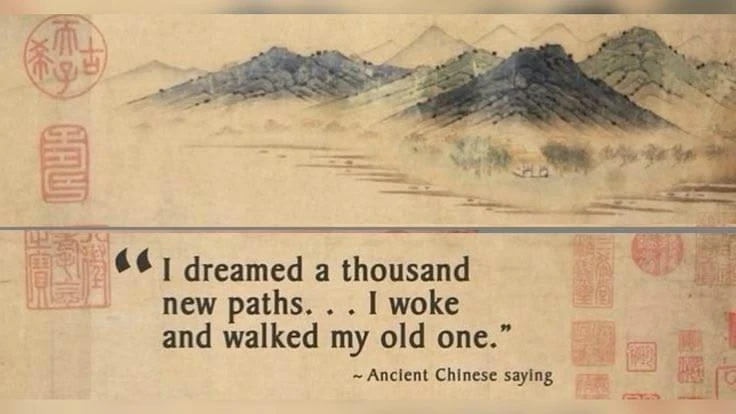
-
Shenzhen’s Longgang District government has just released ten policy measures to support OpenClaw / OPC.
Source - Translation:
To seize the opportunities presented by the intelligent economy, Shenzhen’s Longgang District on March 7 released the “Measures to Support the Development of OpenClaw & OPC in Longgang District, Shenzhen (Draft for Public Consultation)”…
With zero-cost startup as its central highlight, the initiative extends an invitation to intelligent agent developers worldwide and entrepreneurs building OPCs (One Person Companies), aiming to make Longgang the top global destination for launching intelligent-agent startups…
-
China pushes to lead brain-computer interface market by 2030
Beijing has set 17 milestones targeting BCI breakthroughs by 2027 and a fully competitive industry by 2030; clinical implants and rapid market growth are accelerating investment and policy choices. Related: "Rapid Growth on State Backing" China’s BCI Industry Closes In on Neuralink Amid Regulatory Drag"
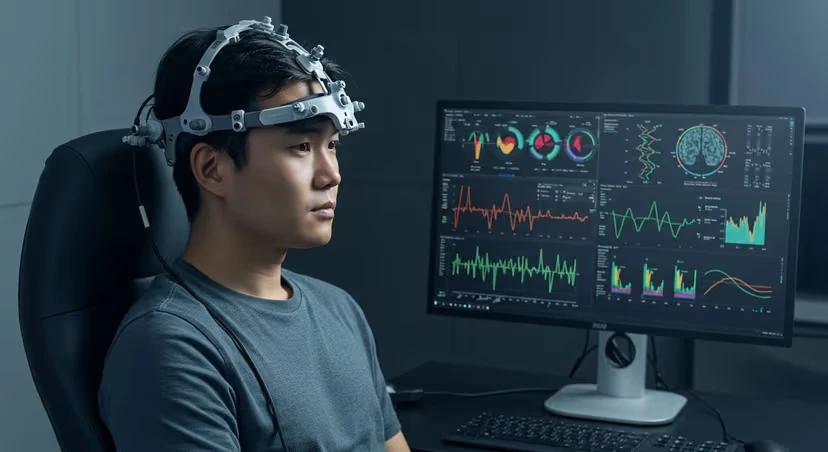
-
China is using this map in its schools
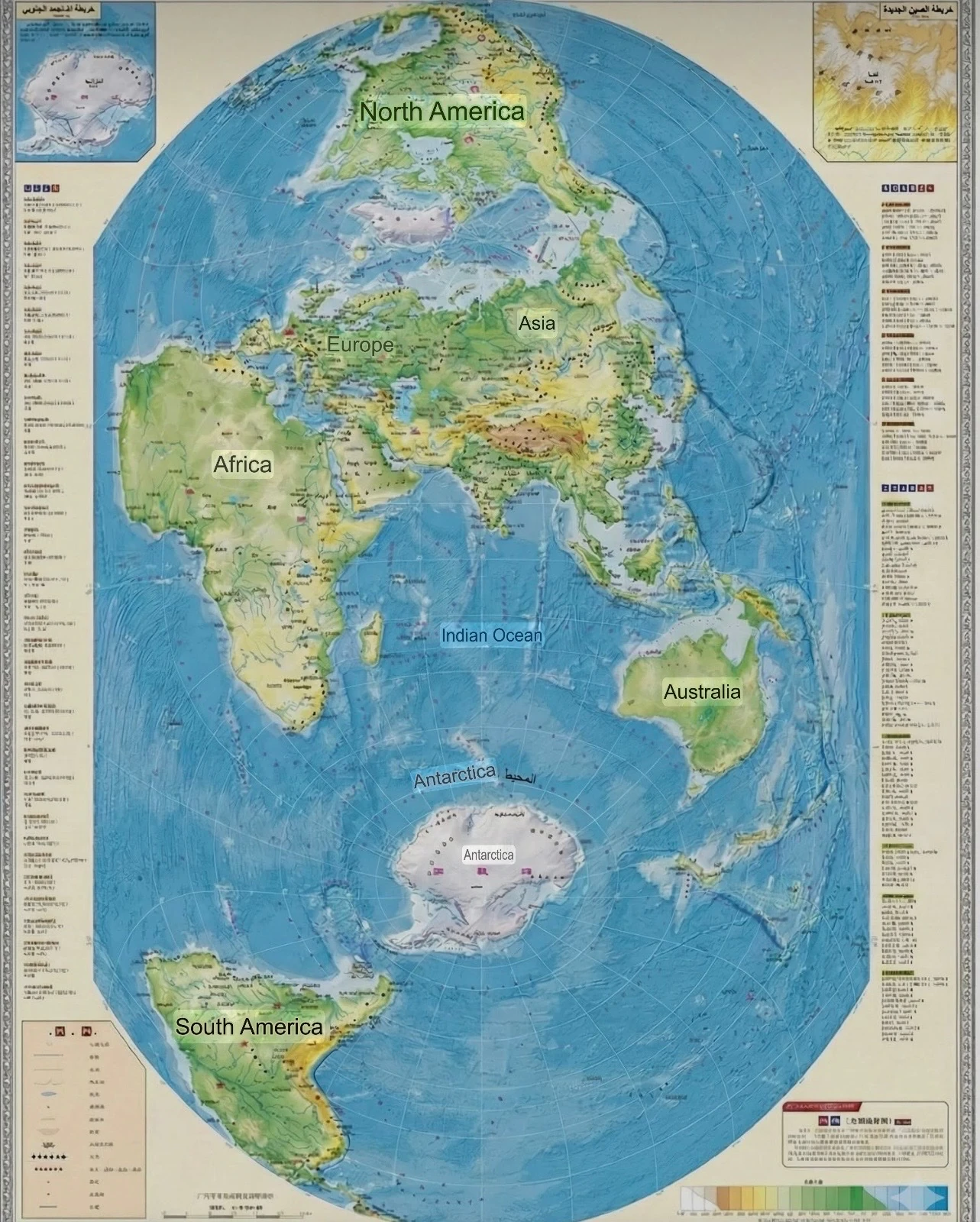
This isn't just an ordinary school map, nor is it an innocent attempt to alter a geographical projection. What we're using in our schools is a map of consciousness before it's a map of the land. It's a tool for rearranging how the Chinese generation sees the world, who stands at its center, and who lives on its periphery.
The map doesn't start at the Atlantic, as the world has for centuries, nor does it give Europe or the United States the visual center of gravity. The center here is distinctly Asian, with China at the natural heart of the scene, while Europe is pushed westward, and the Americas are relegated to the margins, as if they were distant geographical extensions rather than a cosmic axis.