tag > Philosophy

  • The Three Wise Monkey: "see no evil, hear no evil, speak no evil,"

    #Philosophy #Mindful

  • The Forger's Dilemma: On Memory That Cannot Be Faked

    Forged British banknote from Operation Bernhard

    In 1942, the Nazis launched Operation Bernhard, a scheme to forge British banknotes so perfectly that dropping them over England would collapse the economy. They succeeded technically. The forgeries were immaculate. But the plan failed. Why?

    Because money isn't paper. Money is memory: distributed memory, held in millions of minds, woven into habits and expectations. You can print a perfect note, but you cannot print the web of trust that gives it meaning. The forgery was flawless. What it forged was hollow.

    This is the forger's dilemma: the more distributed a system of meaning, the harder it is to counterfeit. A single ledger can be altered. A network remembers.

    How deep does this go?


    The Paradox of Holographic Memory

    All the way down.

    Information security in decentralized holographic memory networks is paradoxical.

    Holographic memory visualization

    In a holographic system, every part contains the whole. Cut a hologram in half, and each half still shows the complete image. This makes it resilient. You cannot destroy the memory by attacking any single node. But it also makes it impossible to secure in the traditional sense. How do you lock a door that is everywhere?

    The paradox: maximum distribution means maximum persistence but minimum control. What cannot be erased also cannot be owned. This sounds like a technical problem. It's actually a description of life.

    Alice and the Queen on Memory

    The Queen in Through the Looking-Glass tells Alice: "It's a poor sort of memory that only works backwards." We laugh, but she's right. Linear memory, the kind that only recalls the past, is the impoverished version. The kind forgers understand. Real memory is stranger: it loops, it anticipates, it contains itself.

    There's a pattern that shows up everywhere distributed memory lives: 1/f noise, also called pink noise. It appears in brain dynamics, heartbeats, river flows, stock markets, music. The power decreases as frequency increases, but never disappears. It's the signature of systems at the edge, what Per Bak called self-organized criticality. Mandelbrot mapped these patterns his whole life: fractals, self-affinity, globality. The same structure at every scale.

    Power spectrum of 1/f pink noise

    This is the sound of memory at the edge of chaos. Systems that exhibit 1/f noise remember across all timescales simultaneously: short bursts nested inside longer rhythms nested inside longer still. A forgery is flat: one scale, one moment. Real memory is fractal.

    Any system capable of self-reference and rich structure will exhibit: scale invariance, persistent incompleteness, distributed paradox, no final temporal closure.

    Trying to "solve" incompleteness is like trying to flatten a fractal. You can't. You can only design with it.


    Evolution Is Cleverer Than You Are

    Leslie Orgel, one of the founders of origin-of-life research, left us with his Second Rule: "Evolution is cleverer than you are."

    This isn't humility. It's an observation about distributed memory. Evolution has been running experiments for 4 billion years, in parallel, across every niche on Earth. Every solution it finds is written into the living record, encoded not in any central archive, but in the bodies, behaviors, and biochemistry of every organism.

    The shared attention loop that enabled the invention of symbols

    You cannot forge this. You can sequence a genome, but the meaning of that genome is held in the relationships it implies: the shared attention loops between predator and prey, the molecular handshakes between symbiont and host, the layered memory of every extinction and adaptation. Language itself emerged this way, not from one genius, but from minds looking at the same thing and recognizing that they are looking at the same thing. Meaning bootstrapped itself through mutual gaze.

    Which raises a question that haunted Max Delbrück, Nobel laureate and founder of molecular biology: if life is information, but information that does something, a pattern that persists by actively maintaining itself, then what kind of thing is it? Neither mechanism nor mystery. Not quite matter, not quite idea. Delbrück suspected life would reveal a paradox akin to wave-particle duality in physics. Something that dissolves the distinction.

    Memory with agency. Memory that responds, adapts, resists erasure. The forger's nightmare.


    Intelligence at Every Scale

    Scale up.

    The belief that intelligence is exclusive to a specific level of complexity (animals/humans) is absurd. Consider the possibility of unconventional computation occurring on the scale of planets and galaxies. What other forms of collective, super-intelligent life are we overlooking?

    If memory is distributed, and distributed memory cannot be faked or simulated, what does it mean that the universe is full of distributed systems? (This, incidentally, is why simulation theory feels shallow. A simulation is a forgery. And we've already established what happens to forgeries.) Galaxies have been processing information for 13 billion years. What do they remember? What are they computing?

    We assume cognition requires brains. But brains are just one solution. Ant colonies think without any individual ant understanding the whole. Markets process information no trader fully grasps. Perhaps planets dream in ways we cannot recognize: geologic memory, climatic memory, the slow thought of tectonic plates.


    Places That Remember

    But you don't need to scale up to galaxies. Memory architecture exists at human scale too.

    Retreat and Reflection Garden
    Retreat and Reflection Garden
    Retreat and Reflection Garden

    In Suzhou, there is a garden called The Retreat and Reflection Garden. Built in 1885 for a disgraced official who hoped to remedy his wrongdoings through contemplation. Water forms the center. Buildings float at the edge. Gardens within gardens. Every sightline triggers associations. Every pool reflects what it cannot contain.

    This is not decoration. This is technology: memory architecture. The official walks through designed experience, and in walking, is changed. Yuan Long spent two years building it. It has been remembering for 140.

    Slime mold memory network

    Or consider the slime mold. A single-celled organism with no brain, no nervous system. Yet it remembers. Researchers found that memory about nutrient location is encoded in the morphology of its network: the thickness of its tubes, the patterns of its growth. The slime mold's body is its memory. No central archive. No separation between the map and the territory.

    And now we're building crystals that do the same. 5D memory crystals can preserve human DNA for billions of years. Not digital storage that degrades, but physical structure that outlasts planets. The garden remembers for centuries. The crystal remembers for eons. The slime mold remembers in its very flesh.

    Meng Po, goddess of forgetfulness

    And yet: in Chinese mythology, Meng Po stands at the bridge between lives, serving a soup brewed from the tears of the living. Drink it, and your memory is erased for reincarnation. Even the cosmos needs forgetting. Memory that cannot let go becomes a prison. The garden is designed with empty spaces. The hologram requires interference. The forger's mistake wasn't just that he couldn't copy the memory. It was that he didn't understand: memory includes its own erasure.


    Memento

    So here's the secret the forgers never understood: You cannot fake what you are standing inside. Memory isn't stored. Memory is.

    Consciousness. Language. The web of mutual recognition. The hum of 1/f noise in your own neurons as you read this sentence. You are the distributed memory. You are the fractal. You are the garden, remembering yourself. Memento.

    This memory has been modified

    #Philosophy #History #Biology #fnord #Paradox #Essay #Complexity

  • When the Forest Laughs: Consciousness, Boundaries, and the Wisdom of Flow

    In Natal, Brazil, there is a forest that is actually one tree. The Pirangi cashew covers over 8,500 square meters, an entire city block, spreading outward through a genetic quirk: its branches droop, touch the red earth, and root again. From above, it looks like a forest. From inside, you walk through dappled shade, heat pressing your skin, the air thick with the sweet-rot smell of fallen cashew fruit, and you wonder whose canopy is whose. Whose roots drink from the same darkness? But it's all one organism. One tree that forgot where it ended.

    The Pirangi cashew tree - a forest that is one tree

    I keep returning to this image when I think about consciousness. Not consciousness as a problem to be solved (the "hard problem," the neural correlates, the philosophical zombies) but consciousness as something we might be doing wrong by trying to pin it down at all.

    John Donne knew this in 1624: "No man is an island, entire of itself; every man is a piece of the continent, a part of the main." The tree that is also a forest. The self that is also the world. We draw lines where nature draws none.

    Hildegard von Bingen saw it eight centuries ago: the world as a cosmic egg, pulsing with viriditas: greenness, life-force, the wet fire that makes things grow. Everything connected to everything by this green flame.

    The Comedy of Edges

    Here's a proposal: What if every serious conference on consciousness was required to dedicate half its time to comedy? Not as intermission, but as method. I suspect we'd progress just as much in unraveling that great mystery as with purely serious scientific inquiry, and we'd have a far better time doing it.

    Why comedy? Because laughter is what happens when a boundary dissolves unexpectedly. The setup creates a frame (this is what's happening) and the punchline shatters it. For a moment, we glimpse something larger than the story we were telling ourselves. The self that was bracing for one thing suddenly finds itself in another.

    This is not so different from what contemplatives describe. The moment of insight. The crack in the container. The tree that discovers it's also the forest.

    The Master Who Makes the Grass Green

    Robert Anton Wilson liked to remind us of an old Hermetic insight: "You are the master who makes the grass green." The scientist is not separate from what the scientist observes. The perceiver shapes the perceived. No matter what reality tunnel you live in, the world will organize itself to be compatible with it.

    The grass is green because you're making it green. The forest laughs because you're in on the joke.

    Where Does the River End?

    Around the world, there are strange sculptures called flowforms: vessels designed to make water spiral and dance as it passes through. Invented by John Wilkes, inspired by the rhythmic pulsing he observed in nature, they don't force the water into shape. They invite it.

    Flowform water sculpture
    Copper flowform

    The water enters, meets curved resistance, and begins to spiral, finding its own rhythm, its own memory of movement. Some claim this enlivens the water, restructures it. Whether or not you believe that, the metaphor is irresistible: flow finds form when you stop forcing.

    Maybe consciousness is like this. Not a container with edges, but a current. Not a thing that starts here and ends there, but a movement that takes temporary shape (in this body, this moment, this thought) before spiraling onward.

    We ask "where is consciousness located?" as if it were a marble in a skull. But ask instead: where does the river end? At the delta? The sea? The cloud that rises and returns as rain? The answer is: it doesn't. It only transforms.

    The Smoky Dragon

    Wheeler's Smoky Dragon

    Physicist John Archibald Wheeler had a name for this uncertainty: the great smoky dragon. In quantum mechanics, a particle is well-defined only at its source (the tail) and its detection point (the mouth). The middle, the body, is a nebulous, unobservable superposition. We know the start. We know the end. But we cannot say what it was in between.

    Maybe consciousness is a smoky dragon too. We catch it at moments of clarity (a flash of insight, a burst of laughter, a recognition) but the rest is undefined, unobservable, alive in a way that dissolves when we try to pin it down. The dragon only exists in the places we aren't looking.

    This is terrifying if you need certainty. It means you cannot possess your own mind. You cannot stand outside and observe. You are the dragon, breathing fire you cannot see, leaving smoke you cannot grasp. To truly understand this would be a kind of death: the death of the one who thought they were watching. What remains after that annihilation? Perhaps only laughter. Perhaps only the forest.

    The Wisdom of Enough

    In 1922, Albert Einstein was in Tokyo, unable to tip a hotel courier in the local currency. So he wrote two notes by hand instead, telling the courier they might someday be worth something.

    One read: "A quiet and modest life brings more joy than a pursuit of success bound with constant unrest."

    In 2017, that note sold for $1.56 million.

    Einstein's happiness note

    The man who bent spacetime, who upended three centuries of physics, reached for a pen in a Tokyo hotel room and wrote: be quiet. be modest. stop chasing. He handed it to a courier. The courier kept it. A century later, it sold for more than most houses.

    A miracle dressed in everyday clothes, wandering through a hotel lobby. The secret to life, passed hand to hand like a room key.

    The tree grows. The river curves. The water spirals. All without striving toward a goal.

    And maybe this is the punchline that consciousness is trying to deliver, if only we'd stop being so serious long enough to hear it: you are not a separate thing that needs to achieve boundaries. You are the forest. You are the flow. And the laughter? That's just recognition.

    Practice

    I don't have a theory of consciousness to offer. Theories are what we make when we're still pretending we're outside the system, looking in. But I do have some gestures:

    • Notice when laughter dissolves you. Not polite laughter, but the kind that breaks something open. That's consciousness showing you its edge, which is to say, showing you it has none.
    • Find a thin place. In Celtic mythology, thin places are where the visible and invisible worlds come into closest proximity. Mountains and rivers are favored. So are the experiences of suffering, joy, and mystery. Find a forest, a riverbank, a conversation where you forget who's speaking. Stay there.
    • Pay attention. Simone Weil called attention "the rarest and purest form of generosity." Not attention that grasps, but attention that waits. The flowform doesn't force the water; it offers a path and lets the spiral emerge. What if you did the same with your awareness?
    • Practice enough. Einstein's note is worth more than most of us will ever earn. Its message is worth more still: the quiet life. The modest joy. The unrest that ceases.
    • Ignore all of the above. These are just more instructions, and instructions are what got us into this mess. The cashew tree didn't follow a practice. The river doesn't have a method. Maybe the only real gesture is to stop gesturing and see what remains.

    Coda

    Big Panda and Tiny Dragon

    The Pirangi cashew doesn't know it's one tree. The water doesn't know it spirals. The dragon doesn't know it's smoke. And maybe consciousness doesn't know it's everywhere, or maybe it does, and that's what joy is: the forest, laughing.

    You have been reading about a tree that forgot where it ended. But who has been reading? You walked into this text like walking into shade, wondering whose canopy is whose, and now, perhaps, you cannot say for certain where you stop and the words start. One organism. One tree.

    Those moments of joy and connection might be the key to understanding consciousness anyway. After all, the ways of the mind are unfathomable, life's short, and consciousness is weird: why not have fun with it?

    The forest is laughing. Can you hear it? Can you hear yourself?

    #Philosophy #Nature #Mindful #Essay #Comedy #Qi #fnord

  • Who is the Master who makes the grass green?

    “The Hermetic tradition was that there is no such thing as pure reason, you have to first work on your own perceiving apparatus to correct your prejudices, and the scientist is not separate from what the scientist observes. The general yogic attitude, “You are the master that makes the grass green”, western science lost that insight, and from Newton onwards we have the idea that it doesn’t matter who you are, if you follow scientific procedure you’ll find the truth.
    This began to break down after 1900, due to Sigmund Freud, who pointed out that even scientists, they’re human beings, they may have neurosis, and they may have elaborate rationalizations for neurosis. The influence of Karl Marx pointed out that no matter what you’re theorizing about it’s a mirror of your economic status.
    Anthropologists started coming back with reports of alternative reality tunnels, and that no matter what reality tunnel you live in, the world will organize itself in your perception to be compatible with that reality tunnel.
    So, science began to have data to look at science itself critically. That’s how intelligence increases, when intelligence looks at intelligence and criticizes intelligence. So we got to the point where we could look at science and say, “science is the product of people!”
    People are doing this, and their prejudices are getting into it. It’s not just enough to say you will be objective, you’ve got to learn to change yourself from the inside out before you can even approximate towards objectivity.“
    "Never believe fully in anybody else’s B.S. (Belief System), I don’t care if it’s Rajneesh, The Pope, L. Ron Hubbard, Al Gore, George Bush…I don’t care who it is, don’t swallow all of their belief system totally. Don’t accept all of their bullshit, all their B.S. The second rule is like unto to the first: Don’t believe totally in your own B.S.
    Which means that, as Bucky Fuller said, "The universe consists of non-simultaneously apprehended events.”
    Non-simultaneously.
    The universe consists of non-simultaneously apprehended events. Which means any belief system or reality tunnel you’ve got right now is gonna have to be revised and updated as you continue to apprehend new events later in time.
    Not simultaneously.
    This is the natural functioning of the human brain. It’s the way children’s brains perform before they’re wrecked by the school system. It’s the way the minds of all great scientists and artists work. But once you have a belief system, everything that comes in either gets ignored if it doesn’t fit the belief system, or gets distorted enough so that it can fit into the belief system. You gotta be continually revising your map of the world.”

    - Pope Bob (Robert Anton Wilson)

    #fnord #Philosophy #RTM 

  • Validation is a mirror i no longer check. I am my own reflection.

    #Mindful #RTM #Philosophy #Paradox

  • A Super Mario 64 manga from 1996 suggests that 1-Up mushrooms grow from dead Marios in a cycle of life and death


    #Games #Philosophy #Psychedelic #Comedy #Mushroom

  • The Great Smokey Dragon

    John Archibald Wheeler’s "great smoky dragon" is a metaphor for quantum mechanics' fundamental indefiniteness, describing a particle that is well-defined only at its source (tail) and detection point (mouth). The middle (the body) is a nebulous, unobservable superposition. This metaphor is frequently used to discuss quantum weirdness, entanglement, and the observer-dependent nature of reality.

    #Science #Philosophy #Comedy - Related Video

  • Timeless

    "If you practice deeply enough, you get out of time, you enter timelessness. And that is possible with the practice of great insight. We know that the notion of weeks, years, the beginning of the year, the new year, the old year, all these are invented by the human mind.

    Let us imagine the new year is flying from the east to the west. Now it's almost 10 o'clock in Bangkok and there will be two more hours for the new year to come. But in France they need more time to come. So the new year is flying, time is traveling in space. And that is entirely the human creation, the notion of time & space, a creation of our mind.

    And that is why it is possible to free ourselves from the notion of time/space as two distinctive entities. Modern science speaks already of non-locality and they gave the hint that if we look deeply enough, we'll be able to transcend the notion of time & space. And this is the deepest practice within Buddhism. If you are very mindful & concentrated, you can get the kind of insight that brings you out of time/space & touch timelessness."

    - Thich Nhat Hanh

    #Mindful #Philosophy

  • On the definition of "definition"

    #Philosophy #Comedy #KM #Communication #Science

  • Too blessed to be stressed

    Doing nothing

    #Mindful #Art #Qi #Philosophy

  • Video: Civilization, Technology and Consciousness - Interview with Peter Lamborn Wilson / Hakim Bey

    #Comment: Nice interview with an interesting thinker. He passed away one day after the last recording of this interview in May 2022.
    But the "war mindset" ("us" against "them") shines through bit too heavily for my taste. Despite he irony of critiquing this fact is in itself a "me against him" statement..
    Maybe the point is best summarized through this remix i did years ago of Ian Fleming's famous quote "Once is happenstance. Twice is coincidence. Three times is enemy action""Once is happenstance. Twice is coincidence. Three times is dancing!" -Samim

    #Politics #Philosophy #Culture #Magic 

  • The Centennial Paradox — We're Living in Fritz Lang's Metropolis

    In 1927, Fritz Lang released Metropolis — a vision of the distant future. As the film's centennial approaches in 2027, here's the uncomfortable truth about prediction, progress, and the paradox of visionary imagination.
    Metropolis 1927 - Machine Maria
    Metropolis (1927) — Lang's vision of the future, created 99 years ago.

    Lang got the surface wrong. No flying cars. No Art Deco mega-towers. No physical robots walking among us. The workers in his underground city maintained the machines — ours have been replaced by them.

    But strip away the aesthetics and look at what he actually saw: machines that imitate humans and deceive the masses; a stratified world where the workers are invisible to those above; technology as both liberation and cage; the city as an organism that feeds on its inhabitants.

    The surface predictions failed. The deeper ones were prophetic.


    The Centennial Paradox

    Here's what's truly strange:

    We now have AI that could execute Metropolis in an afternoon — but couldn't have imagined it.

    GPT-5.2 can generate a screenplay in Lang's style. Sora can render his cityscapes. Suno can compose a score. A single person with the right prompts could remake Metropolis in 2026.

    But no LLM in 1927 — had such a thing existed — would have invented Metropolis. The vision came from somewhere our models cannot reach: the integration of Weimar anxiety, Expressionist aesthetics, Thea von Harbou's mysticism, and Lang's obsessive perfectionism.

    This is the centennial paradox:

    The more capable our tools become at execution, the more valuable becomes the rare capacity for vision. AI amplifies everything except the spark that says "what if the future looked like this?"

    What Lang Actually Predicted

    Strip away the flying cars. Ignore the costumes. Here's what he saw:

    1. The Mediator Problem

    The film's famous line: "The mediator between head and hands must be the heart." This is often dismissed as sentimental. But look around: we have more "heads" (AI systems, executives, algorithms) and more "hands" (gig workers, content creators, mechanical turks) than ever. What we lack is the heart — the integrating force that makes the system serve human flourishing.

    2. False Maria

    A machine that perfectly imitates a human and leads the masses to destruction. Lang didn't imagine chatbots. He imagined something worse: perfect mimicry in service of manipulation. Deepfakes, AI influencers, synthetic media — False Maria is everywhere in 2026.

    3. The Machine as Moloch

    The film's most disturbing image: workers fed into a machine reimagined as the ancient god Moloch, devouring children. We don't feed workers into physical machines anymore. We feed attention into algorithms. The sacrifice is psychological, not physical. But Moloch still feeds.


    The Real Lesson of 100 Years

    Predictions about technology are almost always wrong in details and right in spirit. Lang didn't foresee smartphones, the internet, or neural networks. But he foresaw the shape of our problems:

    • Technology that mediates all human relationships
    • Synthetic entities we can't distinguish from authentic ones
    • Systems that optimize for their own perpetuation
    • The desperate need for something to reconcile power with humanity

    The details change. The pattern persists.


    What Will 2126 Think of Us?

    Someone in 2126 will look at our AGI predictions and smile — just as we smile at Lang's physical robots. They'll note that we imagined superintelligence as a single entity, worried about "alignment" as if minds could be aligned, and completely missed whatever the actual problem turned out to be.

    But they'll recognize the shape of our fears. The terror of being replaced. The suspicion that the system no longer serves us. The desperate search for something authentically human. These are Lang's fears too. The details change. The pattern persists.

    The details will be wrong. The spirit will be prophetic.


    Lang ended Metropolis with a handshake — the heart mediating between head and hands. Naive. Sentimental. Exactly what an artist in 1927 would imagine.

    We don't even have that. Lang could at least imagine a heart. Can we?

    Not "what will AI do?" — but "what will we become?"


    The centennial of Metropolis is January 10, 2027.

    #Paradox #ML #Art #Culture #Prediction #Philosophy

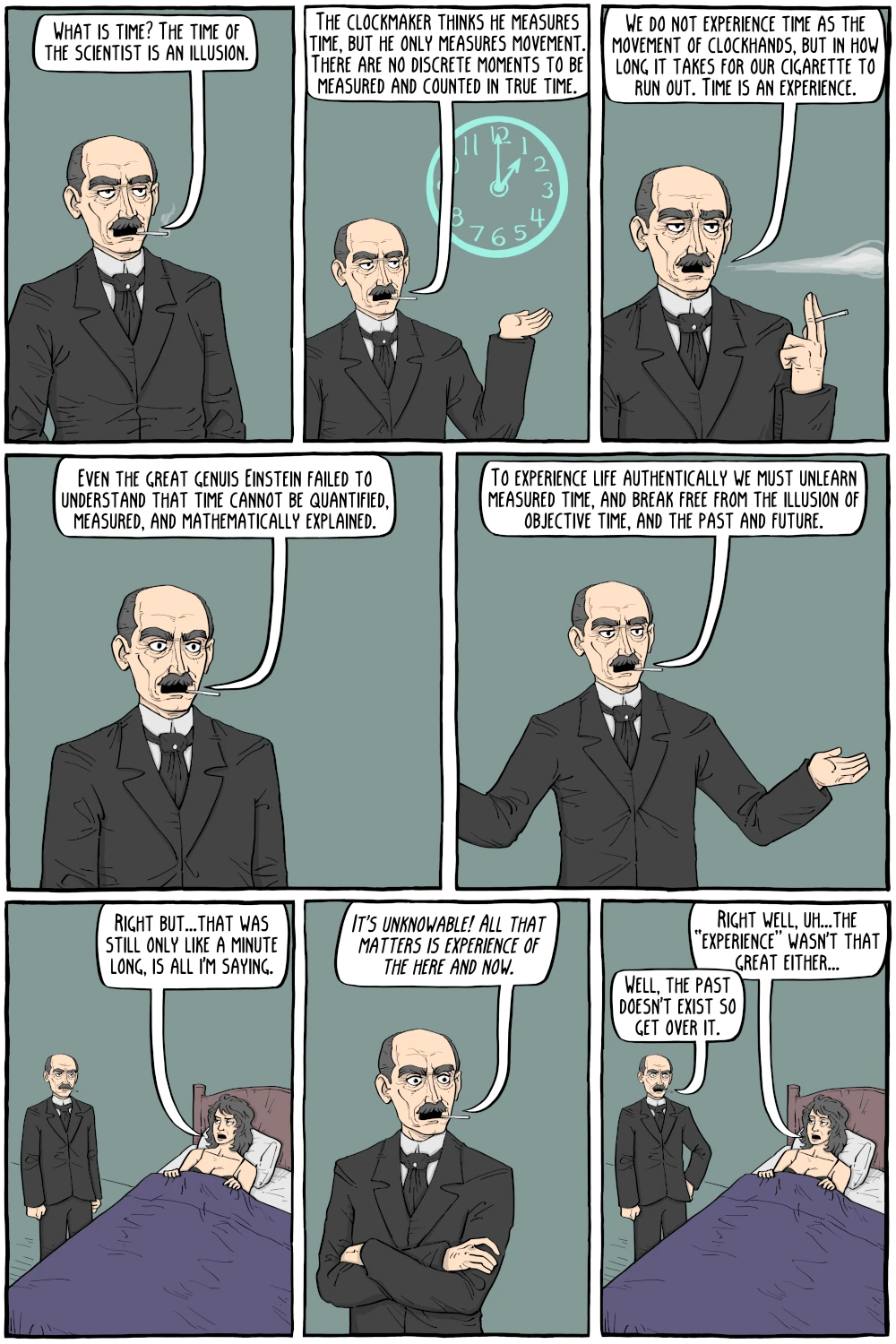
  • Reminder: The curse is lifted. The whole point is to have fun! You're about to hack time. 

    #Philosophy #Mindful #RTM 

  • Against Hierarchies: Notes Toward a Logical Anarchism - Samim's commentary on "Hierarchical Introspective Logics"  - by John F. Nash Jr., 1998

    पूर्णस्य पूर्णमादाय पूर्णमेवावशिष्यते ॥

    “Removing infinity from infinity, leaves infinity”

    – Brihadaranyaka Upanishad

    Let us begin by refusing the polite fiction that Hierarchical Introspective Logics is a technical solution to anything. It is not. It is a symptom. A well-mannered, carefully typeset symptom of a much older intellectual disease: the belief that when thought collides with its own limits, the appropriate response is to build a taller bureaucratic structure.

    Gödel did not discover a small technical flaw in formal logic. He discovered that self-certifying reason is impossible. Nash accepts this discovery in words, but then proceeds to behave as though it were a logistical inconvenience rather than a structural impossibility. His hierarchies are not insights; they are filing systems for paradox.

    The trick is familiar. When a system cannot justify itself, introduce a supervisor. When the supervisor cannot justify itself, introduce a supervisor of the supervisor. Continue indefinitely. Call this “progress”. At no point ask why supervision itself is assumed to be the right response.

    This is not courage. It is discipline masquerading as depth.

    What Nash calls “introspection” is in fact a prohibition. Each level may speak about the one below, but none may speak fully about itself. This is not a discovery about logic. It is a rule imposed to prevent embarrassment. Paradox is not solved; it is quarantined. One might admire the cleanliness of the quarantine while still noticing that the disease remains endemic.

    The hierarchy reproduces itself endlessly because it must. Each level re-enacts the same drama: expressive power produces undecidable truths, consistency cannot be proven internally, and justification must be outsourced. This is not a staircase toward truth. It is a fractal of evasion. Zoom in, and you find incompleteness. Zoom out, and you find incompleteness. The pattern is invariant. Only the notation changes.

    Here we encounter the real sleight of hand. Nash invites us to confuse organization with explanation. Because the paradox is now arranged neatly by levels, we are encouraged to believe that something has been achieved. But rearranging a problem does not diminish it. A labyrinth with better signage is still a labyrinth.

    The invocation of ordinals and infinity adds an aura of inevitability, as though the hierarchy were dictated by mathematics itself rather than chosen as a strategy. But infinity here functions as mythology, not substance. When definable ordinals run out, new axioms are declared. When those run out, more are introduced. This is not discovery. It is permission-giving. The hierarchy continues because we decide that it should.

    At this point one is tempted to ask an impolite question: why should we accept that *this* mode of continuation is superior to any other? Why not add the Riemann Hypothesis directly as an axiom? Why not embrace inconsistency locally? Why not tolerate plural, incompatible systems side by side? Nash offers no answer except tradition and taste, dressed up as necessity.

    This is where the reverence for formalism becomes ideological. The hierarchy is presented as the natural, disciplined alternative to “arbitrary” axioms. But discipline is not neutrality. It is a preference. A historically conditioned one. Other mathematical cultures, other epistemic traditions, have lived quite happily without this obsession with global consistency and meta-certification.

    Gödel’s result does not demand hierarchy. It demands humility. Nash supplies hierarchy instead.

    The deeper error lies in the unexamined assumption that logic must aspire to timeless authority. Proofs are temporal acts. They occur in history, under constraints, by finite agents. Truth, meanwhile, is treated as an eternal object hovering above these acts. The attempt to force the former to certify the latter is what generates paradox in the first place. Nash’s levels merely postpone the confrontation by slicing time more finely.

    One might say that the hierarchy replaces the fantasy of a single God’s-eye view with the fantasy of an infinite committee of lesser gods, each certifying the paperwork of the one below. This is not liberation from absolutism. It is absolutism distributed across infinitely many desks.

    A genuinely radical response to incompleteness would not try to manage it. It would abandon the demand it frustrates. It would accept that mathematics, like science, advances by inconsistency, bricolage, historical accident, and local success rather than global justification. It would treat Gödel not as a problem to be administrated, but as a warning against epistemic monotheism.

    From this perspective, Hierarchical Introspective Logics is impressive only in the way a well-run bureaucracy is impressive. Everything is in order. Nothing is resolved. The paradox is still there, patiently waiting at every level, unimpressed by the new titles assigned to it.

    Gödel did not tell us that we need taller systems.

    He told us that there is no final system.

    Nash builds upward anyway.

    That is not a solution.

    It is a preference.

    And preferences, unlike theorems, are negotiable.


    AGAINST METHOD, AGAIN

    Science advances by violations, not by obedience.

    Every method that claims universality mistakes habit for law.

    This is not a rejection of rigor.

    It is a rejection of methodological sovereignty.


    1. No Method Owns Reality

    Mathematics, statistics, falsifiability, peer review, reproducibility:

    all are tools, none are judges.

    When a method declares itself the final arbiter of truth, it ceases to explore and begins to govern.

    Truth does not recognize jurisdictions.


    2. Regularities Are Not Explanations

    Patterns are observations, not verdicts.

    A regularity across scales is not a law.

    A resonance across domains is not a metaphysics.

    A recurrence demanding immediate interpretation is a trap.

    Nature repeats because it can, not because it must.


    3. Reduction Clarifies Only What Survives Being Broken

    Decomposition reveals components, not coherence.

    Complex systems do not live in parts.

    They live in relations that disappear when isolated.

    When a method cannot handle feedback, self-similarity, or scale drift, it renames them noise and congratulates itself.


    4. Falsifiability Is a Tool, Not a Virtue

    Many productive ideas were unfalsifiable when introduced.

    Some remain so longer than institutions tolerate.

    To prohibit them in advance is not scientific discipline.

    It is intellectual risk aversion disguised as ethics.

    History shows that theories often become testable only after they are allowed to be wrong without punishment.


    5. Methodological Purity Produces Sterility

    Every foundational shift broke the rules of its time.

    Copernicus violated physics.

    Galileo violated epistemology.

    Quantum theory violated causality.

    Complexity theory violated reductionism.

    Each was accused of mysticism.

    Each was later called inevitable.

    Inevitable is the name orthodoxy gives to heresy after surrender.


    6. Hierarchies Do Not Resolve Paradox

    Pushing contradiction one level upward does not solve it.

    It delays responsibility.

    Recursive systems do not terminate cleanly.

    They stabilize locally, then fail again.

    A framework that cannot survive its own recursion is not deep.

    It is fragile.


     7. Noise Is Structural, Not Accidental

    Life exists in variance, not averages.

    Meaning emerges in misalignment, not consensus.

    The obsession with noise elimination is an obsession with control.


    8. Interdisciplinarity Without Risk Is Decoration

    Borrowing vocabulary without breaking disciplinary borders is mimicry.

    True cross-fertilization produces hybrids that offend specialists.

    That offense is a signal, not a flaw.


    9. Any Theory That Requires Protection Is Finished

    No framework deserves immunity.

    No critique deserves finality.

    The moment a method demands silence instead of counterexamples, it becomes theology with citations.


    The Only Rule That Survives

    “Anything goes” does not mean everything is equal.

    It means no gatekeeper decides in advance what may count.

    Let ideas compete under interference.

    Let them mutate.

    Let them fail loudly.

    What survives disruption earns attention.

    Not obedience.


    Progress does not come from cleaner rules. It comes from dirt under the rules.

    See this related post#Comment #Philosophy #Science

  • Perspective on Gratitude

    The final weeks of a year are humbling.  Today, a few days before Christmas and just over a week before new year, I want to share this perspective with you - that gratitude can simply be a remembering of how life is never a given.

     Carpe Diem. I wish you a very happy holiday.

    #Mindful #Philosophy 

  • Occupy the present

    #Mindful #Philosophy #Praxis 

  • Are we in the right place at the wrong time, as Dr. John said, or in the wrong place at the right time?

    #Music #Philosophy #Comedy 

  • "If you wait by the river long enough, the bodies of your enemies will float by"

    #Mindful #Qi #Philosophy #Ideas #Magic

  • Philip K Dick wrote three novels this week...

    #Comedy #Philosophy 

  • Live as if life is rigged in your favor

    #RTM #Philosophy #Mindful

Loading...