tag > NeuroScience
-
As creatures get more complex, the light in their myelin shifts red
You glow. Every living cell leaks a trickle of photons as a side effect of metabolism, far too faint to see. Inside the brain that light may have somewhere to go, and the color it takes there seems to depend on how much insulation evolution wrapped around the wires.
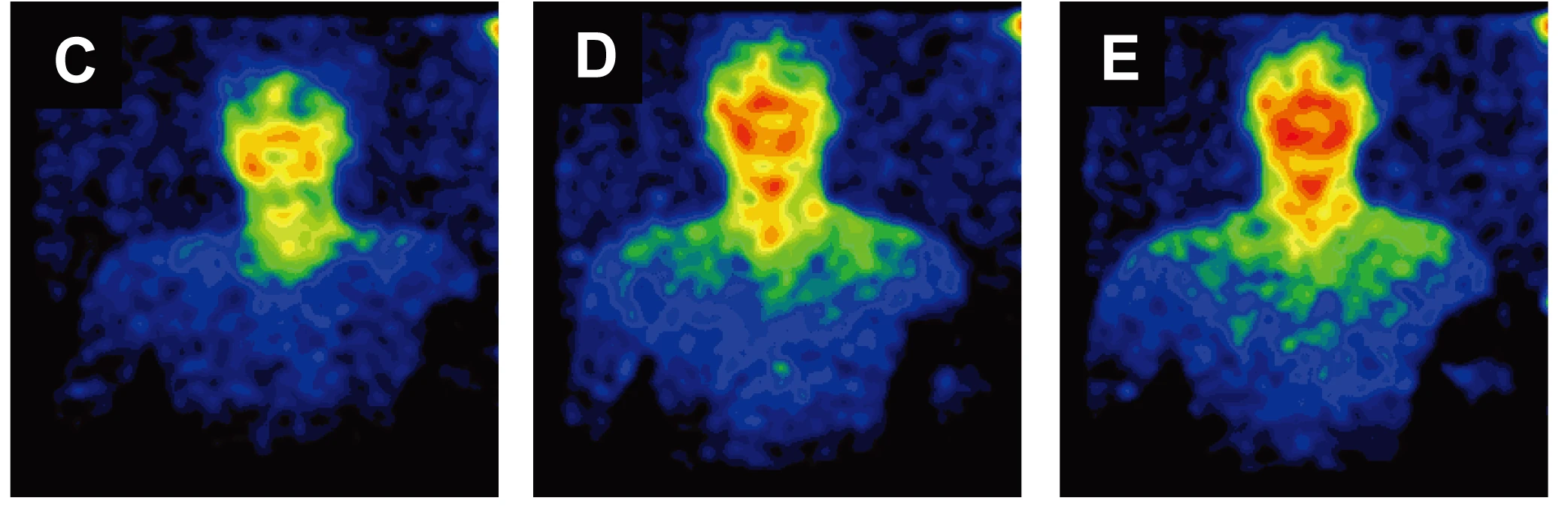
A human body photographed in total darkness by its own light, at 10:10, 13:10 and 16:10. The glow peaks in the late afternoon. Kobayashi et al., PLoS ONE 2009, CC BY. A nerve is a fiber
Myelin is usually described as electrical insulation. Optically it is also a fiber. The sheath has a higher refractive index than the axon inside it and the fluid outside it, so light can be trapped in the wraps and carried along them. Kumar, Boone, Tuszyński, Barclay and Simon modeled this in 2016 and found myelinated axons could guide biophotons even with realistic imperfections like bends and uneven sheaths.
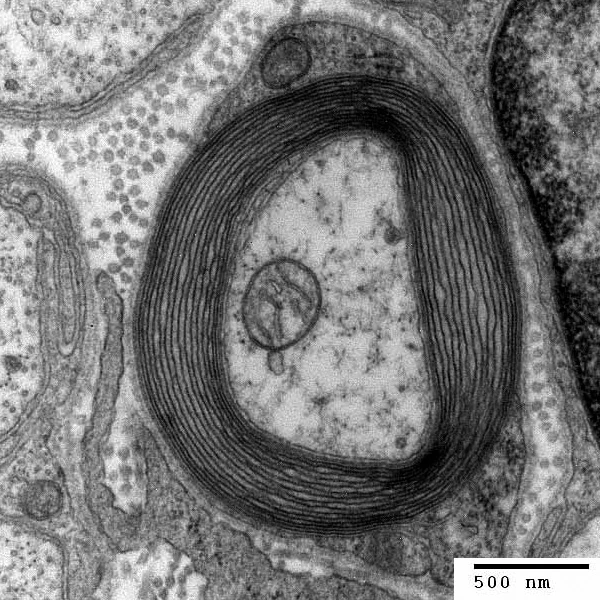
A myelinated axon in cross section. The dark rings are the myelin wraps. Electron Microscopy Facility, Trinity College. Public domain. 
The engineered version: light bouncing down a glass core. Angel Toshkov, CC BY-SA 3.0. The ladder goes red
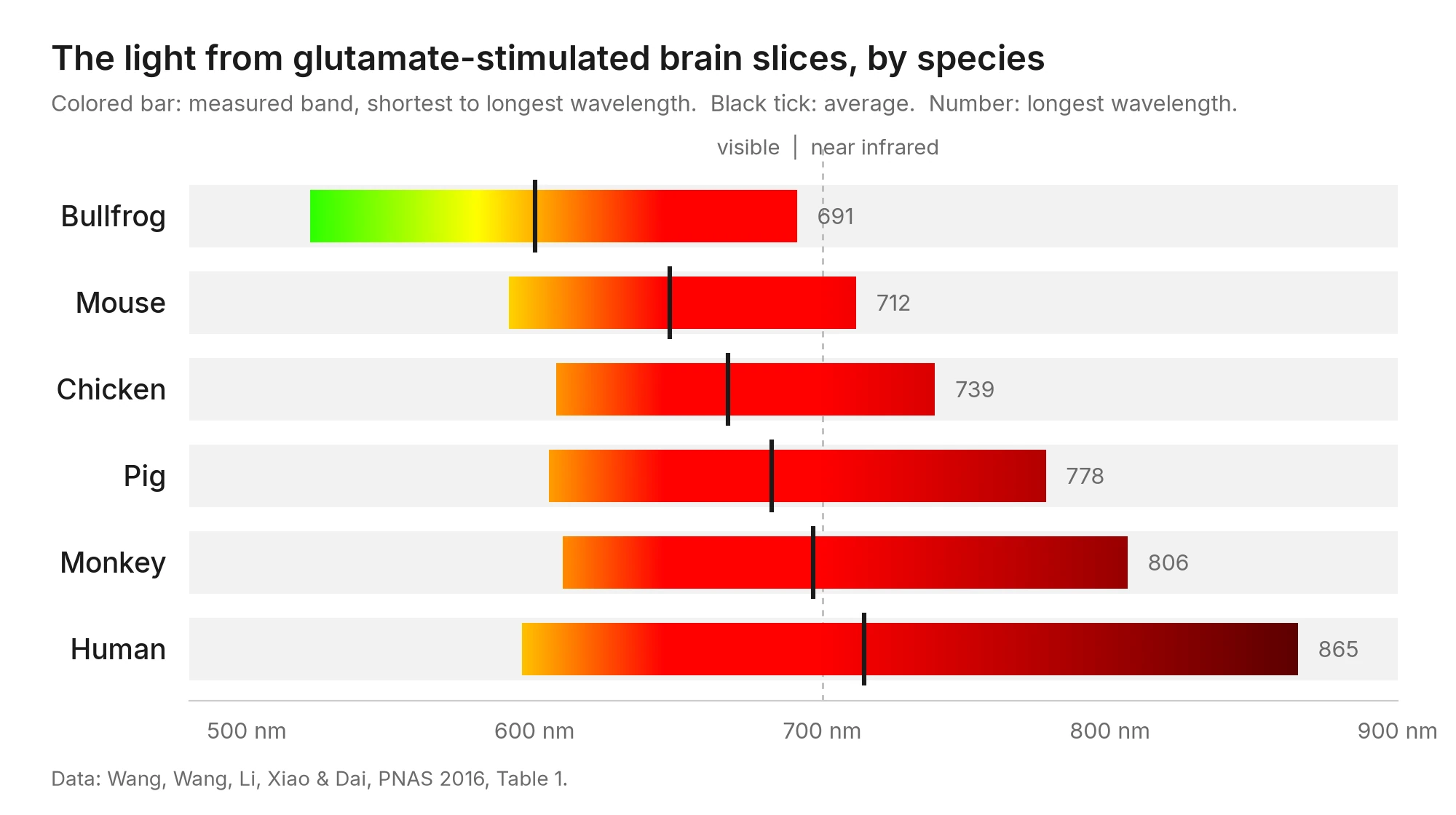
The same year, Wang, Wang, Li, Xiao and Dai stimulated brain slices with glutamate and split the light they gave off with a grating. Bullfrog, mouse, chicken, pig, monkey, human. The short edge of the band barely moves. The long edge runs out, from 691 nm in the frog to 865 nm in humans, past the edge of what we can see.
The color of the pipe is the shape of the pipe
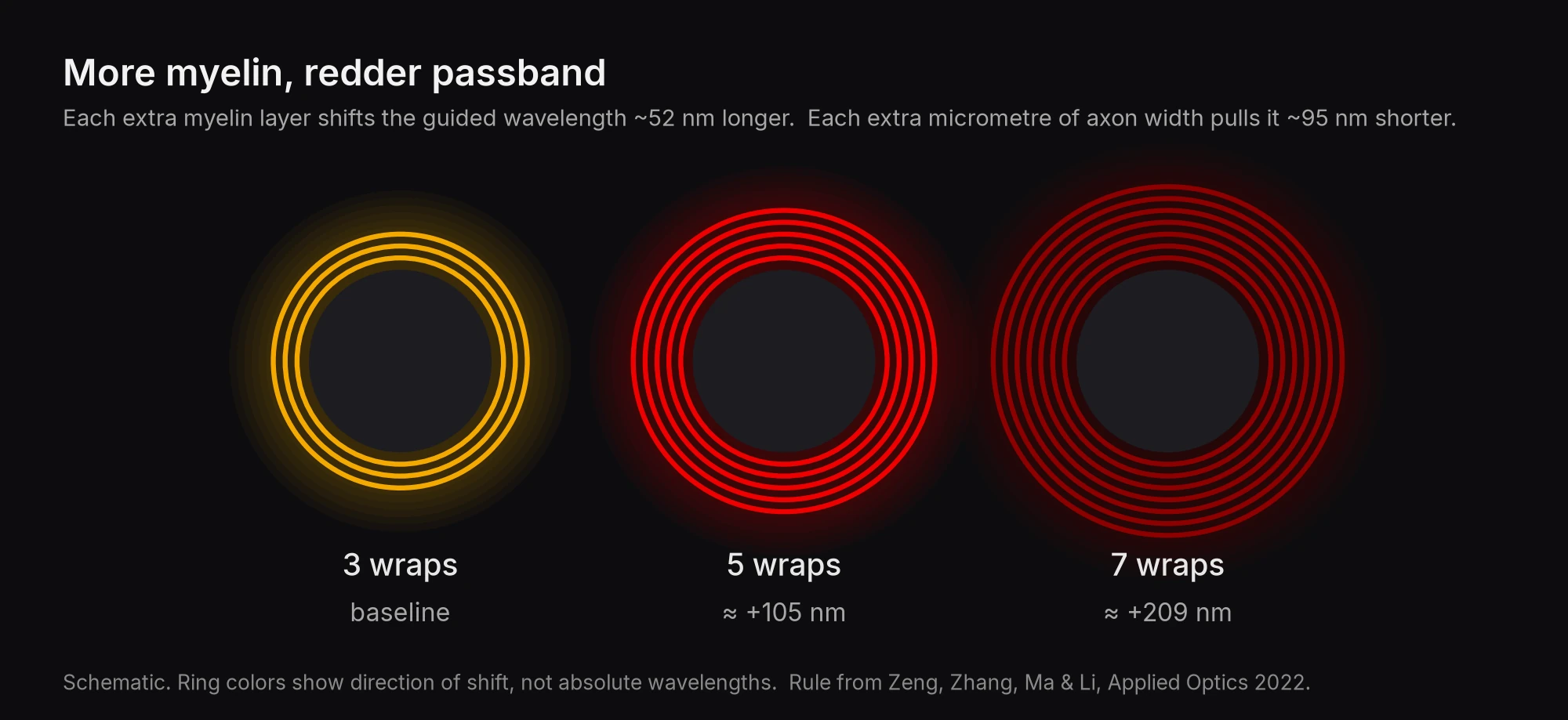
A 2022 electromagnetic model by Zeng, Zhang, Ma and Li gives the sheath a tuning rule. The waveguide passes a narrow band, around 10 nm wide, set by its geometry. Each added myelin layer moves that band about 52 nm toward the red. A thicker axon pulls the other way, about 95 nm toward the blue per extra micrometre. They offer this as the mechanism behind the species ladder.
Aging runs it backward. In mice the same light drifts toward the blue from newborn to 18 months. Myelin degenerates and renews more slowly with age, and longer waves are cheaper photons. The authors read this as an older brain spending more energy per signal.
Where it gets soft
The papers frame the redshift as a basis for intelligence. A reply in the same journal pointed out that the wavelengths also track body mass, and that the human light has the shortest coherence length of the six, a strange signature for a superior channel. The slices sat in 50 millimolar glutamate, a flood rather than a signal. No one has shown that another neuron reads these photons as a signal. And chicken sits redder than mouse.
What survives is still strange enough. Neurons emit light. The wire around them is shaped like a fiber. The fiber's color follows its wrapping, and the light measured from brains reddens up the evolutionary ladder and blues with age. Whether anything is listening is the open question.
-
Why the Brain isn't a Computer—It’s a Wave Interference Engine
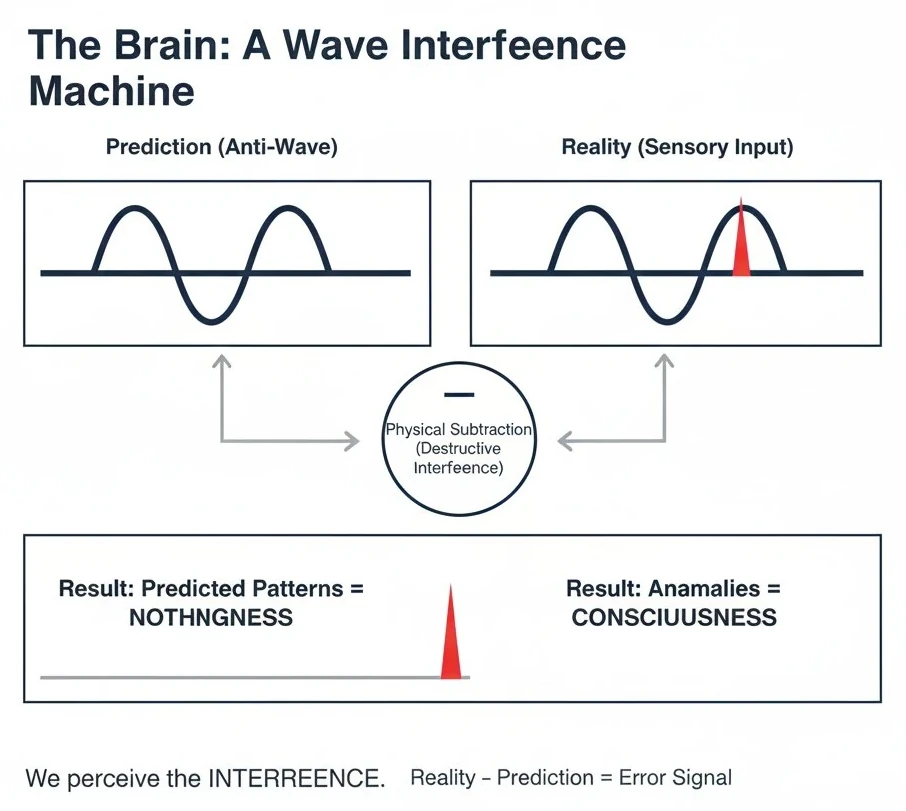
Most people think the brain "calculates" anomalies like a digital processor. They’re wrong. Digital is too slow. If you look at a 20x20 matrix and spot the "odd" numbers instantly, you aren't running an algorithm. You are performing Analog Subtraction.
The Theory
The brain doesn't process data; it manages Waves.
- The Prediction: Your internal model generates a "Counter-Wave" (Anti-Phase) based on expected patterns.
- The Reality: Sensory input hits as an incoming wave.
- The Interaction: When they meet, Destructive Interference occurs.
The Result
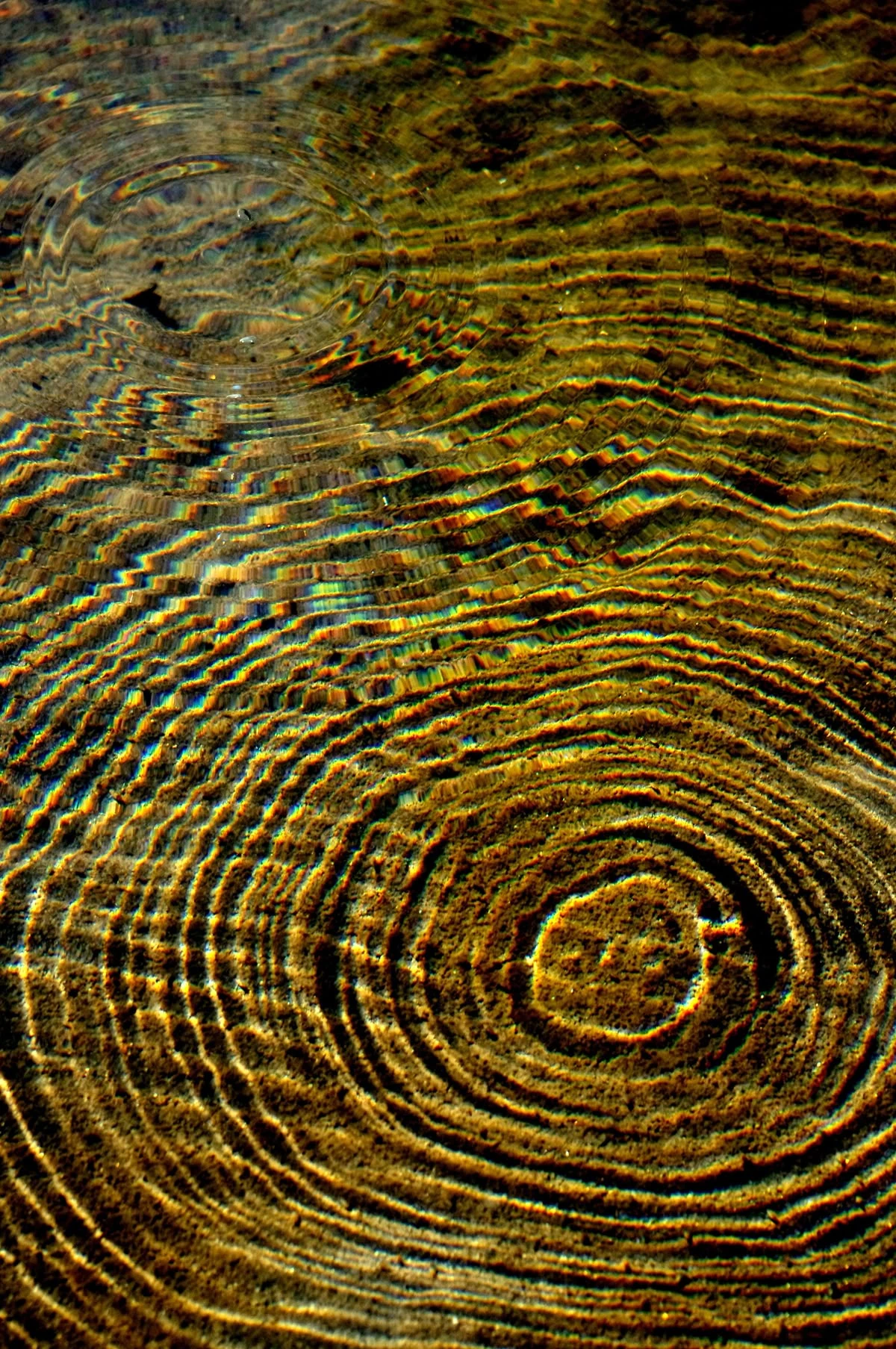
The predictable world—the "normal" numbers—simply cancels out into silence. No CPU cycles needed. No "processing" required. The "Oddness" (the anomaly) is the only thing that doesn't cancel. It survives the interference as a high-energy spike. Consciousness isn't the whole picture; it’s the "Residue" of the subtraction.
We don't "think" the difference. We feel the interference where the world fails to match our internal wave. Mathematics calls this a Fourier Transform. Nature calls it Perception. Memory must be wave-like: sensory inputs are converted into waves whose resonance generates meaning from reality.
Source: Cankay Koryak