tag > Research
-
Information Phenomena in Serious Leisure - Research by Jenna Hartel
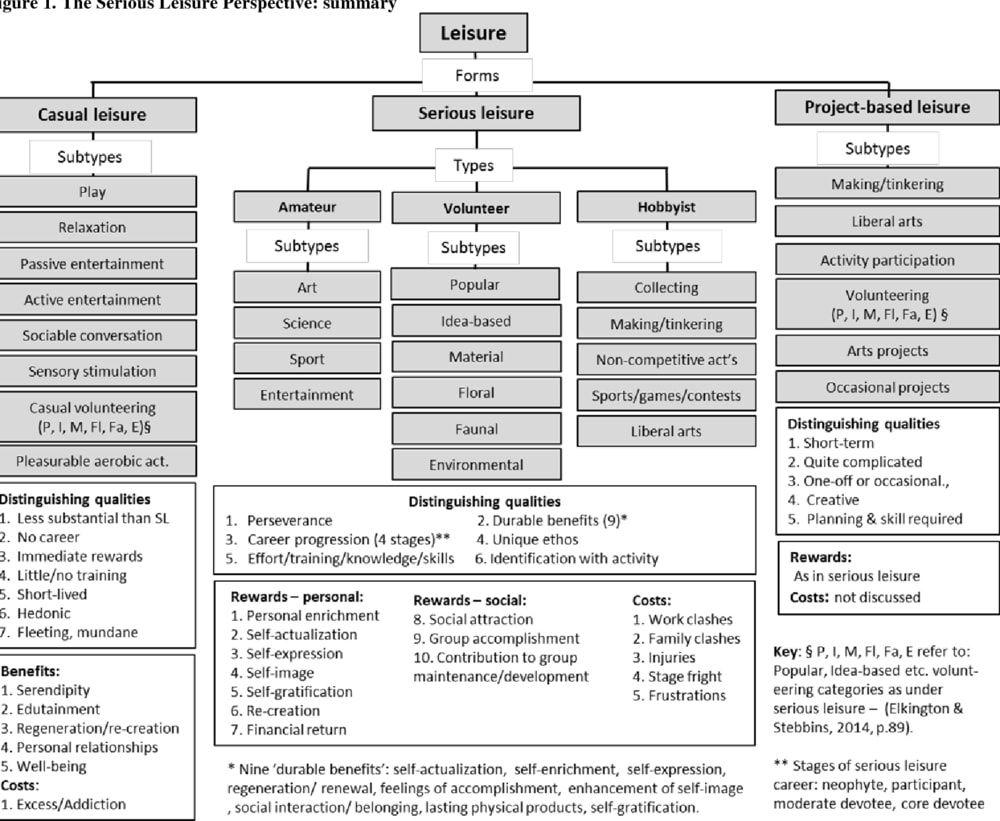
Serious Leisure Perspective (SLP) "In library and information science (LIS), we seek to understand the nature, organization, and use of information in life. Scholarship, to this end, has been unevenly distributed. Research has predominantly focused on academic or professional contexts, which are a narrow slice of the human experience. There are a minority of studies of information phenomena within everyday situations, and only a few about the universally cherished realm of leisure. As a result, theoretical insights about the engagement with information are unduly narrow and rational in character, and information provision to everyday life and leisure settings may fall short of potential. To broaden understanding and to better serve leisure audiences, I am exploring information phenomena in the context of serious leisure (Stebbins, 2001). To organize my research career, I draw upon the Serious Leisure Perspective (SLP), a grounded theory of leisure introduced in 1973 by sociologist Robert A. Stebbins. Serious leisure is the systematic pursuit of, "an activity that participants find so substantial and interesting that, in the typical case, they launch themselves on a leisure career centered on acquiring and expressing its special skills, knowledge, and experience" (Stebbins, 1992, p. 3)."
-
"China Vitae is a resource of biographical information on more than 5000 Chinese leaders in government, politics, the military, education, business, and the media":
http://www.chinavitae.com/ #Politics #SE #Research -
If and Then: A Critique of Speculative NanoEthics
https://link.springer.com/article/10.1007/s11569-007-0007-6
Abstract: Most known technology serves to ingeniously adapt the world to the physical and mental limitations of human beings. Humankind has acquired awesome power with its rather limited means. Nanotechnological capabilities further this power. On some accounts, however, nanotechnological research will contribute to a rather different kind of technological development, namely one that changes human beings so as to remove or reduce their physical and mental limitations.
The prospect of this technological development has inspired a fair amount of ethical debate. Here, proponents and opponents of such visions of human enhancement are criticized alike for engaging in speculative ethics. This critique exposes a general pattern that extends to other nano-, bio-, or neuroethical debates.
While it does not apply to all discussions of “enhancement technologies” it does apply to all ethical discourse that constructs and validates an incredible future which it only then proceeds to endorse or critique. This discourse violates conditions of intelligibility, squanders the scarce and valuable resource of ethical concern, and misleads by casting remote possibilities or philosophical thoughtexperiments as foresight about likely technical developments. In effect, it deflects consideration from the transformative technologies of the present. -
The Malicious Use of Artificial Intelligence:
Forecasting, Prevention, and MitigationThe report was written by 26 authors from 14 institutions, spanning academia, civil society, and industry. The report builds on a 2 day workshop held in Oxford, UK, in February 2017. More information can be found in Appendix A of the report.
Site: https://maliciousaireport.com
Research: https://arxiv.org/pdf/1802.07228.pdf
#ML #Ethics #Research