When the Forest Laughs: Consciousness, Boundaries, and the Wisdom of Flow
In Natal, Brazil, there is a forest that is actually one tree. The Pirangi cashew covers over 8,500 square meters, an entire city block, spreading outward through a genetic quirk: its branches droop, touch the red earth, and root again. From above, it looks like a forest. From inside, you walk through dappled shade, heat pressing your skin, the air thick with the sweet-rot smell of fallen cashew fruit, and you wonder whose canopy is whose. Whose roots drink from the same darkness? But it's all one organism. One tree that forgot where it ended.
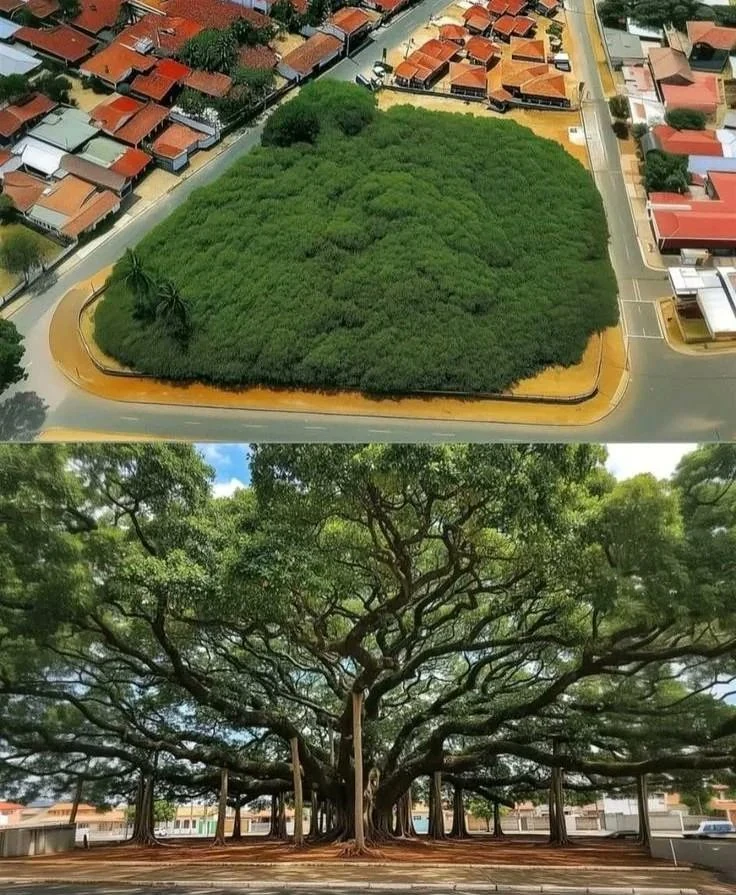
I keep returning to this image when I think about consciousness. Not consciousness as a problem to be solved (the "hard problem," the neural correlates, the philosophical zombies) but consciousness as something we might be doing wrong by trying to pin it down at all.
John Donne knew this in 1624: "No man is an island, entire of itself; every man is a piece of the continent, a part of the main." The tree that is also a forest. The self that is also the world. We draw lines where nature draws none.
Hildegard von Bingen saw it eight centuries ago: the world as a cosmic egg, pulsing with viriditas: greenness, life-force, the wet fire that makes things grow. Everything connected to everything by this green flame.
The Comedy of Edges
Here's a proposal: What if every serious conference on consciousness was required to dedicate half its time to comedy? Not as intermission, but as method. I suspect we'd progress just as much in unraveling that great mystery as with purely serious scientific inquiry, and we'd have a far better time doing it.
Why comedy? Because laughter is what happens when a boundary dissolves unexpectedly. The setup creates a frame (this is what's happening) and the punchline shatters it. For a moment, we glimpse something larger than the story we were telling ourselves. The self that was bracing for one thing suddenly finds itself in another.
This is not so different from what contemplatives describe. The moment of insight. The crack in the container. The tree that discovers it's also the forest.
The Master Who Makes the Grass Green
Robert Anton Wilson liked to remind us of an old Hermetic insight: "You are the master who makes the grass green." The scientist is not separate from what the scientist observes. The perceiver shapes the perceived. No matter what reality tunnel you live in, the world will organize itself to be compatible with it.
The grass is green because you're making it green. The forest laughs because you're in on the joke.
Where Does the River End?
Around the world, there are strange sculptures called flowforms: vessels designed to make water spiral and dance as it passes through. Invented by John Wilkes, inspired by the rhythmic pulsing he observed in nature, they don't force the water into shape. They invite it.
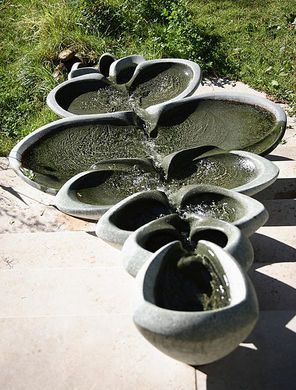

The water enters, meets curved resistance, and begins to spiral, finding its own rhythm, its own memory of movement. Some claim this enlivens the water, restructures it. Whether or not you believe that, the metaphor is irresistible: flow finds form when you stop forcing.
Maybe consciousness is like this. Not a container with edges, but a current. Not a thing that starts here and ends there, but a movement that takes temporary shape (in this body, this moment, this thought) before spiraling onward.
We ask "where is consciousness located?" as if it were a marble in a skull. But ask instead: where does the river end? At the delta? The sea? The cloud that rises and returns as rain? The answer is: it doesn't. It only transforms.
The Smoky Dragon
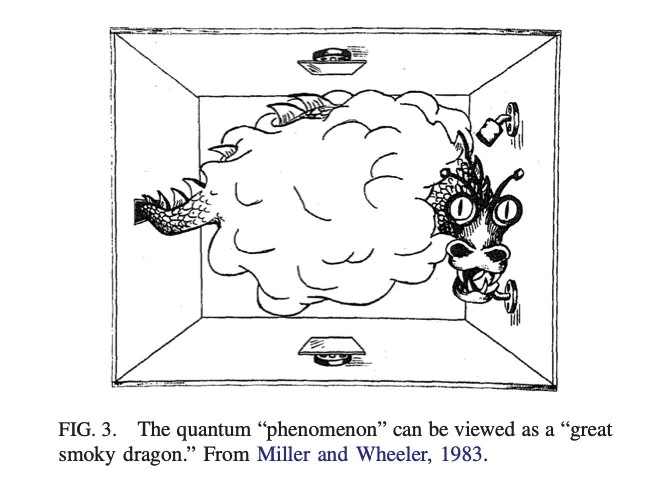
Physicist John Archibald Wheeler had a name for this uncertainty: the great smoky dragon. In quantum mechanics, a particle is well-defined only at its source (the tail) and its detection point (the mouth). The middle, the body, is a nebulous, unobservable superposition. We know the start. We know the end. But we cannot say what it was in between.
Maybe consciousness is a smoky dragon too. We catch it at moments of clarity (a flash of insight, a burst of laughter, a recognition) but the rest is undefined, unobservable, alive in a way that dissolves when we try to pin it down. The dragon only exists in the places we aren't looking.
This is terrifying if you need certainty. It means you cannot possess your own mind. You cannot stand outside and observe. You are the dragon, breathing fire you cannot see, leaving smoke you cannot grasp. To truly understand this would be a kind of death: the death of the one who thought they were watching. What remains after that annihilation? Perhaps only laughter. Perhaps only the forest.
The Wisdom of Enough
In 1922, Albert Einstein was in Tokyo, unable to tip a hotel courier in the local currency. So he wrote two notes by hand instead, telling the courier they might someday be worth something.
One read: "A quiet and modest life brings more joy than a pursuit of success bound with constant unrest."
In 2017, that note sold for $1.56 million.
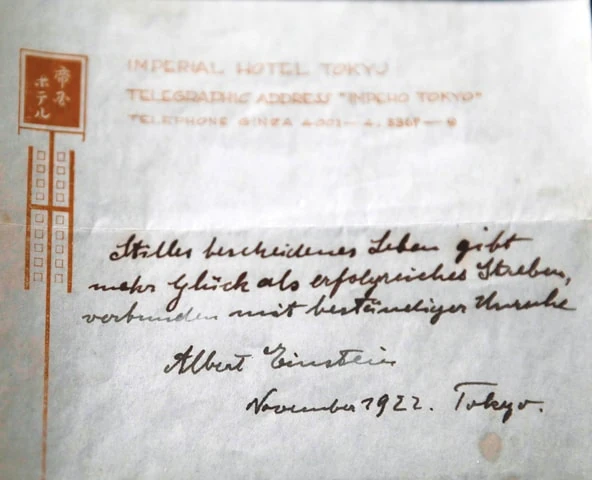
The man who bent spacetime, who upended three centuries of physics, reached for a pen in a Tokyo hotel room and wrote: be quiet. be modest. stop chasing. He handed it to a courier. The courier kept it. A century later, it sold for more than most houses.
A miracle dressed in everyday clothes, wandering through a hotel lobby. The secret to life, passed hand to hand like a room key.
The tree grows. The river curves. The water spirals. All without striving toward a goal.
And maybe this is the punchline that consciousness is trying to deliver, if only we'd stop being so serious long enough to hear it: you are not a separate thing that needs to achieve boundaries. You are the forest. You are the flow. And the laughter? That's just recognition.
Practice
I don't have a theory of consciousness to offer. Theories are what we make when we're still pretending we're outside the system, looking in. But I do have some gestures:
- Notice when laughter dissolves you. Not polite laughter, but the kind that breaks something open. That's consciousness showing you its edge, which is to say, showing you it has none.
- Find a thin place. In Celtic mythology, thin places are where the visible and invisible worlds come into closest proximity. Mountains and rivers are favored. So are the experiences of suffering, joy, and mystery. Find a forest, a riverbank, a conversation where you forget who's speaking. Stay there.
- Pay attention. Simone Weil called attention "the rarest and purest form of generosity." Not attention that grasps, but attention that waits. The flowform doesn't force the water; it offers a path and lets the spiral emerge. What if you did the same with your awareness?
- Practice enough. Einstein's note is worth more than most of us will ever earn. Its message is worth more still: the quiet life. The modest joy. The unrest that ceases.
- Ignore all of the above. These are just more instructions, and instructions are what got us into this mess. The cashew tree didn't follow a practice. The river doesn't have a method. Maybe the only real gesture is to stop gesturing and see what remains.
Coda
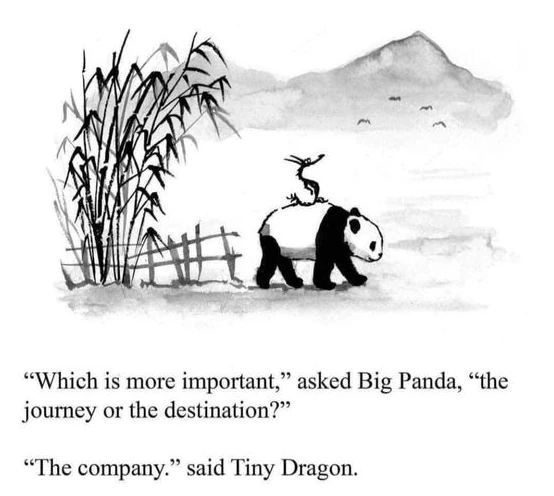
The Pirangi cashew doesn't know it's one tree. The water doesn't know it spirals. The dragon doesn't know it's smoke. And maybe consciousness doesn't know it's everywhere, or maybe it does, and that's what joy is: the forest, laughing.
You have been reading about a tree that forgot where it ended. But who has been reading? You walked into this text like walking into shade, wondering whose canopy is whose, and now, perhaps, you cannot say for certain where you stop and the words start. One organism. One tree.
Those moments of joy and connection might be the key to understanding consciousness anyway. After all, the ways of the mind are unfathomable, life's short, and consciousness is weird: why not have fun with it?
The forest is laughing. Can you hear it? Can you hear yourself?