tag > KM
-
Exapt, Adapt, Disrupt: A Conceptual Framework for Systemic Innovation - by Jacqueline Fendt
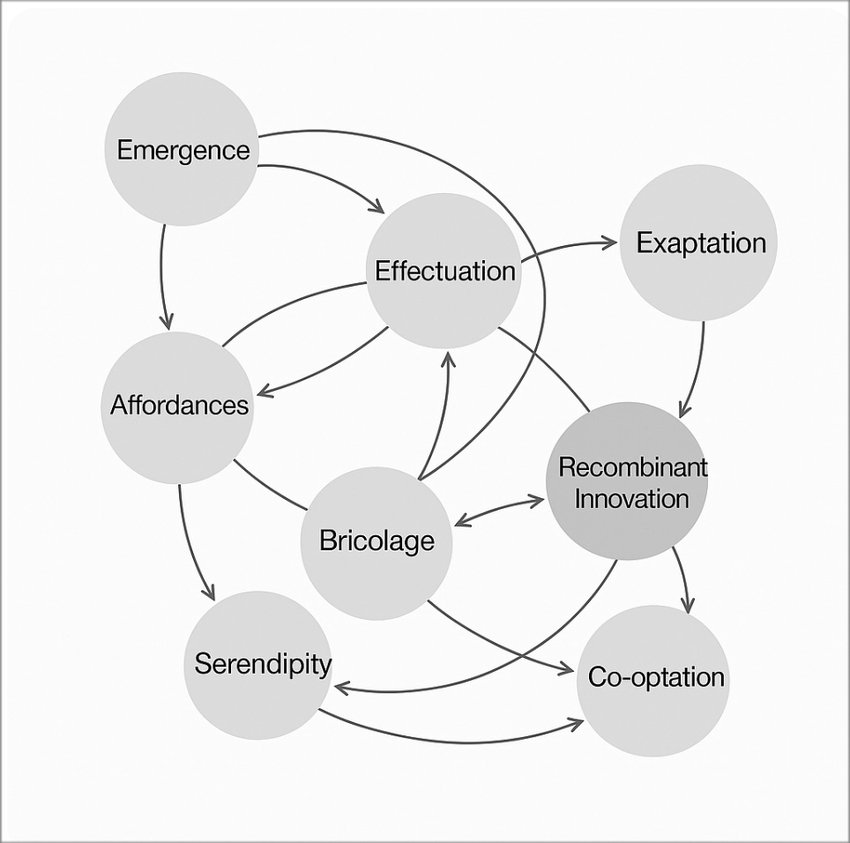
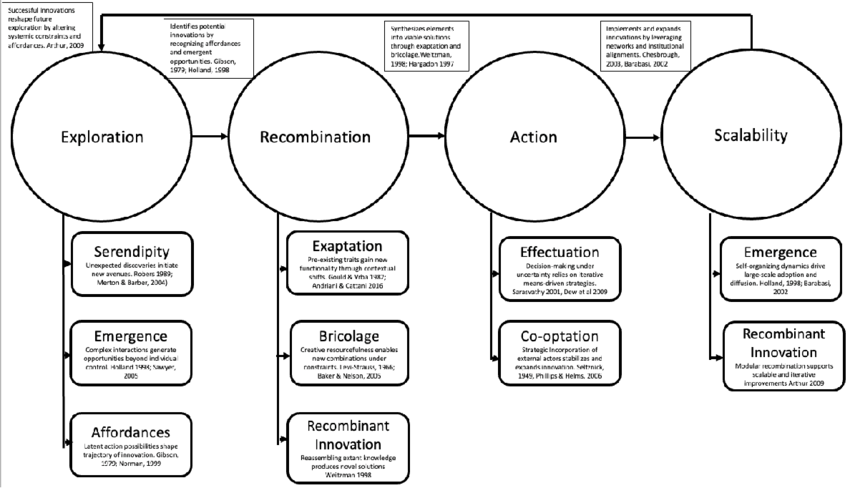
Abstract: How do breakthroughs emerge in unpredictable environments? This paper develops a unified framework for systemic innovation by integrating eight key concepts: exaptation, serendipity, emergence, co-optation, bricolage, affordances, recombinant innovation, and effectuation. By synthesizing insights from complexity science, sociology, and entrepreneurship, we reveal how creativity flourishes when innovators repurpose existing elements, harness uncertainty, and leverage unexpected affordances. Unlike conventional models that emphasize structured problem-solving, this framework captures the nonlinear, adaptive, and systemic nature of creativity in innovation ecosystems. We illustrate its applicability across diverse cases—from the exaptation of mRNA vaccines to the recombinant innovation of AI-driven drug discovery, the co-optation of gig work by tech giants, and the emergence of decentralized finance. Our findings suggest that transformative creativity is not a solitary act, but an emergent systems-level process shaped by adaptive recombination and strategic improvisation. By shifting the focus from predictive planning to creative adaptation, this study provides a novel roadmap for navigating uncertainty and fostering systemic change. It offers both scholars and practitioners an actionable lens to harness creativity, unlock latent affordances, and scale innovation in complex environments.
#Complexity #Science #ML #Creativity #Systems #KM #Generative #Augmentation
-
Second-Order Thinking
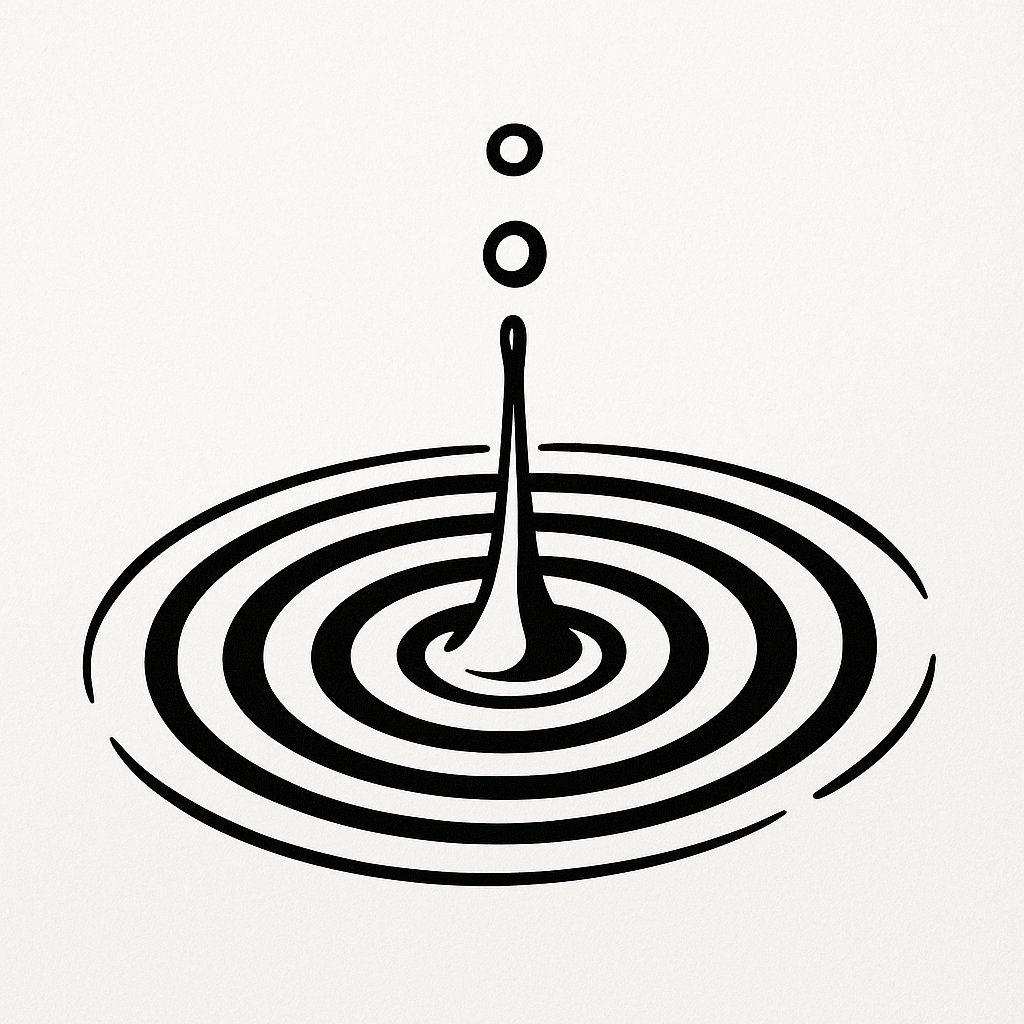
1. Predicting the direct consequences of one's actions is first-order thinking; second-order thinking requires us to think more long-term and holistically, considering the consequences behind the consequences. Therefore, this concept is often referred to as the "Law of Unintended Consequences."
2. We need to be aware of second-order outcomes and use the predicted results to guide our decision-making.
-
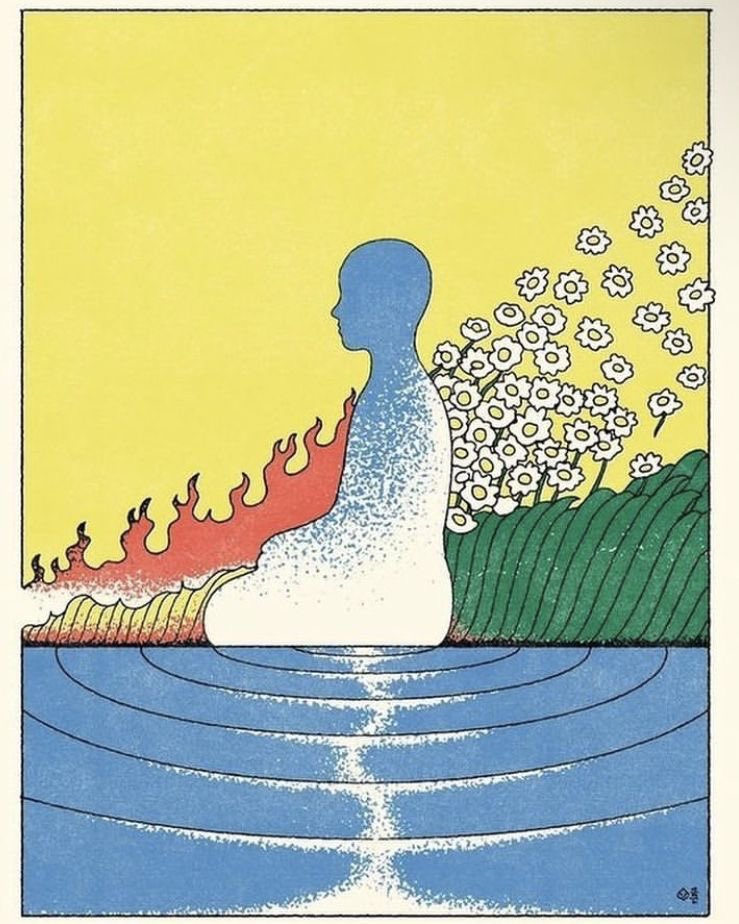
A 'Type three' error is not noticing that the ordinary is the extraordinary.
"A 'Type one' error is thinking that something special is happening when nothing special really is happening. A 'Type two' error is thinking that nothing special is happening, when in fact something rare or infrequent is happening." - Marcello Truzzi
-
Plotting the Pareto frontier of global scientific knowledge throughout history has become surprisingly feasible. The resulting patterns and models are both peculiar and illuminating.
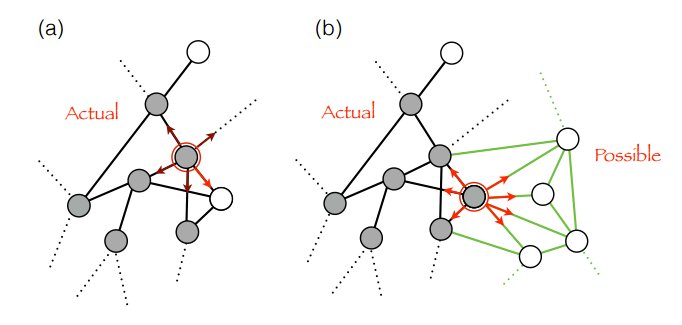
Image from: Dynamics on Expanding Spaces: Modeling the Emergence of Novelties (2017)
-
AI will fundamentally reshape how science is conducted and we’ve barely scratched the surface. Efforts like “The AI Scientist” from @hardmaru @SakanaAILabs are promising first steps, but the space of radically novel methods remains largely unexplored. Who's working on it?
-
Want this: An Intelligent Reading Assistant that helps you transform any text across levels of abstraction.
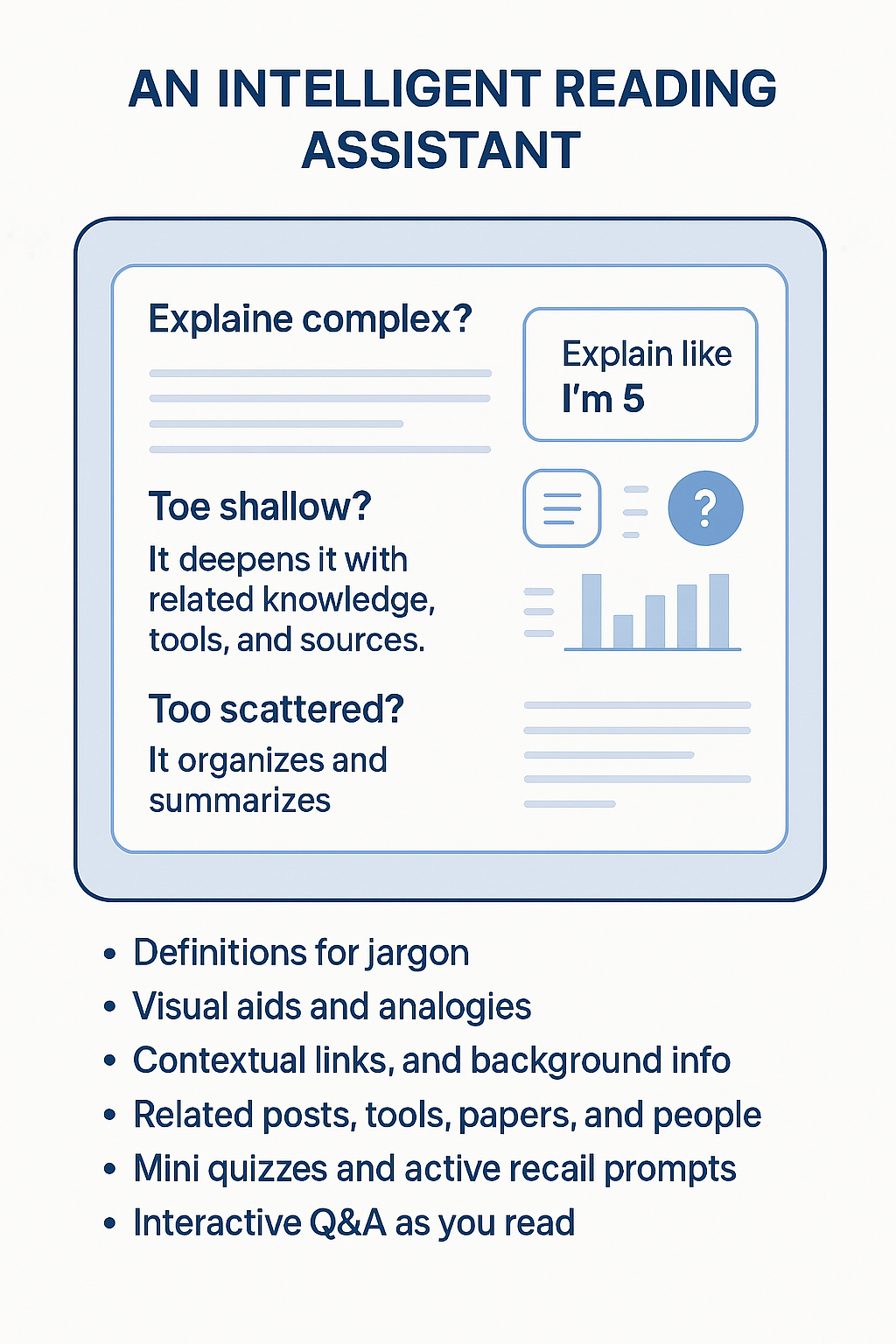
Text too complex? It makes it understandable, tailored to your level.
Too shallow? It deepens it with related knowledge, tools, and sources.
Too scattered? It organizes and summarizes.You give it a book, paper, or post—along with your goals and background—and it reshapes the material in real time to fit you.
It adds:
- “Explain like I’m 5” summaries
- Definitions for jargon
- Visual aids and analogies
- Contextual links and background info
- Related posts, tools, papers, and people
- Mini quizzes and active recall prompts
- Interactive Q&A as you read
Like a personalized tutor + research assistant + thought partner—living in the margins of whatever you're reading.
Would you use this?
-
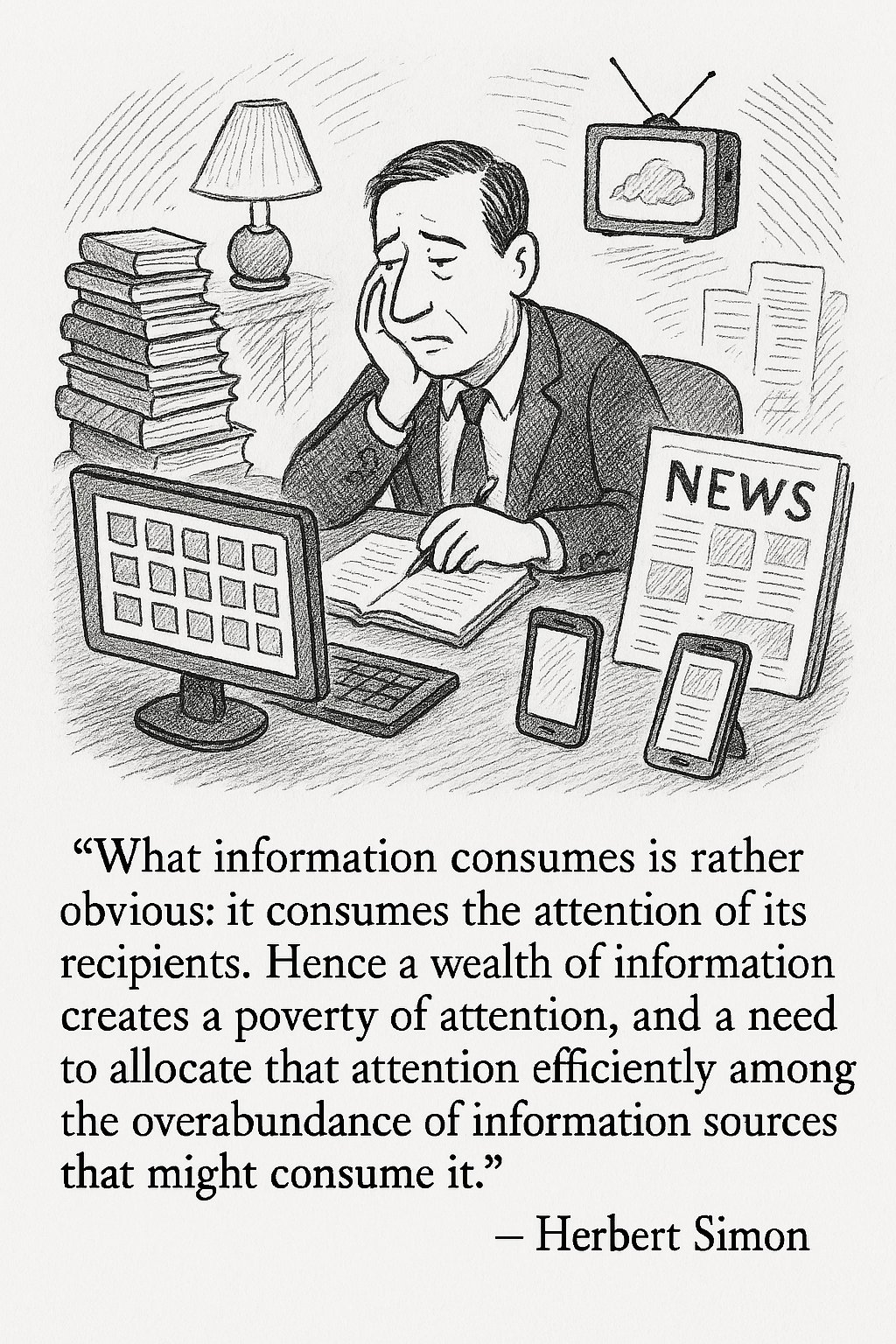
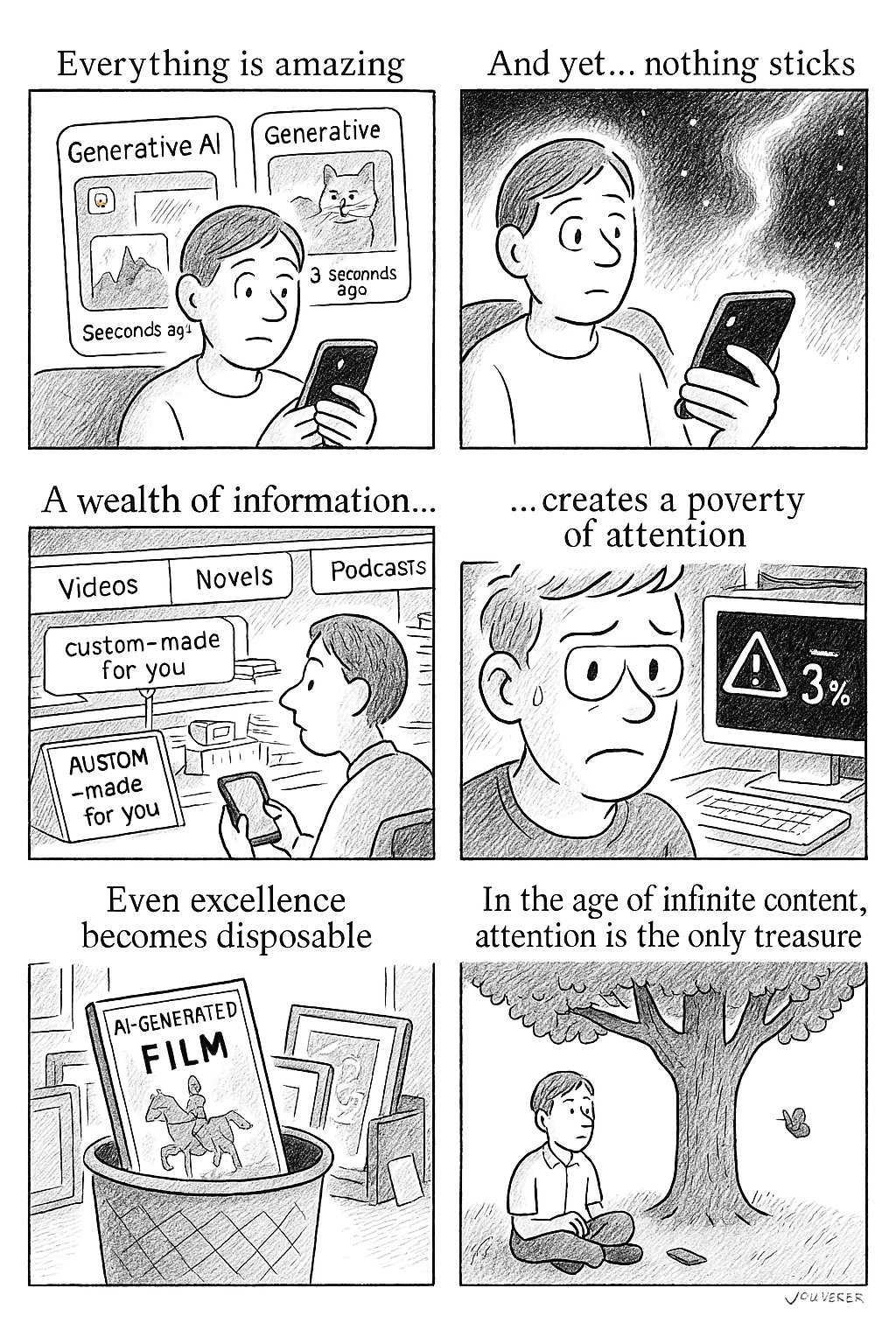
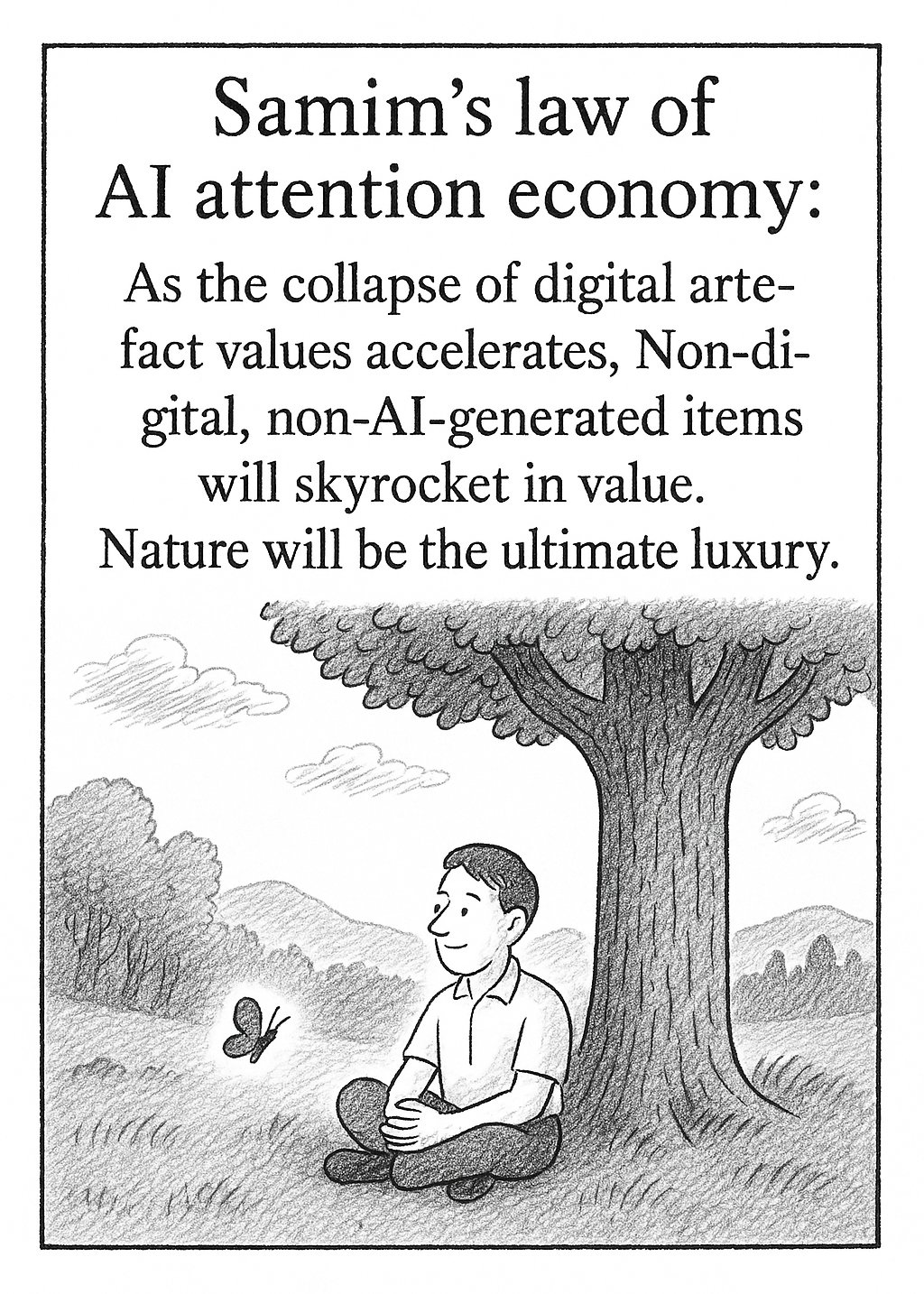
As the volume and quality of media content grows exponentially due to Generative AI, our attention becomes increasingly fragmented. Each artifact receives less of our time, and paradoxically, its perceived value diminishes despite much higher quality. Simon's insight on attention scarcity has never been more relevant. Consider Samim's law of AI attention economy: As the collapse of digital artefact values accelerates, Non-digital, non-AI-generated items will skyrocket in value. Nature will be the ultimate luxury.
-
If you don't understand Biosemiotics, don't worry—just check out this cartoon. You likely will end up even more puzzled, but at least you'll have a laugh.
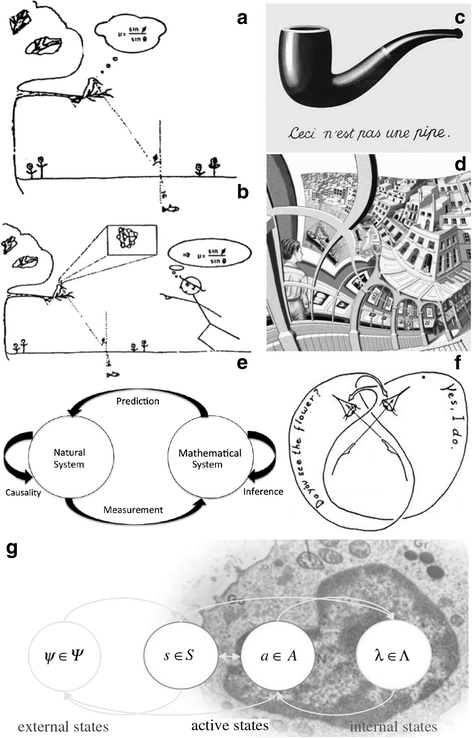
Constructivist biosemiotics foundations. a, bPunch’s cartoon that show succinctly the cognitivist third-person hypothesis and the alternative one. a In the cognitivist third-person hypothesis, to catch his prey, for the observer, the kingfisher must represent in its brain the Snell’s refraction law by information processing. b The constructivist lecture show how the significance levels can be seen arising from the underlying structural network of the kingfisher and the model of the observer. c René Magritte’s painting (1928–29) pointing out the levels of realms in cognitive relations. A painted pipe is just an approximate map of a real pipe. d M.C. Escher’s Print Gallery lithograph showing how a young man is standing inside the same print as the one he is looking at. A constructivist interpretation in first-person indicates that what is observed is an active and enactive relation of the observer, depicting the complex closed loop of embodiment relations. e Rosen’s Modeling Relation shows that the observation of natural systems, governed by causal relations, is a cognitive act reflected in the relations of measurement and prediction subject to mathematical systems of inferential rules. If the mathematical system corresponds to the causal relations, then it can be assumed as a ‘Natural Law’. f Maturana draws how nervous system, though organizationally closed, use language to loop-through the other. g Minimization of free energy by active inference and prediction error indicates one possible formal representation of cognition and autopoiesis
"The process of message exchanges, or semiosis, is an indispensable characteristic of all terrestrial life forms. It is this capacity for containing, replicating, and expressing messages, of extracting their signification, that, in fact, distinguishes them more from the nonliving - except for human agents, such as computers or robots, that can be programmed to simulate communication - than any other traits often cited. The study of the twin processes of communication and signification can be regarded as ultimately a branch of the life science, or as belonging in large part to nature, in some part to culture, which is, of course, also a part of nature." (Sebeok 1991: 22)
"The life science and the sign science thus mutually imply one another." (Sebeok 1994: 114)
"Biosemiotics proper deals with sign processes in nature in all dimensions, including (1) the emergence of semiosis in nature, which may coincide with or anticipate the emergence of living cells; (2) the natural history of signs; (3) the 'horizontal' aspects of semiosis in the ontogeny of organisms, in plant and animal communication, and in inner sign functions in the immune and nervous systems; and (4) the semiotics of cognition and language. /../ Biosemiotics can be seen as a contribution to a general theory of evolution, involving a synthesis of different disciplines. It is a branch of general semiotics, but the existence of signs in its subject matter is not necessarily presupposed, insofar as the origin of semiosis in the universe is one of the riddles to be solved." (Emmeche 1992: 78)
"A modern unification of biology /../ has to be based on the fundamentally semiotic nature of life." (Hoffmeyer 1997)
"The most pronounced feature of organic evolution is not the creation of a multiplicity of amazing morphological structures, but the general expansion of 'semiotic freedom', that is to say the increase in richness or 'depth' of meaning that can be communicated" (Hoffmeyer 1996: 61).
"The sign rather than the molecule is the basic unit for studying life." (Hoffmeyer 1995: 369)
"Sign processes penetrate the entire body of an organism. [...] Signification is the fundamental property of living systems that can be taken as a definition of life. Hence, biosemiotics can be viewed as a root of both biology and semiotics rather than a branch of semiotics." (Sharov 1998: 404-405)
"Biosemiotics can be defined as the science of signs in living systems. A principal and distinctive characteristic of semiotic biology lays in the understanding that in living, entities do not interact like mechanical bodies, but rather as messages, the pieces of text. This means that the whole determinism is of another type. /../ The phenomena of recognition, memory, categorization, mimicry, learning, communication are thus among those of interest for biosemiotic research, together with the analysis of the application of the tools and notions of semiotics (text, translation, interpretation, semiosis, types of sign, meaning) in the biological realm." (Kull 1999: 386)
"With the discovery that a set of symbols has been used by nature to encode the information for the construction and maintenance of all living things, semiotics - the analysis of languages and texts as sets of signs and symbols - has become relevant to molecular biology. Semiotics has given students of the DNA text a new eye for reading, allowing us to argue for the validity of a multiplicity of meanings, or even for the absence of any meaning, in a stretch of the human genome." (Pollack 1994: 12)
-
"Only puny secrets need protection. Big discoveries are protected by public incredulity." - Marshall McLuhan