tag > ML
-
Eye-catching advances in some AI fields are not real

Artificial intelligence (AI) just seems to get smarter and smarter. Each iPhone learns your face, voice, and habits better than the last, and the threats AI poses to privacy and jobs continue to grow. The surge reflects faster chips, more data, and better algorithms. But some of the improvement comes from tweaks rather than the core innovations their inventors claim -- and some of the gains may not exist at all, says Davis Blalock, a computer science graduate student at the Massachusetts Institute of Technology (MIT). Blalock and his colleagues compared dozens of approaches to improving neural networks -- software architectures that loosely mimic the brain. "Fifty papers in," he says, "it became clear that it wasn't obvious what the state of the art even was." The researchers evaluated 81 pruning algorithms, programs that make neural networks more efficient by trimming unneeded connections. All claimed superiority in slightly different ways. But they were rarely compared properly -- and when the researchers tried to evaluate them side by side, there was no clear evidence of performance improvements over a 10-year period. The result, presented in March at the Machine Learning and Systems conference, surprised Blalock's Ph.D. adviser, MIT computer scientist John Guttag, who says the uneven comparisons themselves may explain the stagnation. "It's the old saw, right?" Guttag said. "If you can't measure something, it's hard to make it better."
-
How Baidu’s AI produces news videos using just a URL
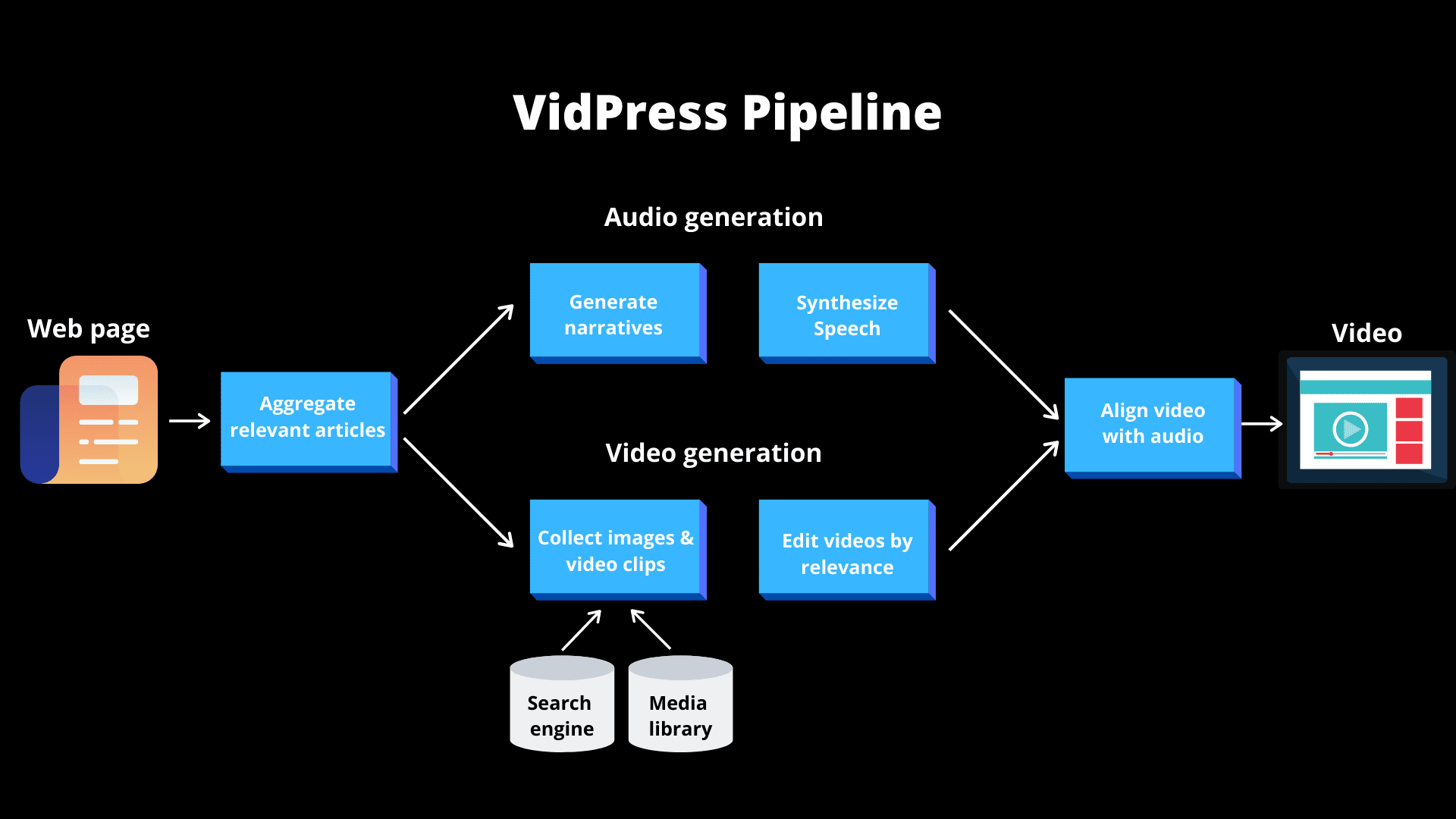
AI for news production is one of the areas that has drawn contrasting opinions. In 2018, an AI anchor developed by China's Xinhua news agency made its debut. Earlier this month, the agency released an improved version that mimics human voices and gestures. There's been advancement in AI with text-based news with algorithms writing great headlines. Baidu has developed a new AI model called Vidpress that brings video and text together by creating a clip based on articles.
-
How this AI-powered auto-completer is helping developers write 25% less code
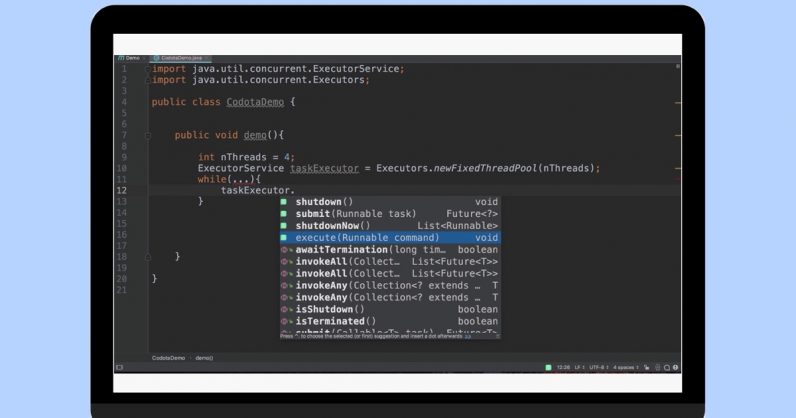
The Israel-based startup was found in 2015 by Dror Weiss and Eran Yahav. Codota’s free-to-use autocomplete plug-in supports major languages such as Java, Python, Javascript, PHP, and Rust across major IDEs such as Eclipse and Android Studio. Yahav told me that Codota differs from other code completion AIs as it’s able to predict the next token completion by leaning on an AI-based code ‘dictionary.’
-
Booz Allen Hamilton wins massive Pentagon artificial intelligence contract
Booz Allen Hamilton won a five-year, $800 million task order to provide artificial intelligence services to the Department of Defense’s Joint Artificial Intelligence Center (JAIC). Under the contract award, announced by the General Services Administration and the JAIC on May 18, Booz Allen Hamilton will provide a “wide mix of technical services and products” to support the JAIC, a DoD entity dedicated to advancing the use of artificial intelligence across the department.
The Pentagon’s Joint AI Center wants to be like Silicon Valley
It was a busy week for defense-focused AI: DarwinAI signed a partnership with Lockheed Martin, the world’s largest defense contractor, to work on explainable AI solutions. Robotics company Sphero, maker of the BB-8 droid from Star Wars, spun out Company Six, which will focus on military and emergency medical applications. And Google Cloud was awarded a Pentagon contract for its multi-cloud solution Anthos this week, even though the $10 billion JEDI contract between AWS and Microsoft Azure is still tied up in courts.
-
FEMA Tells States to Hand Public Health Data Over to Palantir

"If their AI learns to infer and predict patterns of the disease from our public data, then that becomes a hugely lucrative advantage for Palantir, especially now when every business sector wants to know where COVID is going and how hard it’s going to hit"
-
Chinese state news agency unveils 'the world's first 3D AI anchor' after 'cloning' a human
Xinhua reveals its first AI-powered newsreader using 3D modelling technology. Footage shows the lifelike virtual presenter making her debut in a virtual studio. Developers said they 'cloned' the looks and actions of a journalist at the agency.



-
Queen Elizabeth II reads "Wannabe" by Spice Girls (Speech Synthesis)
-
Milton Friedman reads "P.I.M.P" by 50 Cent (Speech Synthesis)
Notorious B.I.G., Dead Wrong vs. Book of Genesis remix by DJ Jimbo
-
Machine Learning Depth Inpainting of Claude Monet Paintings: Using 3D Photography using Context-aware Layered Depth Inpainting : https://arxiv.org/abs/2004.04727
-
Vocal Synthesis Video of "Jay Z" singing Christian Rap Song (Genesis 1:1 Lyrics)
-
ByteSing: A Chinese Singing Voice Synthesis System Using Duration Allocated Encoder-Decoder Acoustic Models and WaveRNN Vocoders
pdf: https://arxiv.org/pdf/2004.11012.pdf abs: https://arxiv.org/abs/2004.11012 audio samples: https://bytesings.github.io/paper1.html
-
OpenAI’s Jukebox Opens the Pandora’s Box of AI-Generated Music (waxy) - OpenAI’s Jukebox AI produces music in any style from scratch — complete with lyrics (venturebeat)
Today, research laboratory OpenAI announced Jukebox, a sophisticated neural network trained on 1.2 million songs with lyrics and metadata, capable of generated original music in the style of various artists and genres, complete with rudimentary singing and vocal mannerisms.
"In this example, the Jukebox AI is fed the lyrics from Eminem’s “Lose Yourself” and told to generate an entirely new song in the style of Kanye West.":
-
ByteSing: A Chinese Singing Voice Synthesis System Using Duration Allocated Encoder-Decoder Acoustic Models and WaveRNN Vocoders (Audio Samples)
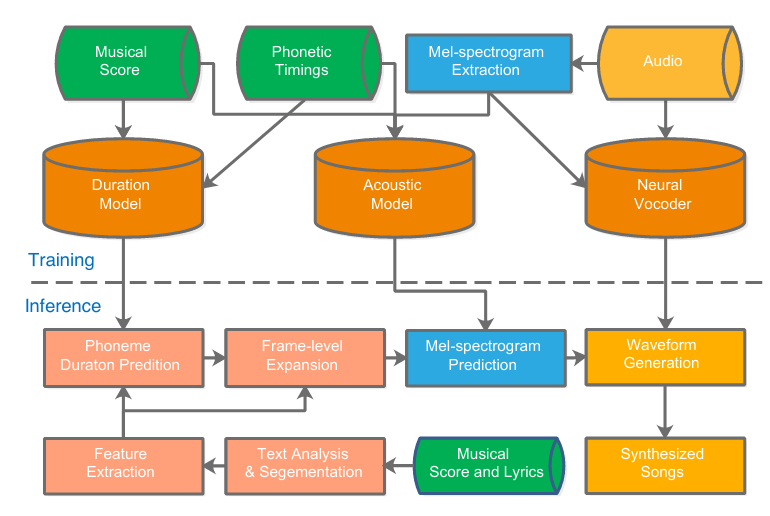
This paper presents ByteSing, a Chinese singing voice synthesis (SVS) system based on duration allocated Tacotron-like acoustic models and WaveRNN neural vocoders. Different fromthe conventional SVS models, the proposed ByteSing employs Tacotron-like encoder-decoder structures as the acoustic models, in which the CBHG models and recurrent neural networks (RNNs) are explored as encoders and decoders respectively.
-
With questionable copyright claim, Jay-Z orders deepfake audio parodies off YouTube
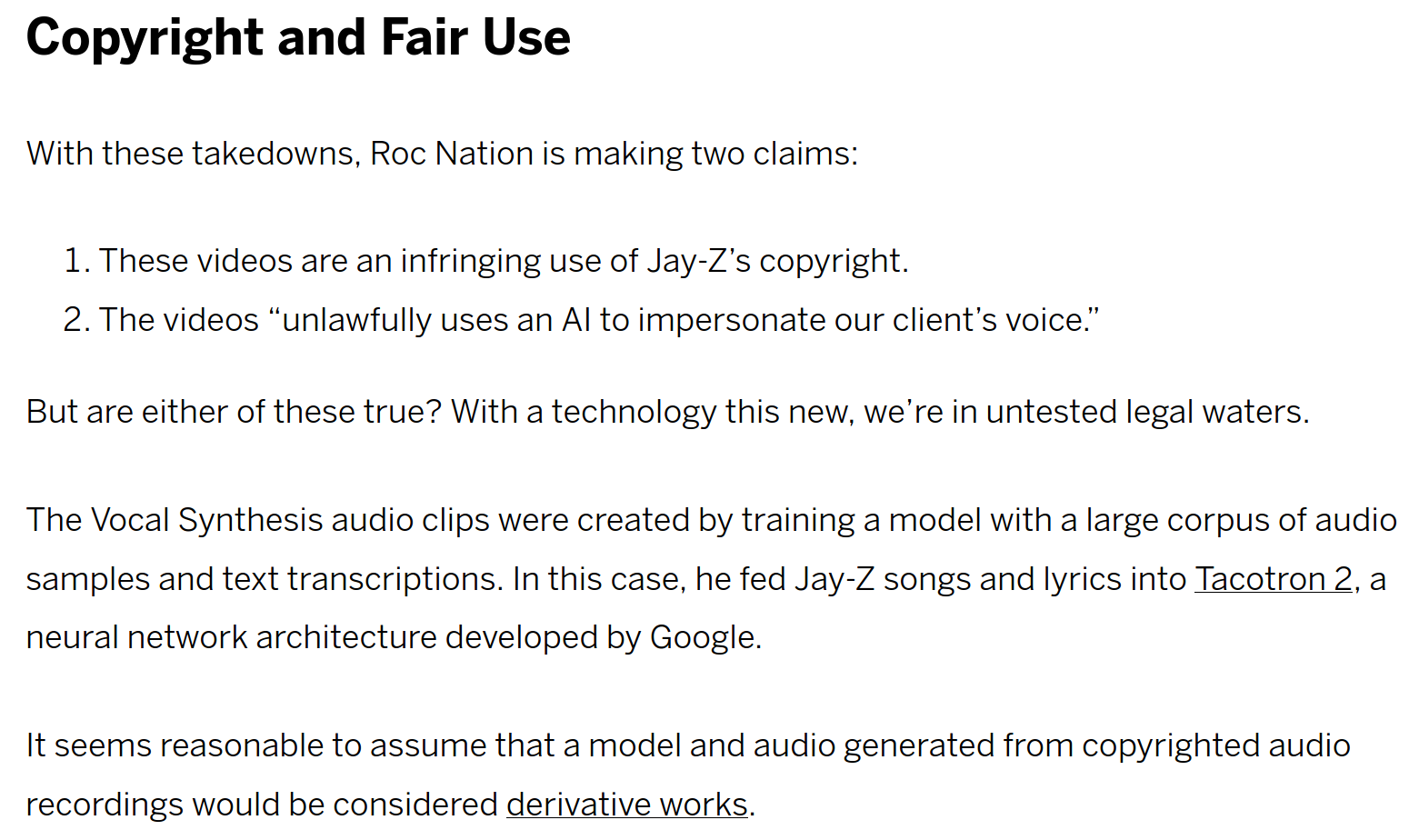
On Friday, I linked to several videos by Vocal Synthesis, a new YouTube channel dedicated to audio deepfakes — AI-generated speech that mimics human voices, synthesized from text by training a state-of-the-art neural network on a large corpus of audio.
-
Chinese Tech Landscape Overview - by National Security Commission on Artificial Intelligence
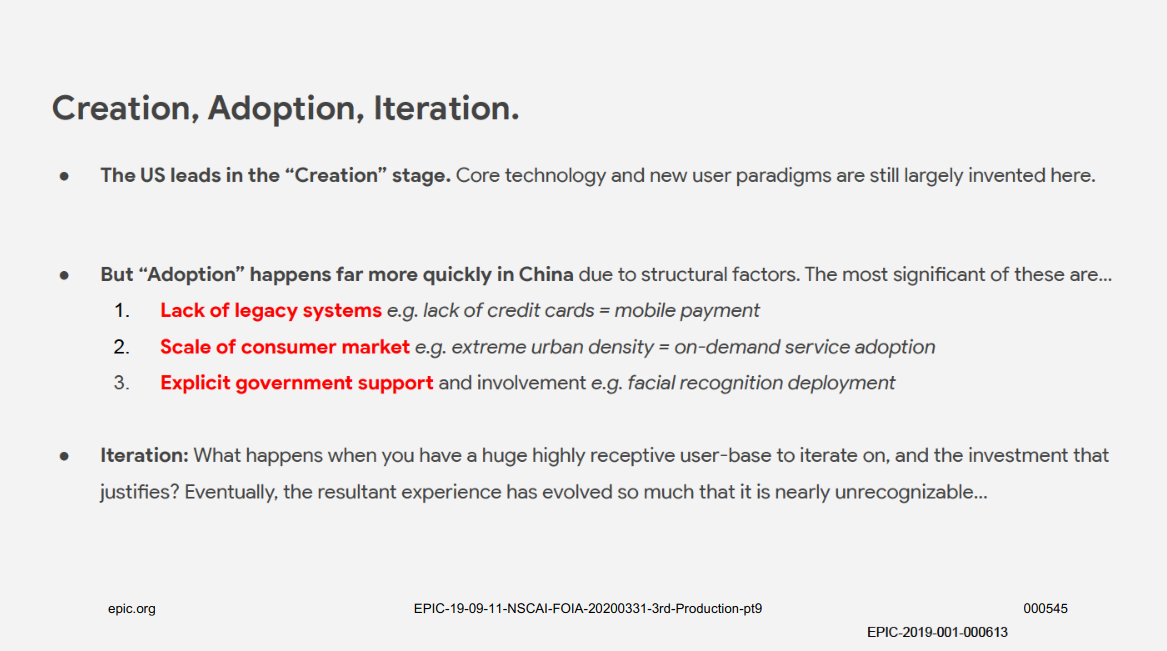
The National Security Commission on Artificial Intelligence (NSCAI) was established in August 2018 as part of the military budget "to consider the methods and means necessary to advance the development of artificial intelligence, machine learning, and associated technologies to comprehensively address the national security and defense needs of the United States."