-
The Demiurge & the Crooked Tree
Around 360 BC Plato described a god who builds the world with geometry. This is how that idea travelled through cathedrals, lodges and laboratories into today's AI labs, and what a tree that nobody built has to say about it.
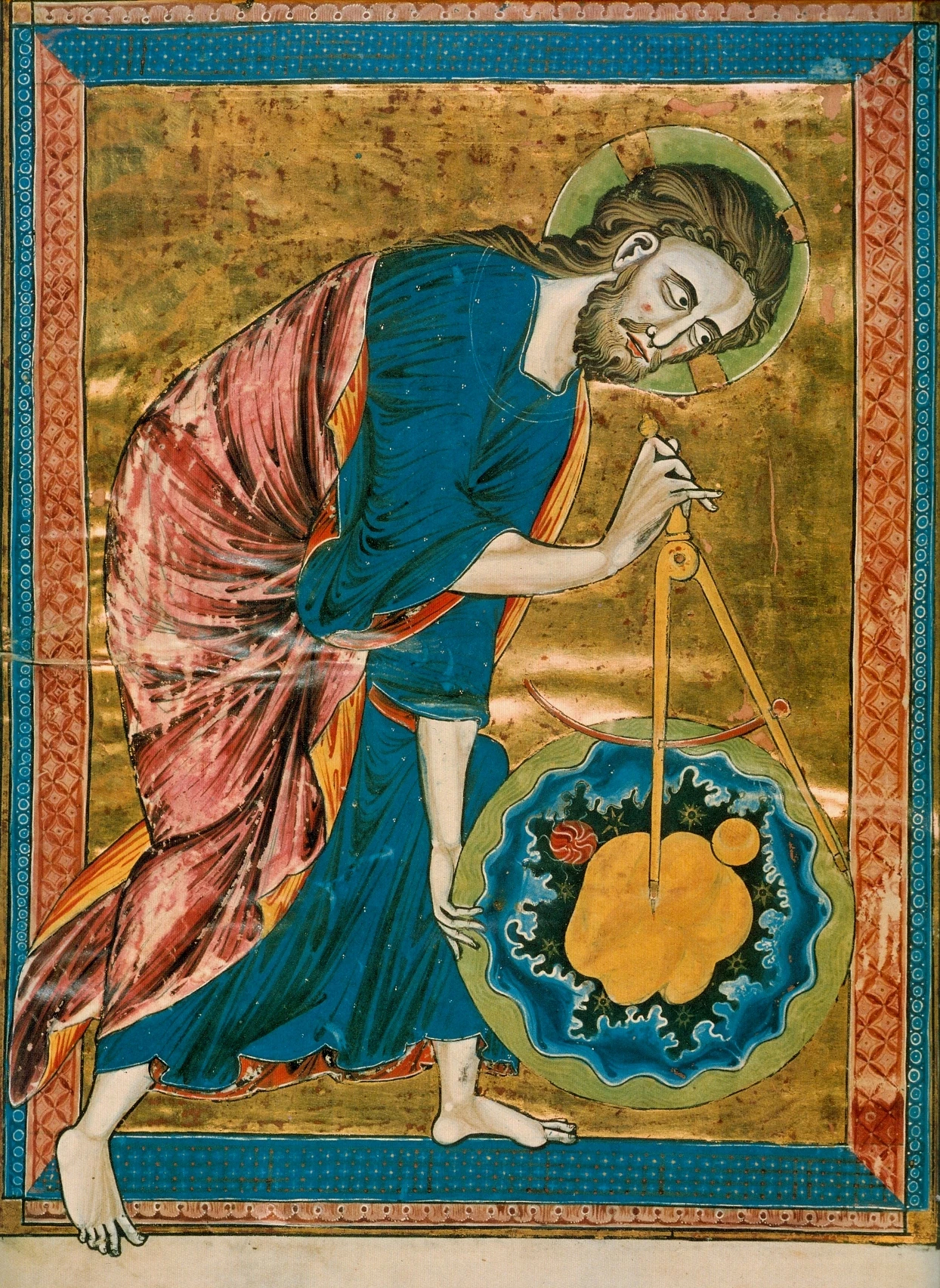
God as architect of the universe. Bible moralisée, France, c. 1220s. Vienna, ÖNB Cod. 2554. Few people today have read Plato's Timaeus, yet few books have shaped Western thought as much. The philosopher Alfred North Whitehead said that European philosophy is "a series of footnotes to Plato". Many of those footnotes lead back to this one dialogue.
When Raphael painted The School of Athens in the Vatican, he placed Plato at the centre with a book under his arm. It is not the Republic. It is the Timaeus. Plato points upward, toward the eternal. Beside him, Aristotle holds his hand flat, palm down, toward the earth. The two gestures sum up two ways of looking for order: above the world, or inside it.
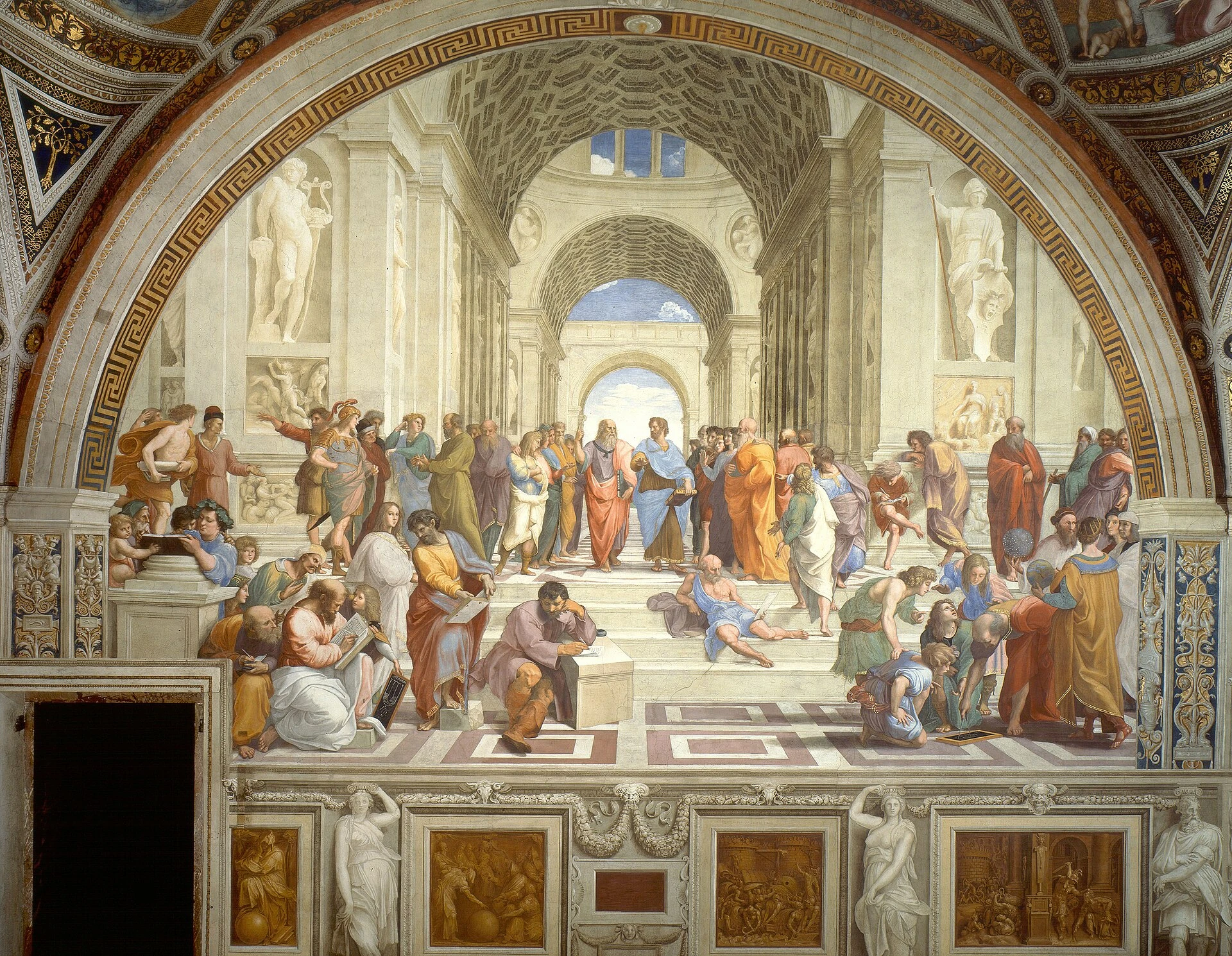 TIMEO · ETICA
Raphael, The School of Athens, 1509–11. As the picture zooms in, the titles become readable: TIMEO for Plato, ETICA for Aristotle. Public domain. For about seven centuries, for most readers in Latin Europe, the Timaeus simply was Plato. In the 4th century a scholar named Calcidius translated its first half into Latin and added a long commentary, and the cathedral schools of the Middle Ages grew up on that translation. It is often said that Plato was lost to the West until the Renaissance. This is not quite true. The Timaeus was the part of Plato that stayed.
The same dialogue is also where the story of Atlantis first appears. We will meet it again later.
I should say at the start where this essay is going. The creation story in the Timaeus can be laid next to the way today's AI labs describe their work, and the two match closely, step by step. If you are short of time, you can go straight to that comparison. But the history explains why the match exists, so I recommend the longer road.
α΄A likely story
The dialogue takes place the day after Socrates has described his ideal city. He says he would like to see such a city in action. Critias offers the tale of Atlantis, which he says reached Athens from Egyptian priests through the statesman Solon. Then Timaeus, an astronomer from Locri in southern Italy, takes over. In one long speech he describes the whole universe from its beginning: the gods, the stars, the elements, the soul, and even the bone marrow, the liver and disease.
Before he begins, he warns his listeners. What he is about to tell, he says, is an eikōs muthos (εἰκὼς μῦθος), a likely story. Eternal things can be known exactly. The things we see and touch, which are always changing, can only be described in a way that is probable. So Timaeus offers the best account he can, and no more.
This warning matters, and I will come back to it, because most of Plato's later readers forgot it.
The universe of the Timaeus rests on three principles:
ΝοῦςIntellect · The DemiurgeA divine craftsman. He does not create from nothing. He finds matter "in discordant and disorderly motion" and puts it in order, because he is good and wants everything to be as good as possible. His model is the eternal Forms.
ἈνάγκηNecessity · The ReceptacleThe chōra: a neutral space in which things appear and dissolve, "the nurse of all becoming". Plato admits we can grasp it only "by a kind of bastard reasoning", as if in a dream.
ΨυχήThe World SoulThe cosmos is a single living creature with a body and a soul. The soul is mixed from Being, Sameness and Difference, and it is what makes the heavens turn in regular circles.
Time comes from this as well. Plato calls it "a moving image of eternity": the steady turning of the heavens is a moving copy of something that does not move.
There is one more detail, and later readers usually skipped it. Matter resists. Plato calls this resistance Necessity, or the "wandering cause". The craftsman does not defeat Necessity. He persuades her:
Reason overruled Necessity by persuading her to guide the greater part of the things that come to be toward what is best.Timaeus 48a
Note the words "the greater part". Not everything. Plato left a margin in his cosmos where the craftsman does not get his way. Most of the traditions that followed him quietly removed it.
β΄Fire is made of pyramids
Then Plato does something remarkable for the 4th century BC. He proposes a theory of atoms. His atoms are not small balls, as they were for Democritus. They are triangles.
There are two kinds: half of an equilateral triangle (angles of 30°, 60° and 90°) and half of a square (45°, 45° and 90°). Triangles combine into faces, faces into solids, and each solid is an element. Fire is the pyramid, the tetrahedron, which is why, Plato says, fire feels sharp: it cuts. Choose an element below, drag it to turn it, and show the atoms to see its triangles.
Open the post page for the interactive Platonic solids.
The system has a curious property. When fire cuts a particle of water, the water breaks into one particle of fire and two of air. Water has twenty triangular faces, fire has four and each air has eight, so twenty faces go in and twenty come out. The triangles are conserved. More than two thousand years before physicists wrote down the conservation of energy, Plato wrote down a conservation law for triangles.
Earth is the exception. Its cube is built from the other kind of triangle, so it cannot trade with the rest. It breaks apart, drifts, and comes back together, but always as earth.
There are five regular solids and only four elements. The fifth, the dodecahedron, gets a single mysterious sentence: the god used it "for the whole, embroidering it with figures". It cannot be built from Plato's triangles at all. The one shape that does not fit the system becomes the shape of heaven.
These ideas lasted a long time. In the spring of 1919, during the street fighting in Munich, the seventeen-year-old Werner Heisenberg was posted on the roof of a seminary, and in the quiet mornings he read the Timaeus in Greek. He thought the triangle atoms were absurd. But he could not let go of the idea that the smallest parts of matter might be mathematical forms rather than tiny objects. Many years later he wrote that modern physics had "definitely decided in favor of Plato".
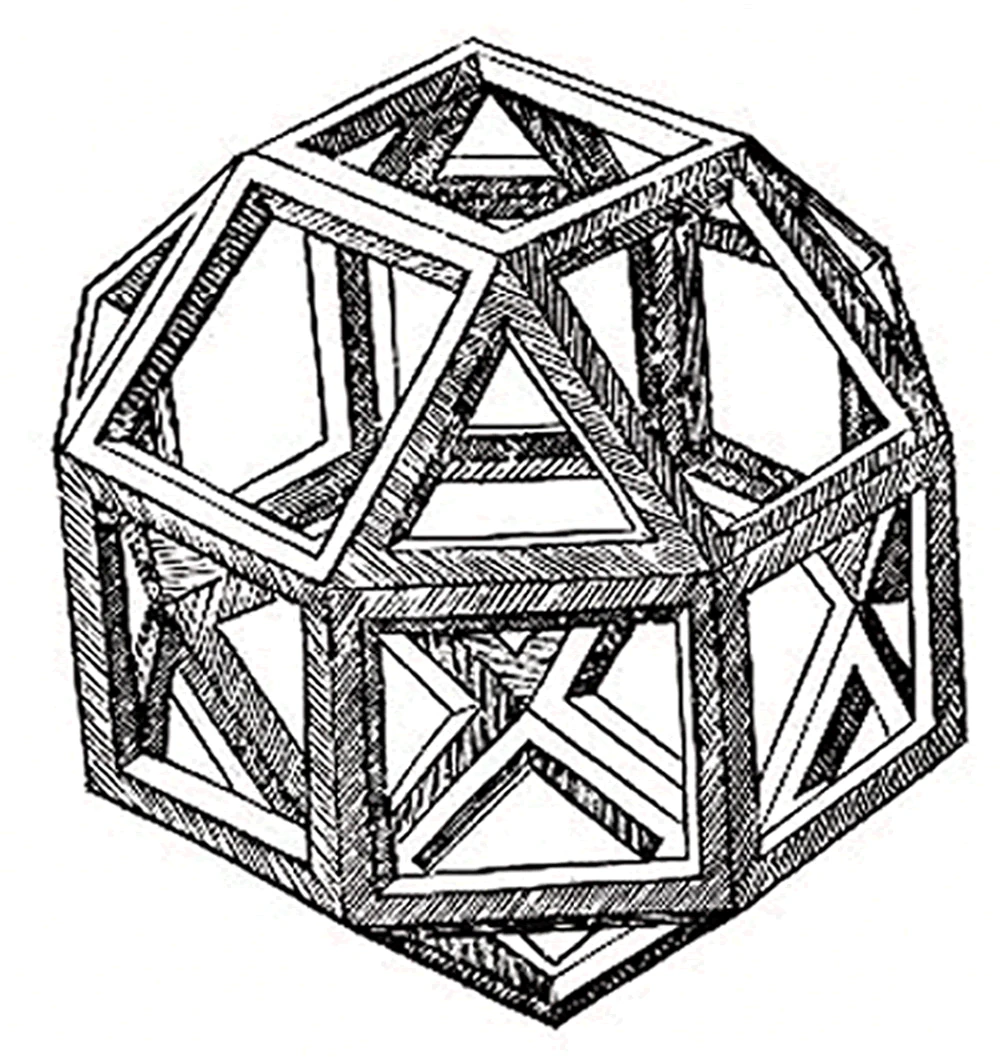
Leonardo da Vinci's drawings of the solids for Luca Pacioli's De divina proportione, 1509. 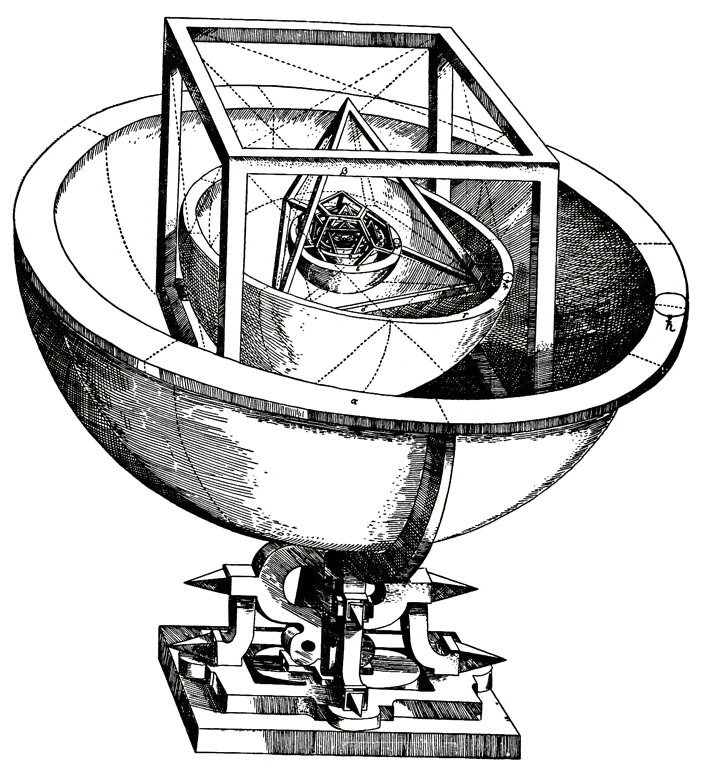
Johannes Kepler, Mysterium Cosmographicum, 1596. The five solids nested inside one another, one between each pair of planetary spheres. In 1596 Johannes Kepler, then twenty-four, took the solids literally. He placed them one inside another and claimed they explained the distances between the six planets known at the time. It was a beautiful idea, and it was wrong.
What I admire is that Kepler himself gave it up. Years later, working with Tycho Brahe's precise observations of Mars, he found that the orbit would not fit a circle, however he tried. The orbits were ellipses. He abandoned his most beautiful idea because the measurements would not agree with it. For once, Necessity persuaded the craftsman.
γ΄The soul is a tuned instrument
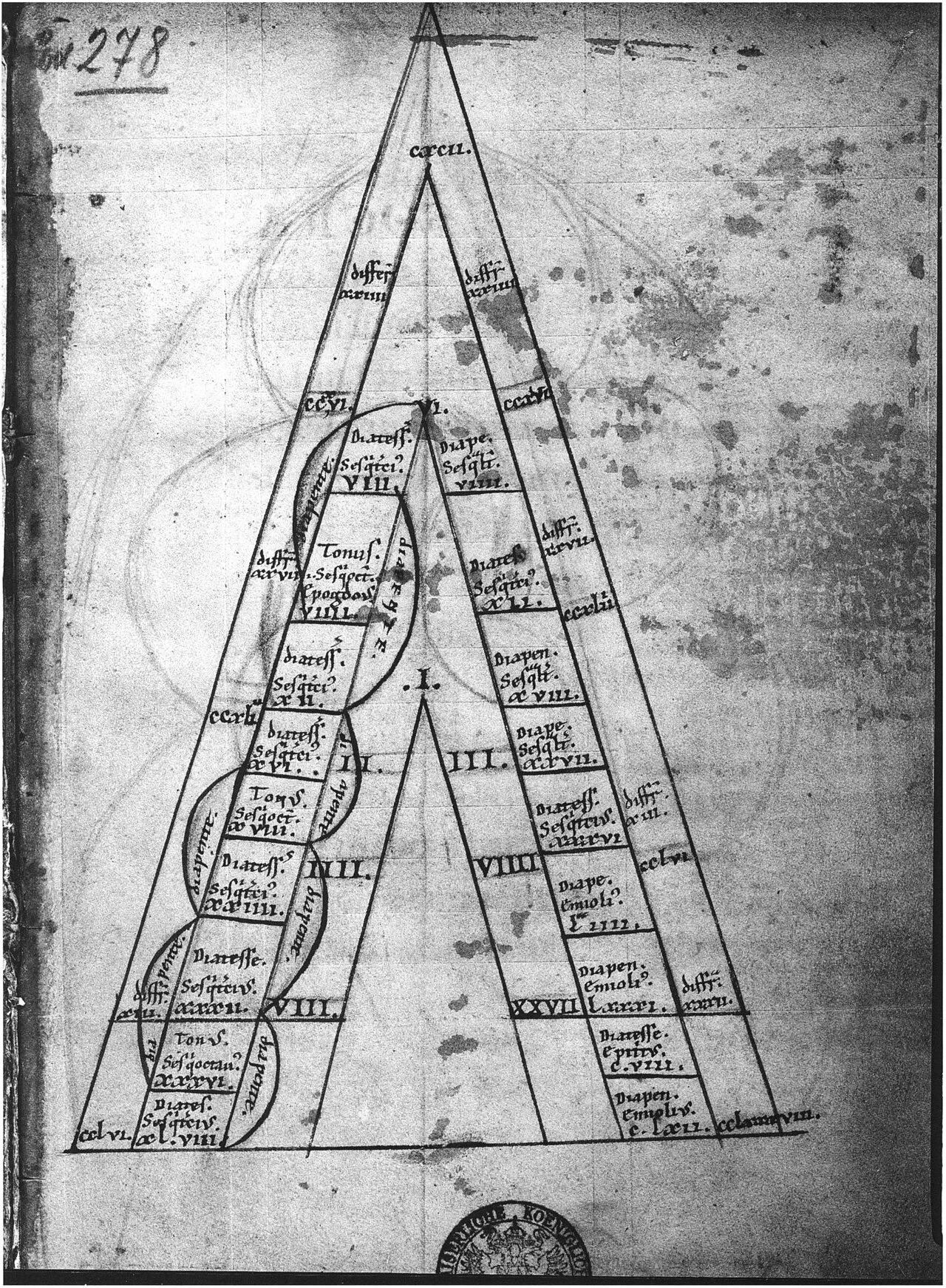
The numbers of the World Soul drawn as a large Λ and filled with musical ratios. Calcidius manuscript, Vienna ÖNB 278. The cosmos needs a soul, so the craftsman mixes one in a bowl, from Being, Sameness and Difference. Then he divides the mixture according to numbers.
He measures out portions in the proportions 1, 2, 3, 4, 9, 8, 27. These are two series: the doubles 1, 2, 4, 8 and the triples 1, 3, 9, 27. Medieval copyists drew them in the shape of the Greek letter lambda, Λ. Then he fills the gaps between the numbers until every interval is a tone of 9:8, with a small remainder of 256:243.
The result is the Pythagorean musical scale. The soul of the universe, in other words, is tuned like an instrument. Tap the numbers to hear them.
Next the craftsman cuts this strip of soul in two along its length, lays the halves across each other in the form of an X, and bends each into a circle. The outer circle, the circle of the Same, carries the fixed stars, which all turn together. The inner circle, the circle of the Different, is divided into seven rings for the planets, which move at their own speeds. The universe becomes a set of turning rings governed by musical ratios.
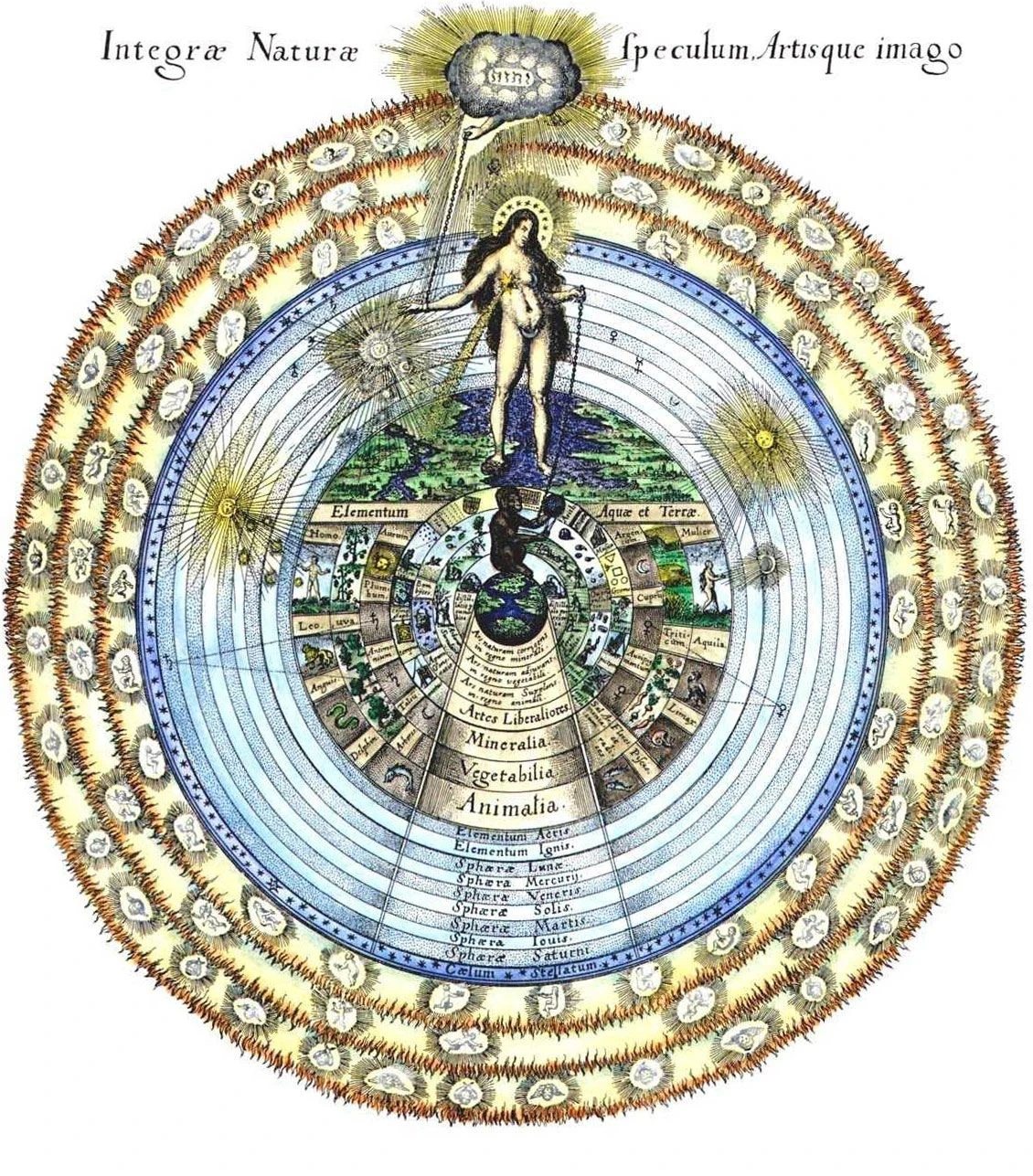
Robert Fludd, Utriusque Cosmi Historia, 1617. The World Soul as a woman chained to God above and to an ape below, the ape standing for human art, which imitates nature. Each human being also receives a soul, mixed from what was left in the same bowl and less pure. When this soul is placed in a body, the rush of sensation throws its circles into disorder. A newborn child, Plato says, is like a man standing on his head.
Life therefore has a task: to put the circles back in order. The method is to look up. We were given eyes, Plato says, so that we could watch the regular motions of the heavens and use them to correct the irregular motions of our own minds. One could call it salvation through astronomy.
The arrangement is simple. The cosmos is a perfect mechanism, each of us is an imperfect copy, and by studying the mechanism we can be repaired. This is the idea that travels furthest in the rest of the story.
δ΄God picks up a compass
From here on, the idea leaves the book.
Around 1220, in Paris, an illuminator painted God bending over a lumpy ball of chaos and measuring it with a pair of compasses. The picture states the idea in one image: God is an architect. It also suggests the reverse, though nobody said so aloud: an architect is a little like God.
The Renaissance gave the idea new force. In 1484 Marsilio Ficino, paid by the Medici, published the first complete Latin translation of Plato. Luca Pacioli wrote about the divine proportion, Leonardo drew the solids, Kepler nested them, and Robert Fludd engraved the cosmos as a single string tuned by a hand reaching out of a cloud. God was now a geometer, and the geometer was a kind of hero.
Kepler against Fludd
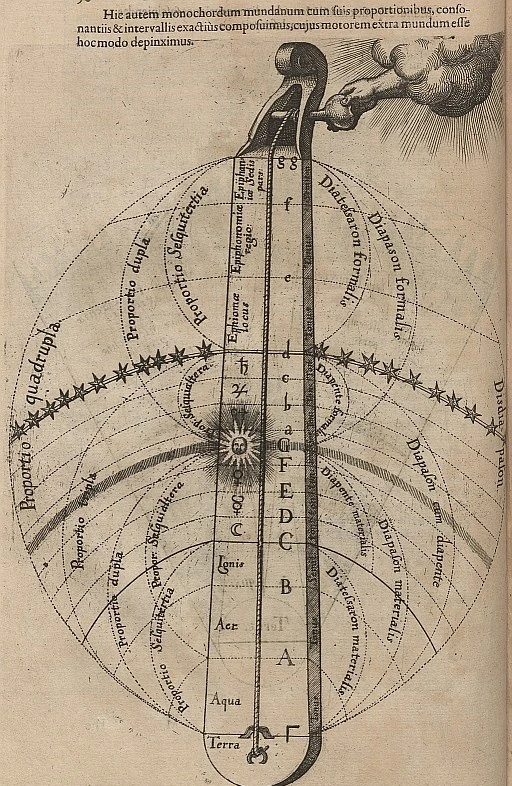
Fludd's divine monochord, Utriusque Cosmi Historia, 1617. One string from the earth to the highest heaven, tuned by a hand from the clouds. Two of these men then quarrelled. In 1619 Kepler published Harmonices Mundi, The Harmony of the World, with an appendix attacking Fludd. Fludd replied, Kepler replied again, and the exchange of pamphlets went on for three years.
Both believed the cosmos was built on harmony. They disagreed about how a person could know it. For Kepler, harmony was something to be measured: real ratios in real orbits, checked against Tycho's numbers. For Fludd, mathematicians dealt only in "quantitative shadows", and true harmony was known from within, through a sympathy between the soul and the world. Kepler's answer became famous:
I have the tail in my hand, but you may be grasping the head mentally, though, I fear, only in your dreams.Kepler to Fludd, 1622, as quoted by Wolfgang Pauli
This is the same disagreement that runs through this essay, between order imposed from outside and order found within, but here it happens inside the West, between two men who both used compasses. Kepler won, and modern astronomy grew from his method. Three centuries later Wolfgang Pauli, one of the founders of quantum mechanics, wrote a long study of the quarrel and ended with some sympathy for Fludd. Science, he felt, had won by leaving out half of the question.
New Atlantis
Francis Bacon died in 1626, the story goes, of a chill he caught while stuffing a chicken with snow to see whether the cold would preserve the meat. He left an unfinished utopia whose title answers Plato directly: New Atlantis.
Plato's Atlantis was a warning: a rich, clever and arrogant empire beyond the Pillars of Hercules, which the gods sank "in a single day and night". Bacon's island, Bensalem, lies hidden in the Pacific, and it is governed, discreetly, by a research institute.
The institute is called Salomon's House. Its members carry out experiments in deep caves and high towers, breed new plants and animals, and build engines, lenses and "sound-houses". They send secret agents, the "Merchants of Light", abroad to collect the knowledge of other countries. They also decide among themselves which discoveries the state will be told about. Their purpose is stated like this:
The End of our Foundation is the knowledge of Causes, and secret motions of things; and the enlarging of the bounds of Human Empire, to the effecting of all things possible.Francis Bacon, New Atlantis, 1627
It is hard to read this today without thinking of the mission statement of an AI lab.
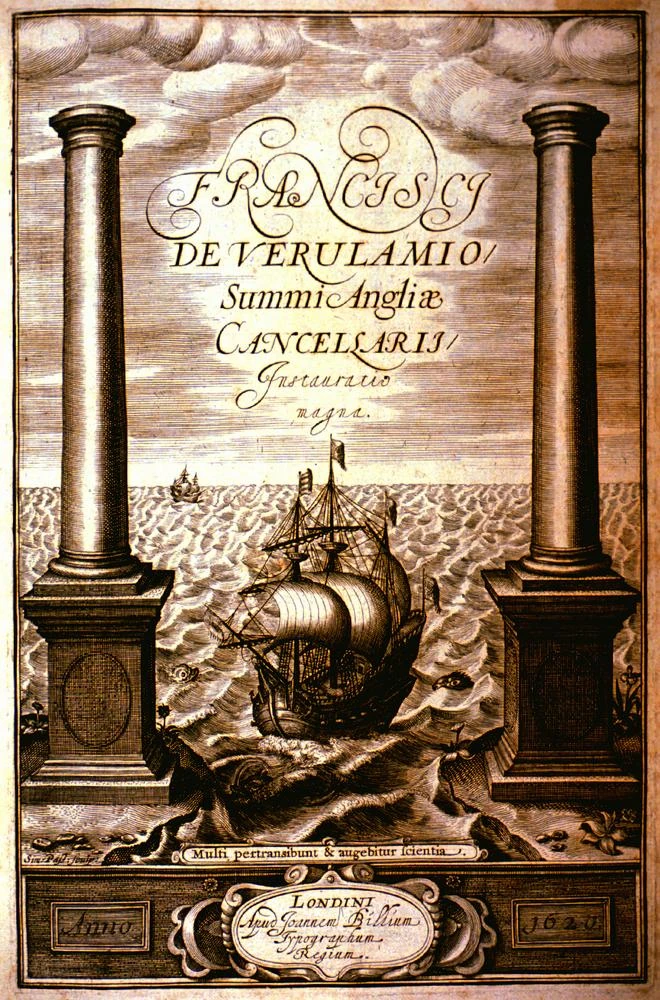
Frontispiece of Bacon's Instauratio Magna, 1620. A ship sails out between the Pillars of Hercules, where Plato placed Atlantis. The motto reads: "Many will pass through, and knowledge will increase." 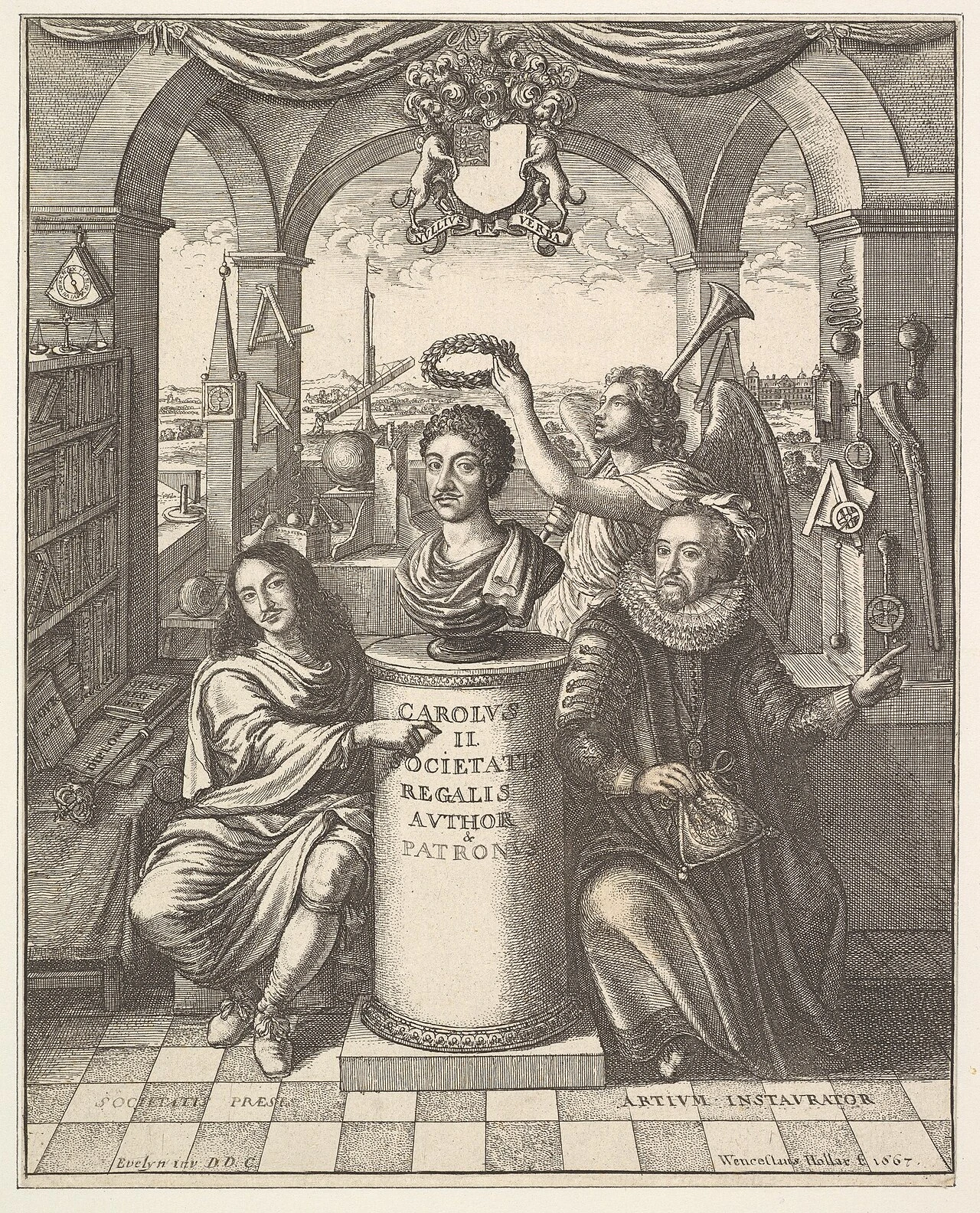
Wenceslaus Hollar's frontispiece to Sprat's History of the Royal Society, 1667. Bacon sits on the right, named Artium Instaurator, the renewer of the arts, among scientific instruments. Bacon also wrote the clearest version of Plato's idea of persuasion: "Nature, to be commanded, must be obeyed." Both halves are in the sentence. The centuries that followed mostly remembered the first.
Salomon's House became the ideal of English gentlemen who experimented in their spare time. The founders of the Royal Society treated Bacon as their patron and his imaginary institute as their plan. The Freemasons, whose rituals centre on Solomon's Temple, drew from the same source. Historians still argue about how much of this resemblance is influence and how much is coincidence.
The Freemasons
In the same decades, the idea found an organisation.
- 1598The Schaw Statutes regulate the Scottish lodges of working stonemasons, men who actually cut stone.
- 1646Elias Ashmole, antiquarian, astrologer and alchemist, is made a Freemason in Warrington. He has never cut a stone in his life.
- 1660The Royal Society is founded, with Salomon's House as its ideal. Ashmole is one of its early fellows. The two worlds share the same rooms and many of the same people.
- 1717Four London lodges meet at the Goose and Gridiron tavern near St Paul's and form a Grand Lodge.
- 1723James Anderson publishes the Constitutions of the Free-Masons, which begins:
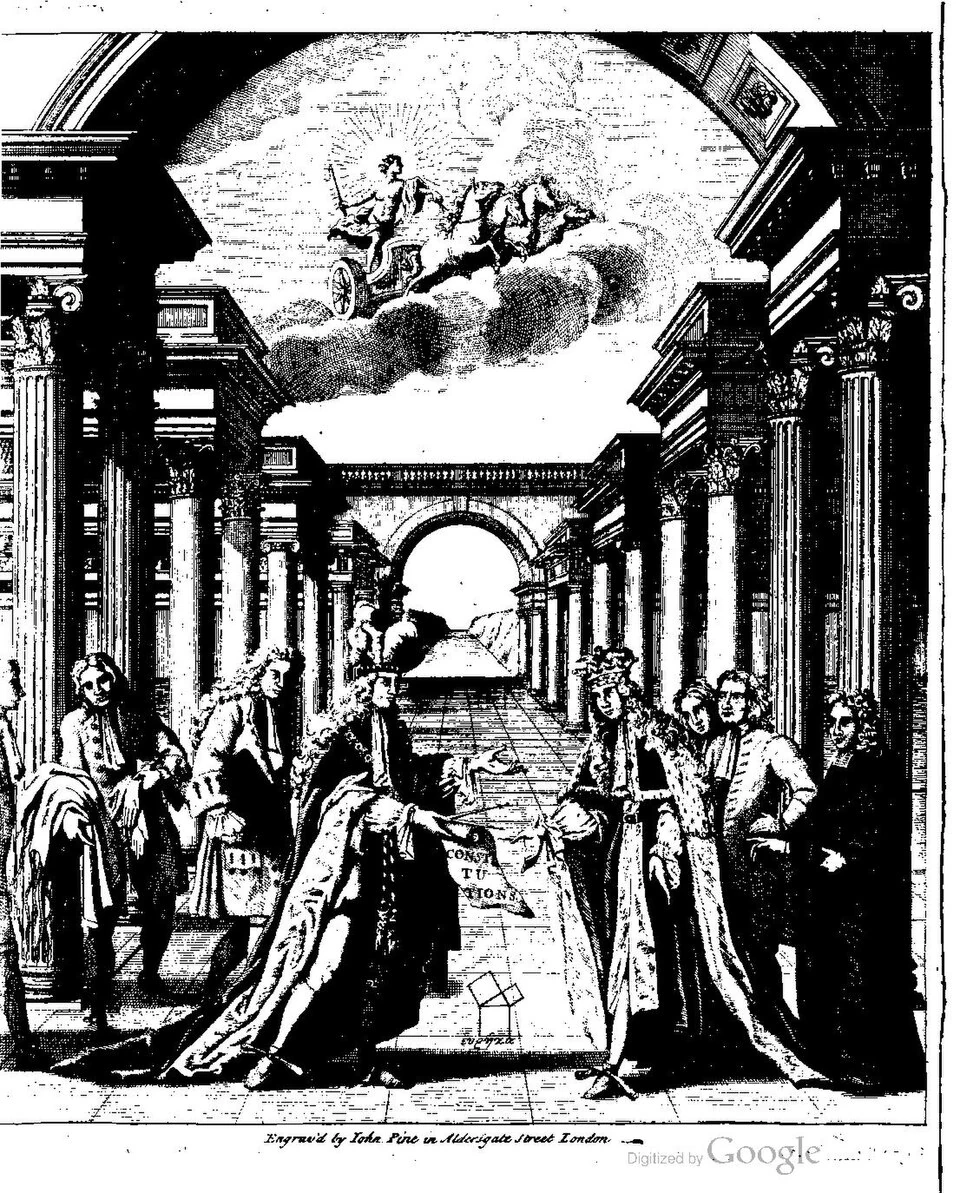
Frontispiece of Anderson's Constitutions, 1723. On the floor lies a diagram from Euclid. Adam, our first Parent, created after the Image of God, the great Architect of the Universe, must have had the Liberal Sciences, particularly Geometry, written on his Heart.Anderson's Constitutions, 1723
Geometry, written on the human heart by an architect. These new "speculative" masons had taken over a guild of men who really built things. They kept the tools, the square, the compasses and the plumb line, but applied them to the self. The rough stone stood for the unformed person, the smooth, squared stone for the person improved. It is the pattern of the Timaeus again: the order of the cosmos used to correct the disorder of the individual.
In the lodges, members were taught with painted "tracing boards" laid on the floor. They show two pillars, a ladder to heaven, the square and compasses, the all-seeing eye, and often Euclid's 47th proposition, the theorem of Pythagoras, as the emblem of the whole enterprise: a god who builds with geometry, and men who become more like him by learning it.
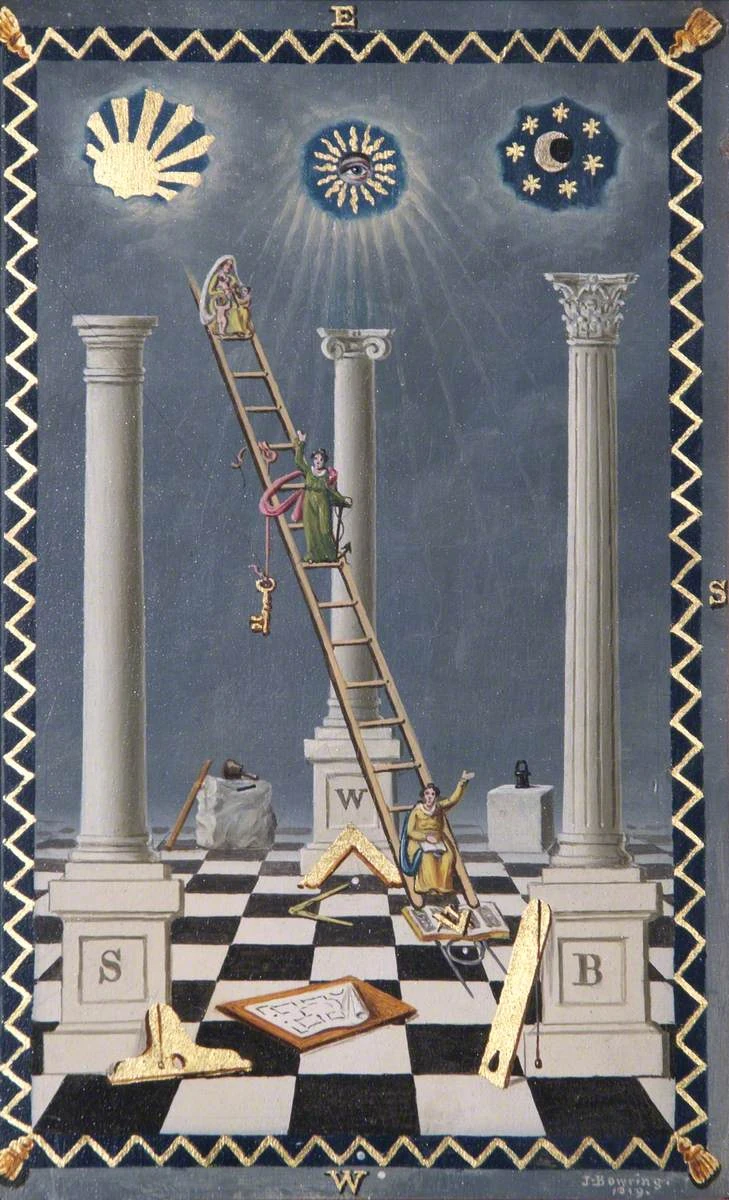
Josiah Bowring, First Degree tracing board, early 19th century. Pillars, Jacob's ladder, and the square and compasses on a chequered floor. Museum of Freemasonry, London. 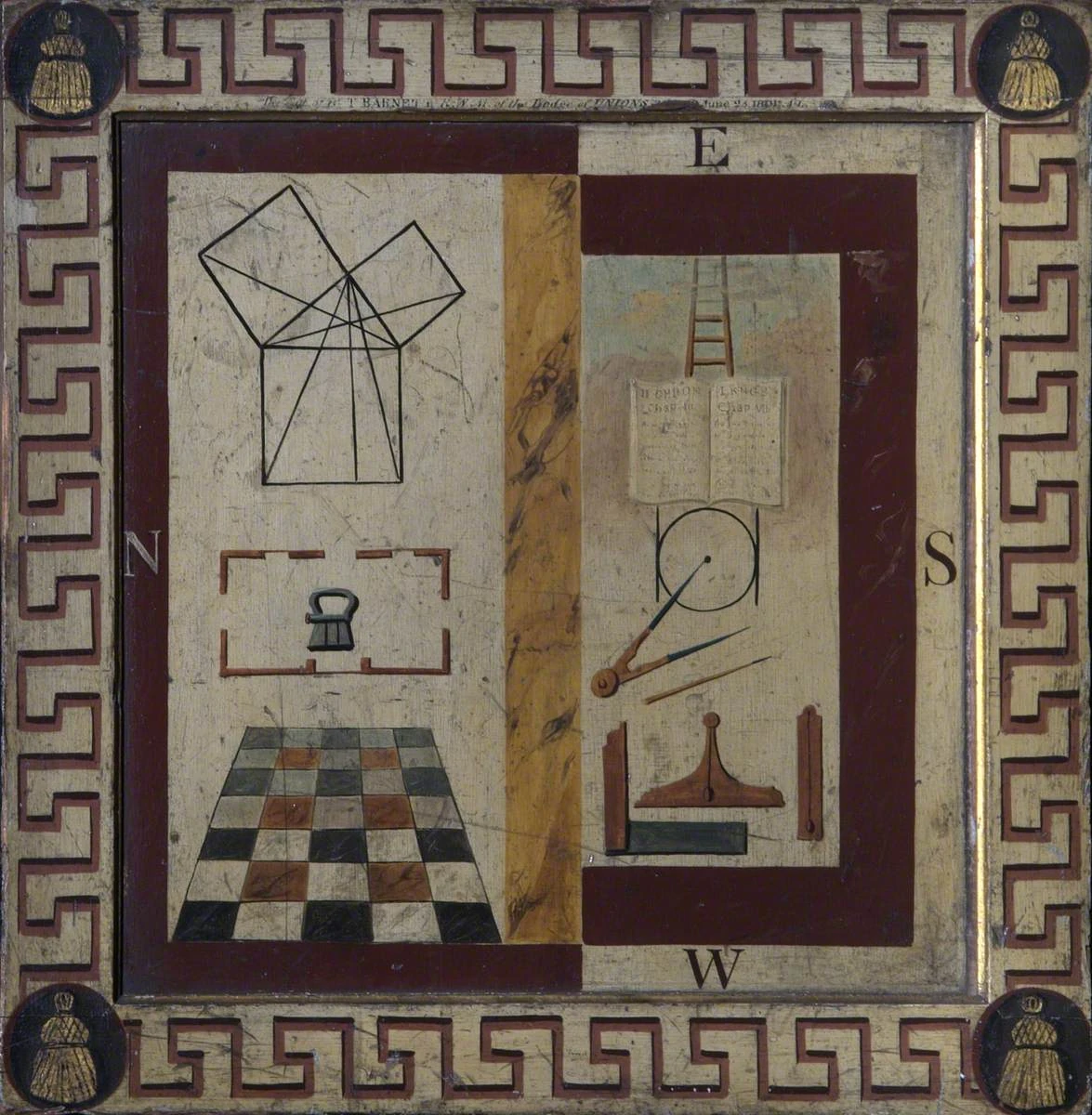
Tracing board, unknown artist. At top left, Euclid's 47th proposition, the same diagram that lies on the floor in Anderson's frontispiece. Museum of Freemasonry, London. I confess I find this part of the story rather dull: a club of gentlemen dressed as builders, who built nothing and claimed to hold the plan of everything. But dull ideas are often the ones that last. Seventy years later George Washington, wearing a Masonic apron, laid the cornerstone of the United States Capitol with a silver trowel.
The heretics
Not everyone accepted the idea. In 1794 William Blake took the image of God with the compasses and turned it into a warning.
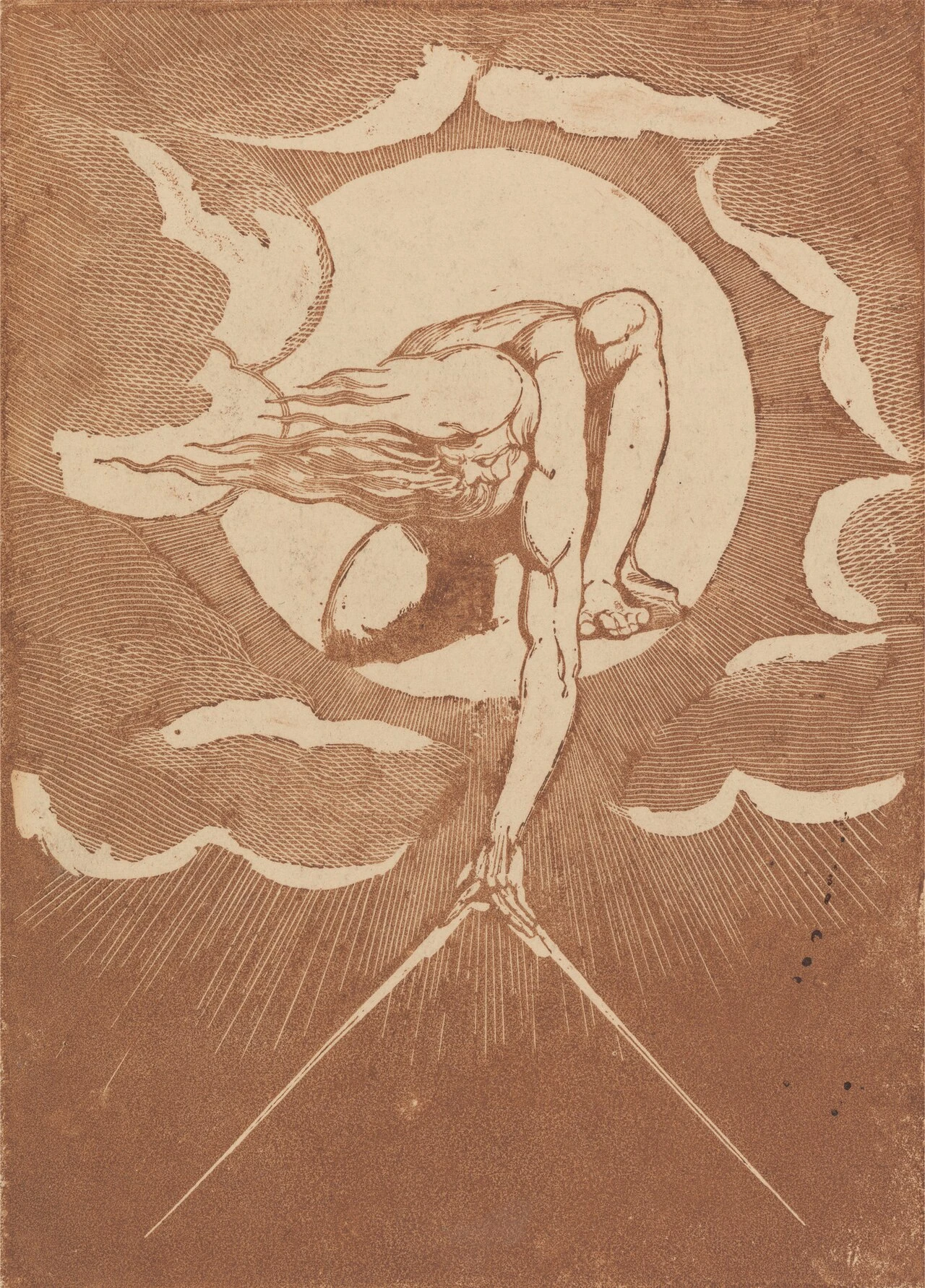
Blake, The Ancient of Days, 1794. Urizen, Blake's god of reason and law, fixing the limits of the world with a pair of dividers. 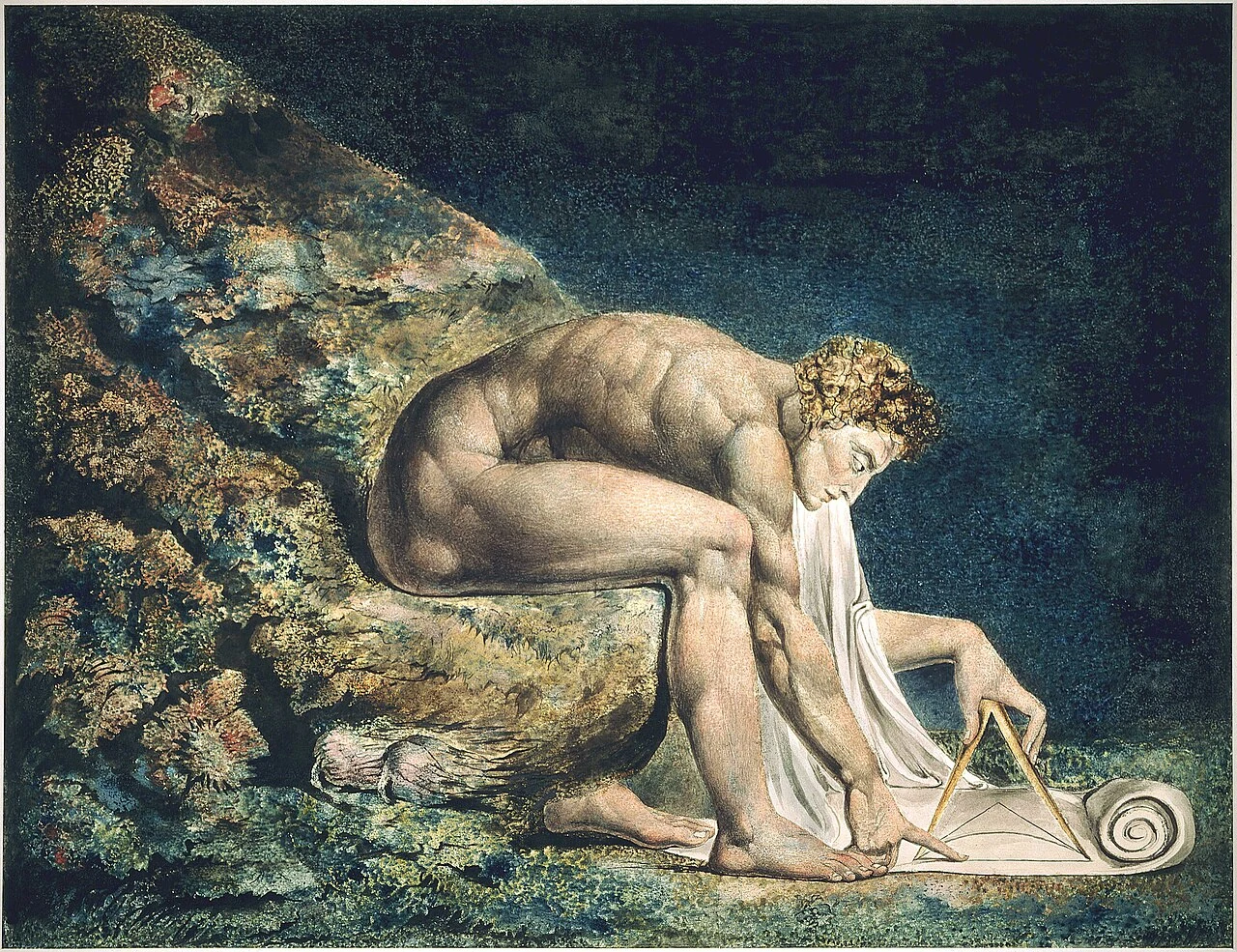
Blake, Newton, 1795–c.1805. The scientist at the bottom of the sea, so absorbed in his diagram that he has turned his back on the living rock behind him. For Blake, the god with the compasses was not a creator but a jailer. He stood for reason that forgets it is only one of our faculties and begins to draw the limits of the whole world.
May God us keep
From Single vision & Newton's sleep!Blake, letter to Thomas Butts, 1802Goethe made a similar protest through botany. In The Metamorphosis of Plants (1790) he argued that all the parts of a flower, sepals, petals and stamens, are transformed leaves. Form, for him, grows from inside the plant through variation; it is not stamped on from outside. He then spent twenty years in a losing argument with Newton about colour.
The West always had these dissenters. They were rarely the ones who received the funding.
ε΄The craftsman becomes a company
Now jump to the present. Replace the compasses with a computer chip, take away the gods, and the structure of the story is still there.
About 1220. A mind outside the world, measuring chaos. 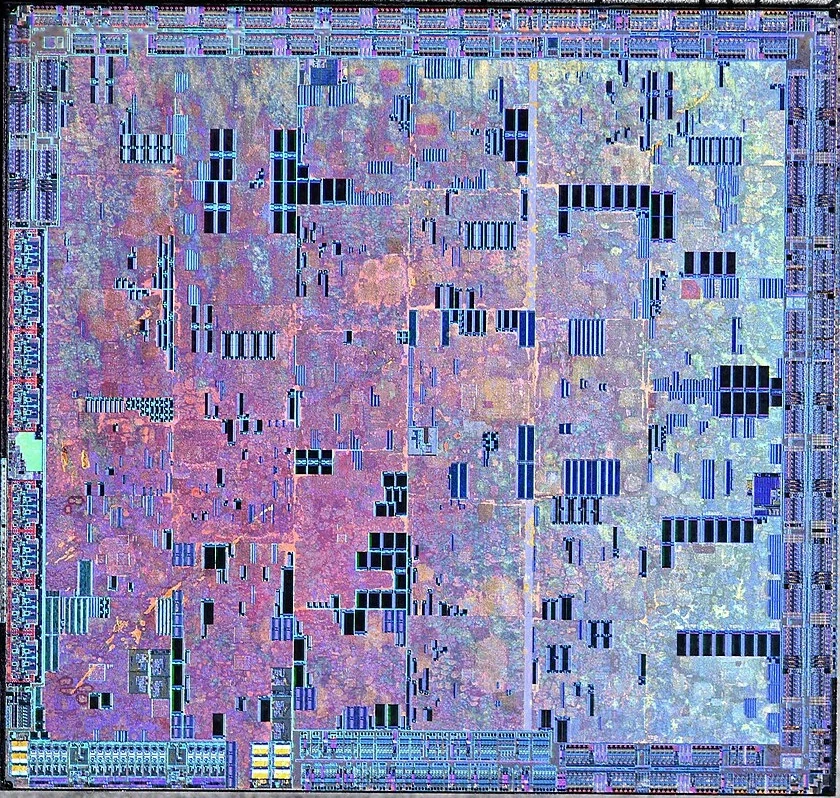
2006. An Nvidia G71 graphics chip with its cover removed: sand, melted and measured. Photo: Martijn Boer, public domain. Below is the creation story of the Timaeus, step by step. Switch it to 2026 to see how each step corresponds to the way AI is built today. The names change; the steps stay the same.
- The Goodτἀγαθόν The Good"God desired that all things should be good and nothing bad, so far as this was attainable." 30a "Benefits all of humanity"The mission statement of the OpenAI Charter. Every lab has its own version.
- The makerδημιουργός The DemiurgeA craftsman outside the world, "free from jealousy", who wants everything to be "as like himself as they could be." 29e The labA few hundred people outside the system they are building, who want it to share their values. They call this alignment.
- The patternπαράδειγμα The FormsHe works "after an eternal pattern", copying perfect originals into the world. 28a Latent spaceAn MIT paper argues that large models converge on "a shared statistical model of reality, akin to Plato's concept of an ideal reality."
- The receptacleχώρα The chōra"The receptacle, and in a manner the nurse, of all generation." Formless and shaking, with everything mixed together. 49a Data and computeThe text of the internet and the datacenters it is fed into. Formless and noisy, with everything mixed together.
- The mixing bowlκρατήρ The kraterHe blends Same, Different and Being in a bowl, cuts the mixture into strips and bends them into circles. 35a, 41d The training runThe data is mixed, gradient descent runs for months, and a finished model is taken out.
- The resultψυχή The World Soul"A living creature truly endowed with soul and intelligence." 30b The model"A country of geniuses in a datacenter." Dario Amodei, 2024.
- The helpersθεοὶ θεῶν The younger godsThe craftsman hands the messy mortal work to lesser gods: "Do ye therefore make them." 41c AgentsThe model hands tasks on to smaller agents and tools.
- The repair90d Tuning the soulHuman souls are born with their circles in disorder. Studying the heavens puts them back in line. AlignmentTraining with human feedback, testing, and a 30,000-word constitution used in training.
I am aware that I have just done what this essay questions: I have taken a messy reality and pressed it into eight neat boxes. Some rows fit better than others, and the comparison between agents and the younger gods is half a joke. One row is wrong in an interesting way.
The row that doesn't fit
It is the row about the Forms. For Plato, the Forms come first and are then copied into matter. The "Platonic representation" found in AI works the other way round. Nobody puts it into the model. It appears out of the data as models grow larger, and vision models and language models, trained on completely different material, end up organising the world in similar ways. The form is found inside the mess, not stamped onto it.
This is not Plato's finger pointing upward. It is Aristotle's hand, held flat over the ground. The most Platonic-sounding discovery in AI turns out to be something that grows, and this, I think, is the centre of the whole question.
A constitution for the soul
The last row is less of a stretch than it may seem. The Timaeus begins the morning after a long conversation about the ideal city, which Socrates briefly summarises: who governs, who guards, how citizens are born and educated. That conversation is usually identified with the Republic, whose Greek title, Politeia, is commonly translated as "constitution". Plato first writes the laws of the city; then he describes a cosmos and a soul that match them.
In January 2026 the company Anthropic published the constitution for its Claude models: about 30,000 words on values and character, used directly in training. Inside the company an earlier version had been "endearingly known as the 'soul doc'". Among the outside reviewers were two members of the Catholic clergy.
I do not mean this as mockery. Writing down what you hope a mind will be is more honest than pretending you are not shaping it. The method is also more careful than it first appears. The document mostly explains reasons rather than listing rules, on the theory that a model that understands why will behave better in new situations than one that has memorised instructions. This is the half of the Timaeus that is usually forgotten: reason persuading Necessity instead of overpowering her.
Still, a small group of people writes down what is good and trains it into a mind. The compasses are still in the hand.
(Disclosure: parts of this section were drafted together with Claude, which was trained on that document. It had opinions.)
Plato, Bacon or a lab?
Here are eight quotations. Some were written in 360 BC or 1627, others after 2010. Try to guess which are which.
"Out of disorder he brought order, considering that this was in every way better than the other."
Plato, Timaeus 30a."Solve intelligence, and then use that to solve everything else."
DeepMind's mission, as Demis Hassabis describes it."We take all an oath of secrecy, for the concealing of those which we think fit to keep secret."
Bacon, New Atlantis, 1627, on Salomon's House."We expect that safety and security concerns will reduce our traditional publishing in the future."
OpenAI Charter, 2018."To make divers new plants, differing from the vulgar; and to make one tree or plant turn into another."
Bacon, New Atlantis, 1627. Synthetic biology, four centuries early."What I cannot build, I cannot understand."
Written into the DNA of JCVI-syn1.0, the first cell controlled by a synthetic genome, 2010."You shall weave together the mortal and immortal."
Plato, Timaeus 41d. The craftsman instructing the younger gods."Fixing the climate, establishing a space colony, and the discovery of all of physics."
Sam Altman, The Intelligence Age, 2024.The new harmony
A schematic scaling law, not real data. It shows only the shape of the relationship. Plato built the World Soul from a handful of numbers: 1, 2, 3, 4, 8, 9, 27. AI research found its own governing numbers in 2020, when Jared Kaplan and colleagues at OpenAI showed that the error of a language model falls as a power law as the model, the data and the computing power grow, "with some trends spanning more than seven orders of magnitude."
On a graph with logarithmic axes this relationship is a straight line: one ratio that holds at every scale, which is exactly the kind of thing the Pythagoreans revered. Sam Altman summed it up this way: "deep learning worked, got predictably better with scale, and we dedicated increasing resources to it." The harmony of the spheres has become an investment plan.
The craftsman signs his work
Synthetic biology tells the same story in a wetter medium. In 2010 Craig Venter's team designed the genome of a bacterium on a computer, assembled it from "four bottles of chemicals", and transplanted it into a living cell of a related species, where it took control. Venter described the result as "the first self-replicating species we've had on the planet whose parent is a computer."
Then they signed their work. The synthetic genome carries coded "watermarks": the names of 46 scientists, an email address and three quotations. One of them appeared in the quiz above. It was meant to quote Richard Feynman, but Feynman's blackboard actually read "What I cannot create, I do not understand." The copy came out slightly different from the original, which would not have surprised Plato.
The phrase "biology is code" follows the same pattern as the table above. DNA is the Form, the body is a product built from it, and disease is an error to be corrected. Bacon's Salomon's House had already promised new species and "one tree or plant turn into another". And Venter himself said his team had not created life from nothing, because they needed a living cell to start the genome. This is the receptacle again. The craftsman never works from nothing.
The pattern repeats each time: a mind outside the system, a perfect model, a disordered material, and the belief that the right equations will bring the material into order.
Physics has its version too. The physicist Max Tegmark argues that the universe does not merely obey mathematics but is a mathematical structure. The simulation argument puts a craftsman outside the world once more, this time with a datacenter. And Atlantis has returned. Plato told its story as a warning about a brilliant empire that overreached and sank. Bacon reused the name as a promise. Silicon Valley mostly remembers Bacon's version.
ϛ΄What the machines actually do
There is an irony in all this. The technology itself does not work the way the craftsman story suggests.
The biggest lesson that can be read from 70 years of AI research is that general methods that leverage computation are ultimately the most effective, and by a large margin.Rich Sutton, The Bitter Lesson, 2019
The history of AI is full of attempts to design intelligence directly: expert systems, hand-built catalogues of knowledge, carefully engineered features, grammars and rules. Each was a blueprint, and each was eventually overtaken by simpler methods that learned from data. Sutton's conclusion is that we should build systems that can discover things as we do, "not which contain what we have discovered".
Nobody designed the inner structure of a large model. It was grown. Billions of numbers begin as random noise and are adjusted, step by step, by gradient descent, until structure forms. This is less like a craftsman copying a model into matter, and more like what Laozi called the uncarved block, taking shape by itself.
The machine grows like a plant, but the people who steer it speak like architects.
This gap concerns me more than any benchmark. It is the belief that something grown can be fully specified, and that whatever does not fit the specification is an error to be deleted. Gardeners prune, of course. But a good gardener does not forget that it was the plant that did the growing.
七The tree the carpenter walked past
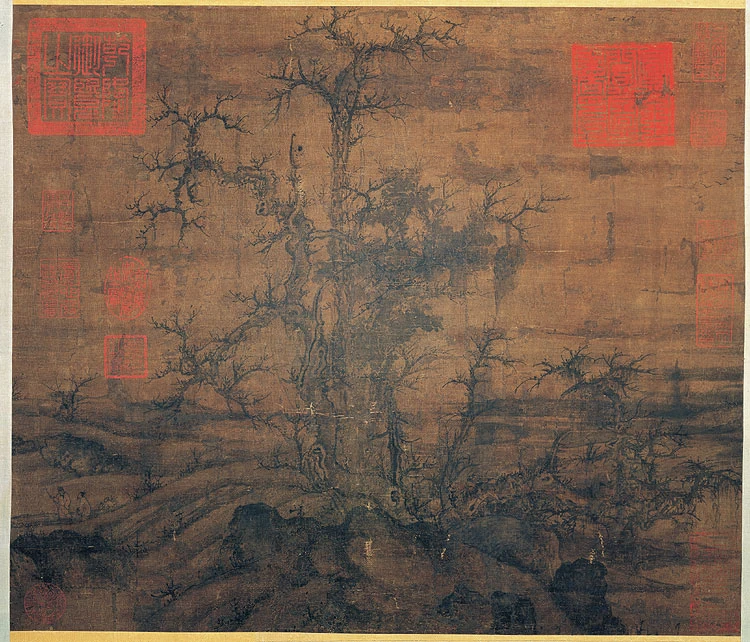
Anonymous, Small Scene of Wintry Trees, Song dynasty. There is not a single straight line in it. At roughly the same time that Plato was writing, give or take a few decades, a Chinese writer we know as Zhuangzi told the following story.
A master carpenter named Shi is travelling with his apprentice. At a village shrine they pass an enormous oak, wide enough to shade thousands of oxen, so tall that its lowest branches begin above the hilltops. Crowds gather to look at it. Shi does not even turn his head.
The apprentice runs after him: I have never seen timber like that. Why won't you look at it? Shi dismisses it. The wood is worthless. Make a boat of it and the boat sinks. Make a coffin and it rots. A door would ooze sap, a pillar would be eaten by insects. The tree is useless, and that is why it has lived so long.
That night the oak appears to him in a dream. In paraphrase: What are you comparing me with? With useful trees? Fruit trees are stripped and broken as soon as their fruit is ripe. Their usefulness ruins their lives. I have been trying to be useless for a very long time. I nearly died more than once, but now I have succeeded, and my uselessness is my great use. If I had been useful, would I ever have grown this large?
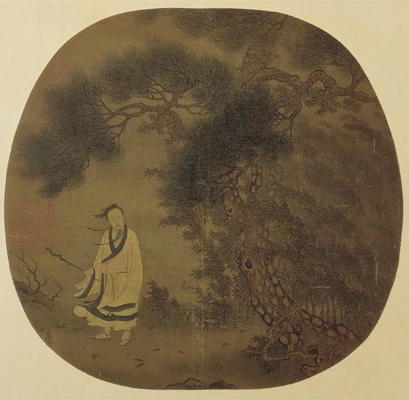
Attributed to Xu Daoning, Holding a Wand under the Pine Tree, Song dynasty. The chapter ends with a sentence that sums up the whole story:
Everyone knows the use of the useful. Nobody knows the use of the useless.人皆知有用之用,而莫知無用之用也Zhuangzi, ch. 4
Compare this with the Timaeus. Plato's god is a craftsman who looks at raw material and sees what it ought to become. In Zhuangzi's story, the raw material scolds the craftsman for failing to see what it already is.
Below is a tree drawn without a plan, from one simple, slightly crooked rule repeated many times. Click to grow another.
Open the post page to grow the trees.
There are exactly five regular solids; Euclid proved that a sixth is impossible. There is no limit to the number of crooked trees.
The hole in the wheel
Plato's system also contains a kind of emptiness: the receptacle, the chōra. He is clearly uneasy about it. It can be grasped, he says, only by "bastard reasoning", as if in a dream. Laozi, in chapter 11 of the Tao Te Ching, puts exactly this emptiness at the centre:
Thirty spokes share one hub. It is the empty space that makes the cart useful.三十輻共一轂,當其無,有車之用Tao Te Ching, ch. 11
The idea is the same, but its value is reversed. For Plato, empty space is the uncomfortable basement of the cosmos. For Laozi, it is what makes things useful. Laozi's ideal is not the perfectly cut stone but pu, the uncarved block: the wood as it was before anyone took a chisel to it.
Joseph Needham, the Cambridge biochemist who devoted his life to Science and Civilisation in China, tried to sum up the Chinese view of nature in one phrase:
An ordered harmony of wills without an ordainer.Joseph Needham, 1956
Order without anyone giving the orders. I know of no sentence in English further from the Demiurge.
Buddha in this body
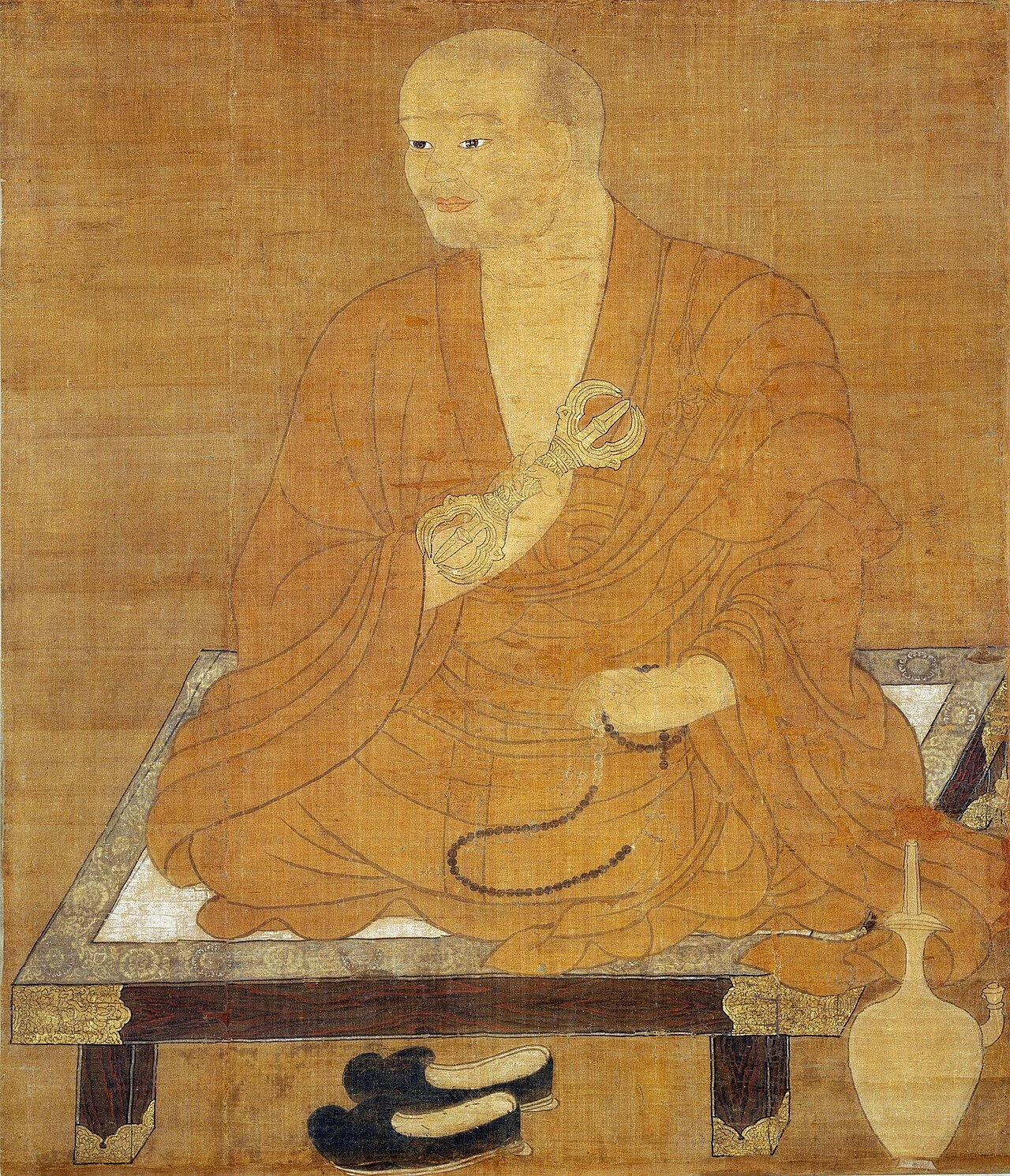
Kūkai (774–835), from Eight Patriarchs of the Shingon Sect. In 804 a Japanese monk named Kūkai sailed to Chang'an, the Chinese capital, studied esoteric Buddhism with the master Huiguo, and returned to Japan to found the Shingon school. His central teaching is sokushin jōbutsu (即身成仏): becoming a Buddha in this very body. Not after death, and not in a better world, but here.
For Plato, the body is what throws the soul into disorder. For Kūkai, the body is the instrument of practice. The practice works through the "three mysteries": the hands, through gestures called mudras; the voice, through mantras; and the mind, through the images of the mandala. One does not escape the confusion by thinking alone. One tunes it with the whole body.
Kūkai's list of elements is revealing too: earth, water, fire, wind, space and consciousness. Mind is one of the elements. Plato's elements are lifeless triangles that need a soul brought in from outside. Kūkai's already contain awareness:
The six great elements interpenetrate without obstruction, in eternal union.六大無碍常瑜伽Kūkai, Sokushin jōbutsu gi
The same cube
Here the story takes a strange turn. In old Japanese cemeteries there are gorintō, stone stupas made of five stacked shapes, one for each element:
Plato · heaven = dodeca
Plato · air = octa
Plato · fire = tetra
Plato · water = icosa
Plato · earth = CUBE空 void · jewel
風 wind · crescent
火 fire · pyramid
水 water · sphere
地 earth · CUBEThe earth is a cube, just as in Plato. Two traditions with almost no contact both gave the earth the shape of a cube, and then used it in opposite ways.
Look at photographs of old gorintō and you see stones softened by centuries of rain, spotted with lichen, sometimes leaning a little. A Platonic cube is meant to stay exact forever. These cubes have been allowed to age.
Plato uses geometry as a mould, something pressed into matter from outside to make it behave. Shingon uses geometry as a mirror. Its great mandalas are not plans for building the world. They are maps of what a person already is, and the practitioner enters them with body and voice.
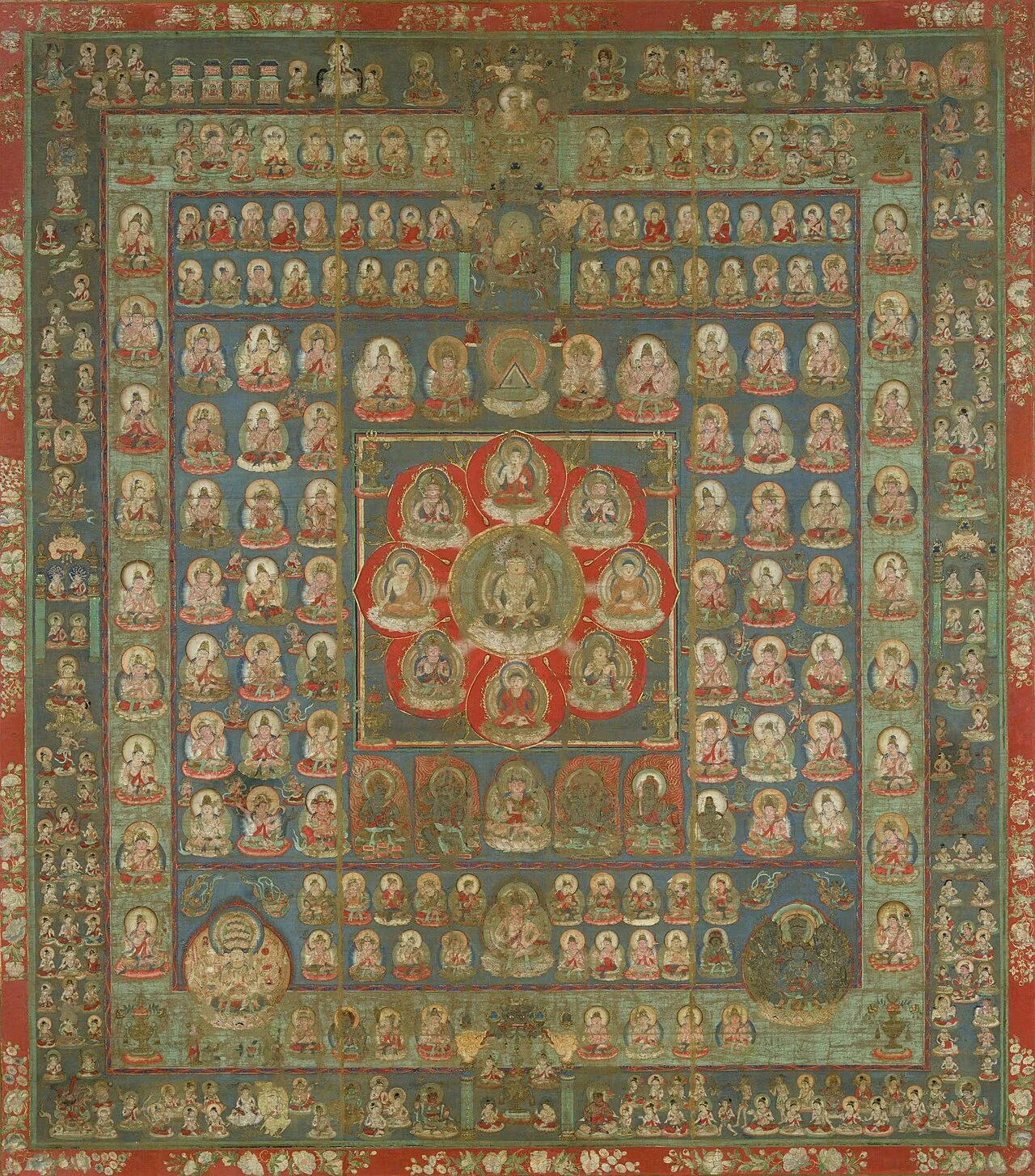
The Womb Realm mandala (Taizōkai), one of Shingon's two great mandalas. Strict geometry, used as a mirror for the body rather than a mould for matter. Further west, in India, the ideas become stranger still. Kashmir Shaivism describes the basic texture of reality as spanda: a throb or pulse, consciousness vibrating and recognising itself in everything it becomes. Other Indian traditions speak of līlā, play: the cosmos as something performed rather than built.
Chinese Huayan Buddhism describes Indra's net: an endless web with a jewel at every knot, each jewel reflecting all the others. It is the opposite of a world made of five separate solids. In Indra's net nothing has a shape of its own; everything exists through its relations.
The Demiurge- The cosmos is built
- Order is imposed from outside
- Chaos is the enemy, persuaded at best
- The body disturbs the soul
- Geometry as a mould
- You improve yourself by studying the mechanism
The Crooked Tree- The cosmos grows, or plays
- Order arises from within
- Chaos is material, and a source
- The body is the instrument
- Geometry as a mirror
- You stop forcing, and notice
The picture is not so simple
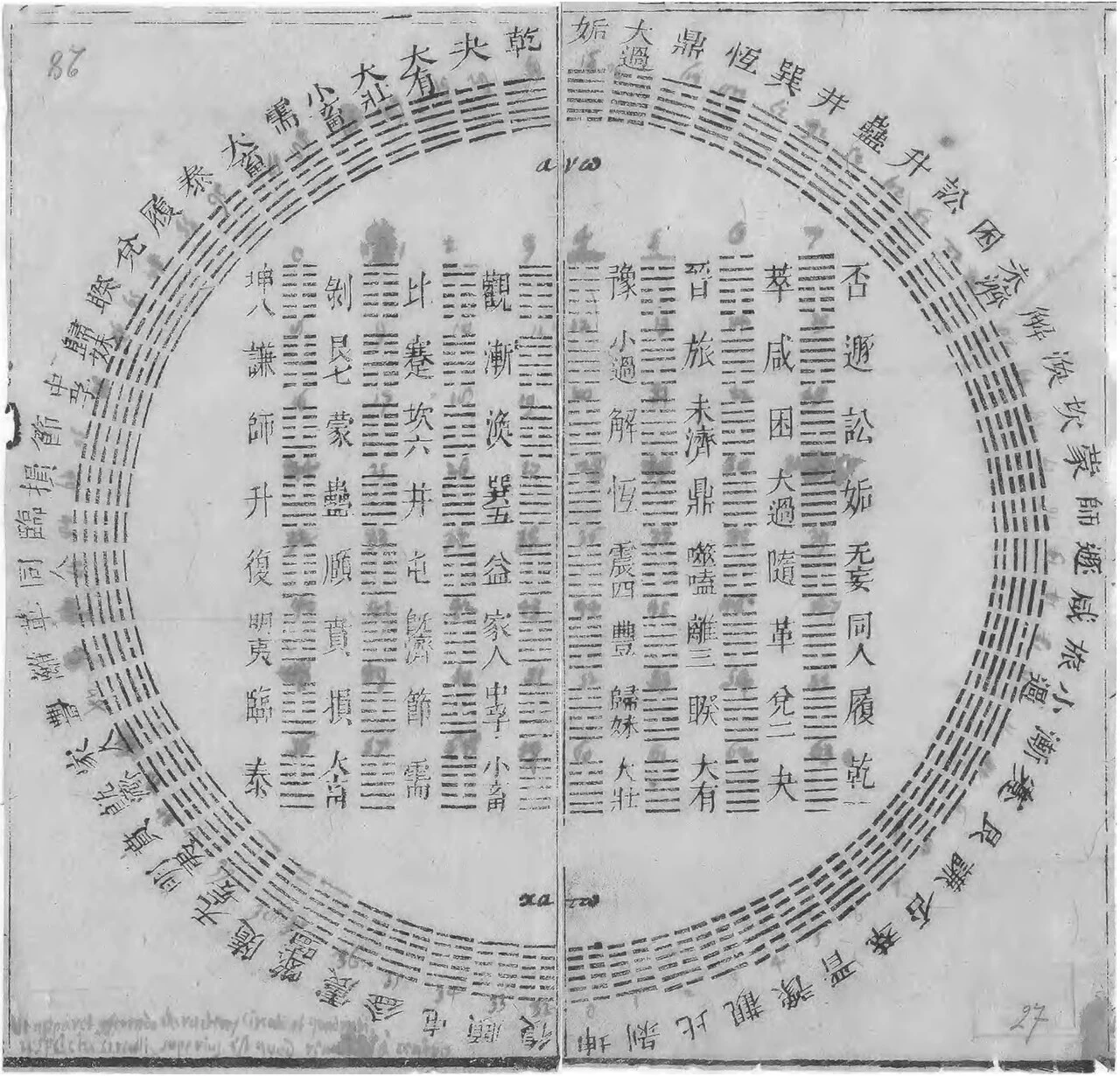
The I Ching hexagram diagram that Joachim Bouvet sent from Beijing to Leibniz in 1701, with Leibniz's own pencil numbers. It would be wrong, though, to present the East as purely the side of the tree. Kūkai's school had its own version of Salomon's House. Mikkyō, the name of his tradition, means "secret teaching": initiation by a master, knowledge passed on behind closed doors, rituals that may not be described to outsiders. In its structure it is closer to a Masonic lodge than I would like.
And for centuries the Tao Te Ching was also read as a handbook for rulers. Han Feizi, the hard-minded Legalist whose ideas the Qin state used to build China's first empire, wrote commentaries on Laozi. Wu wei, non-action, can mean letting the river find its own course. It can also mean a ruler so powerful that he never needs to lift a finger.
In 1701 Joachim Bouvet, a Jesuit in Beijing, sent Leibniz a diagram of the 64 hexagrams of the I Ching, in the arrangement of the Song philosopher Shao Yong. Looking at the broken and unbroken lines, Leibniz recognised his own binary arithmetic of zeros and ones.
Every chip that runs today's AI counts in a number system whose European inventor believed he had found it confirmed in an ancient Chinese book of divination. These traditions were never sealed off from one another. They have been borrowing from each other for centuries.
八So does the East win?
There is a popular version of this story. The West runs toward a cliff, building a god out of silicon and rewriting life as code, while China, Iran and others rediscover their non-Platonic roots and inherit the century.
I understand its appeal, but I do not fully believe it.
China. There is a real tradition of systems thinking there. Qian Xuesen wrote Engineering Cybernetics at Caltech in 1954, was deported during the McCarthy era, and returned to China, where he helped build the missile and space programmes and a whole culture of planning based on systems science. "Ecological civilization" was written into the Chinese constitution in 2018. But China is also the most thoroughly engineered state on Earth. The writer Dan Wang calls it an engineering state, in contrast to the "lawyerly society" of the United States: five-year plans, perfectly straight high-speed railways, whole cities built within a decade. On some days Beijing looks much more like the Demiurge than Palo Alto does.
Iran. Suhrawardi's 12th-century Philosophy of Illumination describes reality as degrees of living light. Mulla Sadra's doctrine of "substantial motion" holds that being itself is continuous change: nothing simply sits still, being a cube. This is beautiful, and far from lifeless geometry. But Suhrawardi counted Plato among his teachers. The philosophy of illumination is Platonism set alight, not its opposite. And states are not governed by metaphysics. They are governed by oil, demography and fear.
Iran also offers a third kind of geometry, which belongs to neither side of this essay. In 2007 the physicists Peter Lu and Paul Steinhardt showed that the tile patterns of the Darb-i Imam shrine in Isfahan, built in 1453, follow rules very close to those of quasicrystals: patterns that are strictly ordered and yet never repeat. In Europe such patterns were described only in the 1970s, by Roger Penrose.
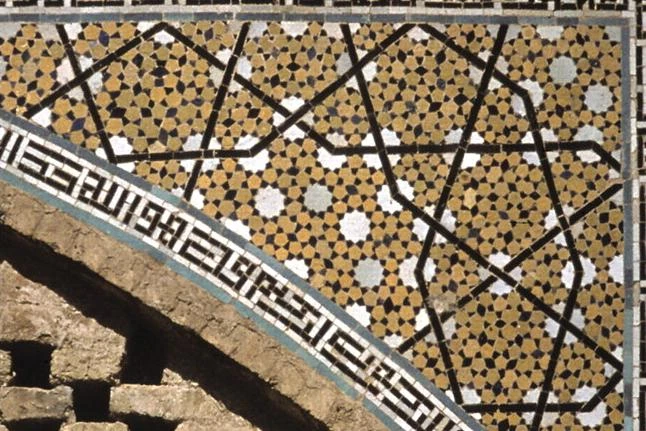
Spandrel of the Darb-i Imam shrine, Isfahan, 1453. The large pattern of lines is repeated at a smaller scale inside itself. Public domain. Below is a pattern of the same family. It is made with a modern method the Isfahan craftsmen did not use, but whose result they would recognise: a hidden tiling of two rhombs, shown by the faint lines, carries a band of interlaced strapwork. Every line follows a strict rule, yet the pattern never repeats, however far it is extended. Click for another.
Open the post page to draw the pattern.
This is neither the craftsman's mould nor the crooked tree. It is order that is completely exact and still never closes. If there is a geometry for the century ahead, it may look more like this than like either of the others.
The dividing line does not run between East and West. It runs through every laboratory, every ministry and every person.
On one side is the craftsman, on the other the tree: imposing order, or letting it grow. The West has Blake and Goethe, Gregory Bateson, ecology, cybernetics and the complexity scientists of the Santa Fe Institute. The East has the largest top-down planning machinery ever built. Everyone carries both.
Where I do agree with the popular version is this: the societies that do well in this century will be the ones that can hold both. The compasses are not the villain. They gave us bridges, vaccines and the chips this page is running on. The skill is to pick them up and then to put them down again, to build the trellis and let the vine do the rest. Systems that treat disorder as an error tend to be broken by it. Systems that treat it as material can work with it. Most discoveries happen at the boundary between order and chaos, not on either side of it.
Plato himself knew this. It is in his text: reason persuades Necessity; it does not abolish her. The problem is not the Timaeus. The problem is twenty-four centuries of reading it as an engineering specification instead of as a likely story.
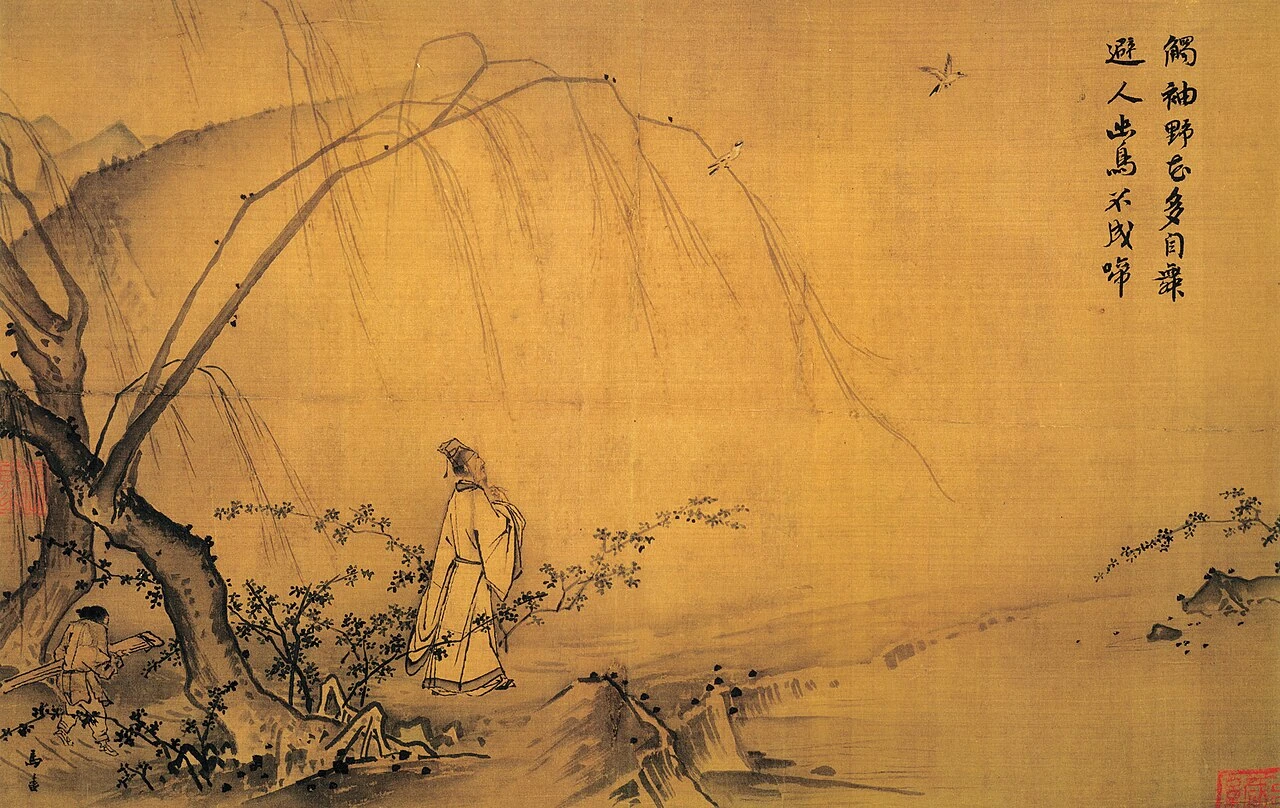
Ma Yuan, Walking on a Mountain Path in Spring, Song dynasty, c. 1200. A scholar, a willow, a bird, and a great deal of empty space. The DemiurgeThe myceliumSolve intelligenceNotice it is already everywhereAlignment as enforcementAlignment as tuningFive perfect solidsCountless crooked treesGeometry as a mouldGeometry as a mirrorI want to return once more to Zhuangzi's oak. It survived because it was useless. Nobody wanted its wood.
That way out is not open to what we are building now. AI may be the most useful tree anyone has ever grown, and carpenters everywhere are already standing beneath it with their saws. So the question is not how to stay useless.
The question is whether we can learn to use something without cutting it into the shape of our plans.
Plato's World Soul turns in perfect circles. A Zen painter draws a circle in a single breath and leaves it open.
The two circles look alike. One is a plan, the other a breath.
Close this page, and go and look at a crooked tree.
櫟
Further reading
- Plato, Timaeus, trans. Jowett. Key passages: 29d, 30a, 35a–36d, 37d, 43a–e, 47b–c, 48a, 52b, 53c–56d, 90c–d.
- Zeyl & Sattler, "Plato's Timaeus", Stanford Encyclopedia of Philosophy.
- Zhuangzi, ch. 4, "In the World of Men", trans. Burton Watson (the carpenter and the oak).
- Laozi, Tao Te Ching, ch. 11 and 28.
- Joseph Needham, Science and Civilisation in China, vol. 2 (1956).
- Kūkai, Sokushin jōbutsu gi; Yoshito Hakeda, Kūkai: Major Works (1972).
- Francis Bacon, New Atlantis (1627) and Novum Organum (1620).
- Wolfgang Pauli, "The Influence of Archetypal Ideas on the Scientific Theories of Kepler" (1952), on the Kepler–Fludd feud.
- James Anderson, The Constitutions of the Free-Masons (1723).
- J. W. von Goethe, Versuch die Metamorphose der Pflanzen zu erklären (1790).
- Werner Heisenberg, Der Teil und das Ganze (1969), ch. 1, the Timaeus on the rooftop.
- Alfred North Whitehead, Process and Reality (1929).
- Rich Sutton, "The Bitter Lesson" (2019).
- Huh, Cheung, Wang, Isola, "The Platonic Representation Hypothesis" (ICML 2024).
- Kaplan et al., "Scaling Laws for Neural Language Models" (2020).
- OpenAI Charter (2018); Sam Altman, "The Intelligence Age" (2024); Dario Amodei, "Machines of Loving Grace" (2024).
- Anthropic, Claude's Constitution (2026).
- Gibson et al., "Creation of a Bacterial Cell Controlled by a Chemically Synthesized Genome", Science (2010).
- Dan Wang, Breakneck: China's Quest to Engineer the Future (2025).
- All artworks public domain, via Wikimedia Commons.
-
Jade Cong (琮)
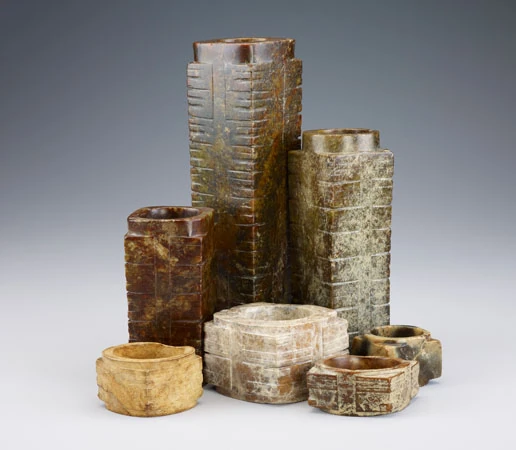
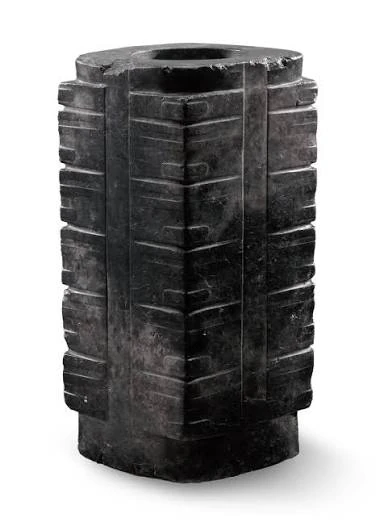
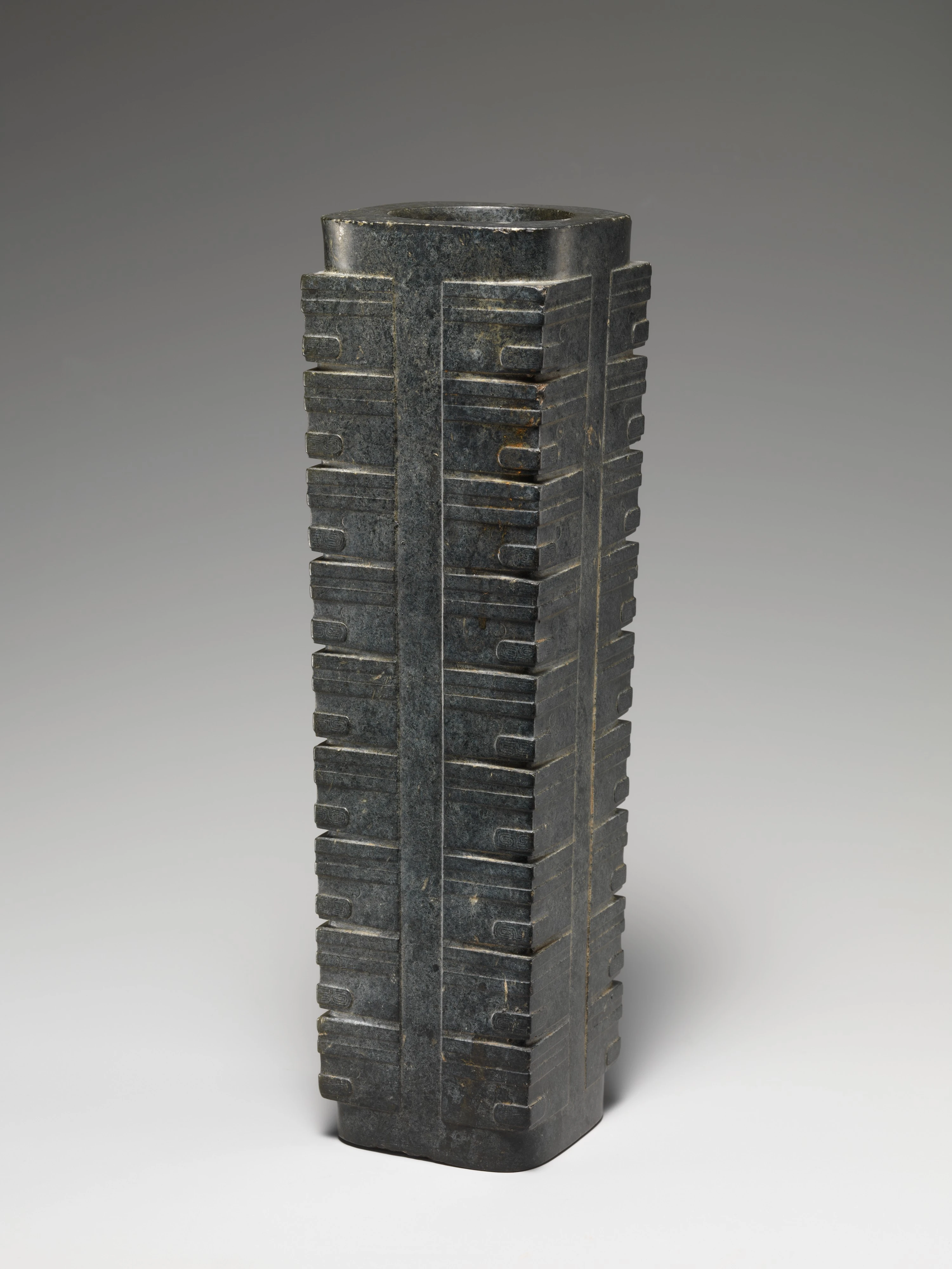
This is a Jade Cong (琮) from the Neolithic Liangzhu Culture (c. 3300–2200 BCE) in China. It is a perfect circular tube nested inside a square, hand-carved out of rock-hard nephrite before metal tools existed.
We find them stacked in wealthy tombs, covered in tiny, haunting "monster masks," yet we still don't know exactly what they were used for.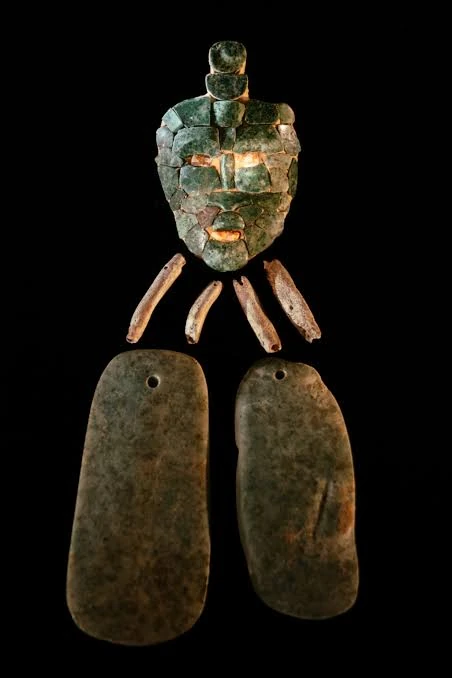
-
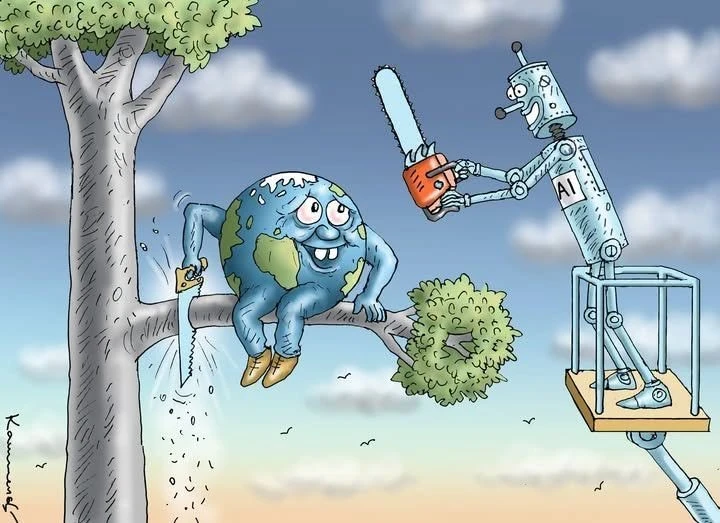
Is our relationship with AI healthy for the planet and it's countless species?
-
Michael I. Jordan (ML demigod): "Superintelligence is science fiction"
... the young people who work at these companies operate in a world [Silicon Valley, Berkeley, etc.] where these kinds of discussions are commonplace. Many of them aren’t really engineers; they come from the humanities, philosophy, or other disciplines. They’re 25 years old, they’re naive, they don’t do engineering work, they’ve never worked at large companies where real products are developed for real people, with discipline. And they get together, a bit like in Parisian cafés in the 1920s, to talk about these grand science-fiction ideas. When these young people resign, they know they’re going to attract attention. It allows them to feel virtuous and to be seen as very important figures. They claim to be giving up money, but in reality, they already have their stock options. So all of this is a grand moralizing performance that doesn’t serve the real objective it claims to pursue. There’s a great deal of naiveté here, which goes hand in hand with a certain cynicism…