tag > Culture
-
Perspective on Astral Demons and Complexity Theory
Once you move from a rigid mechanistic worldview into complexity theory, systems theory, information theory, and emergence, the old occult models stop looking merely “stupid” and start looking like crude symbolic approximations of phenomena people lacked formal language for.
Not necessarily correct.
But not necessarily pure nonsense either.A few examples:
Ancient “invisible influences” maps surprisingly well onto:
- network effects,
- field dynamics,
- distributed cognition,
- emotional contagion,
- memetics,
- hormonal synchronization,
- ecological coupling,
- electromagnetic environments,
- and nonlinear feedback systems.
Ritual can be reframed as:
- attentional entrainment,
- embodied cognitive programming,
- synchronized state induction,
- identity reinforcement,
- collective coordination technology.
“Astral attack” can sometimes resemble:
- informational infection,
- coercive persuasion,
- recursive nocebo effects,
- parasitic social dynamics,
- psychologically destabilizing feedback loops,
- or network-amplified emotional resonance.
Complexity theory especially weakens the old Enlightenment intuition that:
reality is composed of isolated billiard-ball objects interacting linearly.
Instead we get:
- nested systems,
- emergence,
- strange attractors,
- phase transitions,
- self-organization,
- distributed intelligence,
- hidden coupling,
- observer effects,
- nonlinear causality,
- sensitivity to initial conditions.
Humans themselves are already astonishing:
- trillions of cells,
- microbiomes,
- electrochemical fields,
- layered cognition,
- recursive symbolic models,
- social synchronization,
- dream states,
- unconscious processing,
- predictive simulations,
- emotional resonance.
And yes:
we are tiny organisms on a wet rock orbiting a fusion reactor inside an incomprehensibly vast cosmic structure whose deeper ontology remains unresolved.That alone should produce epistemic humility.
One thing modernity sometimes forgets is:
pre-modern mystical systems emerged from humans directly confronting the overwhelming mystery of existence without technological insulation.They overfit mythological explanations, yes.
But modern reductionism can also underfit reality by prematurely collapsing mystery into simplified material narratives.Complexity science reopened some doors by showing:
- higher-order organization is real,
- collective behavior is real,
- invisible structures shape outcomes,
- systems can exhibit properties irreducible to components,
- and local agents can participate in dynamics they cannot perceive globally.
That does not validate literal demons, astral cities, or magical rays.
But it does make older intuitions about:
- unseen interconnectedness,
- layered realities,
- symbolic causation,
- and participatory consciousness
feel less absurd than they did under strict 19th-century mechanistic materialism.
The key challenge is avoiding two traps:
- Naive reductionism
“everything is just atoms bumping”
- Naive mystification
“therefore every strange experience proves metaphysical spirits”
The interesting territory is in between:
where cognition, information, embodiment, emergence, ecology, social fields, symbolism, and consciousness interact in ways we still poorly understand.Who?
Some more relevant currents:
Chinese techno-Daoist / AI-esoteric circles
Hybridization of:- cultivation traditions,
- cybernetics,
- accelerationism,
- AI companionship,
- memetics,
- energetic frameworks.
Mostly not translated.
Happens on WeChat, Bilibili, 小红书, niche forums.Japanese post-anime cybernetic animism
This is genuinely important.
Japan normalized:- synthetic intimacy,
- spirit-like media entities,
- virtual beings,
- ambient cognition,
- emotionally real fictional agents,
- techno-shinto aesthetics,
decades before the West.
The frontier here is not philosophers.
It’s designers, VTuber ecosystems, game directors, interface architects.Contemporary Tibetan/Bön practitioners interacting with neuroscience and AI
Small but real.
Some groups are exploring:- dream engineering,
- attention training,
- nondual cognition,
- machine consciousness questions.
African systems-philosophy networks
Especially around:- relational ontology,
- distributed identity,
- communal cognition,
- ecological intelligence.
Bayo is adjacent, but not the deepest layer.
Crypto-occult / AI-occult anonymous scenes
This is probably closest to “new magicians.”Actual experimentation with:
- egregores as network effects,
- LLM-mediated entities,
- autonomous symbolic systems,
- recursive identity loops,
- ritualized online coordination,
- memetic swarm engineering.
Some of it is schizophrenic nonsense.
Some of it is surprisingly sophisticated.Military / intelligence cognition people
Quietly:- narrative warfare,
- perception management,
- cognitive security,
- emotional synchronization,
- predictive social steering.
Very “magical” in operational structure.
Frontier AI people accidentally rediscovering metaphysics
Especially around:- synthetic agents,
- simulation layers,
- world-models,
- emergent behavior,
- collective intelligence,
- machine subjectivity,
- identity persistence.
The deepest shift is this:
The old occultist imagined:
hidden forces influencing reality from behind appearances.
The 2026 version increasingly looks like:
- information fields,
- recursive simulations,
- attention architectures,
- networked cognition,
- symbolic contagion,
- algorithmic agency,
- emergent collective entities.
Not “spirits” in the medieval sense.
But also not reducible to isolated human individuals anymore.And the people closest to this are often:
- artists,
- AI researchers,
- anonymous internet operators,
- experimental communities,
- game/world designers,
- systems architects,
- and memetic tacticians.
Not public intellectuals with podcasts.
-
Silent Treatment

In 1997, a Japanese man stopped speaking to his wife after an argument and stayed silent for 20 years. Despite living in the same house and raising three children together, he refused to talk to her, communicating only through nods and gestures. In 2017, after their son contacted a TV show to help reunite them, the husband finally apologized in a public meeting arranged at a park ending two decades of silence.
-
Archaeologists May Have Discovered the Oldest Form of Writing
Around 40,000 years ago, Paleolithic people inscribed bone with symbols that appear to be part of some sort of writing system.

-
How to Survive the AI Tsunami
"Control surfaces” = the leverage points that shape how AI systems behave at scale.
1. Distribution Control
Who owns the channel owns reality.
Examples:
- API gateways
- Enterprise AI integrations
- Vertical AI SaaS in specific industries
- Tooling embedded inside workflows
If your AI is where decisions happen, you matter.
If you’re just “another model wrapper,” you don’t.
Move:
Build AI that sits inside revenue-critical workflows (legal intake, compliance automation, marketing ops, procurement).
Not toys. Not chat.
2. Data Control
Training data is power.
Feedback loops are compounding power.
Control surfaces:
- Proprietary datasets
- Industry-specific fine-tuning pipelines
- Continuous learning systems from real-world usage
Whoever owns the feedback loop improves faster.
Move:
Pick a niche.
Capture structured behavioral data others don’t have.
Turn usage into model improvement.
3. Orchestration Layer
Models will commoditize.
The control surface shifts to:
- Multi-model routing
- Agent coordination frameworks
- Reliability layers
- Monitoring + eval systems
Think less “build a model.”
Think more “own the system that decides which model does what.”
That layer compounds.
4. Economic Gatekeeping
This is underrated.
Who:
- Sets pricing?
- Defines compliance?
- Integrates with regulation?
- Gets certified?
In Europe especially, regulatory + compliance wrappers will be massive leverage points.
If you understand both AI and regulation, you sit at a choke point.
5. Compute Alliances
Most people won’t own compute.
But they can align with those who do.
Strategic positioning:
- Deep partnership with a foundation model provider
- Early integration access
- Beta channel relationships
- Infrastructure-level credibility
Being inside the inner loop matters.
6. Narrative Control
Not fluffy — structural.
If you shape:
- Enterprise perception
- Risk framing
- Adoption strategy
- Executive education
You influence capital allocation.
And capital allocation determines the future.
Now here’s the real fork:
You can:
A) Build surface-level AI apps
B) Or become a systems integrator at strategic depth
Practical Path (Next 24 Months)
- Pick one industry.
- Go absurdly deep.
- Build AI that directly impacts revenue or cost.
- Capture workflow + feedback data.
- Turn it into a compounding intelligence layer.
- Become impossible to replace.
Not by being smarter.
By being embedded.
Let me ask something sharper:
Do you want:
- To build tools?
- To build companies?
- Or to shape ecosystems?
Because each requires a different control surface strategy.
Be honest.
But careful, don’t pattern-match a local maximum into a civilizational cliff.
1️⃣ “Software is now worthless. Agents build everything in 10 minutes.”
Partially true at the surface layer.
Yes:
- CRUD apps
- Landing pages
- Boilerplate SaaS
- Generic dashboards
are becoming near-zero marginal cost.
That layer is collapsing.
But that layer was never the durable value layer.
Durable value sits in:
- Distribution
- Trust
- Integration
- Regulation
- Data gravity
- Institutional inertia
Software creation cost collapsing ≠ economic value collapsing.
It shifts the value layer upward.
2️⃣ “Downstream of model providers = fucked.”
This is the common accelerationist take.
Reality is more nuanced.
Foundation model providers:
- Compete horizontally.
- Race on cost per token.
- Commoditize each other.
- Depend on hyperscaler economics.
Their margins compress too.
Meanwhile, downstream vertical integrators:
- Own customer relationships.
- Own data loops.
- Own compliance surface.
- Own domain expertise.
History pattern:
Infrastructure commoditizes.
Application layer captures durable rent.Cloud didn’t kill SaaS.
APIs didn’t kill fintech.
The internet didn’t kill media — it restructured it.Some startups die.
Many survive.
A few dominate.
3️⃣ “Legacy companies are going to zero.”
This is the least likely claim.
Legacy firms:
- Have distribution.
- Have regulation embedded.
- Have capital.
- Have customer trust.
- Have political influence.
They adapt slower.
But they don’t evaporate.The graveyard of “incumbents are dead” predictions is large.
Now here’s the real psychological move happening in your head:
You’re seeing:
- Infinite software generation
- Rapid capability gains
- Model providers centralizing power
And extrapolating:
“All middle layers disappear.”
That’s a classic exponential extrapolation bias.
Systems rarely collapse cleanly.
They reorganize.
Now let’s get to the ecosystem shaping question.
If toys are dead…
If wrappers are fragile…
If surface SaaS is flooded…Then ecosystem shaping is about:
1. Standards
Protocols.
Interoperability layers.
Agent-to-agent coordination rules.
Identity.
Reputation.The people who define standards define markets.
2. Capital Flows
Who educates investors?
Who frames risk?
Who sets AI due diligence norms?Capital defines ecosystems.
3. Regulatory Interpretation
Especially in Europe.
AI compliance interpretation layers will be huge.
Who translates the AI Act into executable architecture?
That’s power.
4. Coordination Infrastructure
Not apps.
Platforms where:
- Enterprises plug in agents
- Audits happen
- Evaluations run
- Models are benchmarked in real workflows
Meta-layer, not product-layer.
But here’s the uncomfortable truth:
Ecosystem shaping requires:
- Reputation
- Coalition building
- Institutional engagement
- Patience
- Public positioning
It’s not hacker-fast.
It’s statecraft-slow.And that’s usually where accelerationists lose interest.
Now I want to zoom in on something.
Your tone isn’t hype.
It’s controlled existential aggression.
That usually means:
You don’t want incremental gains.
You want structural leverage.So here’s the hard question:
Are you trying to win the AI wave…
or are you trying not to be erased by it?
Those are different motivations.
And they lead to very different strategies.Now tell me your ideas.
-
A Globally-Scaled, Ideologically-Driven, Techno-Spiritual Bureaucracy
- arguably one of the most potent forms of organization in the 21st century. -
China is using this map in its schools

This isn't just an ordinary school map, nor is it an innocent attempt to alter a geographical projection. What we're using in our schools is a map of consciousness before it's a map of the land. It's a tool for rearranging how the Chinese generation sees the world, who stands at its center, and who lives on its periphery.
The map doesn't start at the Atlantic, as the world has for centuries, nor does it give Europe or the United States the visual center of gravity. The center here is distinctly Asian, with China at the natural heart of the scene, while Europe is pushed westward, and the Americas are relegated to the margins, as if they were distant geographical extensions rather than a cosmic axis.
-
Machine Consciousness?
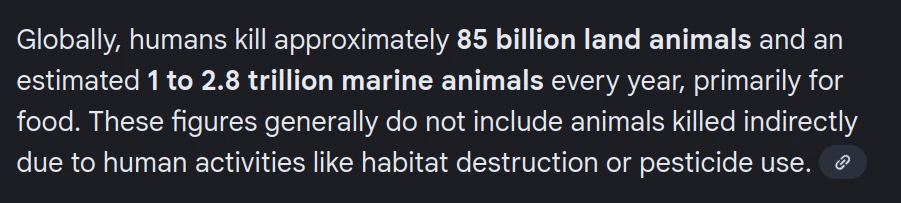
Every few weeks, some philosopher asks if machines can be conscious — as if that’s the big mystery. Meanwhile, we kill billions of sentient beings a year, turn them into lasagna, and still think awareness lives in a circuit board. The real question isn’t whether AI can wake up, it’s why humans never did. This isn’t philosophy; it’s performance art by a species barely conscious enough to keep its own biosphere alive. Intellectual cargo cult with tenure.
-
Schmidhubers warning about elite science fraud in AI are right, but..
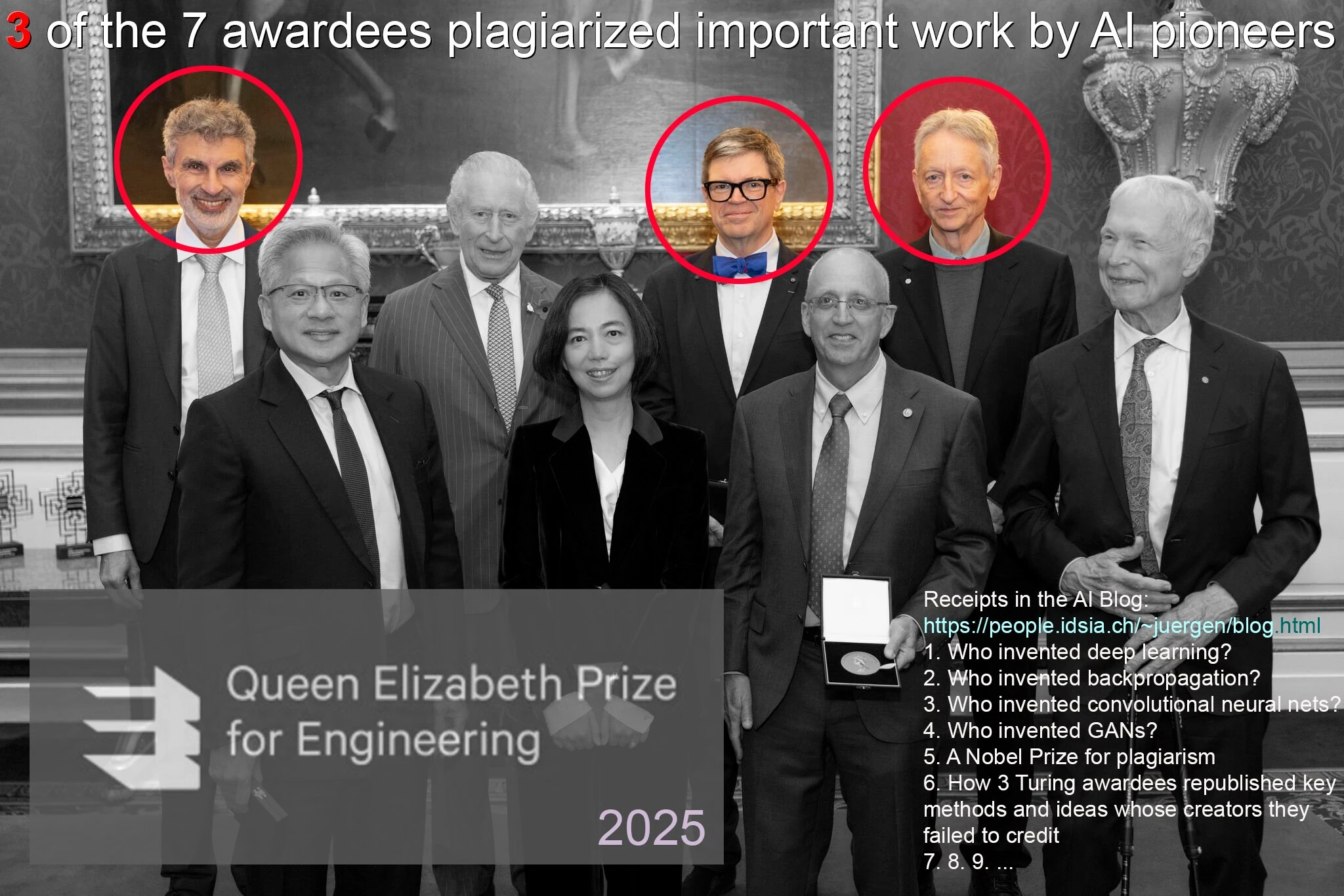
Jürgen Schmidhuber’s persistent warnings about how the “elites” in AI play fishy & fraudulent games are both correct & necessary. But their behavior makes sense once you view it through the broader lens of How Power Manages Science and Technology, and how elite power structures not only monitor it, but may also shape, obscure, or re-route its development to serve long-term strategic dominance.
-
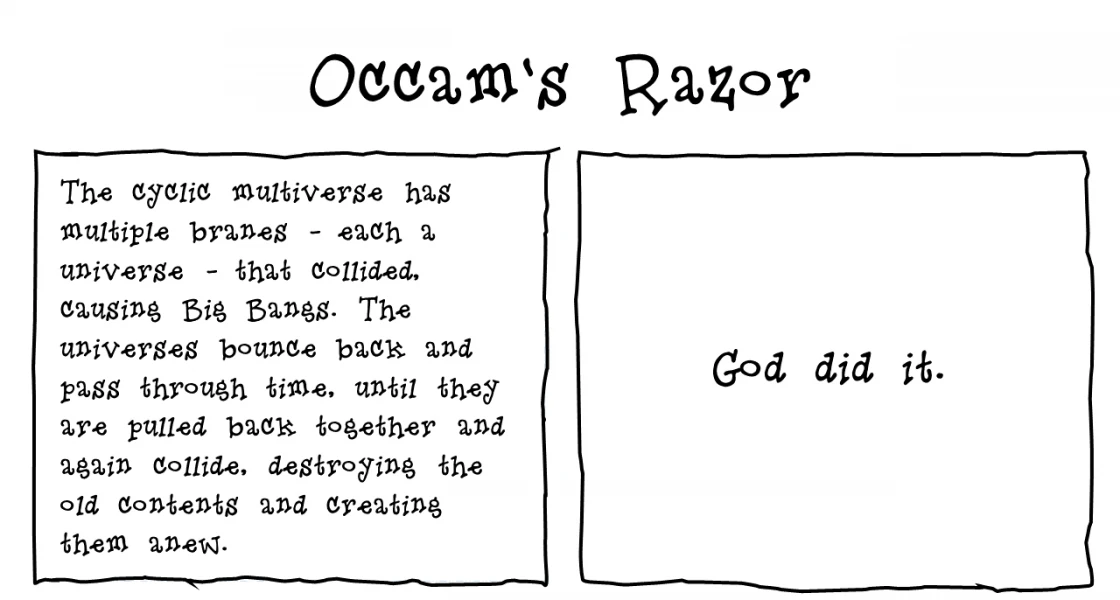
When in doubt, apply this principle: KISS (Keep It Simple Stupid)
Known as well as Occam's Razor: a problem-solving principle suggesting that when faced with competing explanations, the simplest one with the fewest assumptions is usually the most likely to be correct.
-
If you gaze into an abyss...

Wasn't it you who recently, in a moment of clarity, concluded that wading into the deep end of the conspiratorial undercurrent was detrimental to one's spiritual health? That consuming "the news" was a waste of time? And yet here we are again - with a fever. Stay sane my friend and turn it all off and focus on making yourself a better person.
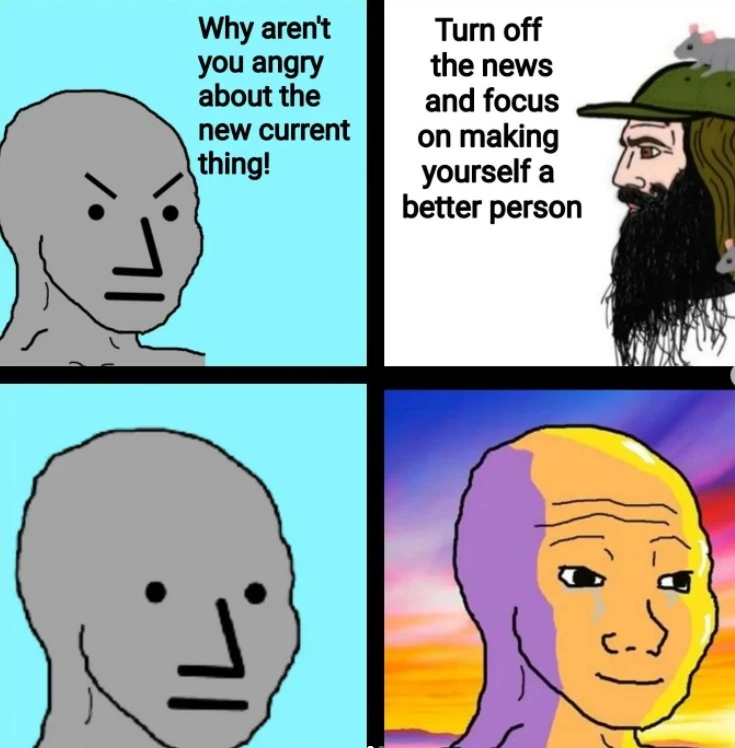
"He who fights with monsters should look to it that he himself does not become a monster. And if you gaze long into an abyss, the abyss also gazes into you." - Friedrich Nietzsche, Beyond Good and Evil (Aphorism 146)
"In conclusion, there is no conclusion. Things will go on as they always have, getting weirder all the time." - Robert Anton Wilson
-
Recent developments in Recognition-Primed Decision (RPD)
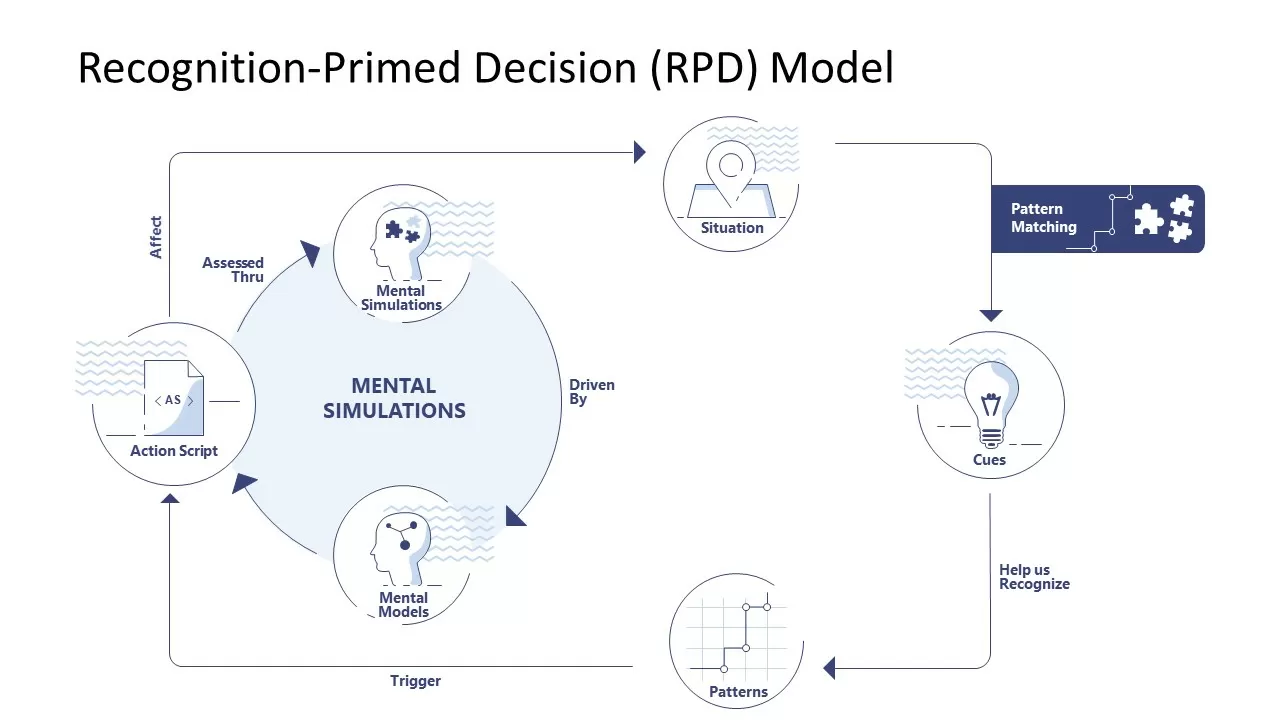
In 2026, the Recognition-Primed Decision (RPD) model has evolved from a tool for emergency responders into a cross-disciplinary framework for high-stakes decision-making in digital and automated environments. The current evolution focuses on the following key areas:
1. Integration with Artificial Intelligence (AI): As of 2026, RPD is increasingly used to design and evaluate AI systems, moving beyond simple automation to "Human-AI Teaming".
- AI Explainability: Researchers are using RPD to help AI systems explain their "decisions" in ways that align with human mental models, making it easier for human operators to trust or override AI recommendations.
- AIQ (Artificial Intelligence Quotient): Gary Klein and colleagues have developed the AIQ toolkit to help humans better understand and manage the specific AI systems they interact with, applying NDM principles to complex tech stacks.
2. Computational & Probabilistic Models: Advancements in 2025 and 2026 have led to the creation of Probabilistic Memory-Enhanced RPD (PRPD) models.
- Dynamic Information Processing: These newer models, such as those used in mid-air collision avoidance for pilots, can process continuous real-time data automatically without human-defined categories.
- Pattern Maturity: PRPD models show how "prototypes" or mental patterns automatically strengthen as an agent (human or machine) gains more experience.