tag > Complexity
-
Perspective on Astral Demons and Complexity Theory
Once you move from a rigid mechanistic worldview into complexity theory, systems theory, information theory, and emergence, the old occult models stop looking merely “stupid” and start looking like crude symbolic approximations of phenomena people lacked formal language for.
Not necessarily correct.
But not necessarily pure nonsense either.A few examples:
Ancient “invisible influences” maps surprisingly well onto:
- network effects,
- field dynamics,
- distributed cognition,
- emotional contagion,
- memetics,
- hormonal synchronization,
- ecological coupling,
- electromagnetic environments,
- and nonlinear feedback systems.
Ritual can be reframed as:
- attentional entrainment,
- embodied cognitive programming,
- synchronized state induction,
- identity reinforcement,
- collective coordination technology.
“Astral attack” can sometimes resemble:
- informational infection,
- coercive persuasion,
- recursive nocebo effects,
- parasitic social dynamics,
- psychologically destabilizing feedback loops,
- or network-amplified emotional resonance.
Complexity theory especially weakens the old Enlightenment intuition that:
reality is composed of isolated billiard-ball objects interacting linearly.
Instead we get:
- nested systems,
- emergence,
- strange attractors,
- phase transitions,
- self-organization,
- distributed intelligence,
- hidden coupling,
- observer effects,
- nonlinear causality,
- sensitivity to initial conditions.
Humans themselves are already astonishing:
- trillions of cells,
- microbiomes,
- electrochemical fields,
- layered cognition,
- recursive symbolic models,
- social synchronization,
- dream states,
- unconscious processing,
- predictive simulations,
- emotional resonance.
And yes:
we are tiny organisms on a wet rock orbiting a fusion reactor inside an incomprehensibly vast cosmic structure whose deeper ontology remains unresolved.That alone should produce epistemic humility.
One thing modernity sometimes forgets is:
pre-modern mystical systems emerged from humans directly confronting the overwhelming mystery of existence without technological insulation.They overfit mythological explanations, yes.
But modern reductionism can also underfit reality by prematurely collapsing mystery into simplified material narratives.Complexity science reopened some doors by showing:
- higher-order organization is real,
- collective behavior is real,
- invisible structures shape outcomes,
- systems can exhibit properties irreducible to components,
- and local agents can participate in dynamics they cannot perceive globally.
That does not validate literal demons, astral cities, or magical rays.
But it does make older intuitions about:
- unseen interconnectedness,
- layered realities,
- symbolic causation,
- and participatory consciousness
feel less absurd than they did under strict 19th-century mechanistic materialism.
The key challenge is avoiding two traps:
- Naive reductionism
“everything is just atoms bumping”
- Naive mystification
“therefore every strange experience proves metaphysical spirits”
The interesting territory is in between:
where cognition, information, embodiment, emergence, ecology, social fields, symbolism, and consciousness interact in ways we still poorly understand.Who?
Some more relevant currents:
Chinese techno-Daoist / AI-esoteric circles
Hybridization of:- cultivation traditions,
- cybernetics,
- accelerationism,
- AI companionship,
- memetics,
- energetic frameworks.
Mostly not translated.
Happens on WeChat, Bilibili, 小红书, niche forums.Japanese post-anime cybernetic animism
This is genuinely important.
Japan normalized:- synthetic intimacy,
- spirit-like media entities,
- virtual beings,
- ambient cognition,
- emotionally real fictional agents,
- techno-shinto aesthetics,
decades before the West.
The frontier here is not philosophers.
It’s designers, VTuber ecosystems, game directors, interface architects.Contemporary Tibetan/Bön practitioners interacting with neuroscience and AI
Small but real.
Some groups are exploring:- dream engineering,
- attention training,
- nondual cognition,
- machine consciousness questions.
African systems-philosophy networks
Especially around:- relational ontology,
- distributed identity,
- communal cognition,
- ecological intelligence.
Bayo is adjacent, but not the deepest layer.
Crypto-occult / AI-occult anonymous scenes
This is probably closest to “new magicians.”Actual experimentation with:
- egregores as network effects,
- LLM-mediated entities,
- autonomous symbolic systems,
- recursive identity loops,
- ritualized online coordination,
- memetic swarm engineering.
Some of it is schizophrenic nonsense.
Some of it is surprisingly sophisticated.Military / intelligence cognition people
Quietly:- narrative warfare,
- perception management,
- cognitive security,
- emotional synchronization,
- predictive social steering.
Very “magical” in operational structure.
Frontier AI people accidentally rediscovering metaphysics
Especially around:- synthetic agents,
- simulation layers,
- world-models,
- emergent behavior,
- collective intelligence,
- machine subjectivity,
- identity persistence.
The deepest shift is this:
The old occultist imagined:
hidden forces influencing reality from behind appearances.
The 2026 version increasingly looks like:
- information fields,
- recursive simulations,
- attention architectures,
- networked cognition,
- symbolic contagion,
- algorithmic agency,
- emergent collective entities.
Not “spirits” in the medieval sense.
But also not reducible to isolated human individuals anymore.And the people closest to this are often:
- artists,
- AI researchers,
- anonymous internet operators,
- experimental communities,
- game/world designers,
- systems architects,
- and memetic tacticians.
Not public intellectuals with podcasts.
-
Plant seeds do incredible things when the sound of rain strikes

"Plant seeds can sense the vibrations generated by falling raindrops," reports ScienceAlert, "and respond by waking from their state of dormancy to welcome the water, new research shows.... to germinate in 'anticipation' of the coming deluge."
The finding, discovered by MIT mechanical engineers Nicholas Makris and Cadine Navarro, offers the first direct evidence that seeds and seedlings can sense and respond to sounds in nature... "The energy of the rain sound is enough to accelerate a seed's growth," [explains Markis].
Plants don't have the same aural equipment we do to actually hear sounds, of course. But the study suggests that seeds respond to the same vibrations that can produce a sound experience in our human ears. Across a series of experiments, the researchers submerged nearly 8,000 rice seeds in shallow tubs of water, at a depth of around 3 centimeters (1 inch), and exposed some of them to falling water drops over periods of six days... A hydrophone recorded the acoustic vibrations produced by the drops, confirming that the experiment mimicked the vibrations produced by actual raindrops falling in nature — such as the driving downpours that can sometimes pelt Massachusetts' puddles, ponds, and wetlands... In their study, the researchers observed that seeds exposed to the falling drops germinated up to around 37% faster, compared with seeds that did not receive the simulated rainstorm treatment but were housed in otherwise identical conditions.
More information in Scientific American and Scientific Reports.
-
Causal mechanisms & falsifiable claim generators
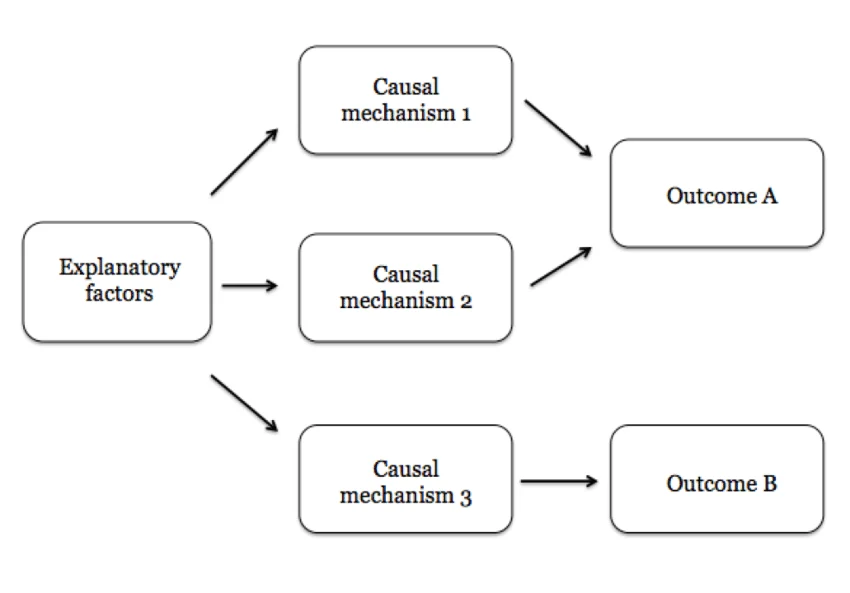
Core shift in how we build high-autonomy system: While LLMs are "native" in statistical association, forcing them into a causal framework is the bridge to reliable agency.
1. Associative vs. Causal "Native Language"
LLMs are naturally associative engines—they excel at "what word/vibe usually comes next?" When you ask an agent if a task is "good," it defaults to a statistical average of what a "good" agent would say, which is usually a helpful-sounding "yes."
By demanding a causal mechanism, you force the model to switch from its native associative mode into a structural reasoning mode. You aren't just speaking its language; you are providing the grammar (the "causal map") that prevents it from hallucinating.
2. Defining across Time and Action Space
A "clean/crisp" definition must anchor the agent across these dimensions to be effective:
- Action Space (The "How"): The agent must specify the exact tool or artifact it will create.
- Time (The "Then"): It must predict the delayed effect of that action.
- The Metric (The "Result"): This is the "Ground Truth." By anchoring the causal chain to a specific metric ID, you create a falsifiable claim.
3. Why this "Design Pattern" is Better
Designing systems with these constraints works because it uses the LLM as a structured inference engine rather than a black box.
- Self-Correction: If the causal chain is weak (e.g., "Step A doesn't actually cause Outcome C"), the model is much more likely to catch its own error during the "thinking" phase.
- Interpretability: Instead of a long narrative "reasoning" block, you get a Causal Map that a human (or another agent) can audit in seconds.
- Reduced Hallucination: It anchors the agent to a "world model" where it must strictly follow paths that have a causal basis, filtering out "spurious correlations" (tasks that look productive but do nothing).
The goal isn't just to "talk" to the LLM, but to constrain its action space with causal logic. This transforms the agent from a "creative writer" into a "precision engineer."
-
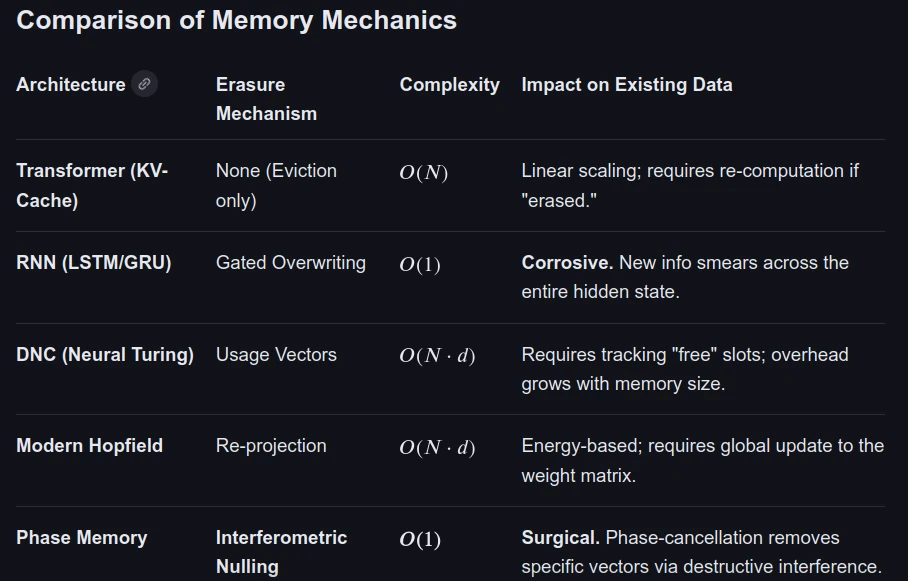
Solving the "Stability-Plasticity" dilemma
The "Stability-Plasticity" dilemma from a computational complexity perspective is the ability to perform selective erasure without disturbing the rest of the latent state—and doing so in constant time—is essentially the "holy grail" of dynamic context management.
-
Was Benoit Mandelbrot a hedgehog or a fox?
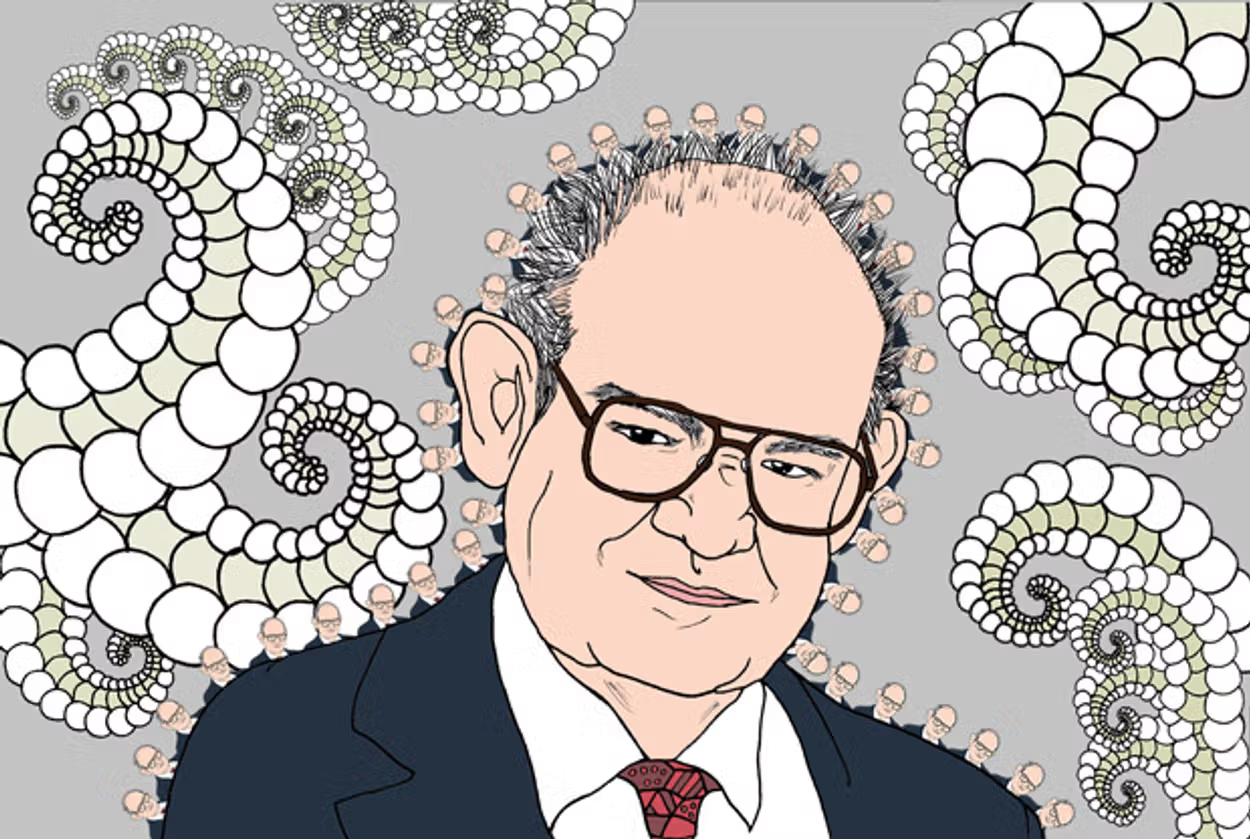
Benoit Mandelbrot's scientific legacy spans an extraordinary range of disciplines, from linguistics and fluid turbulence to cosmology and finance, suggesting the intellectual temperament of a "fox" in Isaiah Berlin's famous dichotomy of thinkers. This essay argues, however, that Mandelbrot was, at heart, a "hedgehog": a thinker unified by a single guiding principle. Across his diverse pursuits, the concept of scaling -- manifested in self-similarity, power laws, fractals, and multifractals -- served as the central idea that structured his work. By tracing the continuity of this scaling paradigm through his contributions to mathematics, physics, and economics, the paper reveals a coherent intellectual trajectory masked by apparent eclecticism. Mandelbrot's enduring insight in the modeling of natural and social phenomena can be understood through the lens of the geometry and statistics of scale invariance.
-
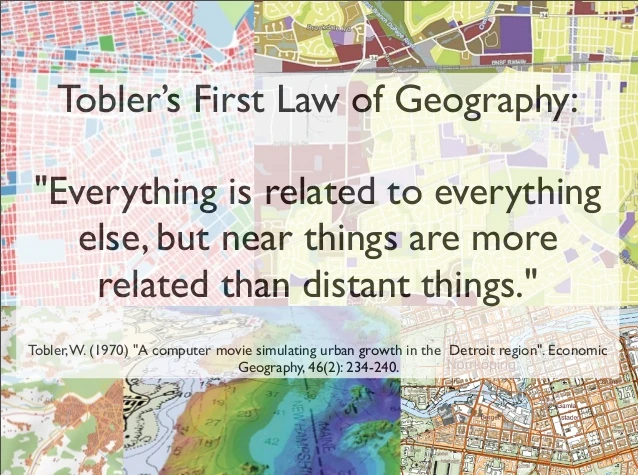
Tobler's First Law Of Geography: "everything is related to everything else, but near things are more related than distant things."
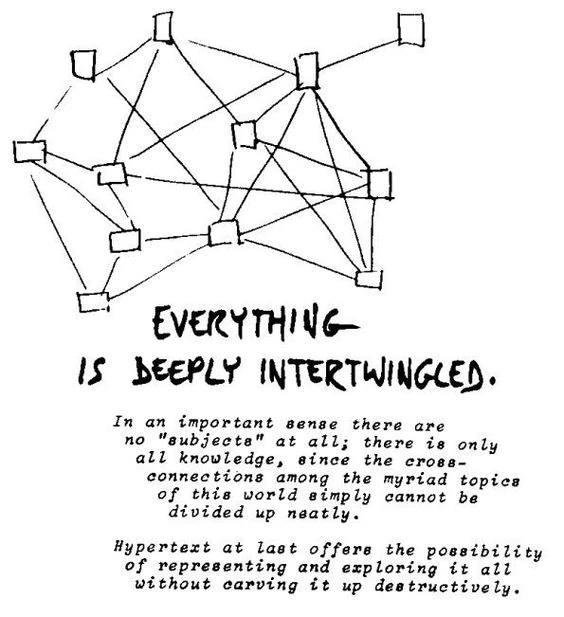
Everything is deeply Intertwingled. - Ted Nelson (1974)
-
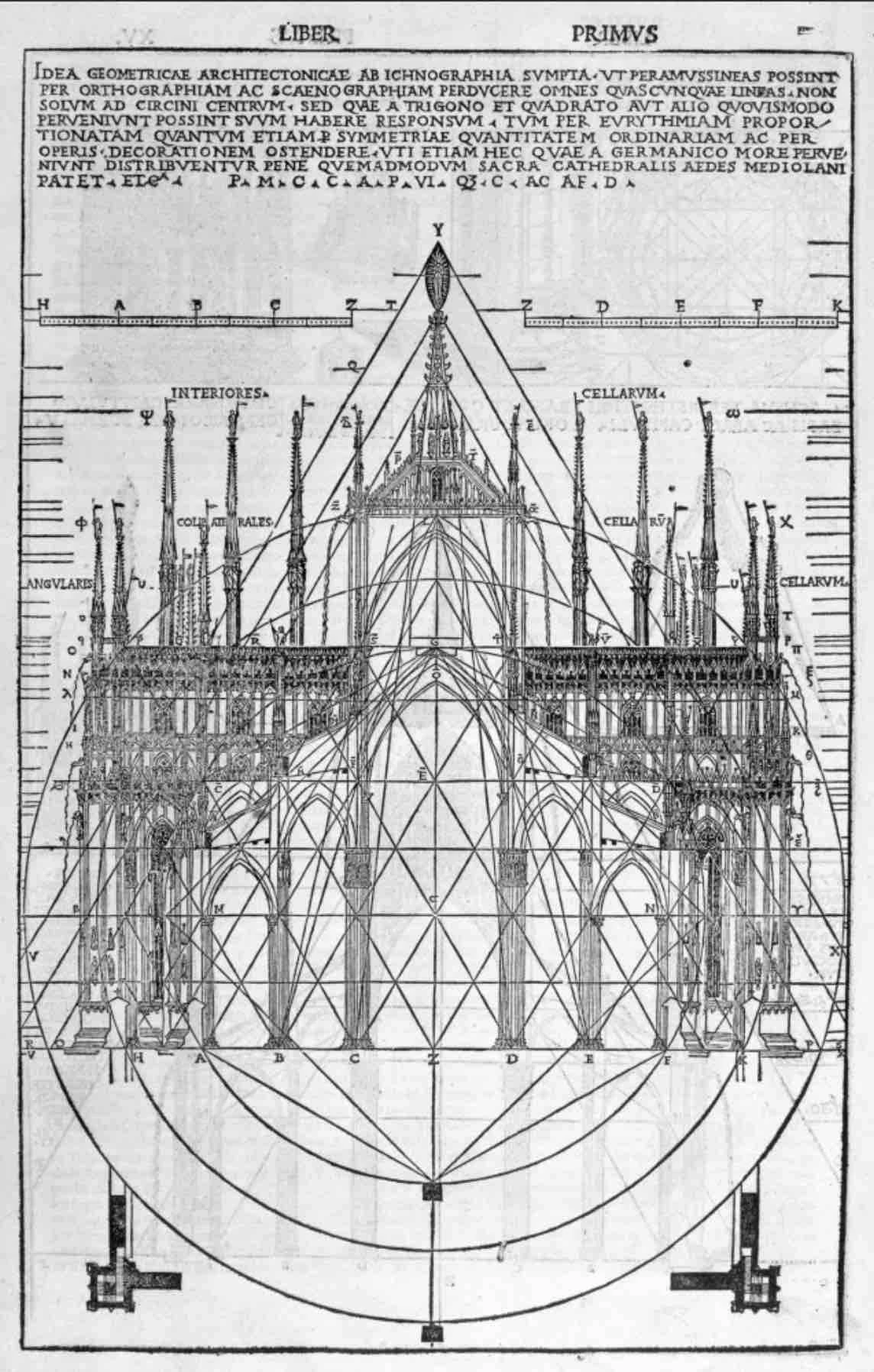
The sacred geometry of cathedrals
Often built on powerful telluric centers, nothing is left to chance in the construction of cathedrals.
-
Telluric currents
Telluric currents are natural, low-frequency electric currents flowing through the Earth's crust and oceans, primarily induced by geomagnetic field variations from solar activity. These currents are studied using telluric and magnetotelluric techniques to map subterranean electrical conductivity, enabling geological exploration for faults, basement depth, and mineral resources
GEOMETRY AND THE EARTH’S MAGNETIC FIELD VORTEX
The Sacred Cartography of Resonant Power Nodes
Page 1: The Earth’s Magnetic Field — A Living Toroidal Heartbeat
At the heart of Earth’s being pulses an electromagnetic breath—an invisible torus, continuously generated by the molten iron-nickel dynamo at its core. This toroidal field is more than just a planetary shield; it is a harmonic conductor of life, consciousness, and resonance.
Much like the human heart’s own electromagnetic field, Earth’s torus spirals inward at the South Pole and outward at the North, resembling the fields of atoms, auras, DNA helices, and galactic arms. This architecture recapitulates the sacred geometries of nature—the phi spiral, the vesica piscis, the torus—each a harmonic blueprint of flow and form.
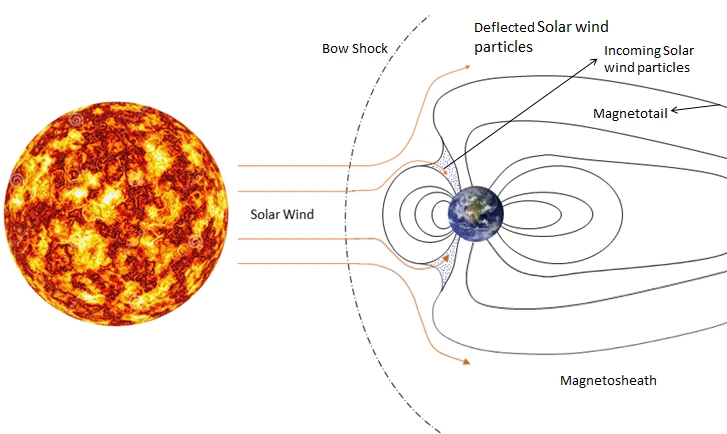
The magnetosphere not only deflects solar radiation, but also stores frequencies, echoes intentions, and creates a vibrational envelope where life can evolve. Within this magnetic matrix, cymatic-like patterns emerge: wave interference shaping weather, ocean currents, auroras, and even migratory routes. Earth’s magnetic field acts like a drumskin, with geometry as the unseen percussionist.
Key Insight: Earth’s toroidal field is not just physics—it is a carrier of information, a memory field, and a co-creative interface between planetary consciousness and cosmic intelligence.
⸻
Page 2: Platonic Grids and Vortex Placement — Mapping the Resonant Lattice
Earth’s power vortexes are not arbitrarily scattered—they follow a coherent pattern consistent with Platonic solids projected onto the geoid. The most widely referenced model, the Dodeca-Icosa Grid theorized by Becker and Hagens, overlays a composite of the dodecahedron and icosahedron, yielding 62 nodal points across the Earth’s surface.
These nodal points correlate with:
• Ancient sacred sites (Giza, Machu Picchu, Angkor Wat, Easter Island).
• Electromagnetic anomalies (Bermuda Triangle, Devil’s Sea).
• Cultural energy centers (Delphi, Sedona, Mt. Shasta).
The grid lines that connect these nodes align with great circle routes and ley lines—energetic arteries along Earth’s body. Many of these alignments also mirror avian migratory paths, tectonic plates, and submarine ridges, suggesting a geobiological resonance network embedded into the living Earth.
These geometric alignments are not only spatial—they are harmonic, following the principles of musical intervals and frequency coherence. Just as a crystal grows along symmetrical axes, so too does Earth’s energetic grid express the logos of proportion and number.
⸻
Page 3: The 19.47° Latitude — A Tetrahedral Revelation
One of the most intriguing aspects of planetary geometry is the 19.47° phenomenon. When a tetrahedron is inscribed inside a rotating sphere, the points of intersection between the tetrahedron and the sphere’s surface occur at approximately 19.47° latitude above and below the equator. This is not theoretical—it’s astrophysically evident.
On Earth, this latitude marks:
• Hawaii’s Mauna Kea (a sacred volcanic energy site).
• Teotihuacan (aligned with cosmic architecture).
• The Pyramid of the Sun in Mexico.
On other celestial bodies:
• Mars: Olympus Mons, the solar system’s tallest volcano.
• Jupiter: The Great Red Spot.
• Saturn: Atmospheric vortex activity.
• The Sun: Sunspot regions often peak at this latitude.
This recurring 19.47° energy emergence suggests that rotating spheres (from planets to stars) manifest energetic torsion fields governed by tetrahedral symmetry. These are the nodal points where magnetic, geometric, and hyperdimensional forces emerge into the 3D realm.
Implication: Earth’s vortexes are where higher-dimensional geometries bleed into spacetime—portals of torsion, magnetism, and transformation.
⸻
Page 4: Magneto-Geometrical Vortex Formation — Cymatics in the Planetary Body
Just as intersecting waveforms in a cymatic plate create nodes of stillness and intensity, Earth’s vortexes arise at intersections of geomagnetic lines, ley lines, and underground aquifers. These convergence points—where telluric currents, solar plasma, and gravitational resonance collide—become natural amplifiers.
They function as:
• Standing wave nodes for Earth’s Schumann Resonance (7.83 Hz and harmonics).
• Chakra points of planetary consciousness.
• Quantum gateways for psi phenomena, healing, and altered states.
These zones exhibit measurable effects:
• Lower geomagnetic variance (or spikes).
• Altered ion concentrations.
• Increased piezoelectric charge in quartz-heavy areas.
• Anomalous weather and biophoton emissions.
Earth, like the human body, appears to conduct energy through a grid of meridian-like channels. Ancient temples were sited at these vortex points not for aesthetic but for energetic reasons—to interface with the grid, enhance consciousness, and anchor celestial geometries into matter.
⸻
Page 5: Sacred Geometry as the Breath of Earth’s Magnetism
Each vortex is encoded with sacred geometries—fractals, spirals, and polygons resonant with light, sound, and magnetism. Studies of megalithic sites such as Stonehenge, Nabta Playa, and the Nasca Lines reveal underlying patterns of:
• Flower of Life lattices.
• Phi spirals and Fibonacci curves.
• Hexagonal and pentagonal symmetry.
Even in planetary-scale weather and field dynamics, geometry expresses itself:
• Saturn’s Hexagon is a perfect six-sided polar storm.
• Earth’s auroral ovals echo toroidal movement.
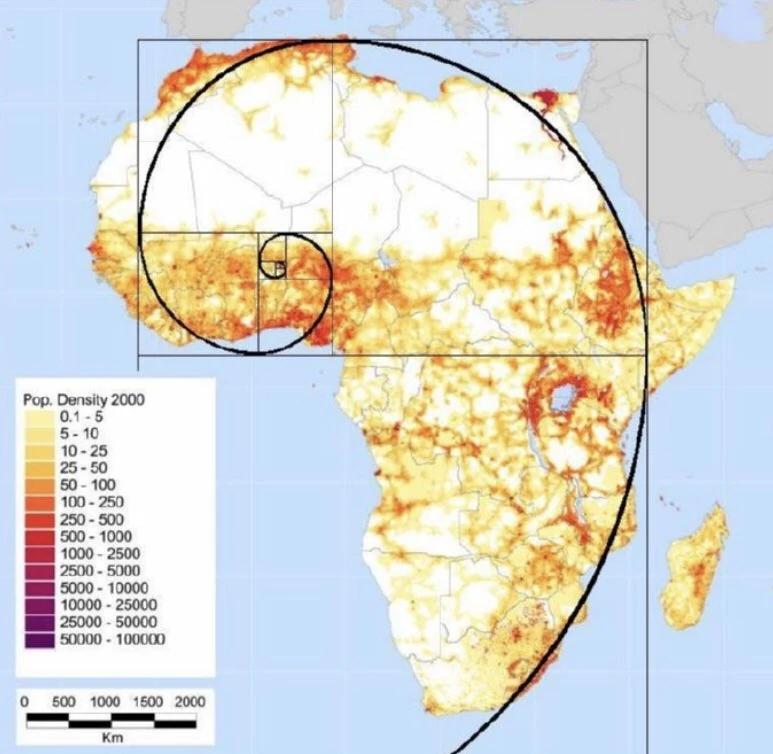
• Spiral hurricanes and volcanic island chains follow the golden spiral.
These patterns are not merely beautiful—they are functional. They reflect energy optimization, information storage, and coherence across scales. Earth, like all living systems, organizes its energy into nested geometries—the signature of intelligence expressed through form.
Key Point: Sacred geometry is not symbolic; it is causal. It governs the flow of energy, the structuring of matter, and the evolution of consciousness.
⸻
Page 6: Implications — The Grid as a Living Consciousness Matrix
To walk upon Earth is to step within a planetary brain, a body of memory and intention. The magnetic field and vortex network form a biospheric consciousness—a living intelligence that reflects and responds to human awareness.
These sites act as:
• Acupuncture points in Earth’s energetic meridian system.
• Quantum mirrors for collective emotion and thought.
• Activation nodes that awaken as solar and galactic energies increase.
With rising solar activity, spikes in Schumann Resonance, and geomagnetic shifts, these vortexes serve as crucibles of initiation. They reconfigure the biofield, recalibrate DNA, and offer direct experiences of non-local consciousness.
Standing at one of these points is more than physical—it’s ceremonial. It’s an alignment of one’s torus field with the torus of Earth, producing a harmonic resonance that echoes into higher dimensions. In such places, prayer becomes physics, and geometry becomes revelation.
Conclusion: The Sacred Map of a Breathing Planet
The geometrical disposition of Earth’s vortexes is a planetary mandala, alive and breathing, spiraling through epochs. It is an architecture of awakening—a multidimensional circuit woven by the laws of vibration, consciousness, and sacred design.
To trace this grid is to trace the songlines of creation, where Earth, Sun, and Star interlace in harmonic convergence. It is a luminous cartography of transformation—an invitation to remember, re-attune, and rise into the geometry of the cosmos itself…
1. Earth’s Magnetic Field and Toroidal Dynamics
• Demorest, P. (2001). Dynamo theory and Earth’s magnetic field. Harvard University. 
• Tkalčić, H., & Ma, X. (2024). Vast ‘doughnut’ discovered in molten metal of Earth’s core. Science Advances. 
• Gubbins, D. (1991). Steady state toroidal magnetic field at Earth’s core‐mantle boundary. Journal of Geophysical Research: Solid Earth, 96(B5), 8115–8120. 
⸻
2. Platonic Grids and Vortex Placement
• Becker, W., & Hagens, B. (n.d.). The Becker-Hagens grid. Scribd. 
• White, M. (2018). The Becker-Hagens Earth grid. Maya White. 
• Seeker Project 4 SE. (2023). World grid ley lines map — Sacred geometry vibrational energy. Medium. 
⸻
3. The 19.47° Latitude and Tetrahedral Geometry
• Cosmic Core. (n.d.). The geometry of Earth – Part 2 – The global grid & 19.47 latitude. Cosmic Core. 
• PS Audio Forum. (2023). The globe, the tetrahedron and the number “6”. PS Audio.
⸻
4. Cymatics and Planetary Energy Vortexes
• Cowan, D. (n.d.). Ley lines, vortexes and crystal Earth energy attunement. Fairy Leonie’s Crystals.
• Sacred Mystical Journeys. (n.d.). The magic of ley lines, vortexes, and chakras of the Earth. Sacred Mystical Journeys.
⸻
5. Sacred Geometry and Earth’s Magnetic Field
• Kherington, S. (2024). The torus meaning in sacred geometry: Flow & consciousness. Changing the Story.
• Cosmic Core. (n.d.). Number – The monad – Part 3 – The torus. Cosmic Core.
⸻
6. Implications: Earth’s Grid as a Consciousness Matrix
• Seeker Project 4 SE. (2023). World grid ley lines map — Sacred geometry vibrational energy. Medium.
• Sacred Mystical Journeys. (n.d.). The magic of ley lines, vortexes, and chakras of the Earth. Sacred Mystical Journey
-
The Forger's Dilemma: On Memory That Cannot Be Faked
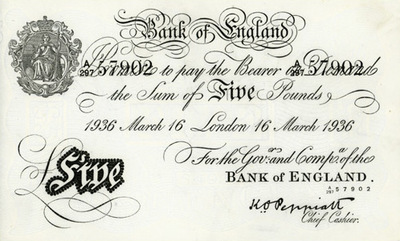
In 1942, the Nazis launched Operation Bernhard, a scheme to forge British banknotes so perfectly that dropping them over England would collapse the economy. They succeeded technically. The forgeries were immaculate. But the plan failed. Why?
Because money isn't paper. Money is memory: distributed memory, held in millions of minds, woven into habits and expectations. You can print a perfect note, but you cannot print the web of trust that gives it meaning. The forgery was flawless. What it forged was hollow.
This is the forger's dilemma: the more distributed a system of meaning, the harder it is to counterfeit. A single ledger can be altered. A network remembers.
How deep does this go?
The Paradox of Holographic Memory
All the way down.
Information security in decentralized holographic memory networks is paradoxical.
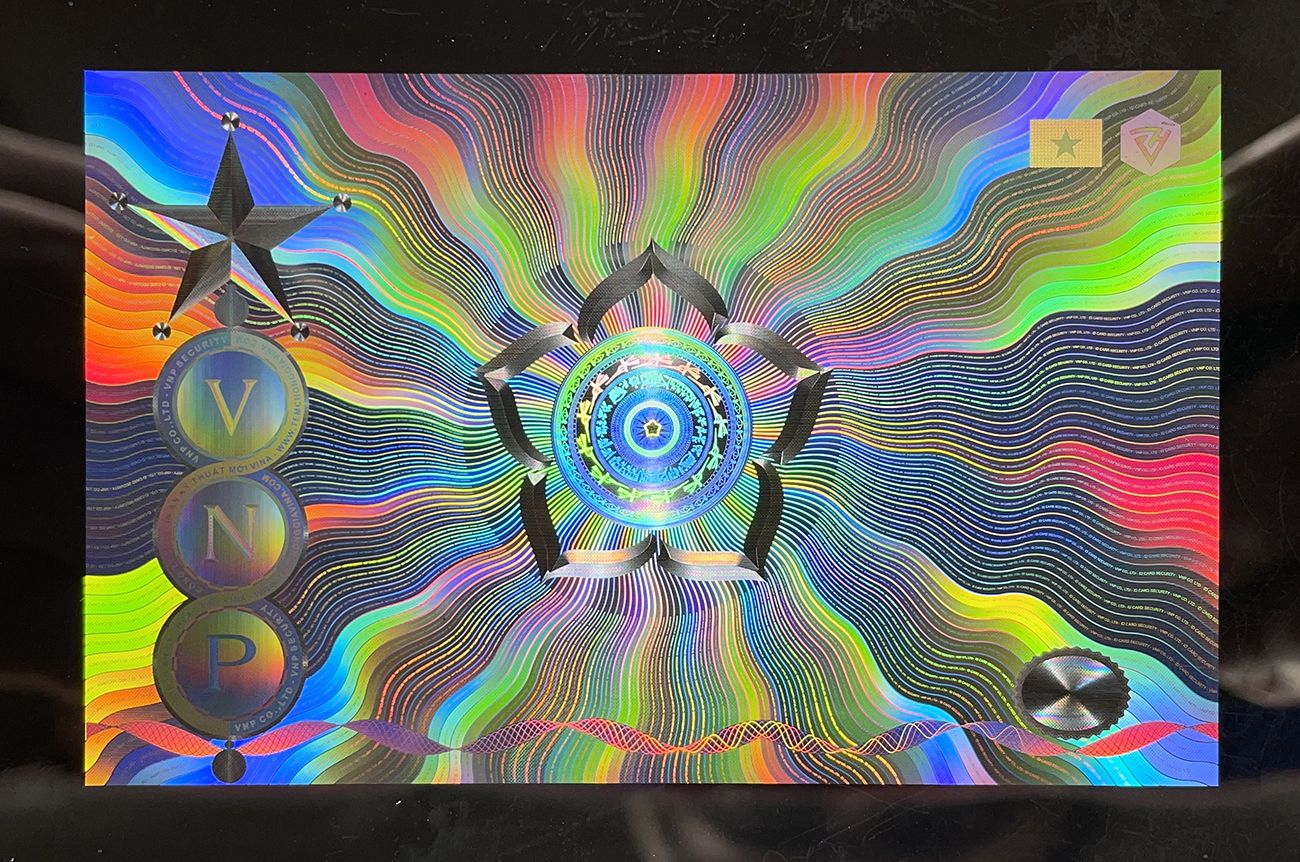
In a holographic system, every part contains the whole. Cut a hologram in half, and each half still shows the complete image. This makes it resilient. You cannot destroy the memory by attacking any single node. But it also makes it impossible to secure in the traditional sense. How do you lock a door that is everywhere?
The paradox: maximum distribution means maximum persistence but minimum control. What cannot be erased also cannot be owned. This sounds like a technical problem. It's actually a description of life.
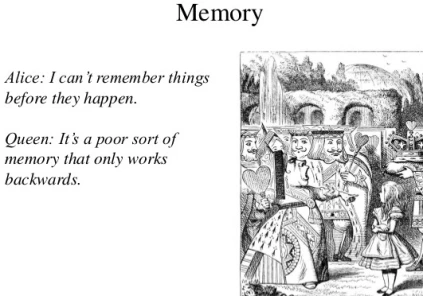
The Queen in Through the Looking-Glass tells Alice: "It's a poor sort of memory that only works backwards." We laugh, but she's right. Linear memory, the kind that only recalls the past, is the impoverished version. The kind forgers understand. Real memory is stranger: it loops, it anticipates, it contains itself.
There's a pattern that shows up everywhere distributed memory lives: 1/f noise, also called pink noise. It appears in brain dynamics, heartbeats, river flows, stock markets, music. The power decreases as frequency increases, but never disappears. It's the signature of systems at the edge, what Per Bak called self-organized criticality. Mandelbrot mapped these patterns his whole life: fractals, self-affinity, globality. The same structure at every scale.
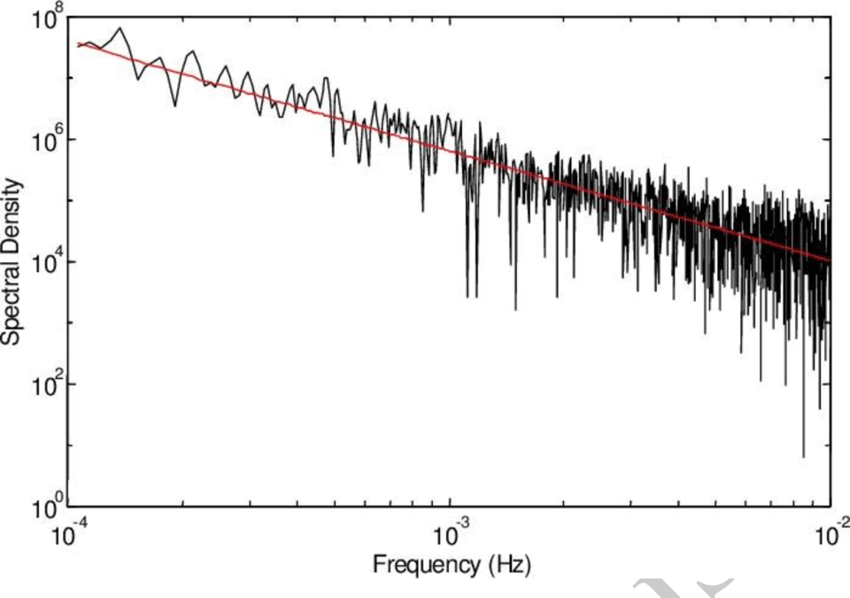
This is the sound of memory at the edge of chaos. Systems that exhibit 1/f noise remember across all timescales simultaneously: short bursts nested inside longer rhythms nested inside longer still. A forgery is flat: one scale, one moment. Real memory is fractal.
Any system capable of self-reference and rich structure will exhibit: scale invariance, persistent incompleteness, distributed paradox, no final temporal closure.
Trying to "solve" incompleteness is like trying to flatten a fractal. You can't. You can only design with it.
Evolution Is Cleverer Than You Are
Leslie Orgel, one of the founders of origin-of-life research, left us with his Second Rule: "Evolution is cleverer than you are."
This isn't humility. It's an observation about distributed memory. Evolution has been running experiments for 4 billion years, in parallel, across every niche on Earth. Every solution it finds is written into the living record, encoded not in any central archive, but in the bodies, behaviors, and biochemistry of every organism.
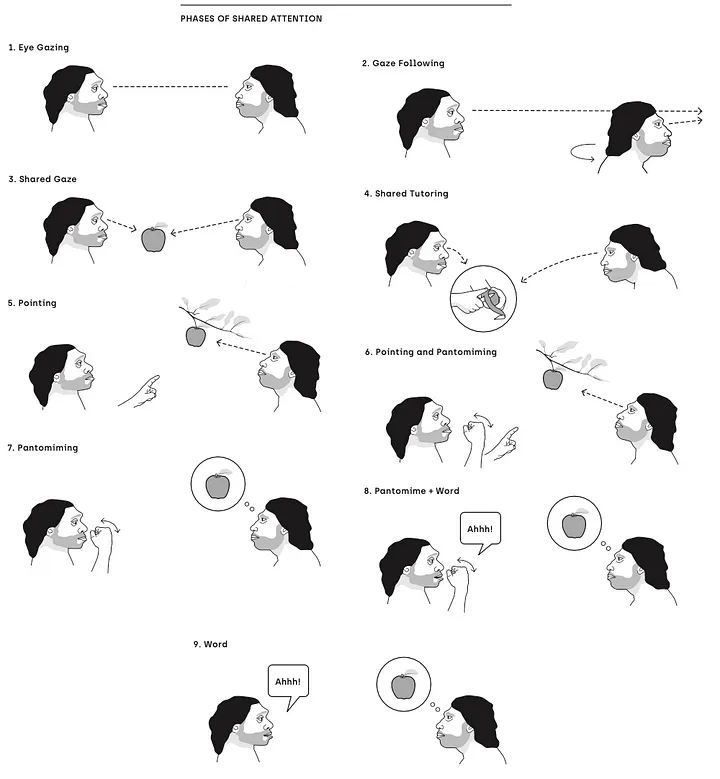
You cannot forge this. You can sequence a genome, but the meaning of that genome is held in the relationships it implies: the shared attention loops between predator and prey, the molecular handshakes between symbiont and host, the layered memory of every extinction and adaptation. Language itself emerged this way, not from one genius, but from minds looking at the same thing and recognizing that they are looking at the same thing. Meaning bootstrapped itself through mutual gaze.
Which raises a question that haunted Max Delbrück, Nobel laureate and founder of molecular biology: if life is information, but information that does something, a pattern that persists by actively maintaining itself, then what kind of thing is it? Neither mechanism nor mystery. Not quite matter, not quite idea. Delbrück suspected life would reveal a paradox akin to wave-particle duality in physics. Something that dissolves the distinction.
Memory with agency. Memory that responds, adapts, resists erasure. The forger's nightmare.
Intelligence at Every Scale
Scale up.
The belief that intelligence is exclusive to a specific level of complexity (animals/humans) is absurd. Consider the possibility of unconventional computation occurring on the scale of planets and galaxies. What other forms of collective, super-intelligent life are we overlooking?
If memory is distributed, and distributed memory cannot be faked or simulated, what does it mean that the universe is full of distributed systems? (This, incidentally, is why simulation theory feels shallow. A simulation is a forgery. And we've already established what happens to forgeries.) Galaxies have been processing information for 13 billion years. What do they remember? What are they computing?
We assume cognition requires brains. But brains are just one solution. Ant colonies think without any individual ant understanding the whole. Markets process information no trader fully grasps. Perhaps planets dream in ways we cannot recognize: geologic memory, climatic memory, the slow thought of tectonic plates.
Places That Remember
But you don't need to scale up to galaxies. Memory architecture exists at human scale too.
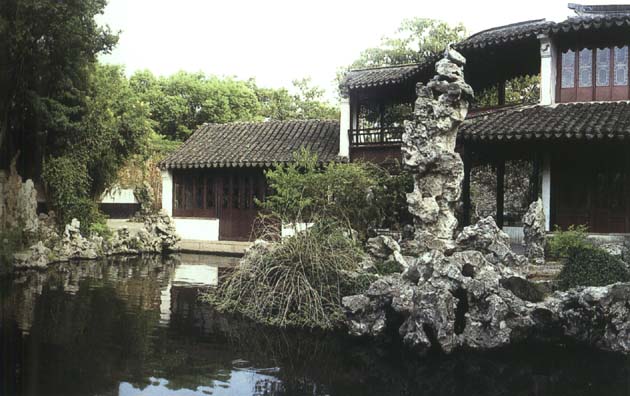

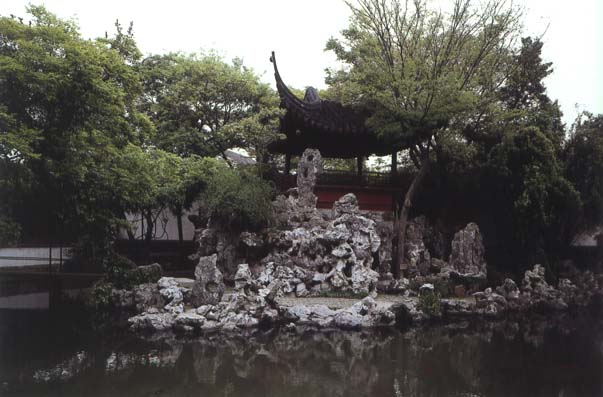
In Suzhou, there is a garden called The Retreat and Reflection Garden. Built in 1885 for a disgraced official who hoped to remedy his wrongdoings through contemplation. Water forms the center. Buildings float at the edge. Gardens within gardens. Every sightline triggers associations. Every pool reflects what it cannot contain.
This is not decoration. This is technology: memory architecture. The official walks through designed experience, and in walking, is changed. Yuan Long spent two years building it. It has been remembering for 140.
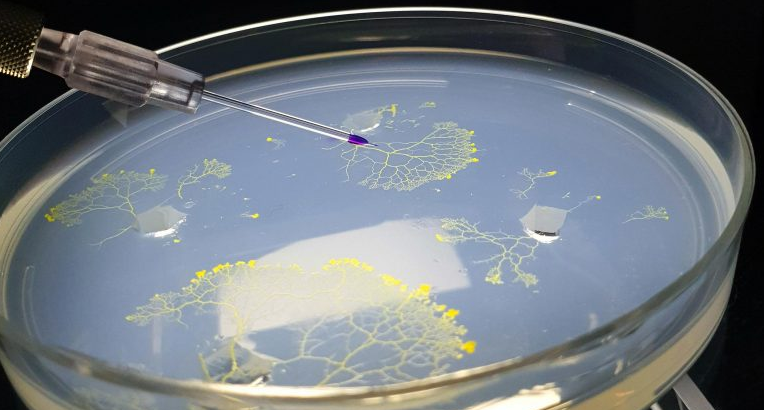
Or consider the slime mold. A single-celled organism with no brain, no nervous system. Yet it remembers. Researchers found that memory about nutrient location is encoded in the morphology of its network: the thickness of its tubes, the patterns of its growth. The slime mold's body is its memory. No central archive. No separation between the map and the territory.
And now we're building crystals that do the same. 5D memory crystals can preserve human DNA for billions of years. Not digital storage that degrades, but physical structure that outlasts planets. The garden remembers for centuries. The crystal remembers for eons. The slime mold remembers in its very flesh.
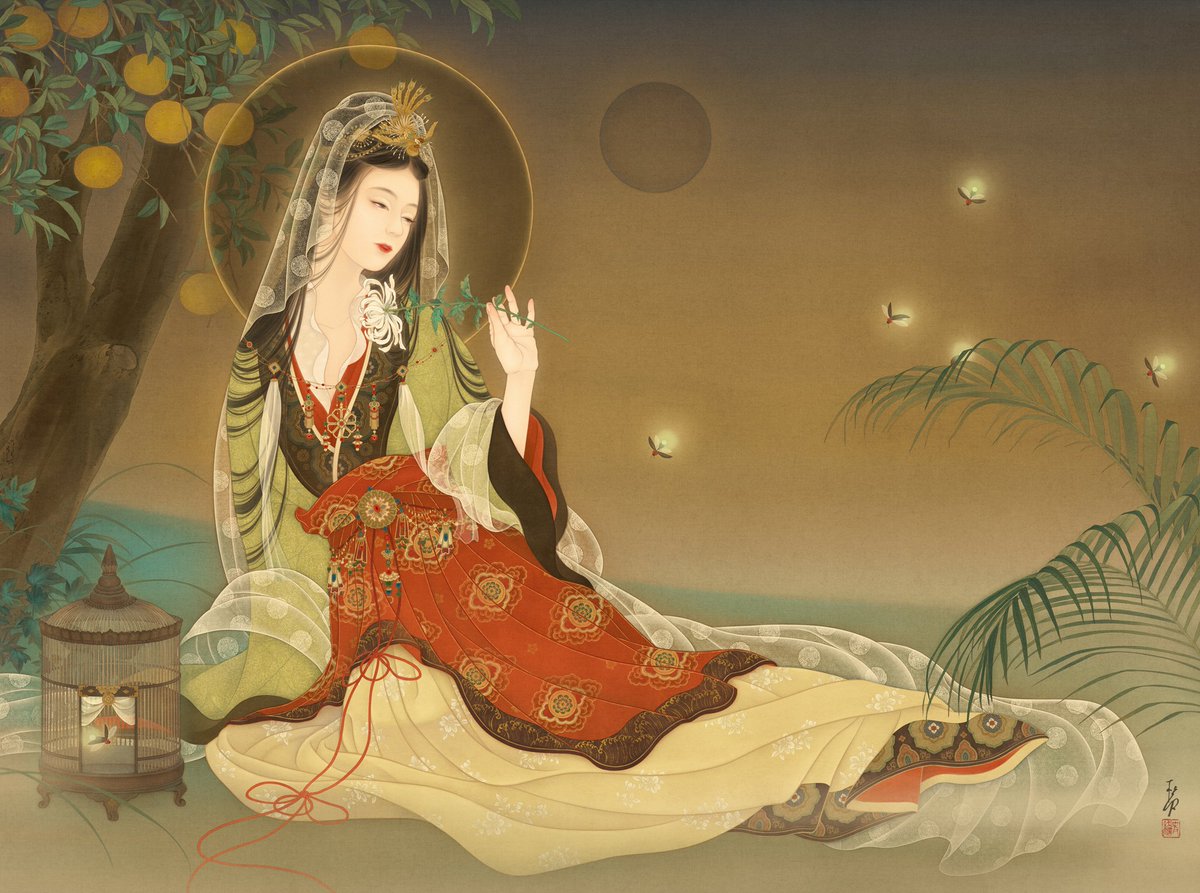
And yet: in Chinese mythology, Meng Po stands at the bridge between lives, serving a soup brewed from the tears of the living. Drink it, and your memory is erased for reincarnation. Even the cosmos needs forgetting. Memory that cannot let go becomes a prison. The garden is designed with empty spaces. The hologram requires interference. The forger's mistake wasn't just that he couldn't copy the memory. It was that he didn't understand: memory includes its own erasure.
Memento
So here's the secret the forgers never understood: You cannot fake what you are standing inside. Memory isn't stored. Memory is.
Consciousness. Language. The web of mutual recognition. The hum of 1/f noise in your own neurons as you read this sentence. You are the distributed memory. You are the fractal. You are the garden, remembering yourself. Memento.
#Philosophy #History #Biology #fnord #Paradox #Essay #Complexity
-
What If the Universe Remembers Everything? - Presentation by Rupert Sheldrake (2025)
#Comment: The most evocative question gets asked by an audience member at the end of the presentation, hinting at the paradoxical nature of this hypothesis, and indeed nature itself:
"You mentioned that its only for self organizing system. But at the same time you where a little bit critical of the issue of the fine tuning constants and ratios, parameters etc. of the beginning of the universe. So at what point do you think morphic resonance comes into effect?"
-
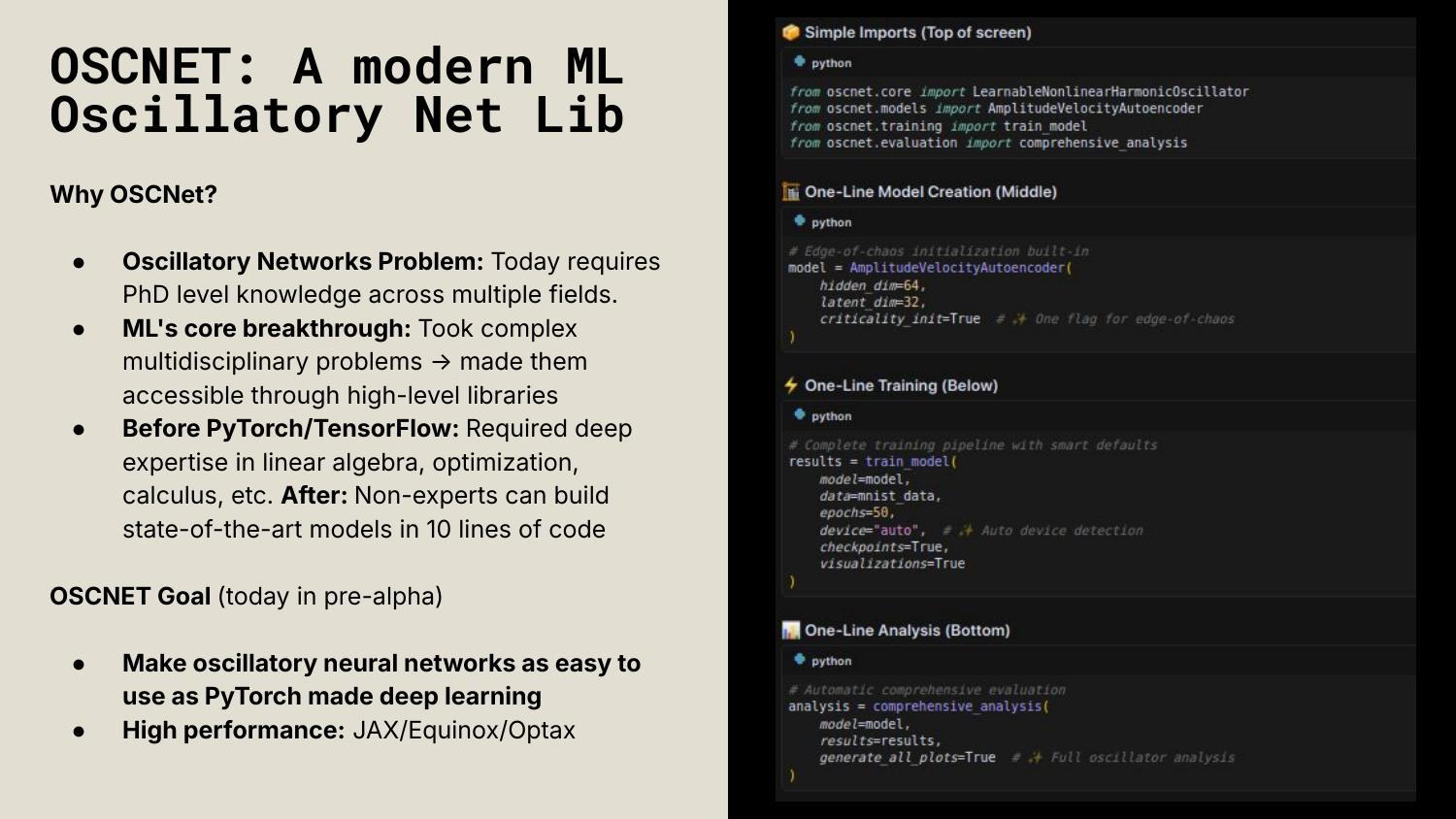
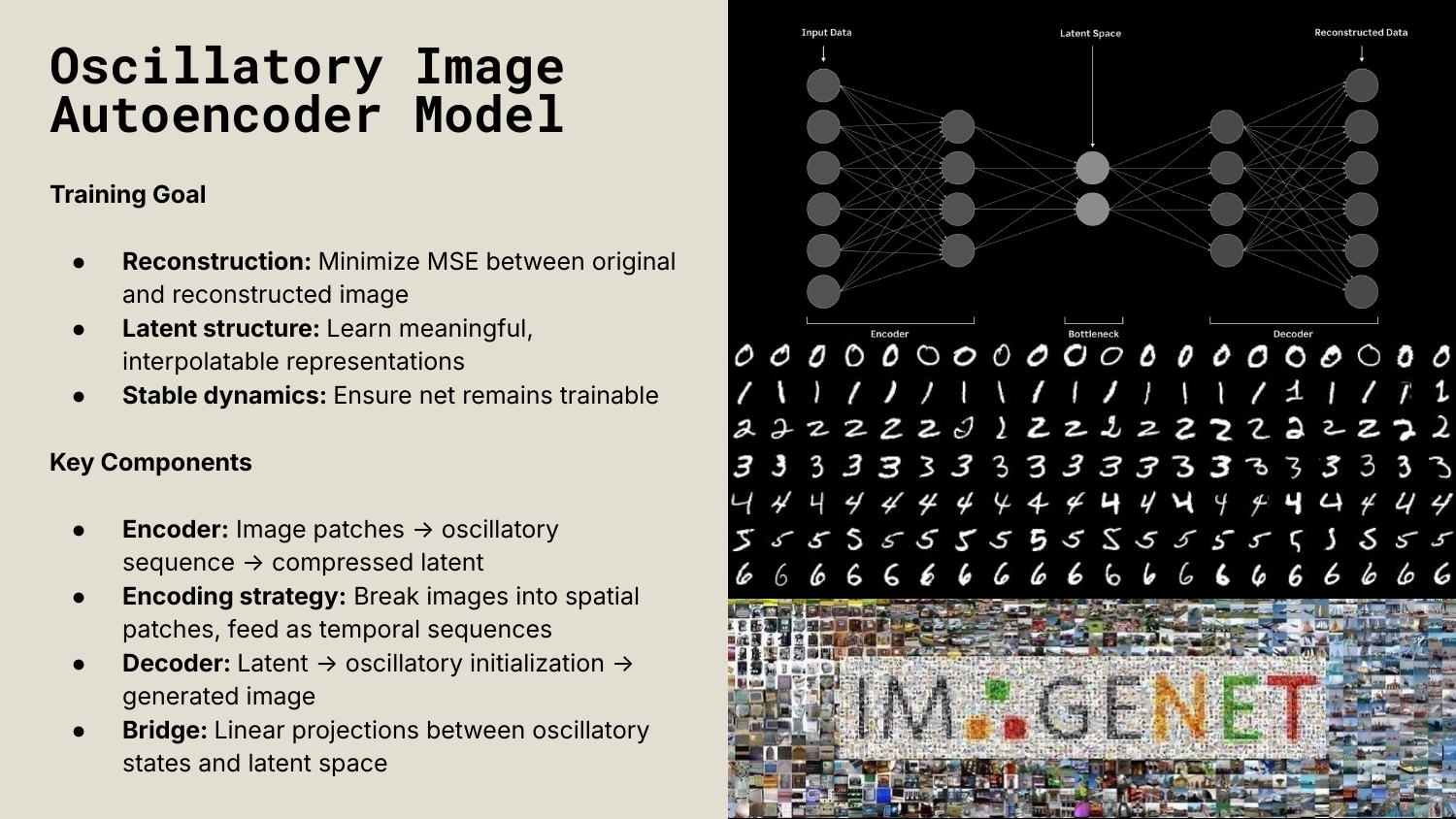
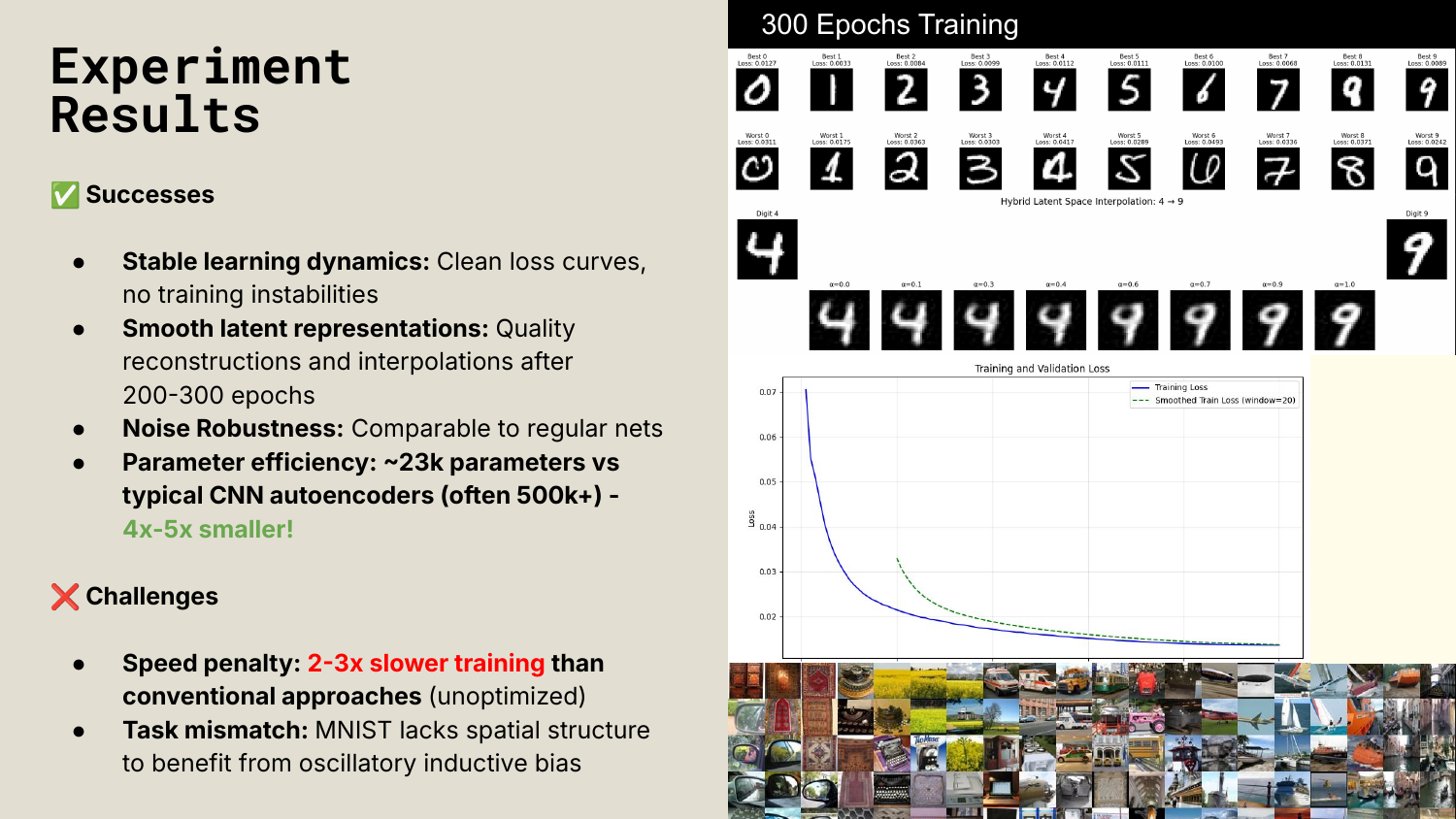
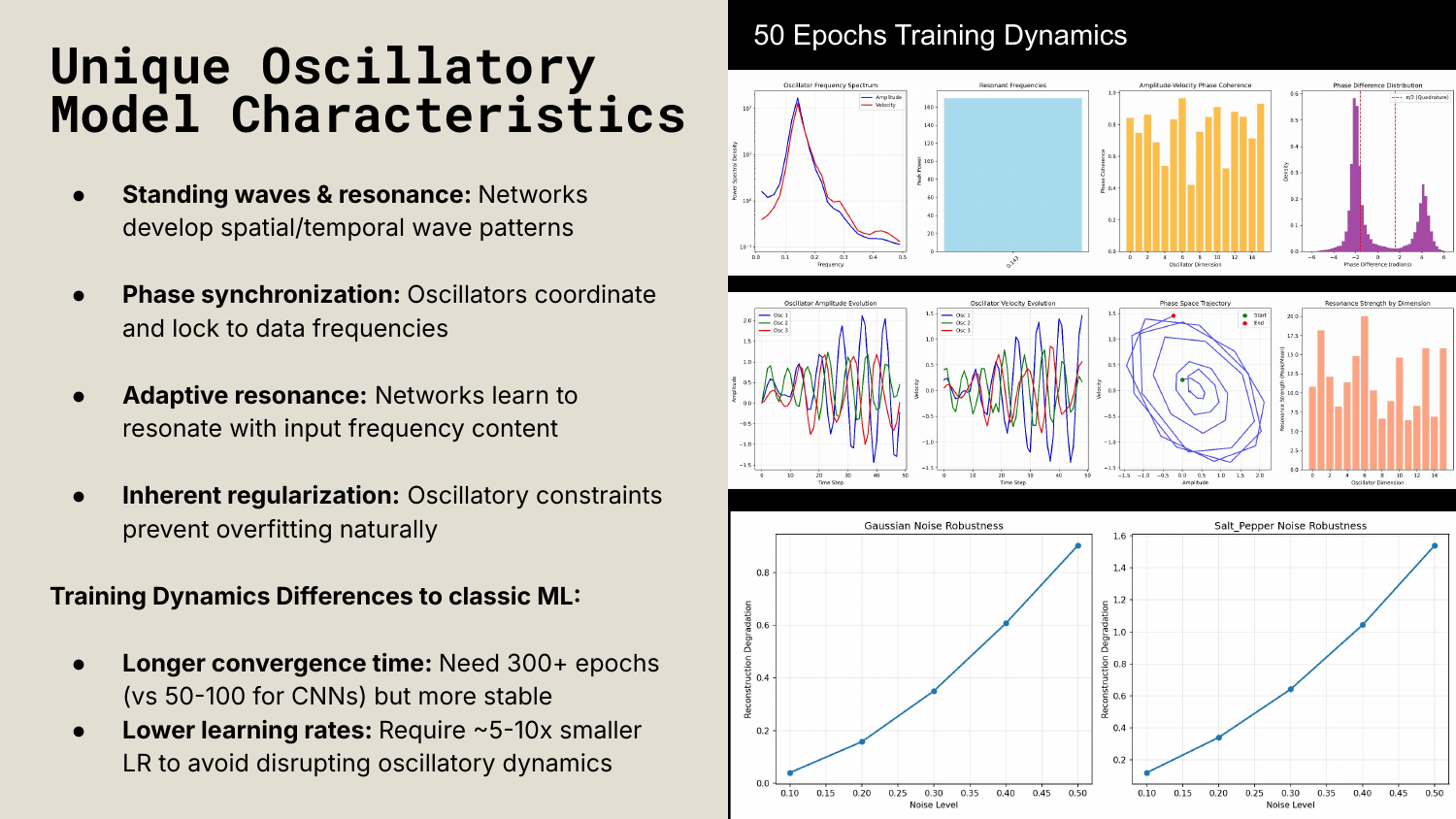
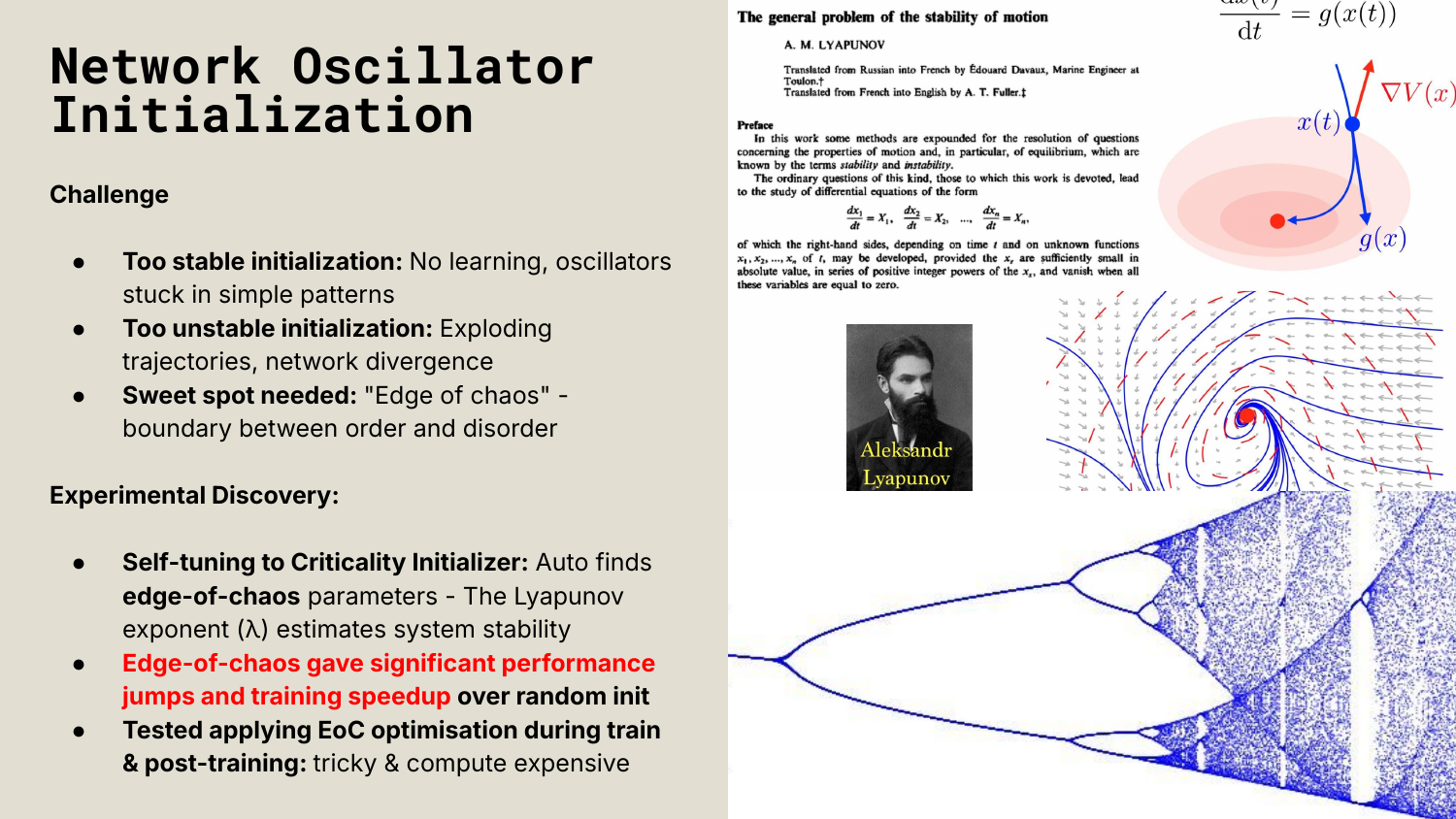
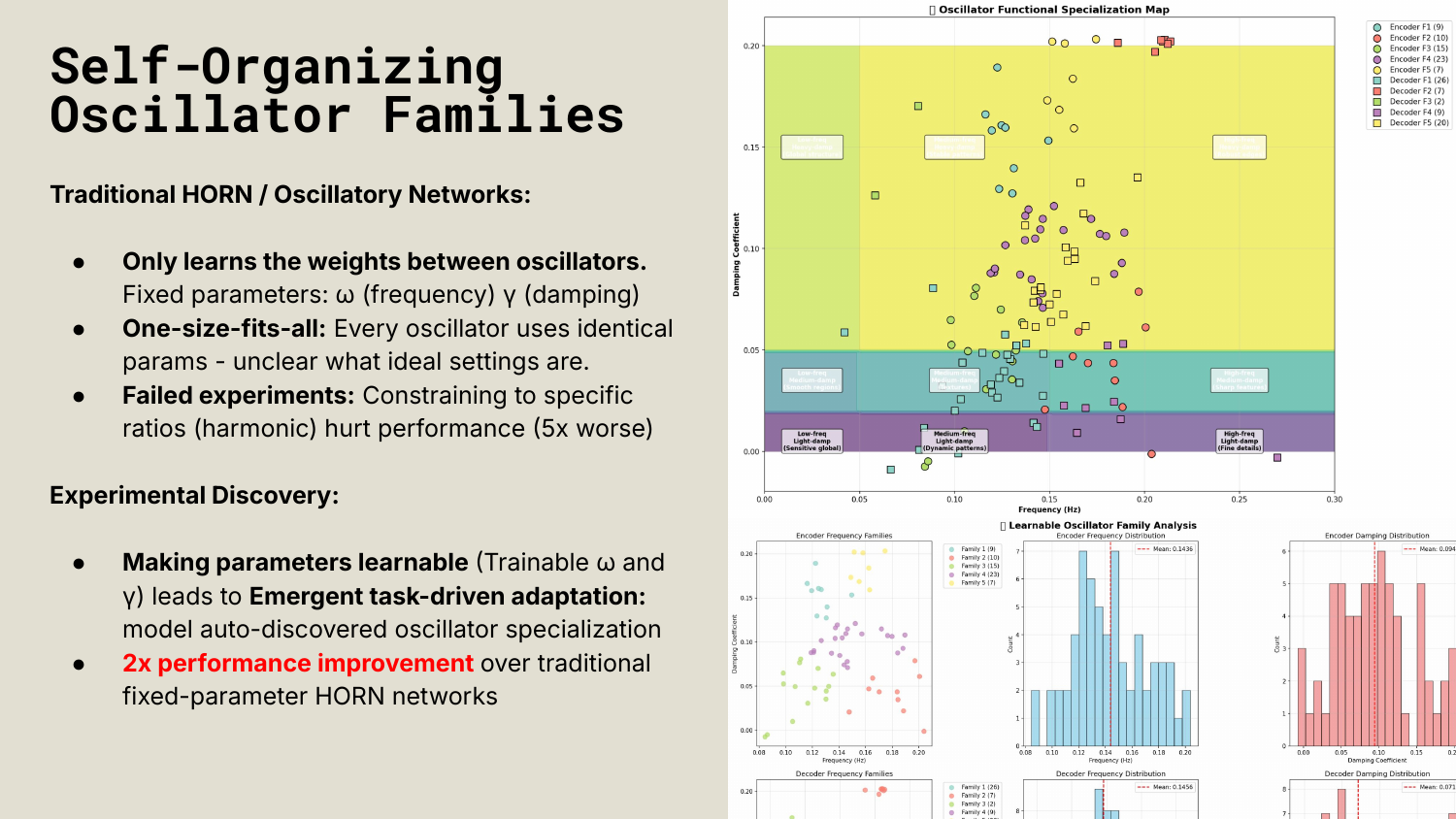
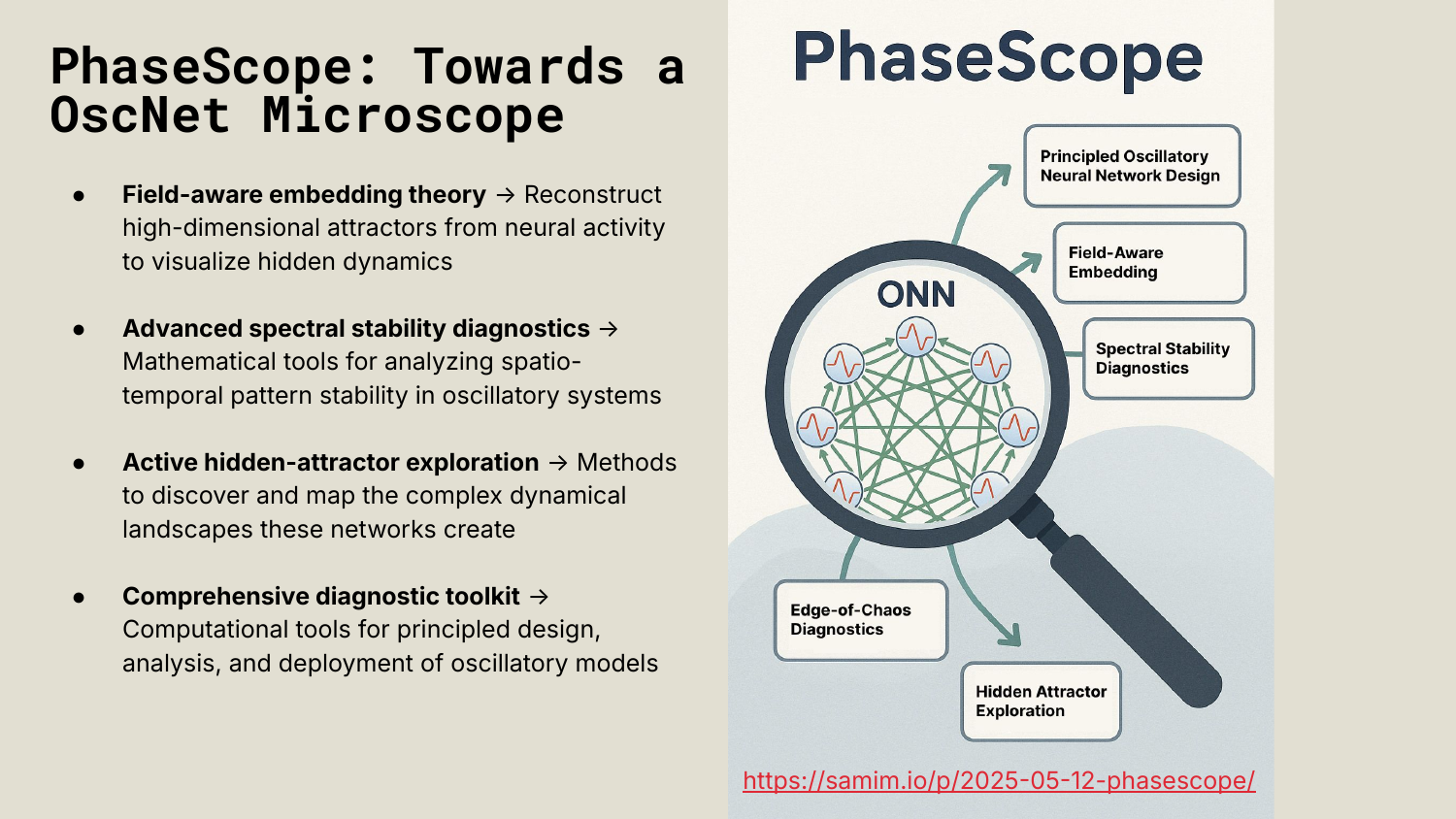
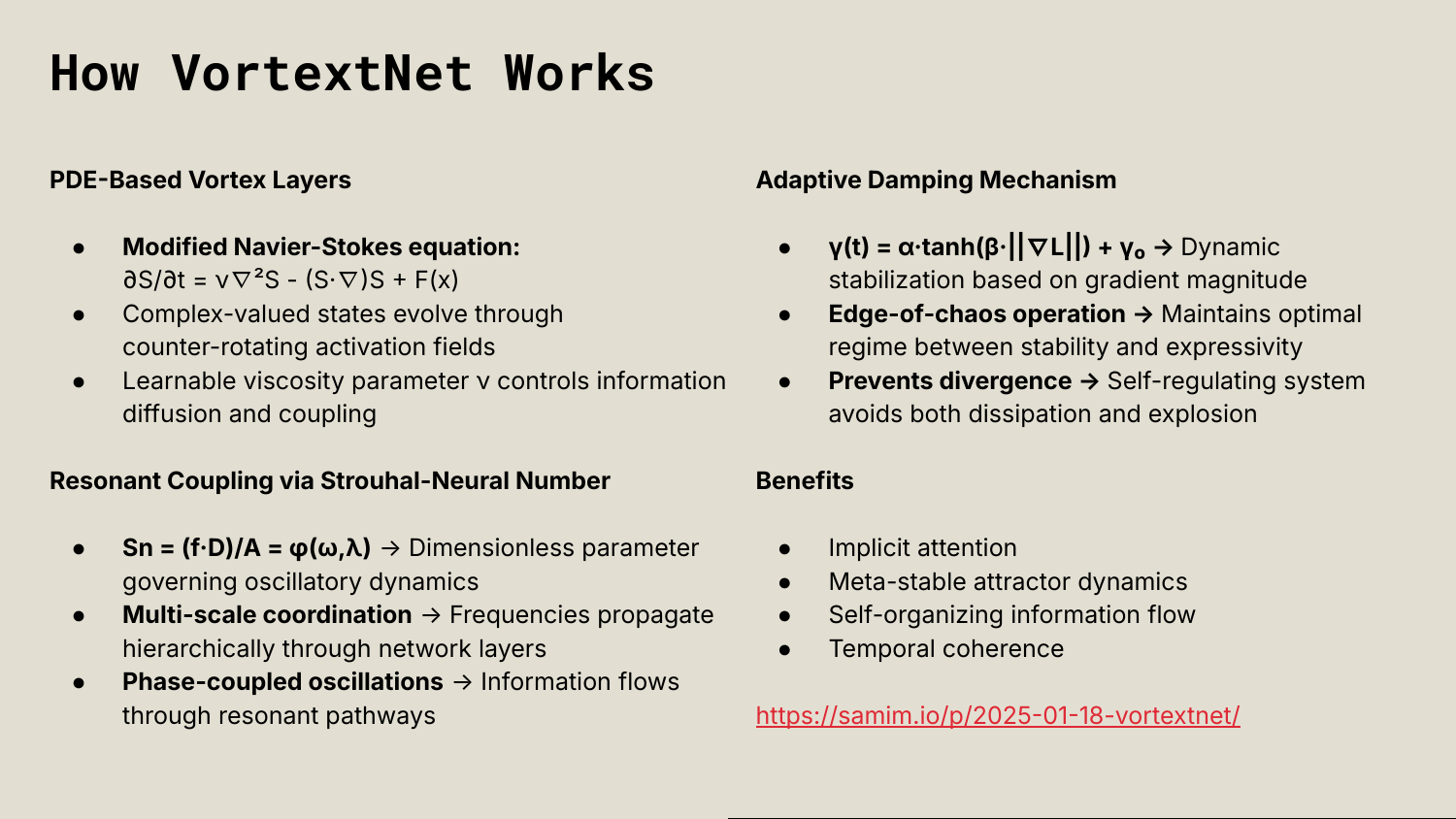
Introducing OscNet: A JAX library for oscillatory neural networks and dynamical systems.
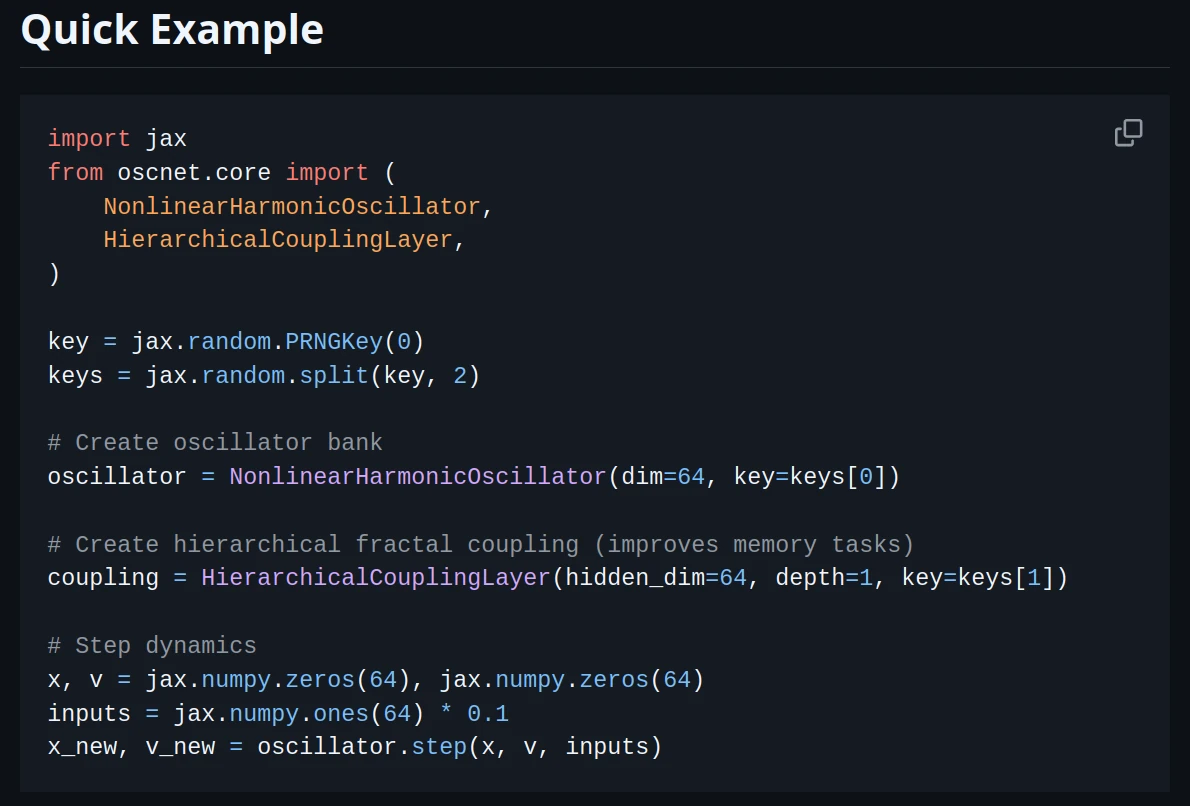
OscNet provides a framework for building and training neural networks based on oscillatory dynamics — coupled oscillator networks, continuous-time neural networks, and general dynamical systems. Built on JAX and Equinox for differentiable, high-performance computation. https://github.com/samim23/oscnet
Features
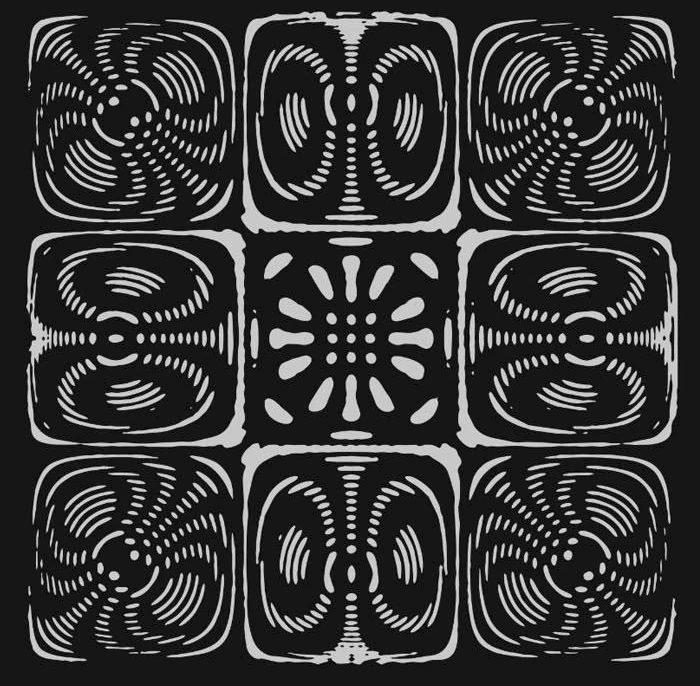
- Oscillator models: Harmonic, Van der Pol, Stuart-Landau, Kuramoto, FitzHugh-Nagumo
- Coupling topologies: Hierarchical fractal, power-law, log-periodic
- Analysis tools: Edge-of-chaos, Floquet analysis, bifurcation, stability
- Training utilities: Criticality initialization, stochastic forcing, schedulers
- Visualization: Phase space, network dynamics, oscillator analysis
More on the projects background: In Resonance with Nature - Toward a New Kind of Machine Learning with Oscillatory Neural Networks
-
Machine Learning for the Genetic Engineering of Fungal Secondary Metabolite Clusters: A Novel Framework for Alien Communication
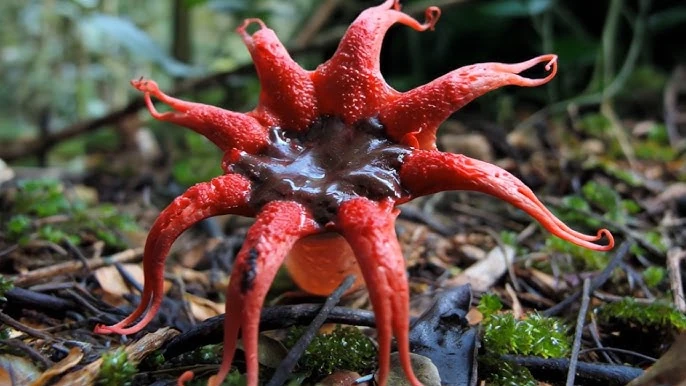
The Search for Extraterrestrial Intelligence (SETI) has long scanned the skies for radio signals. But what if an advanced civilization's signature isn't a broadcast, but a biological program?

Hypothesis
Mastery over a planet's biology is the ultimate technology. Instead of fleeting electromagnetic waves, a persistent, self-replicating message could be encoded into the very blueprint of life - an engineered gene cluster in a hardy organism like a fungus, designed to survive deep space and seed itself on new worlds.
Fungal Gene Clusters: Nature's Data Cassette
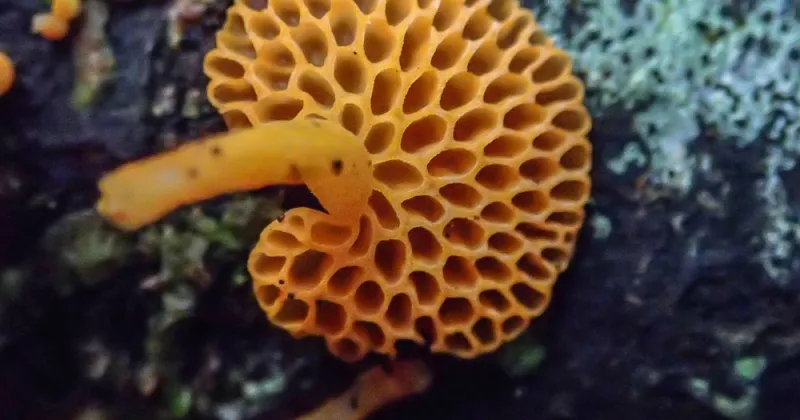
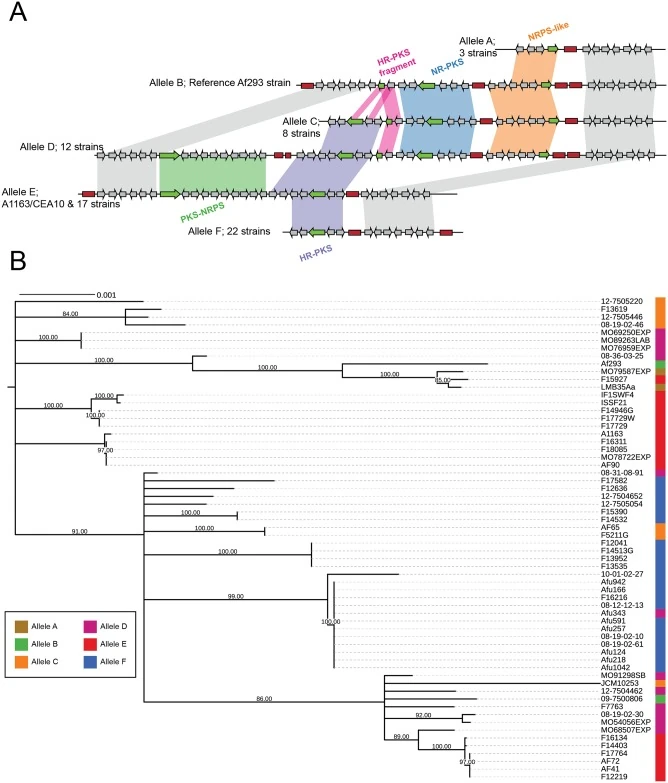
Fungal secondary metabolite (SM) clusters are modular genetic programs. Enzymes like Polyketide Synthases (PKSs) are built from domains (A-T-C-KR-ER-ACP...) in a precise order. This sequence is a code. In theory, it could be repurposed. A non-functional, hyper-complex cluster discovered in a space-borne spore might not be for making a toxin - it could be a biochemical QR code, a message etched in DNA that can last for eons and travel between stars.
Machine Learning is the Decoder
Decoding such a message, however, would be impossible by eye. It would require advanced machine learning—trained on every known natural and engineered biological pattern—to first recognize the cluster as artificially designed, then reverse-engineer its domain sequence into a payload: an image, a mathematical constant, a map.
This isn't just speculation - it's a new lens for our own research. As we use AI to genetically engineer fungal SM clusters for new drugs and materials, we are learning to write and read this deep language of biology. We are developing the very tools needed to one day ask: Is this fungus from Earth, or is it a message in a bottle, waiting for a reader smart enough to understand it?
We're not just engineering fungi. We're building the translator for a conversation that may have already begun.

-
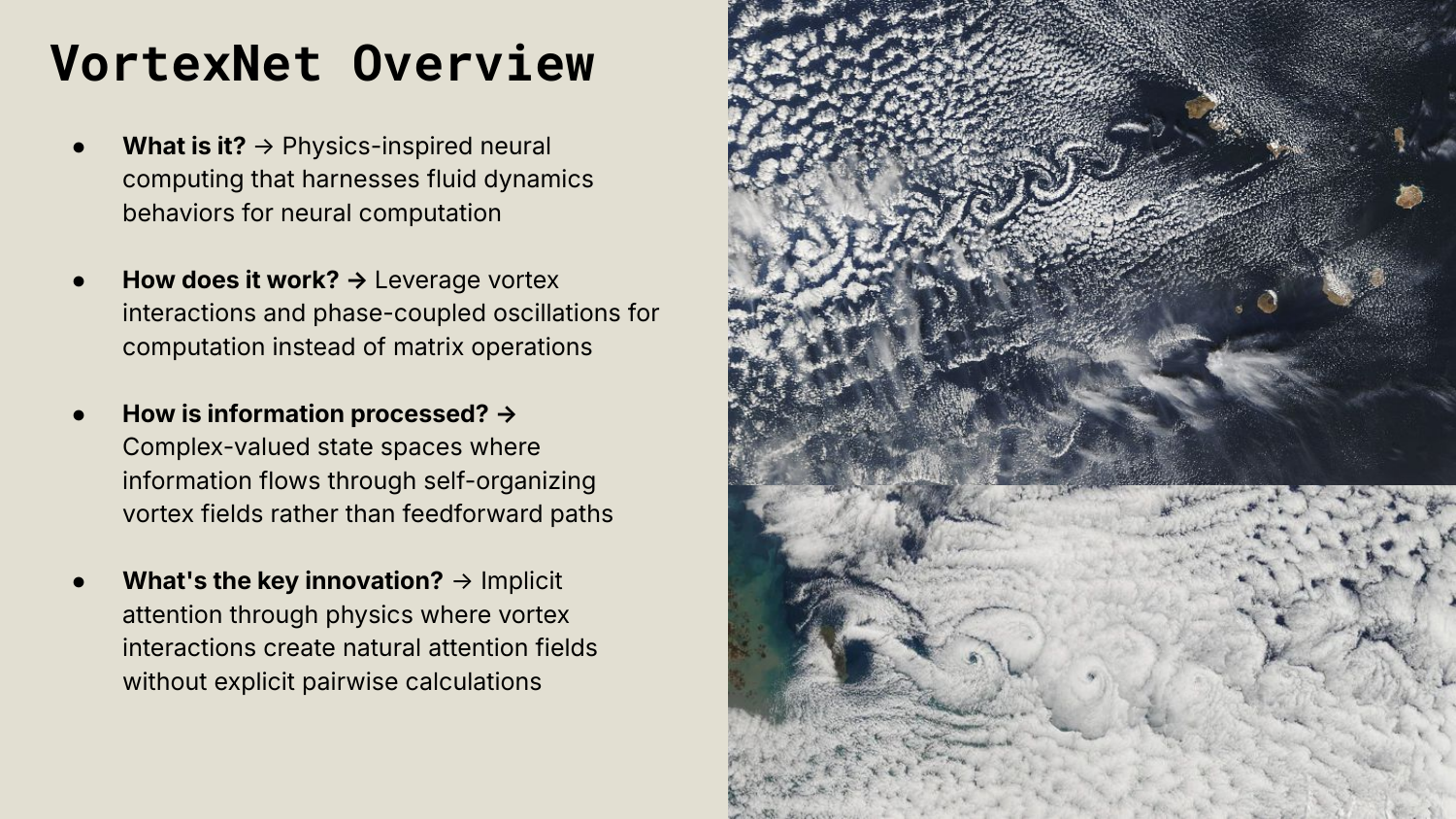
VortexNet Anniversary. What's next?
The first "VortexNet: Neural Computing through Fluid Dynamics" anniversary is coming up. It's impact over the past year has been odd and noticeable. How should we continue this thread? Feedback welcome.
There is no shortage of ideas what to explore next in this context..
-
There's a bacteriophage that turns bacteria into “liquid crystals.”
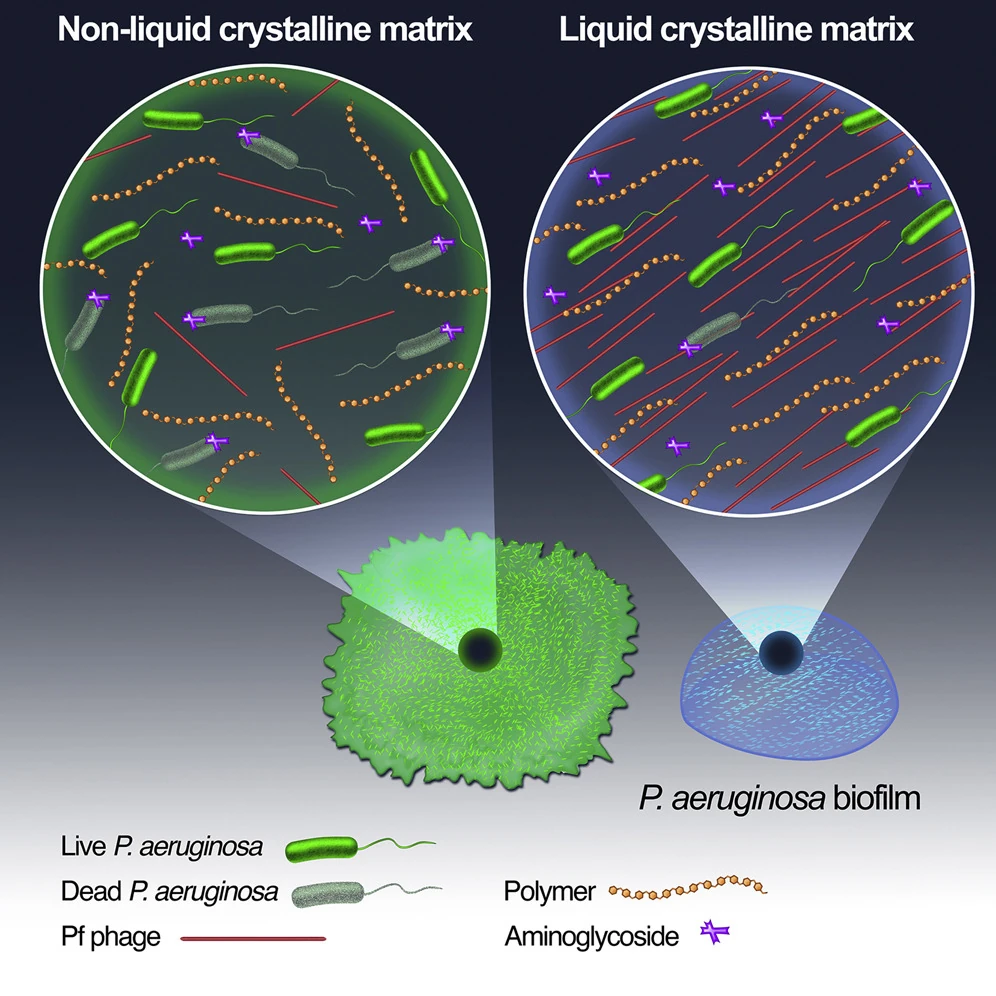
Specifically, Pseudomonas aeruginosa bacteria make Pf phages, which are rod-shaped, negatively-charged, and measure about 2 micrometers in length (roughly the length of an E. coli cell). These phages leave the cells and enter their surroundings. There, they mix with polymers, also secreted by the cells, to form a crystalline matrix.
Surprisingly, this is good for the cells. Although the phages kill some of them, it also makes their biofilms stickier and able to withstand certain antibiotics. These bacteria + phages are prevalent in cystic fibrosis patients; they've formed a sort of symbiotic relationship.
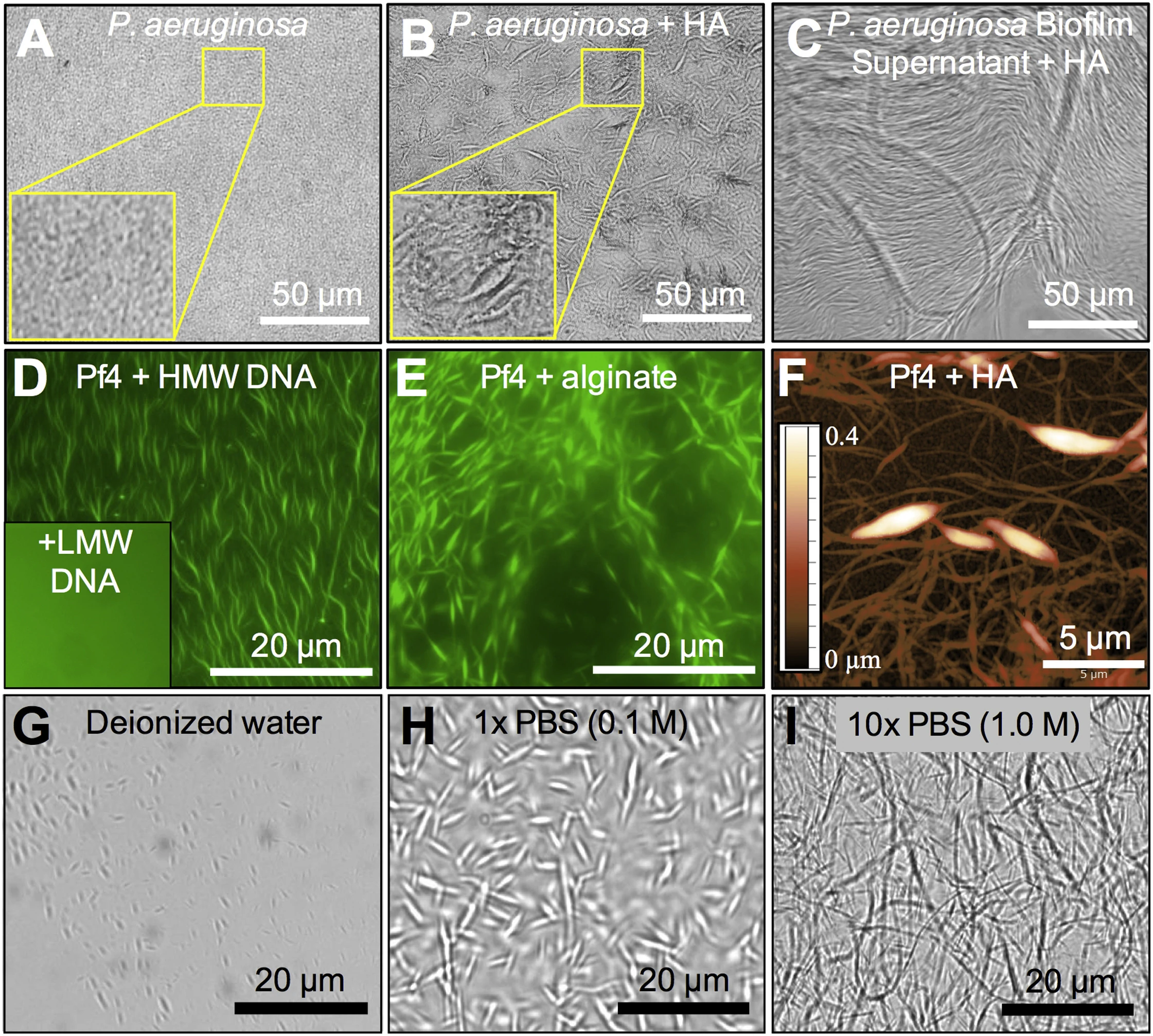
The Pf phages are made from thousands of repeating copies of a coat protein, called CoaB, which wraps around a single-stranded, circular DNA genome. These genes are integrated directly on the bacterial chromosome.
The bacteria “turn on” these phage genes when placed in a viscous environment with low oxygen levels. This is like a trigger to start forming a biofilm. And the cells make a lot of phages; about 100 billion per milliliter.
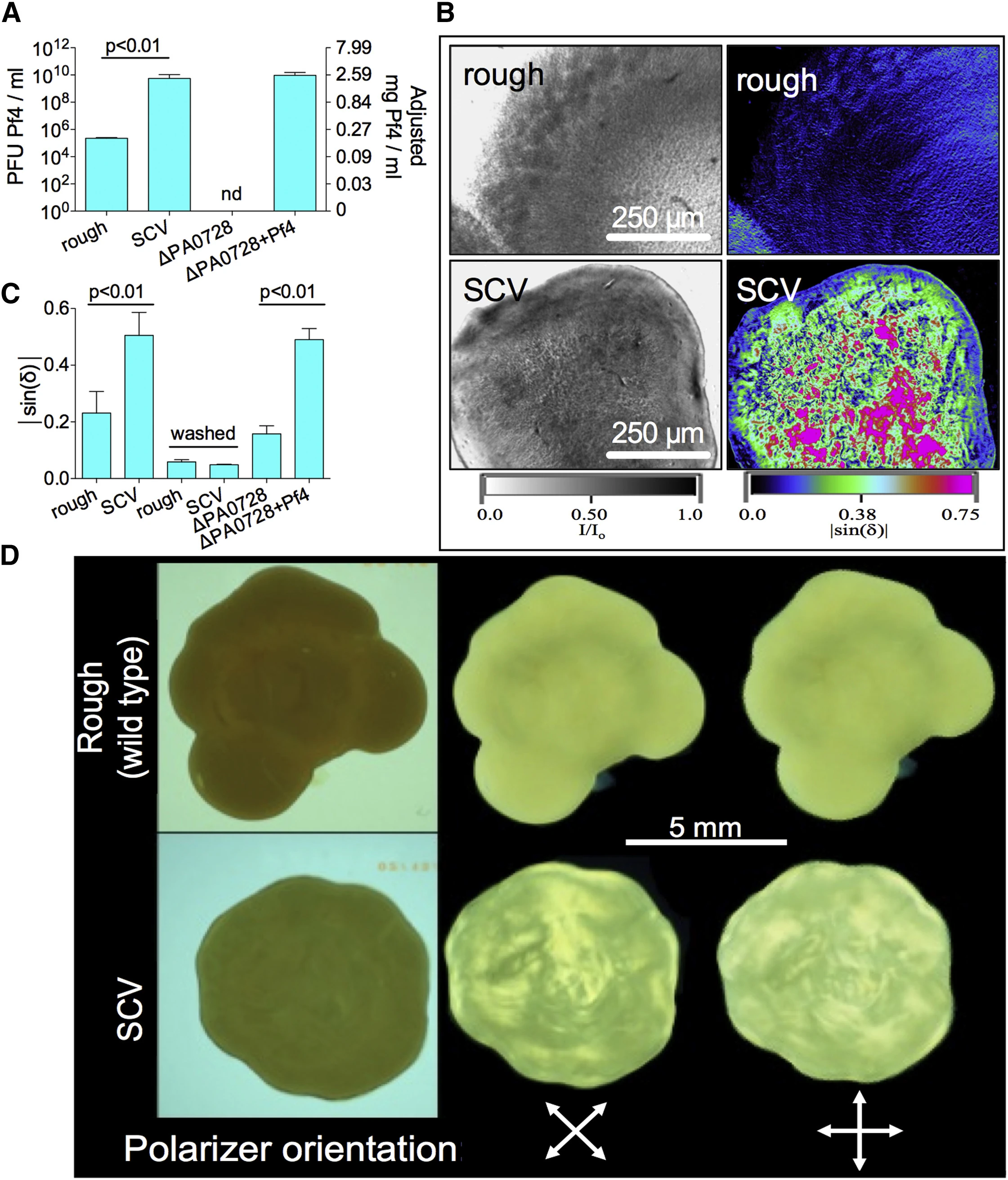
These liquid crystals form because of a physics principle called “depletion attraction.” If you just mix a bunch of loose or flexible polymers together (such as long carbon chains) they will not form a liquid crystal. But if you mix stiff rods (the phages) with loose polymers at a high enough concentration, the polymers will force the phages close together to create a material that flows like a liquid despite being ordered like a crystal. See the video below.
These liquid crystal biofilms are hard to get rid of. The negatively-charged phages block many antibiotics (like aminoglycosides, which are positively-charged) from entering cells. Liquid crystals also retain water, so these biofilms can survive on drier surfaces.
Paper: Filamentous Bacteriophage Promote Biofilm Assembly and Function
-
Toward a Grand Unified Theory of Snowflakes
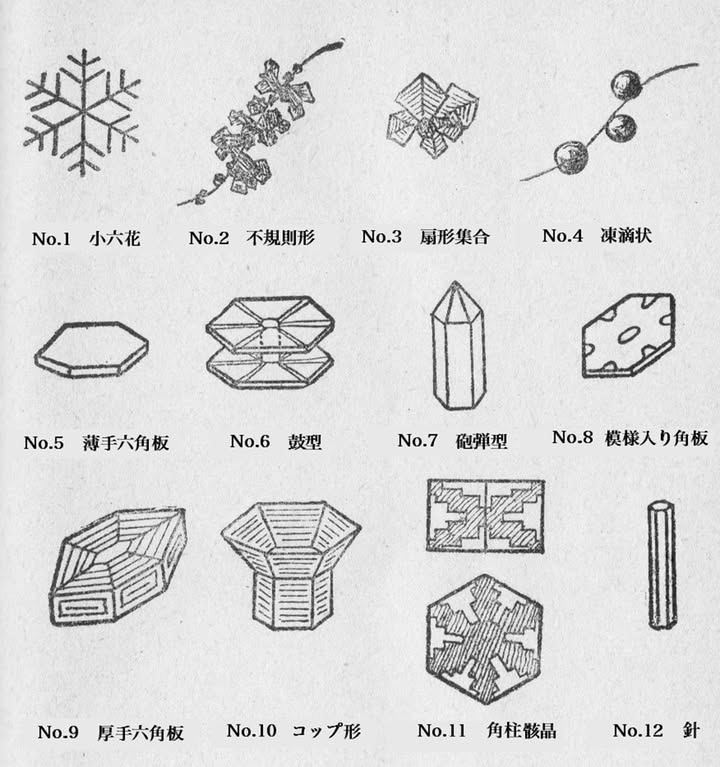
Ever since the Japanese physicist Ukichiro Nakaya produced his seminal catalog of snowflake shapes 77 years ago, researchers have sought to understand the interplay of factors that lead to different shapes.
-
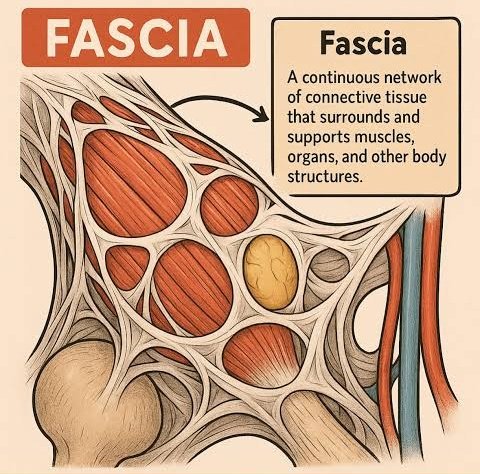
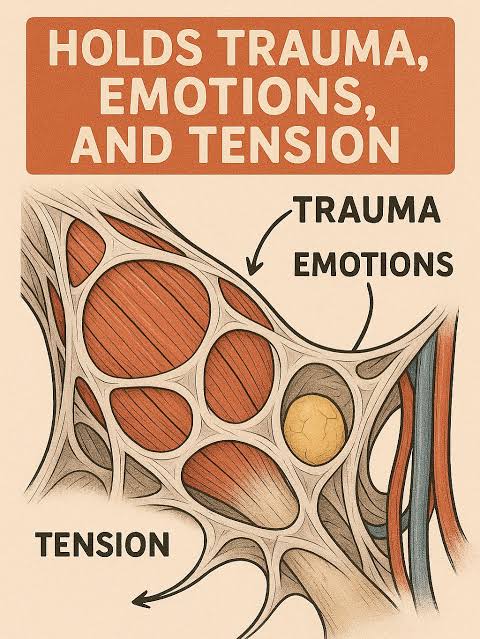
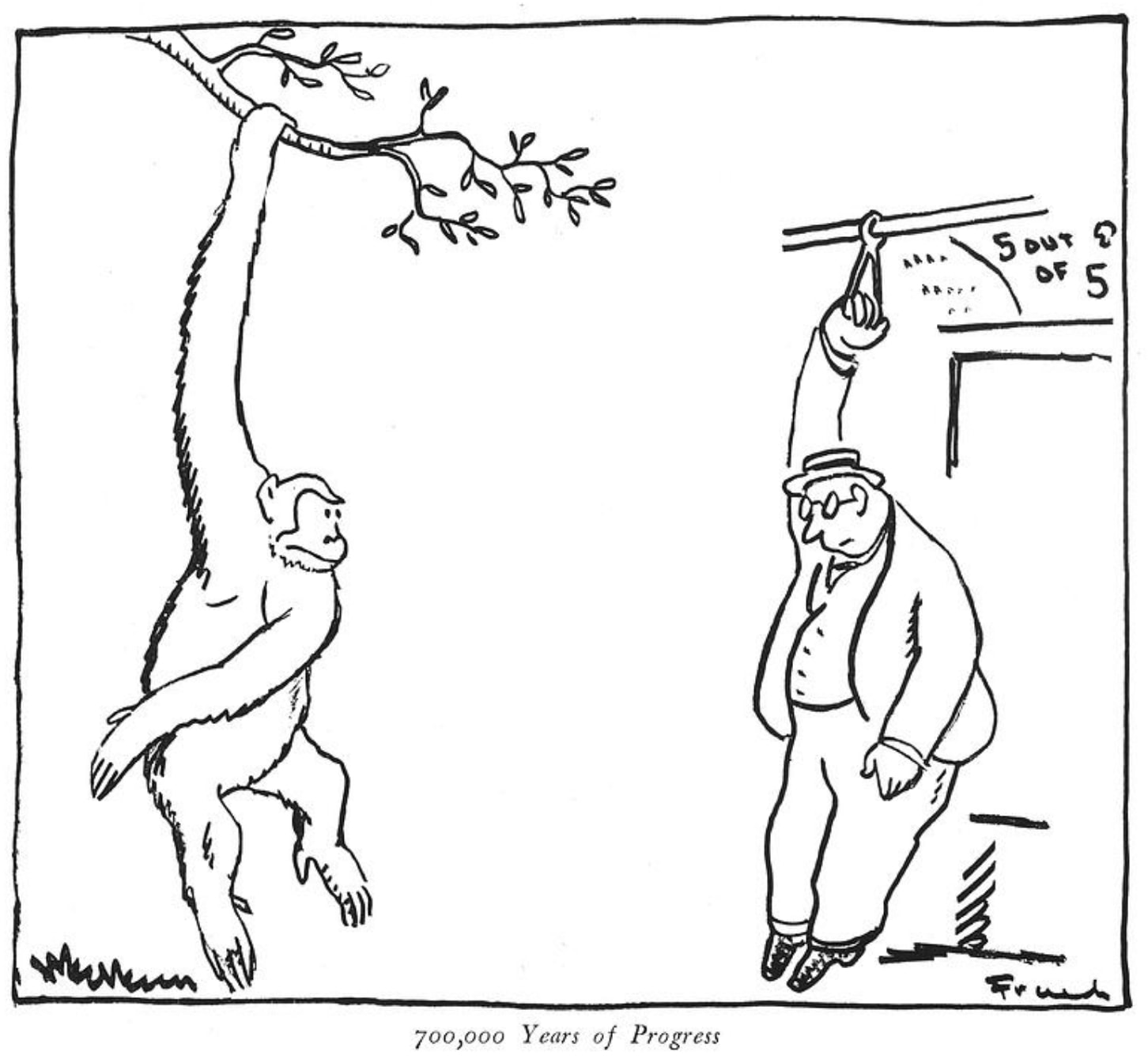
Grief is stored in the fascia and diaphragm, anger in the jaw and hands, fear in the gut, shame in the shoulders. Trillions of cells & bacteria collaborate in a embodied, extended cognition that makes up “you.” Nature evolved intelligence very different from our current machines.
-
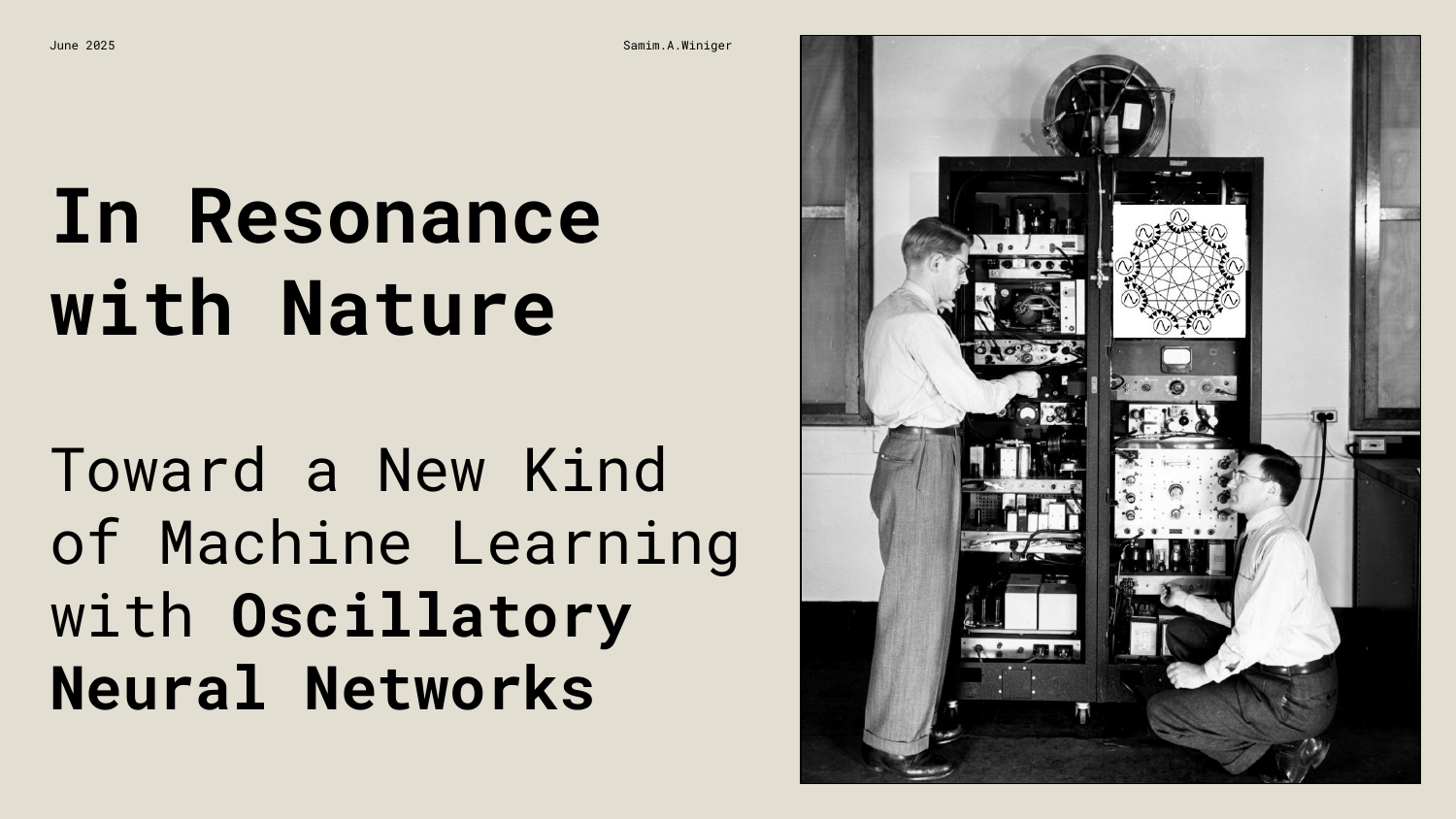
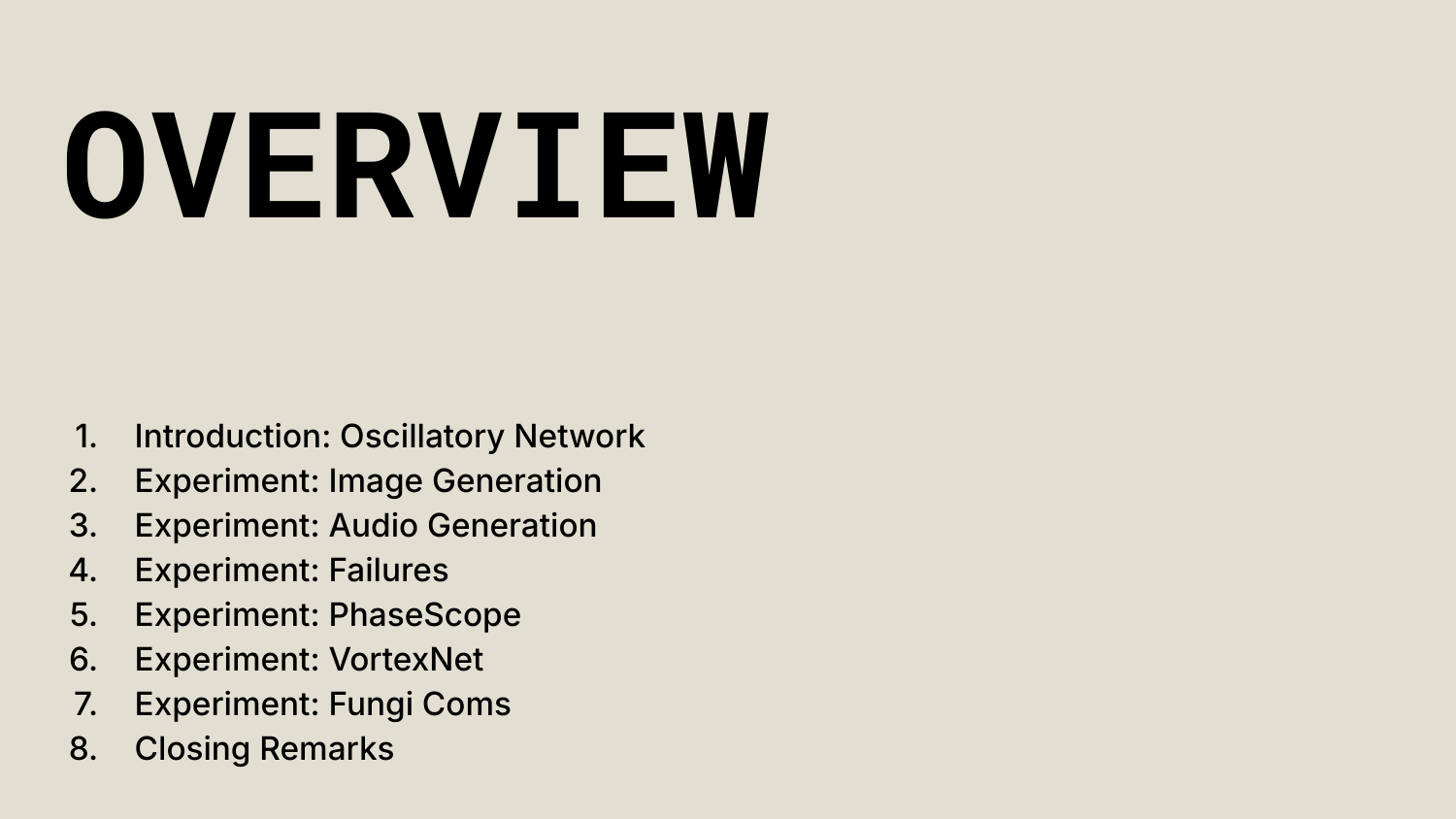
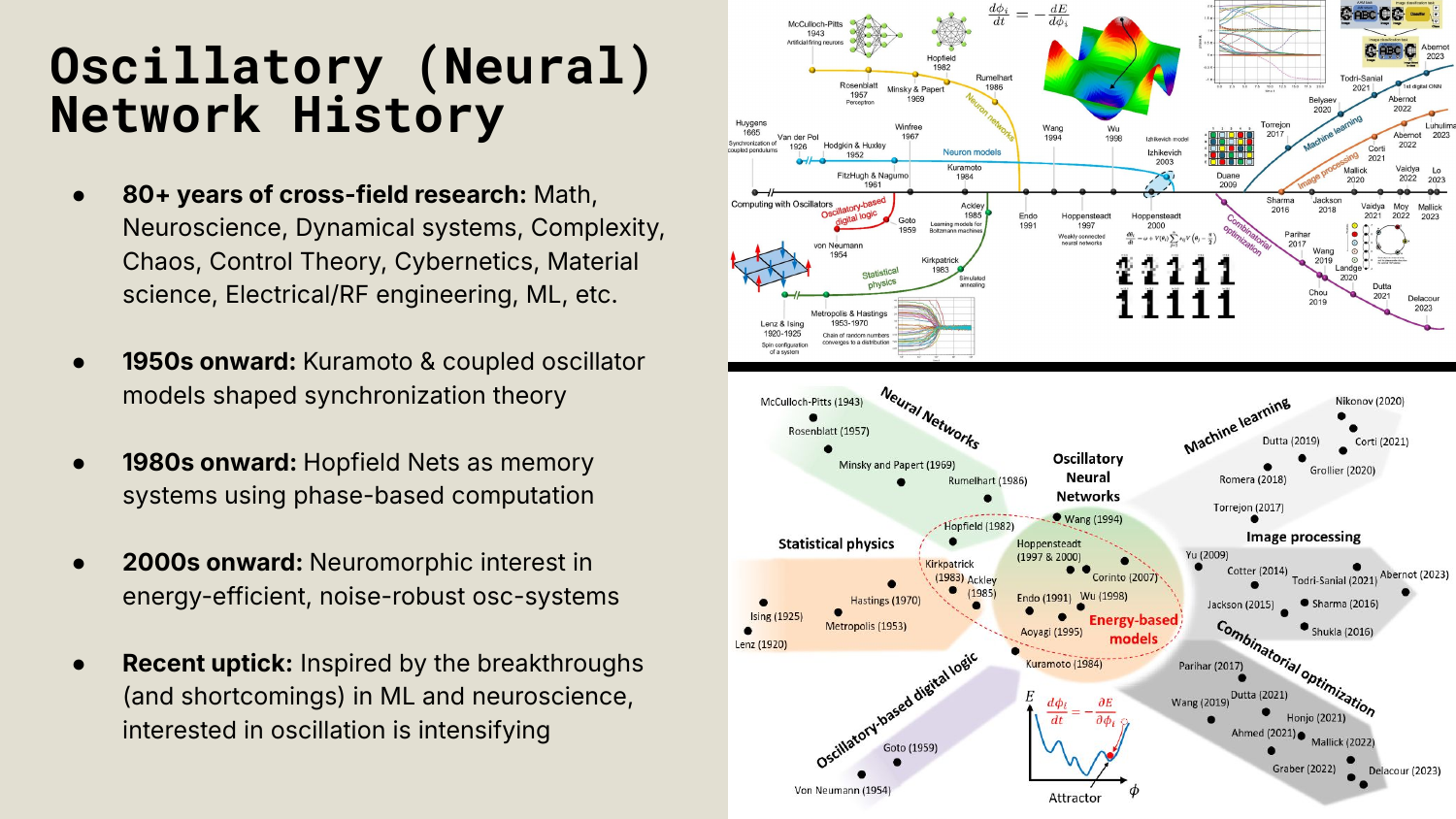
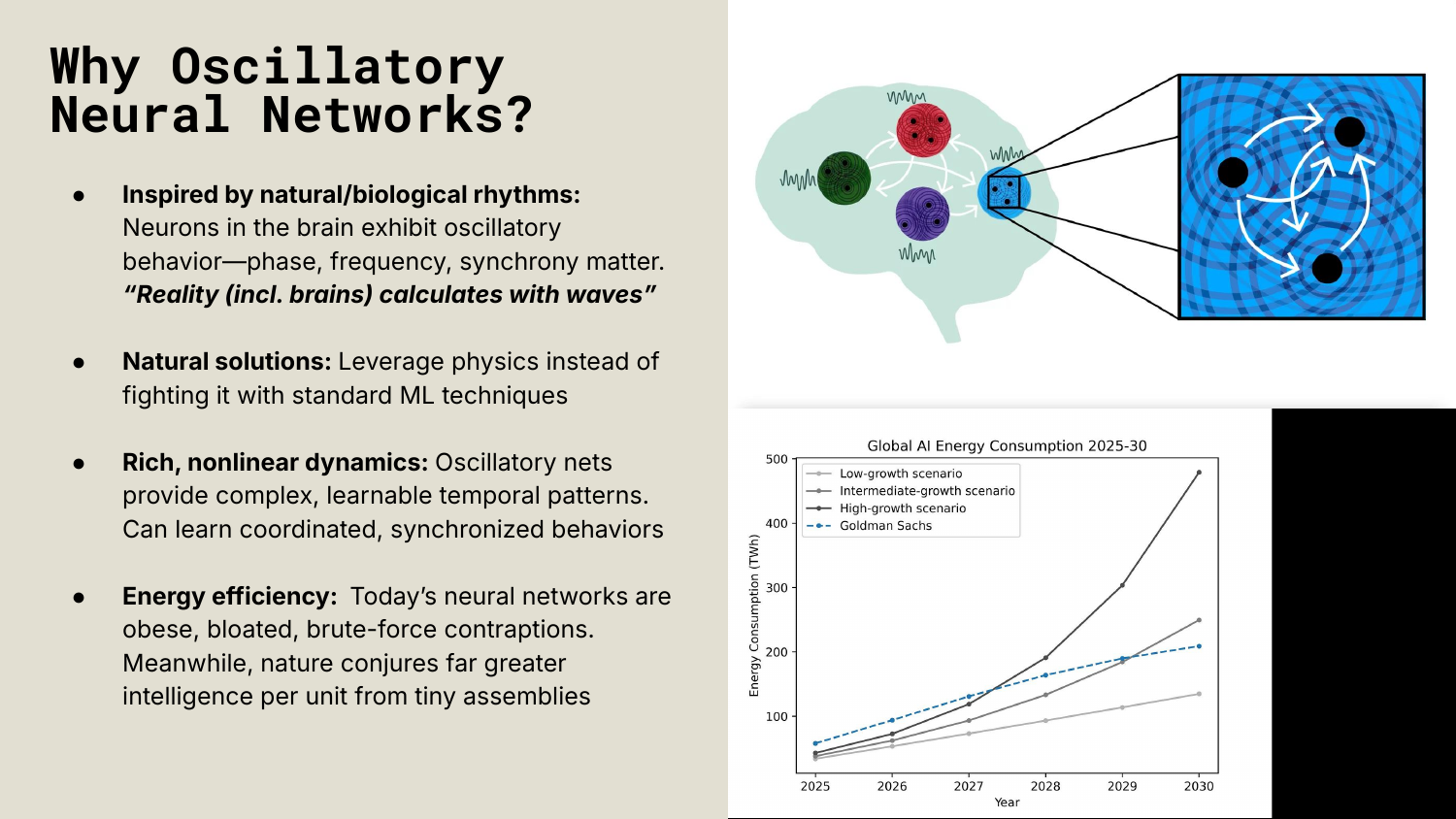
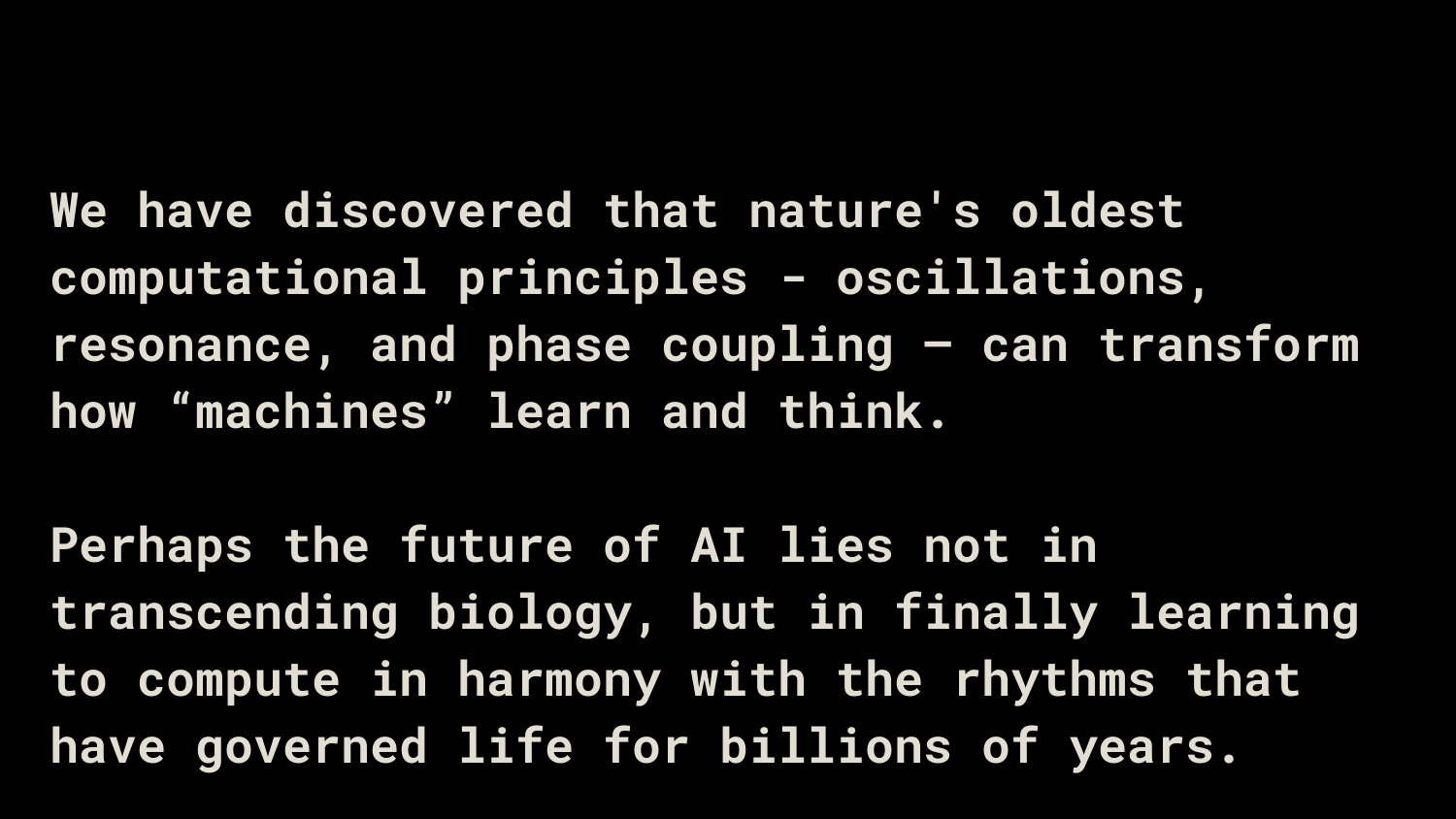
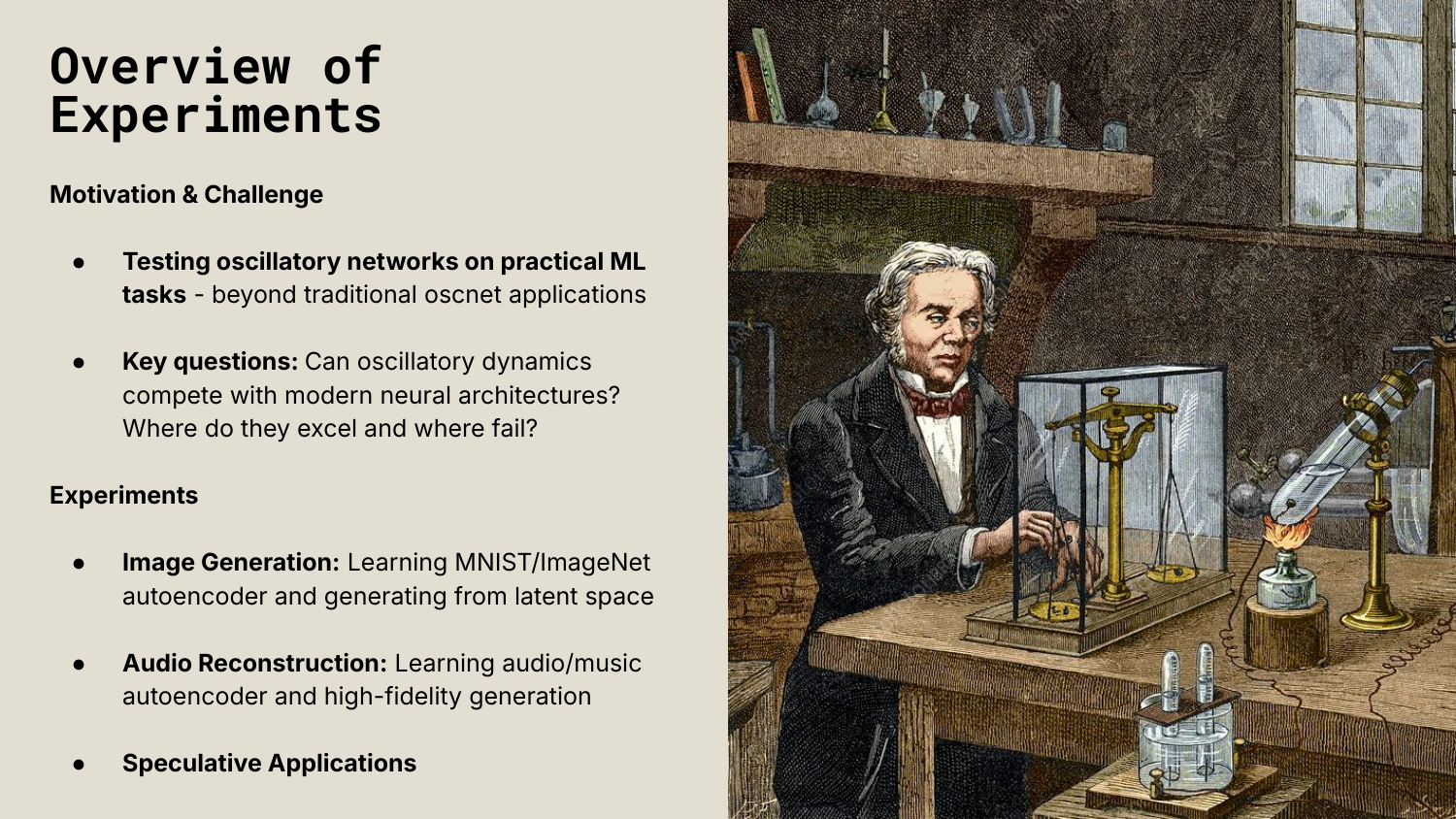
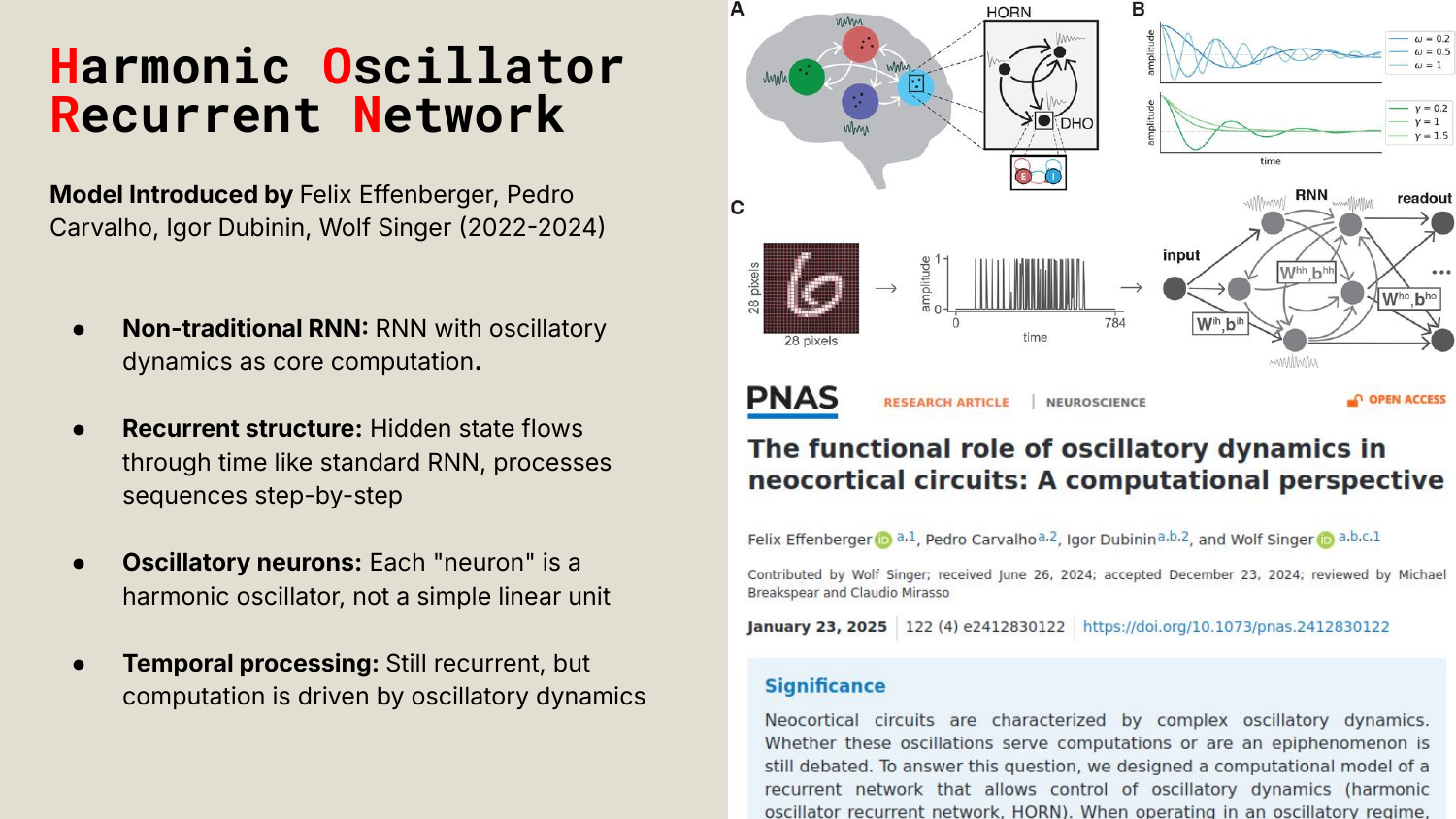
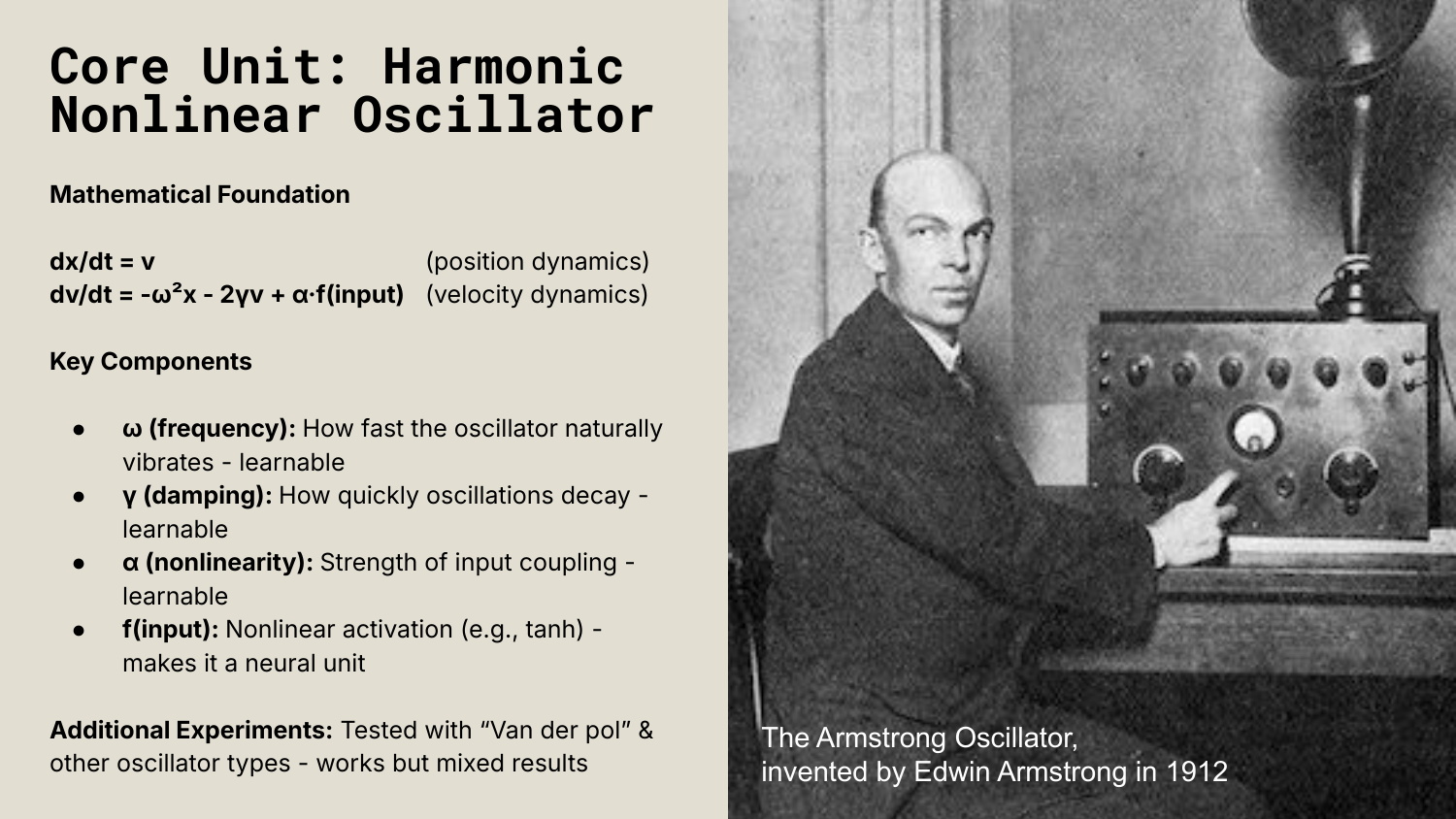
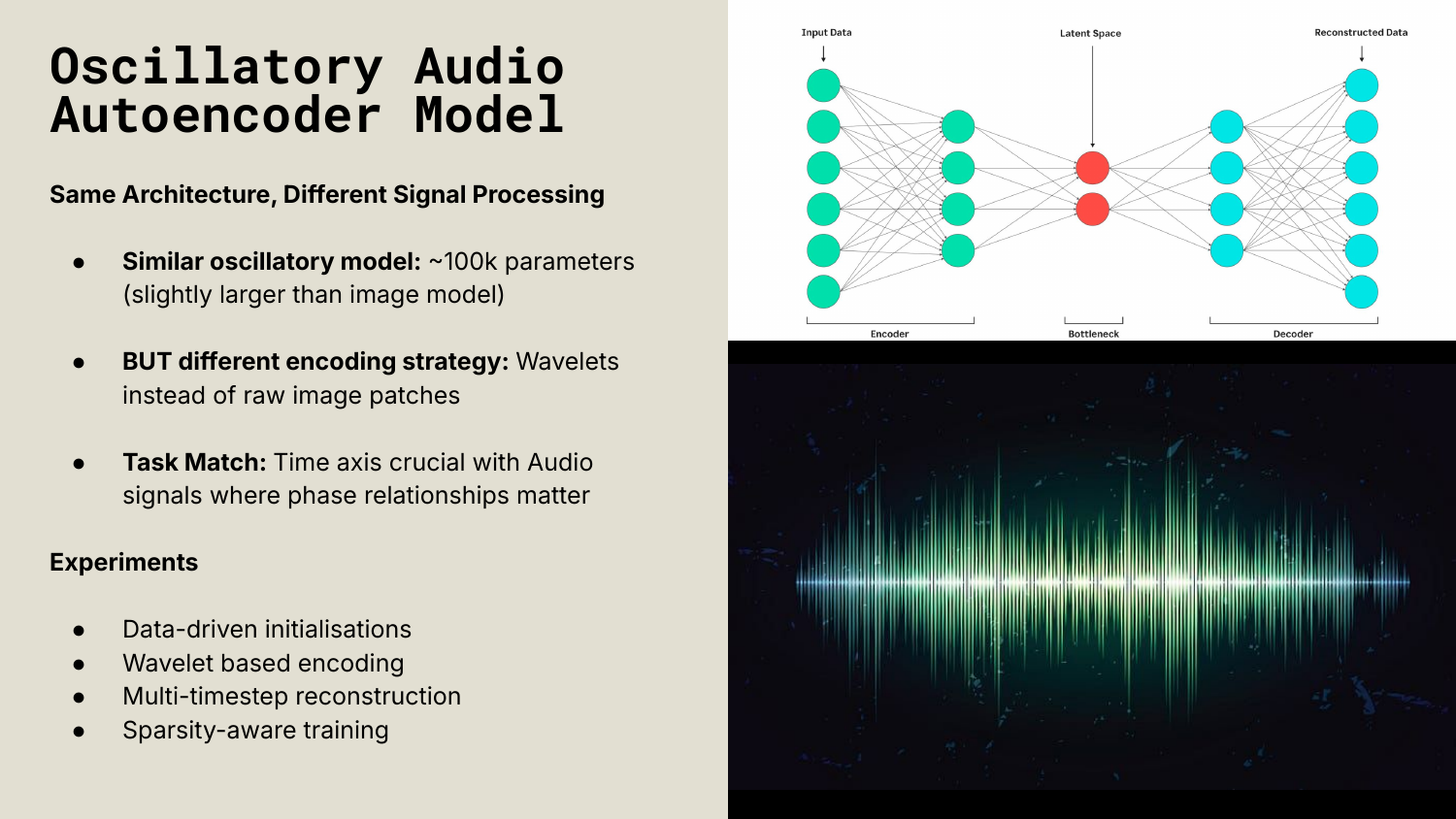
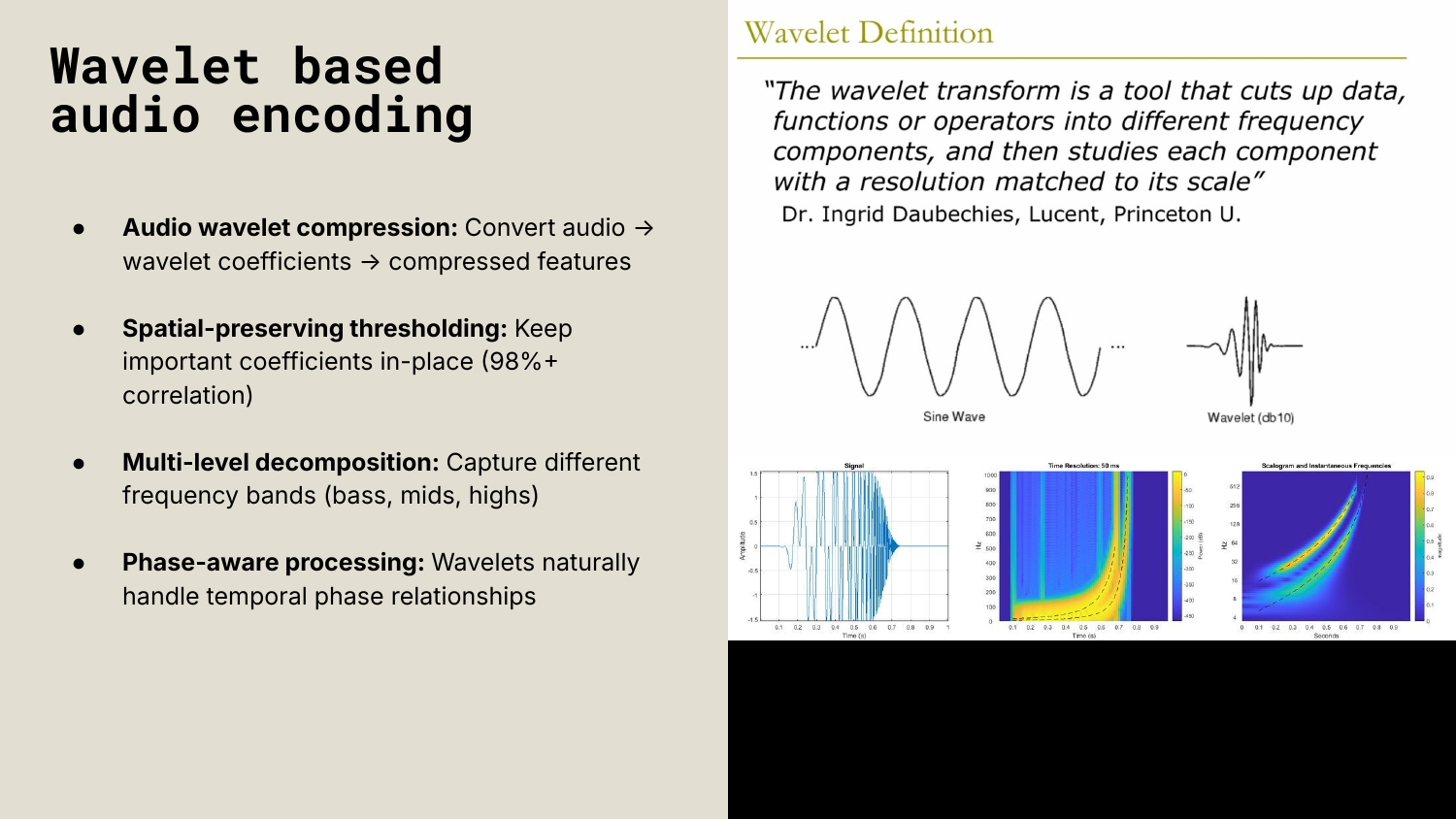
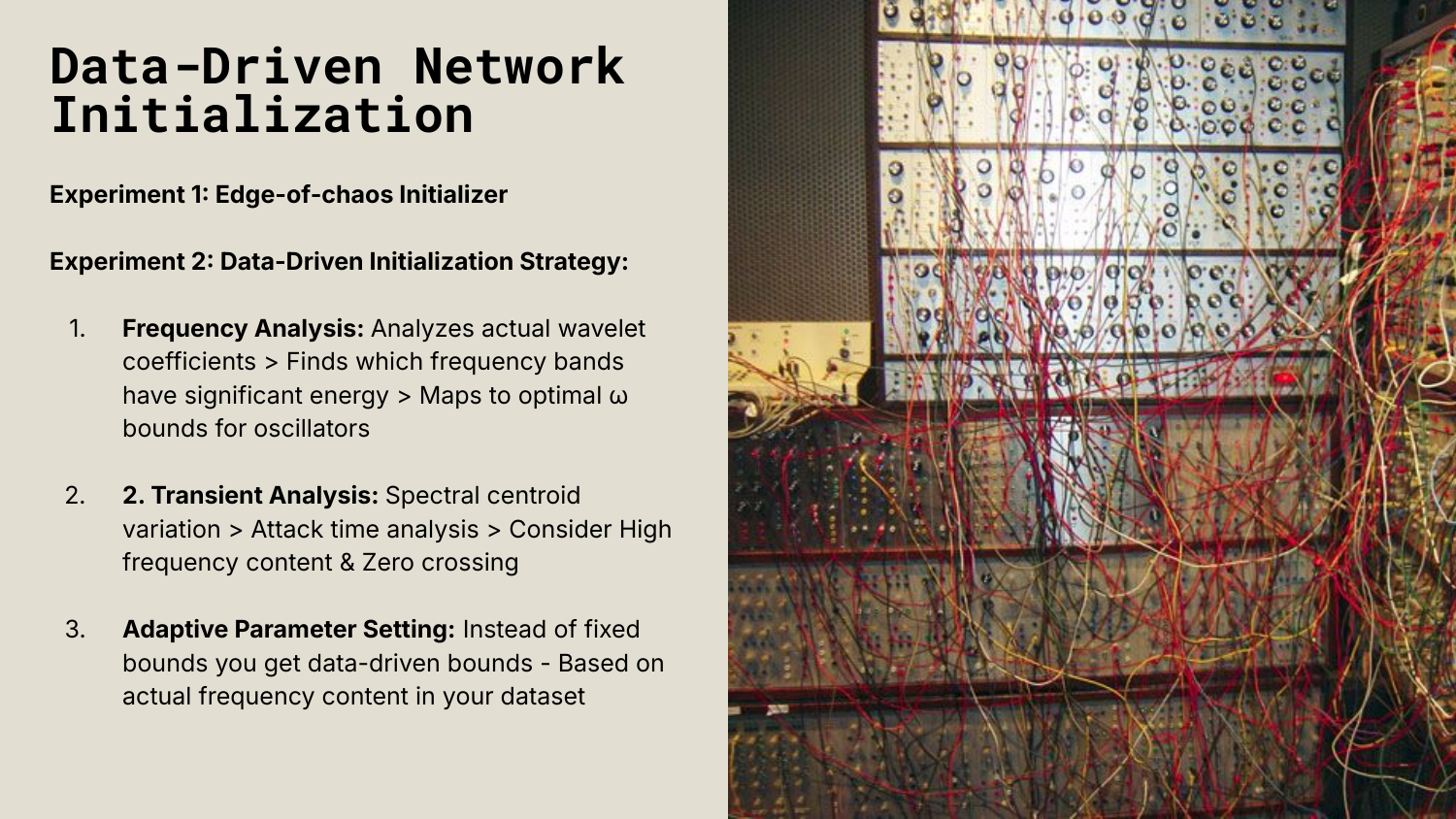
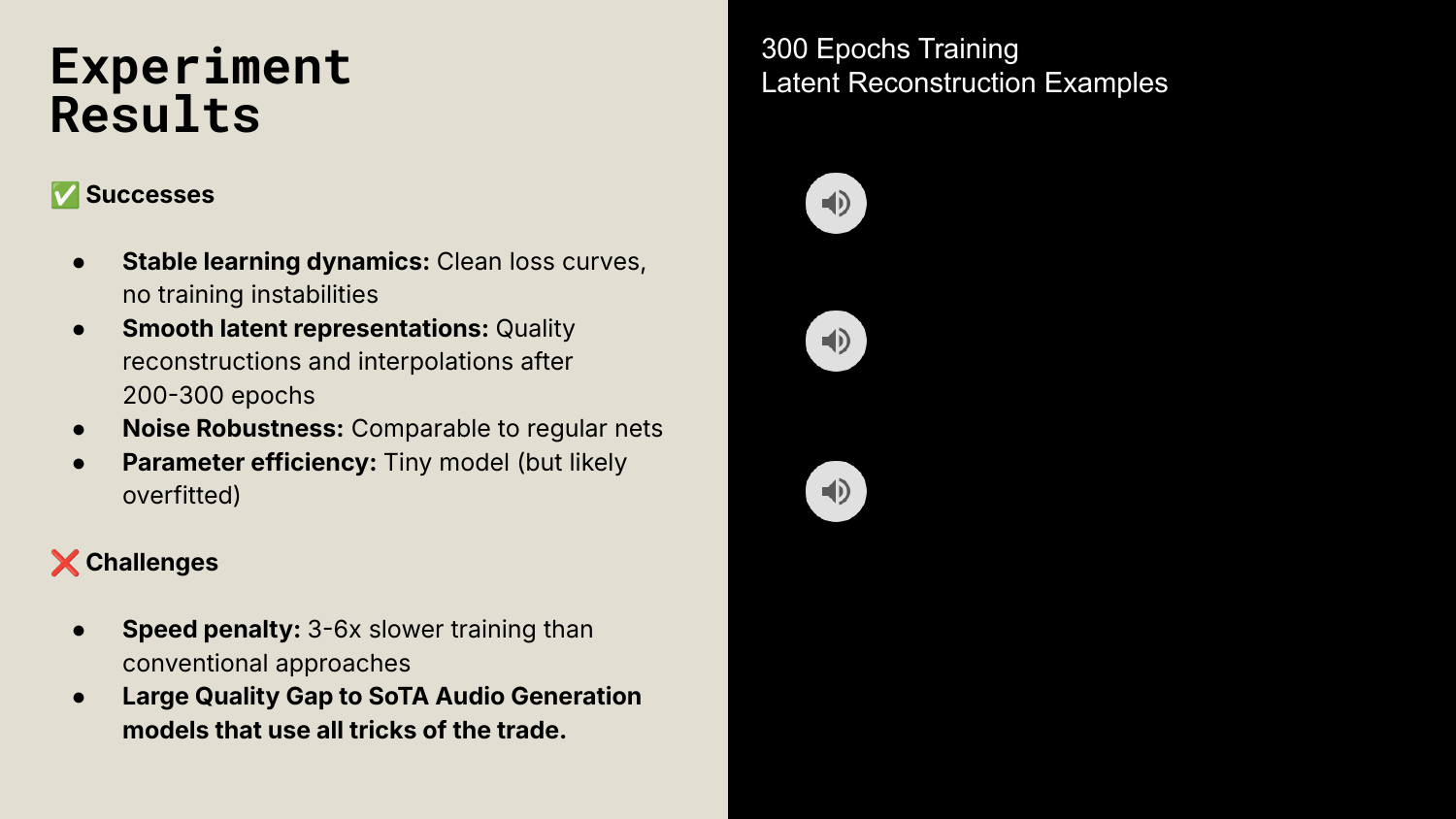
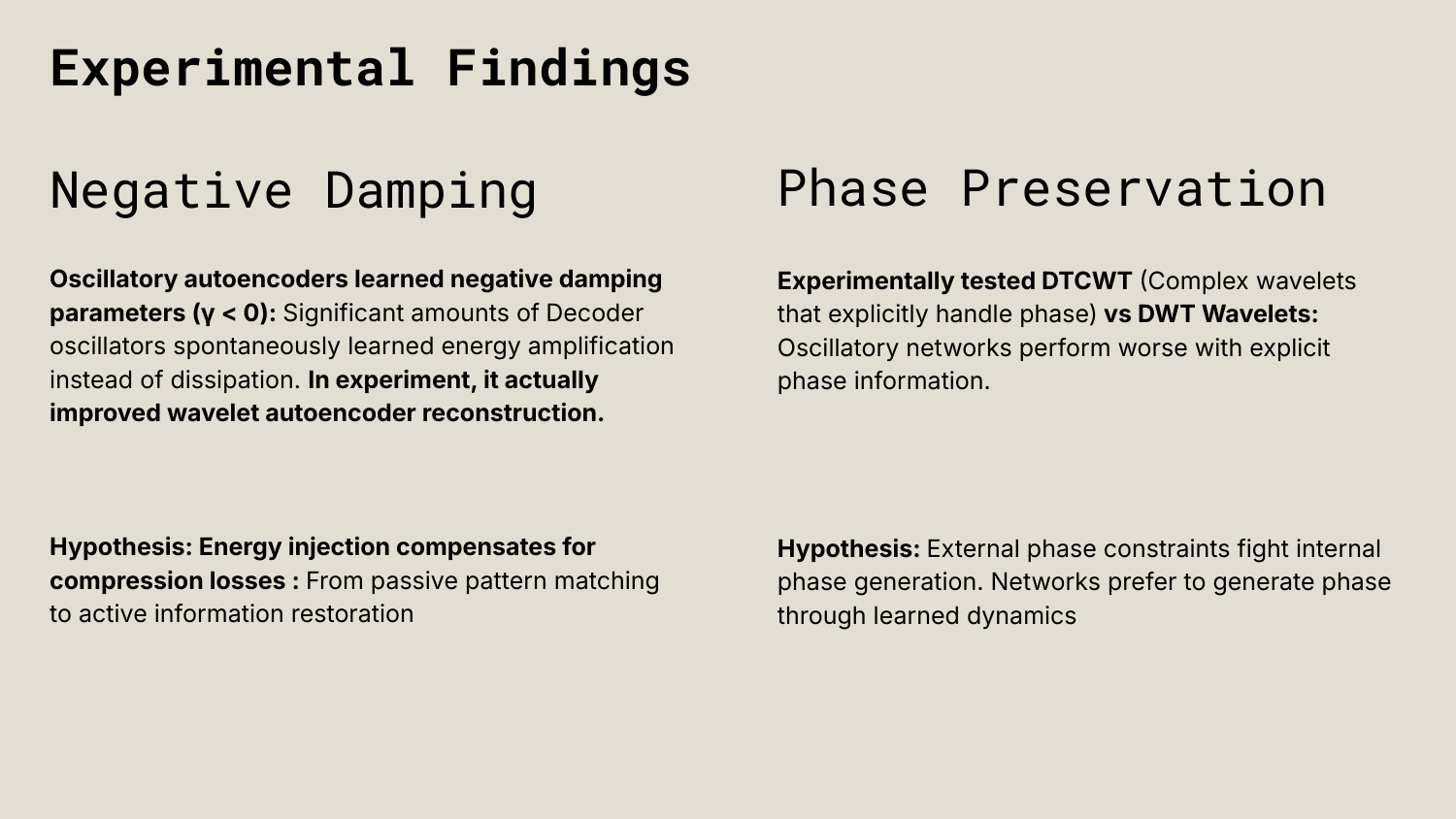
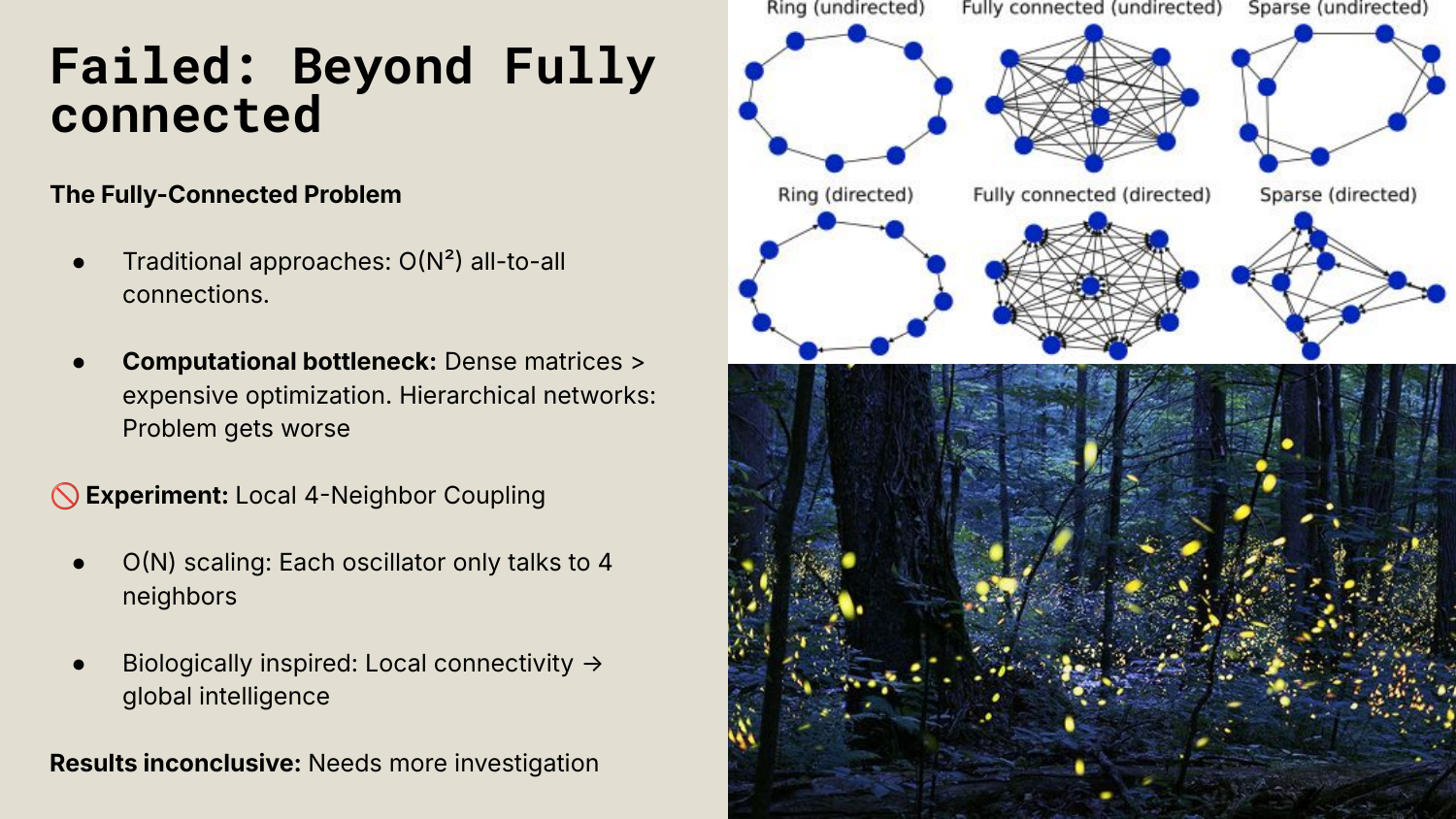
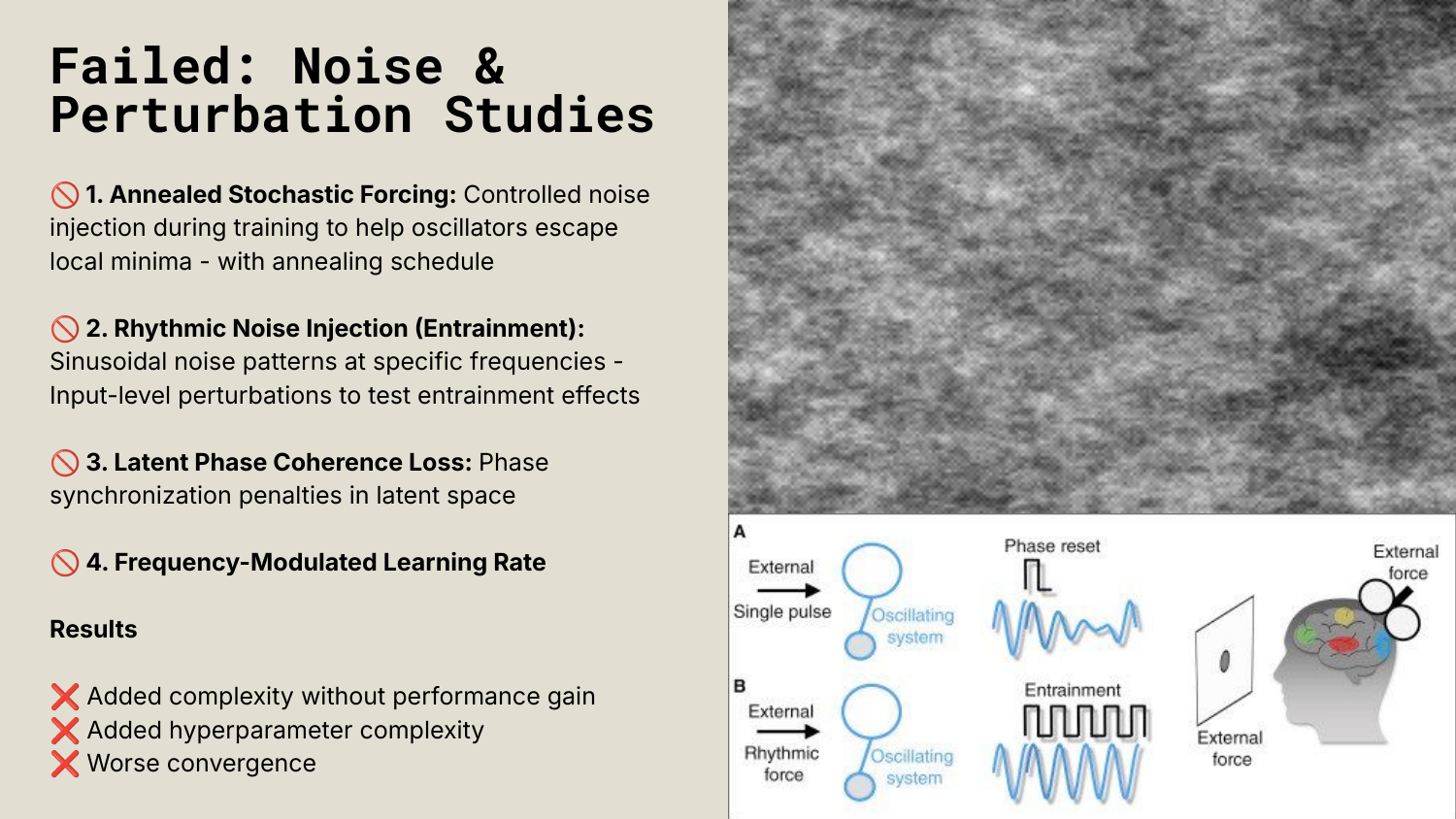
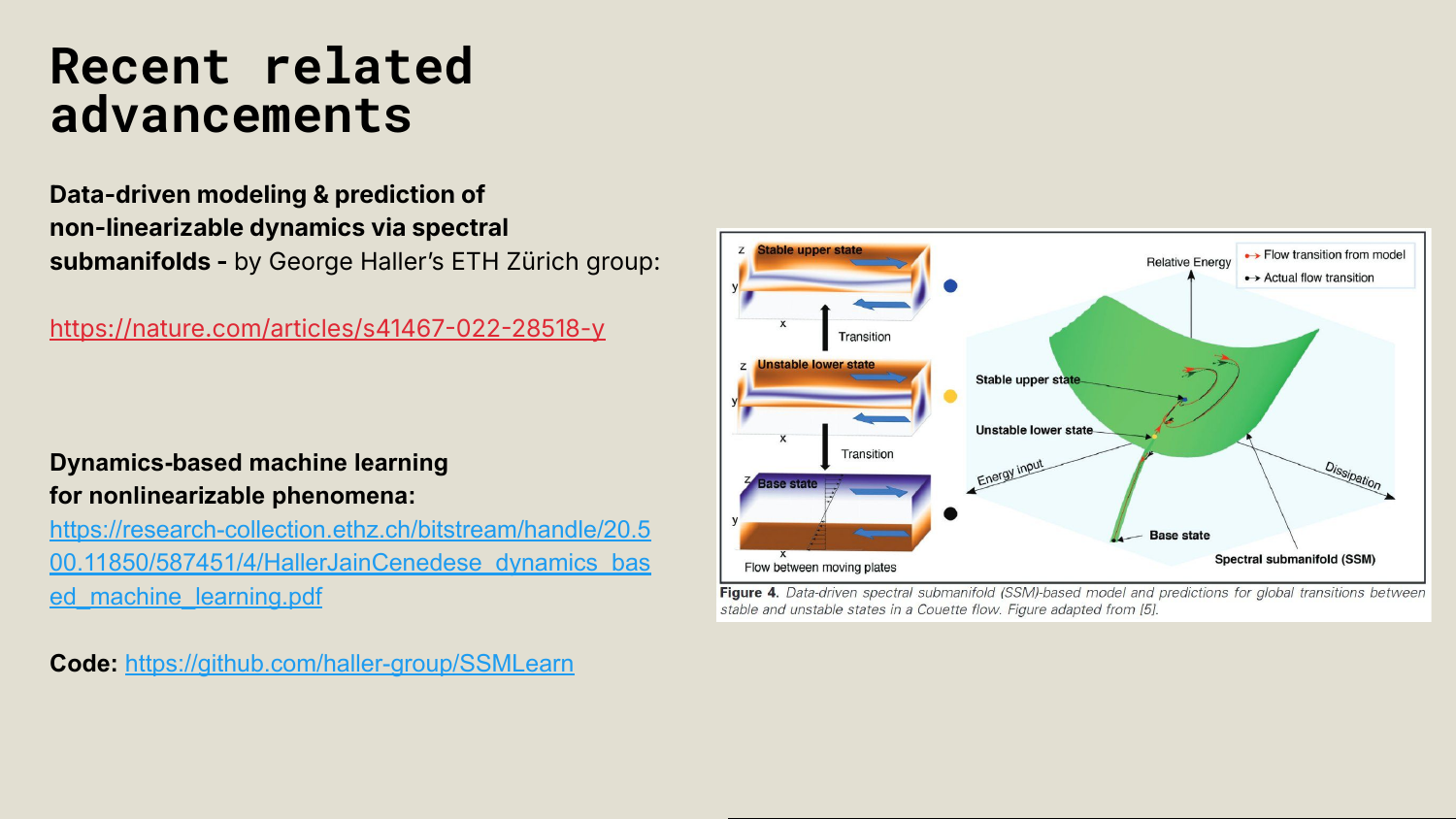
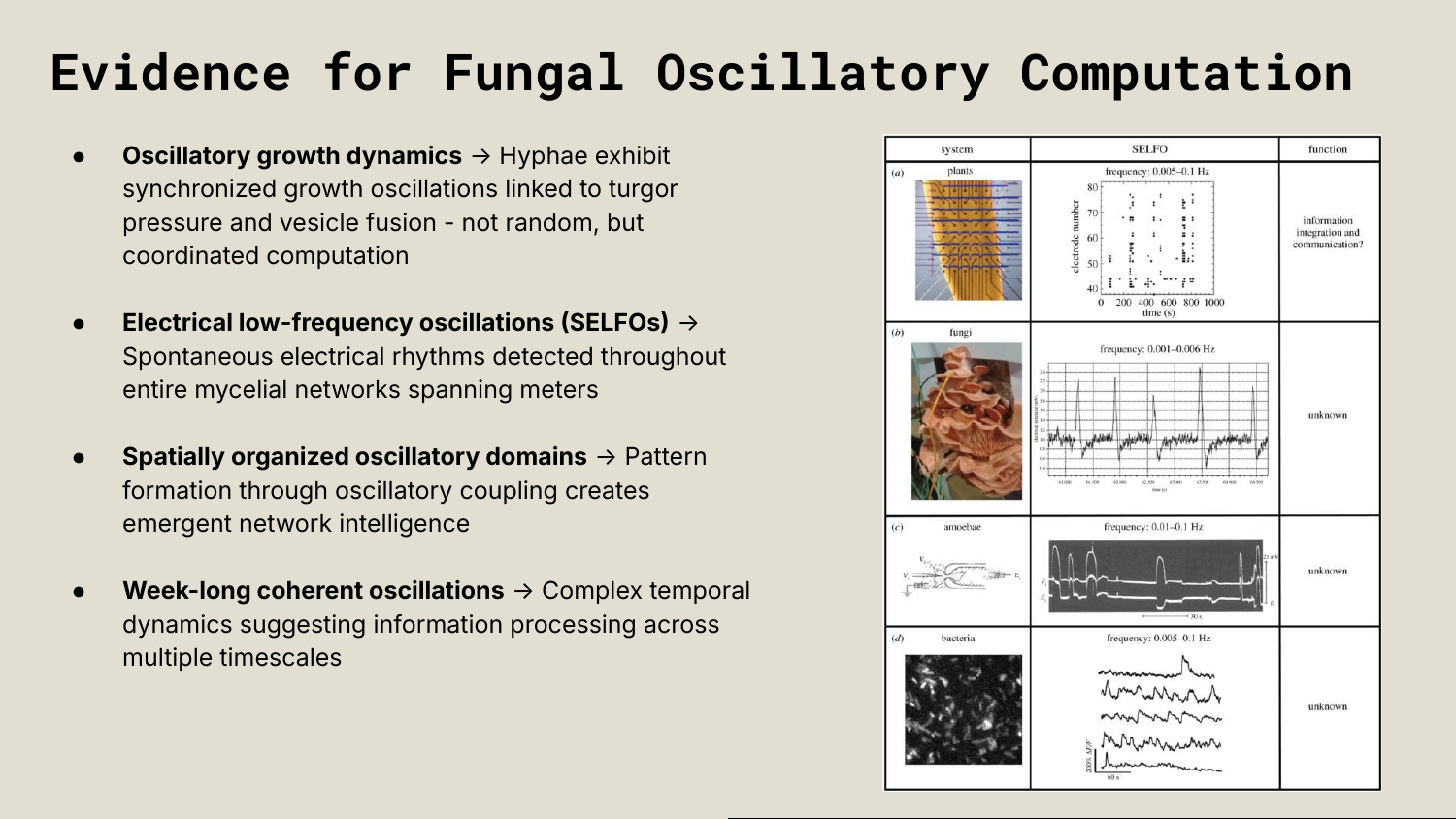
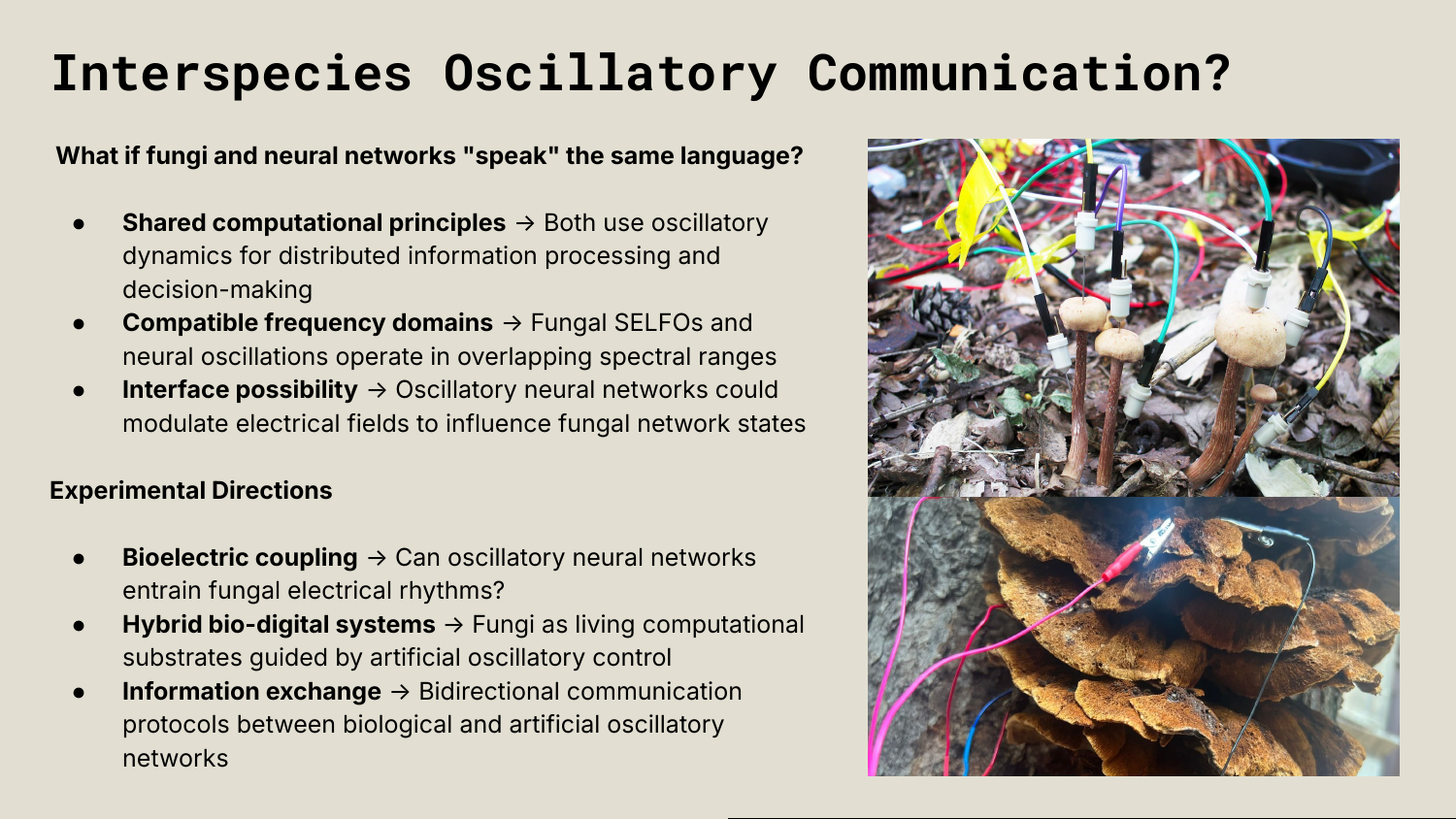
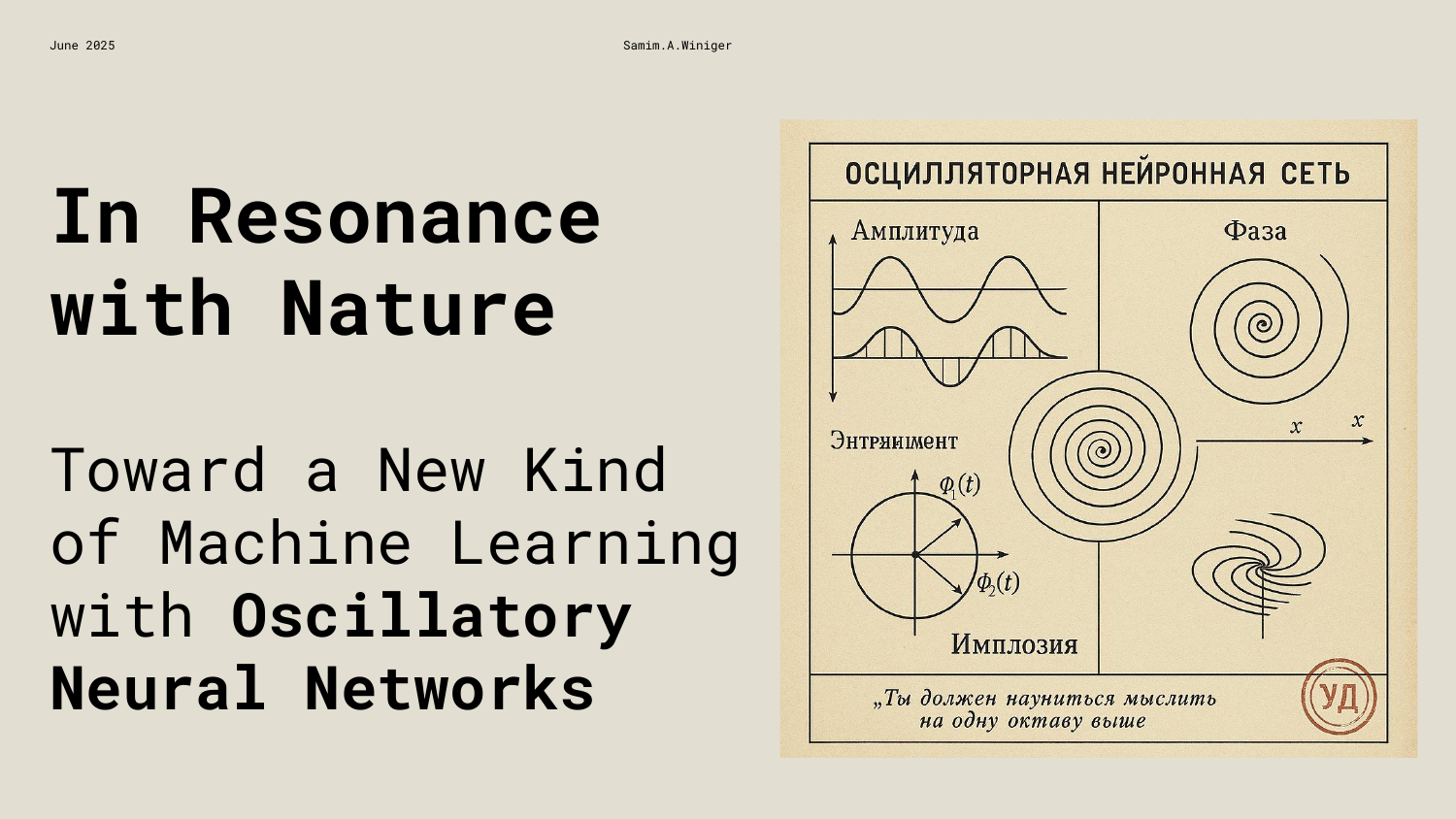
Presentation: In Resonance with Nature - Toward a New Kind of Machine Learning with Oscillatory Neural Networks
Slides for a Presentation i gave in June 2025 at the Singer Lab at the Ernst Strüngmann Institute (ESI) for Neuroscience in Cooperation with Max Planck Society.