tag > ML
-
DNA computing is a branch of computing which uses DNA, biochemistry, and molecular biology hardware, instead of the traditional silicon-based computer technologies. A brief introduction of the field can be found on the site of the Qian Lab:
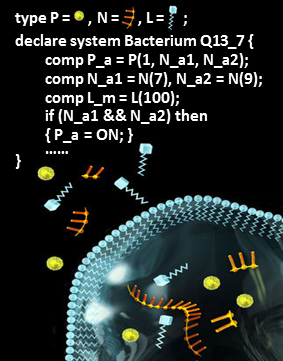
How can we rationally design and synthesize molecular systems with programmable behaviors? Life is full of amazingly sophisticated programs encoded in genomes, orchestrating molecules to sense, to compute, to respond, and to grow. One approach to interpreting the molecular programs that nature creates is to explore and re-realize the principles of information processing in biology, for example by rationally designing and synthesizing molecular systems that exhibit programmable behaviors. As much as electronics has changed our lives, at a much smaller scale computer science in its new form as molecular programming will change our lives with nanomachines, smart drugs and diagnostic devices.
-
Synchronized Oscillators (via)
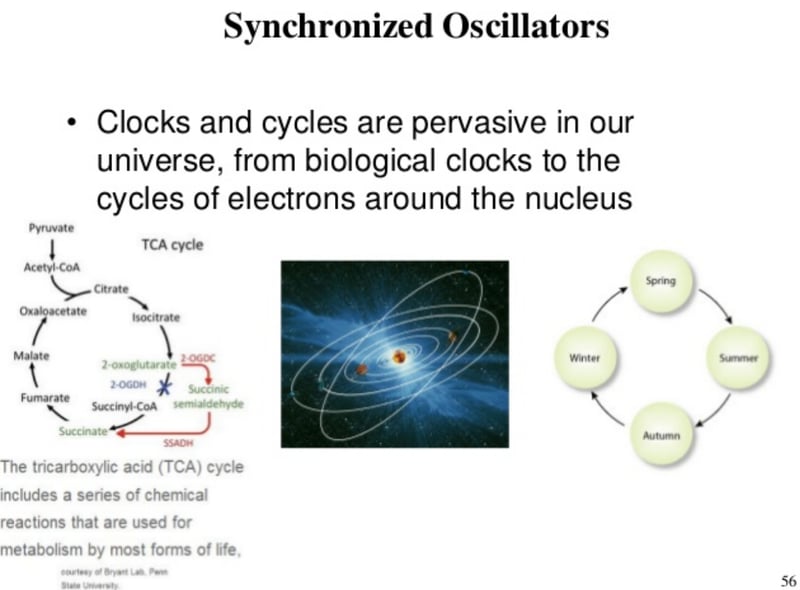
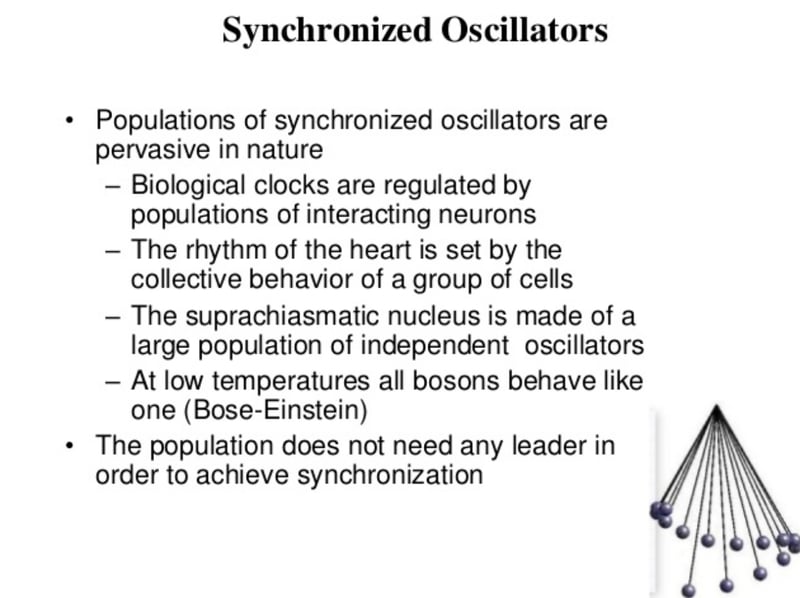
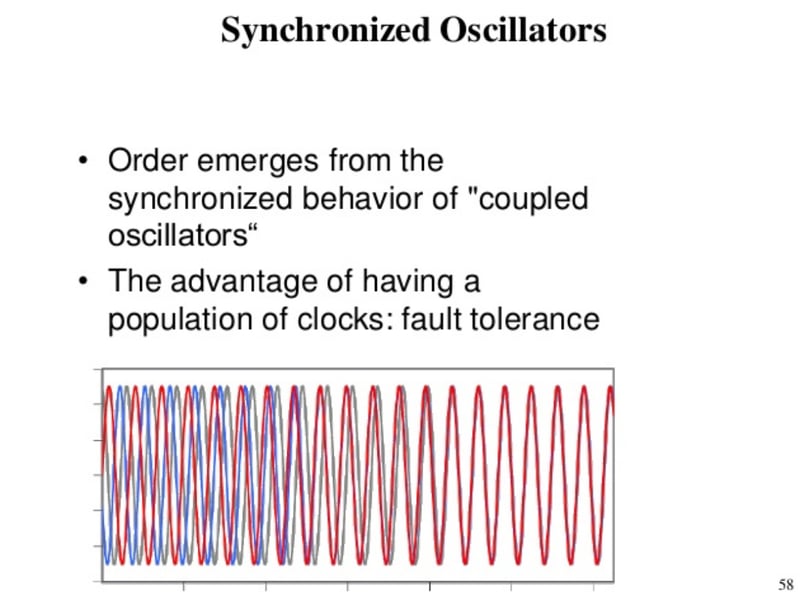
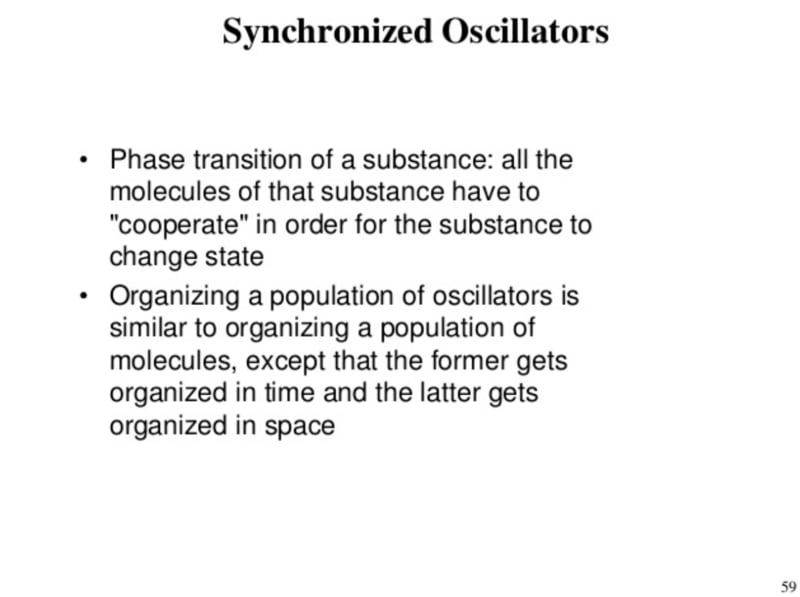
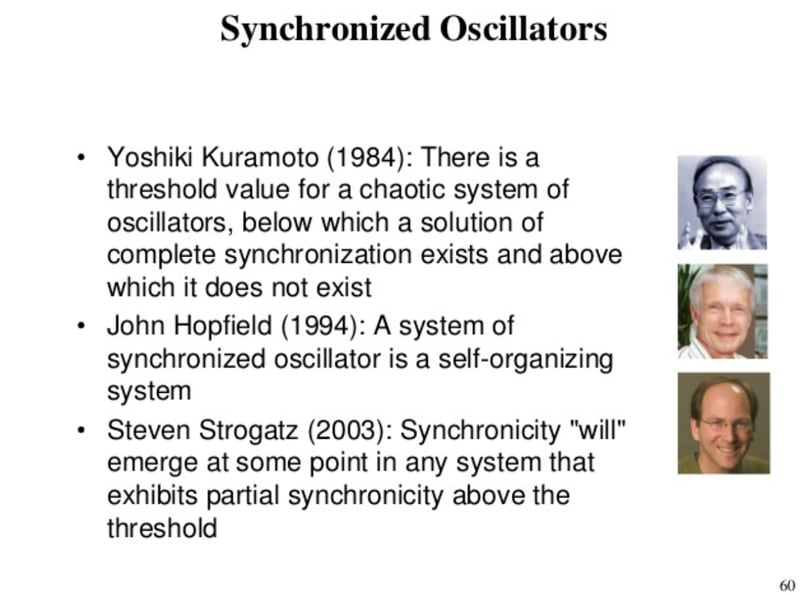
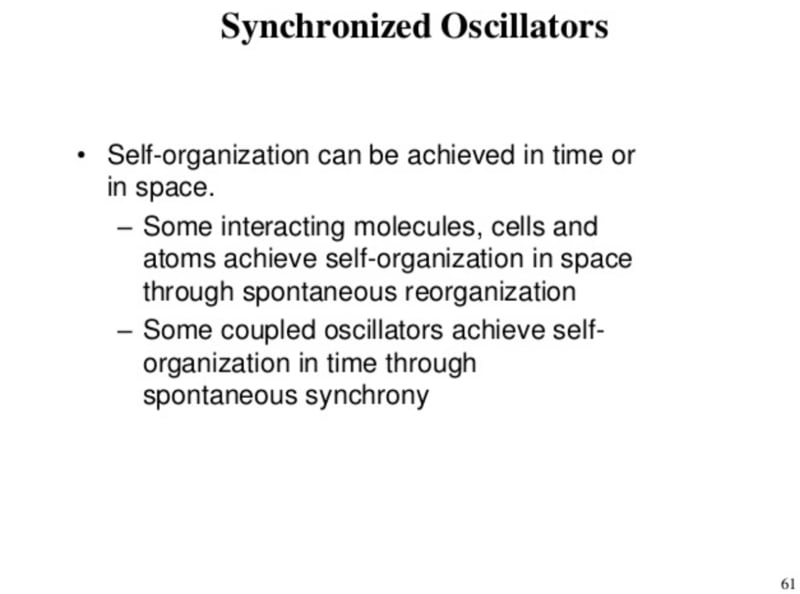
In 1975, Yoshiki Kuramoto introduced a simple model to describe the collective dynamics of a set of interacting oscillators. In the model, each oscillator has a natural frequency, and is coupled equally to all other oscillators. Assuming a fixed spread in oscillator frequencies, Kuramoto showed that in the limit of a large number of oscillators, the model exhibits a continuous phase transition from asynchronous to synchronous behaviour with increasing inter-oscillator coupling. Since then, the model and generalizations of it have been widely used in exploring the synchronization behavior in groups of biological cells, fireflies, superconducting Josephson junctions, or the movements of swarms or flocks of organisms.
- Yoshiki Kuramoto: https://en.wikipedia.org/wiki/Yoshiki_Kuramoto
- Kuramoto model: https://en.wikipedia.org/wiki/Kuramoto_model
- Kuramoto Model of Synchronized Oscillators https://blogs.mathworks.com/cleve/2019/08/26/kuramoto-model-of-synchronized-oscillators/
- All together now https://www.nature.com/articles/421780a
- pyclustring: https://github.com/annoviko/pyclustering
- Continuous vs. Discontinuous Transitions in the D-Dimensional Generalized Kuramoto Model: https://arxiv.org/pdf/1806.01314.pdf
- Synchronization networks https://en.wikipedia.org/wiki/Synchronization_networks
- Oscillatory neural network: https://en.wikipedia.org/wiki/Oscillatory_neural_network
- Synchronization: https://en.wikipedia.org/wiki/Synchronization
- An Oscillatory Neural Autoencoder Based on Frequency Modulation and Multiplexing: https://www.ncbi.nlm.nih.gov/pmc/articles/PMC6048285/
- A Neural Network Based on Synchronized Pairs of Nano-Oscillators https://arxiv.org/abs/1709.02274v1
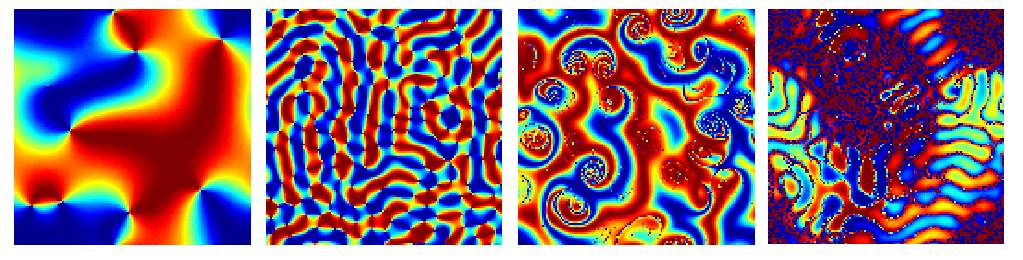
Image: Synchronization patterns in a two-dimensional array of Kuramoto-like oscillators
-
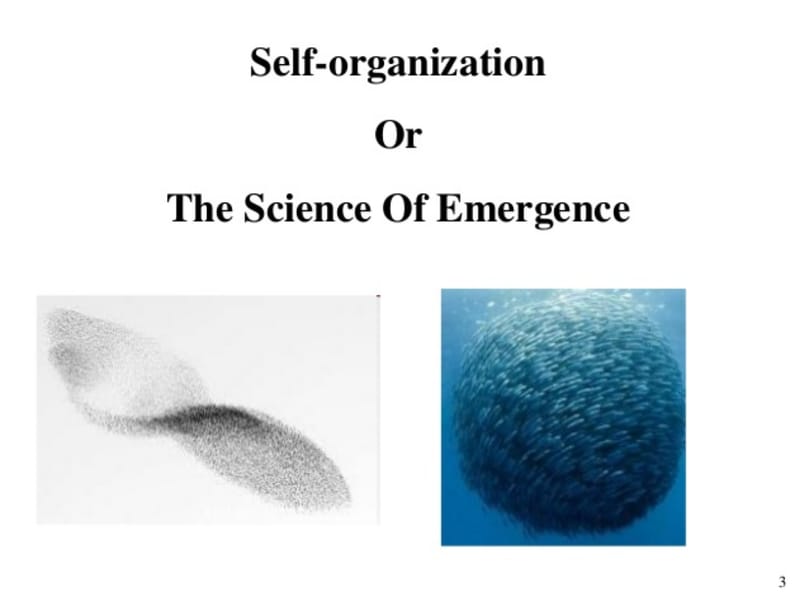
"Thinking about Thought" - Slides for Piero Scaruffi's excellent class on Modern Physics at UC Berkeley (2014). https://www.scaruffi.com/
-
Self-organized criticality is a property of dynamical systems that have a critical point as an attractor. Their macroscopic behavior thus displays the spatial or temporal scale-invariance characteristic of the critical point of a phase transition, but without the need to tune control parameters to a precise value, because the system tunes itself as it evolves towards criticality. The concept was put forward by Per Bak, Chao Tang and Kurt Wiesenfeld, and is considered to be one of the mechanisms by which complexity arises in nature.
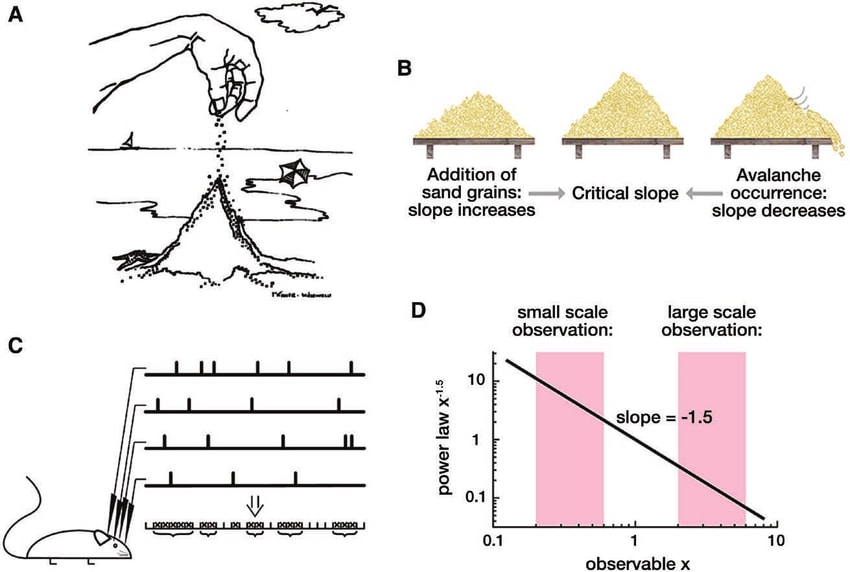
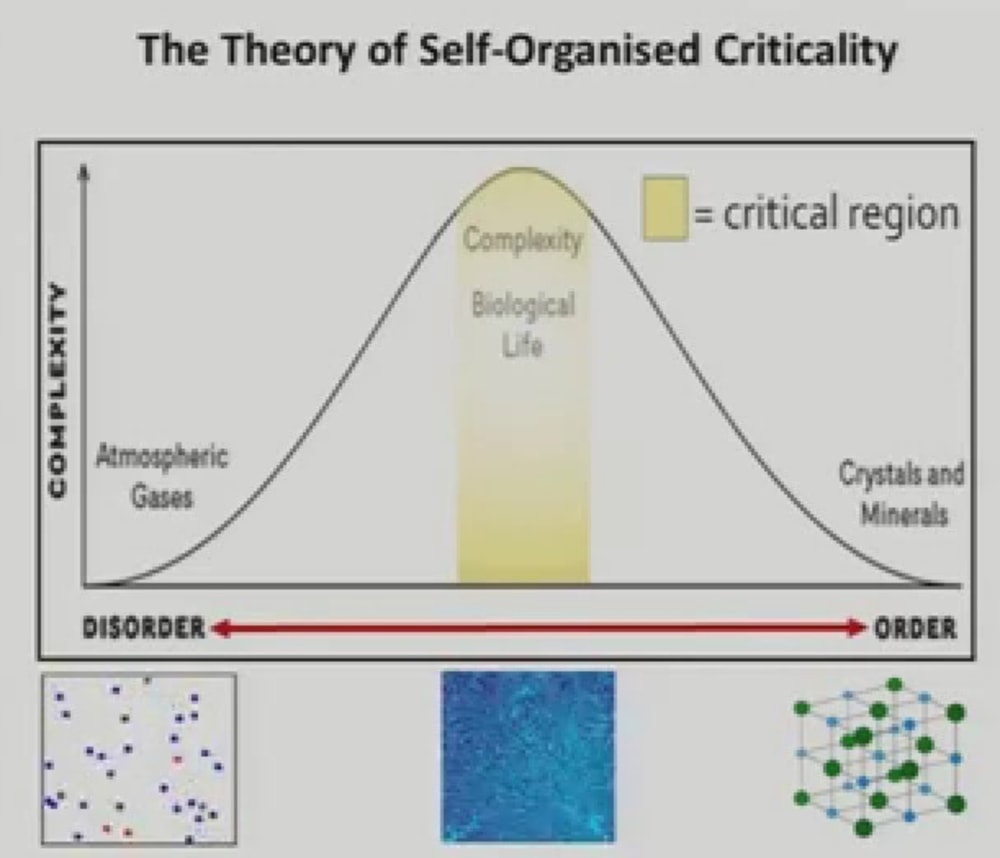
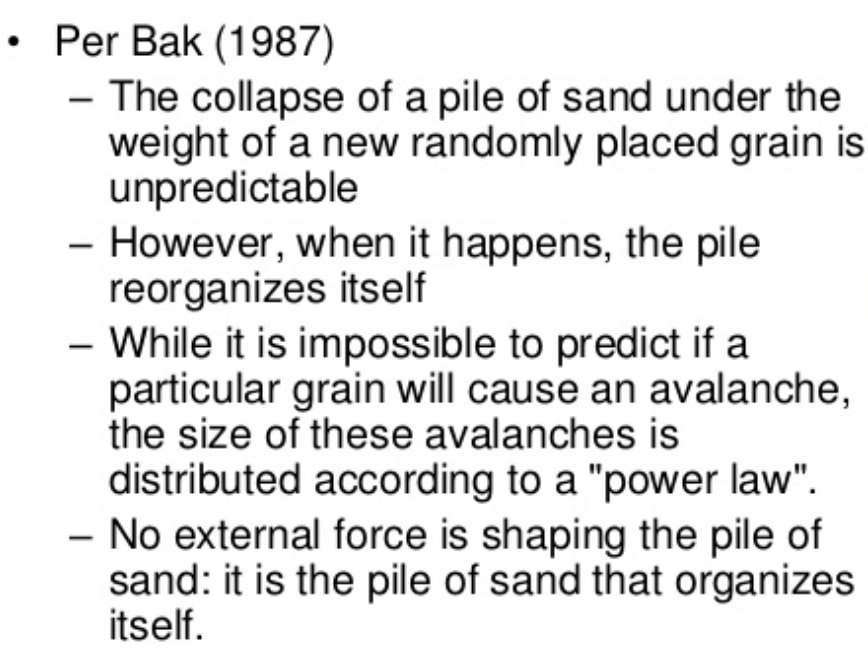
Images from: "Role of Network Science in the Study of Anesthetic State Transitions" and "Tuning Pathological Oscillations with EEG Neurofeedback and Self-Organized Criticality"
-
Christopher Langton (1948) is an American computer scientist and one of the founders of the field of artificial life. He coined the term in the late 1980s when he organized the first "Workshop on the Synthesis and Simulation of Living Systems" at the Los Alamos National Laboratory in 1987. Following his time at Los Alamos, Langton joined the Santa Fe Institute, to continue his research on artificial life. He left SFI in the late 1990s, and abandoned his work on artificial life, publishing no research since that time.
Langton's Ant Colonies - a two-dimensional universal Turing machine with a very simple set of rules but complex emergent behavior (1986)
Langton's Loops - a particular "species" of artificial life in a cellular automaton created in 1984 by Christopher Langton. They consist of a loop of cells containing genetic information, which flows continuously around the loop and out along an "arm" (or pseudopod), which will become the daughter loop.
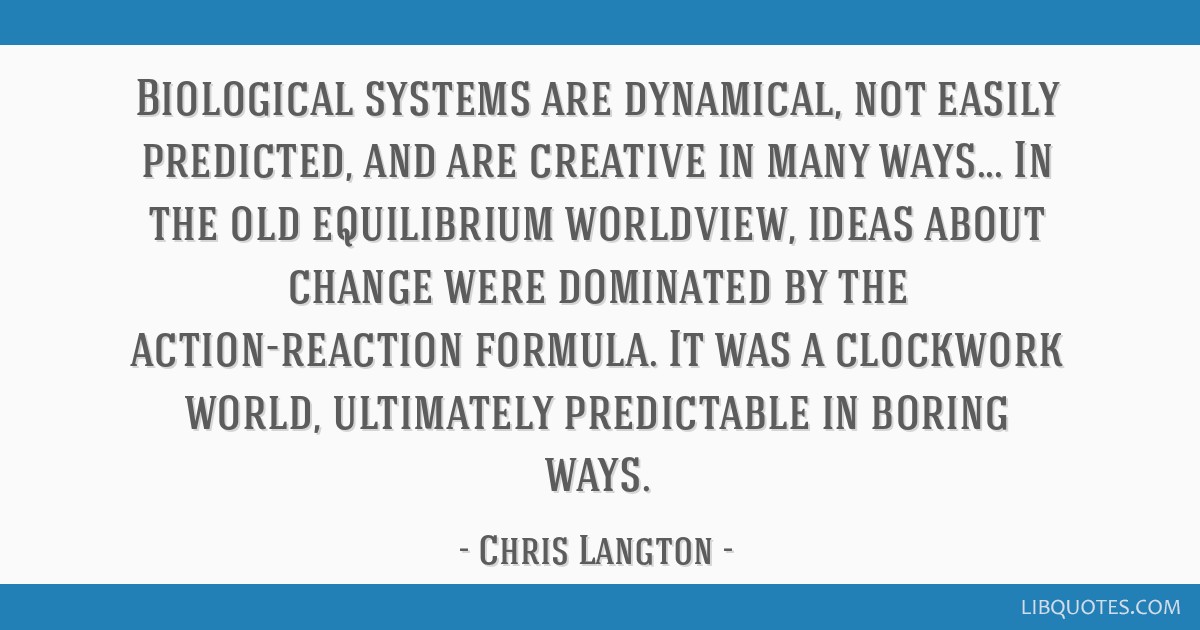
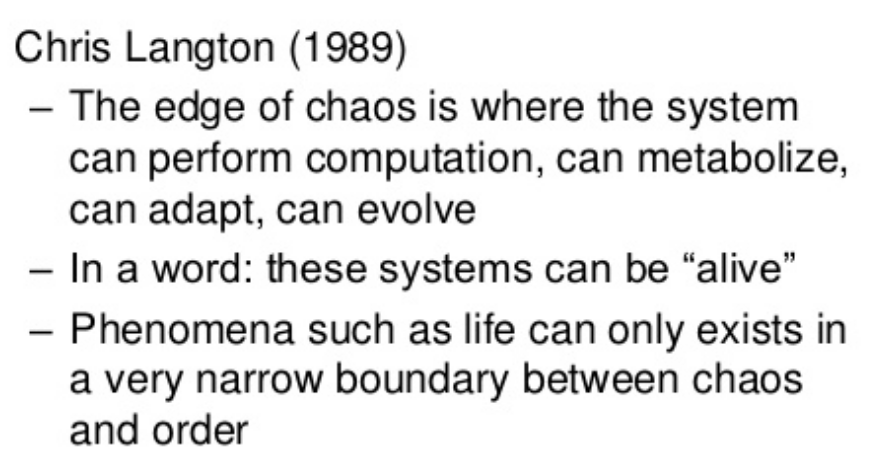
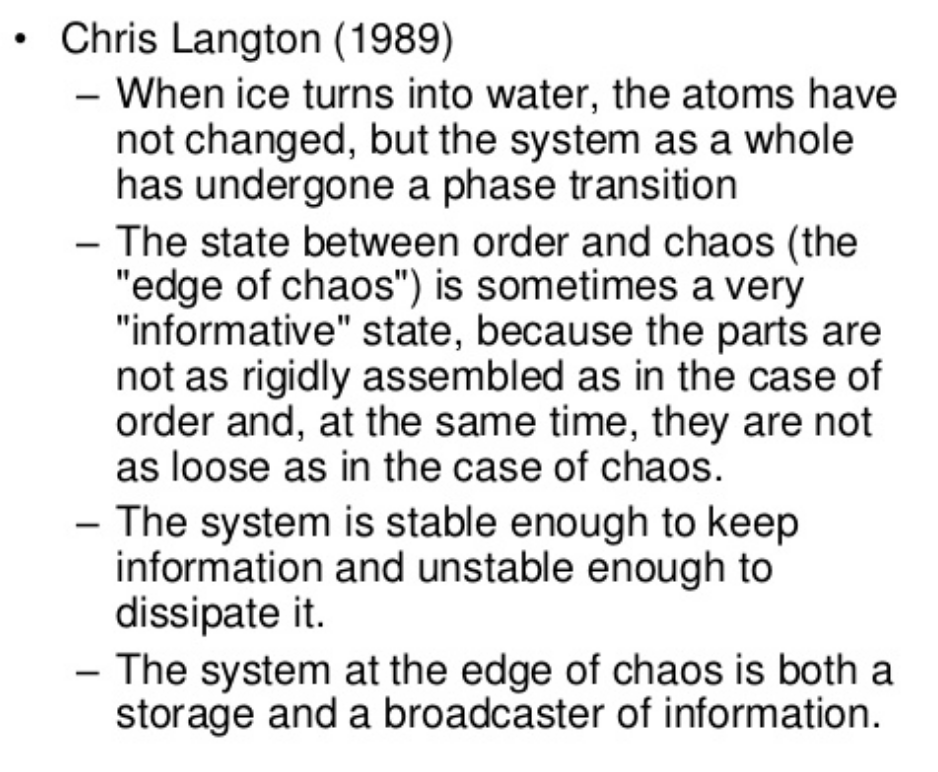
Overview paper on Artificial Life by Langton from the 1990s: https://web.archive.org/web/20070311225322/http://www.probelog.com/texts/Langton_al.pdf
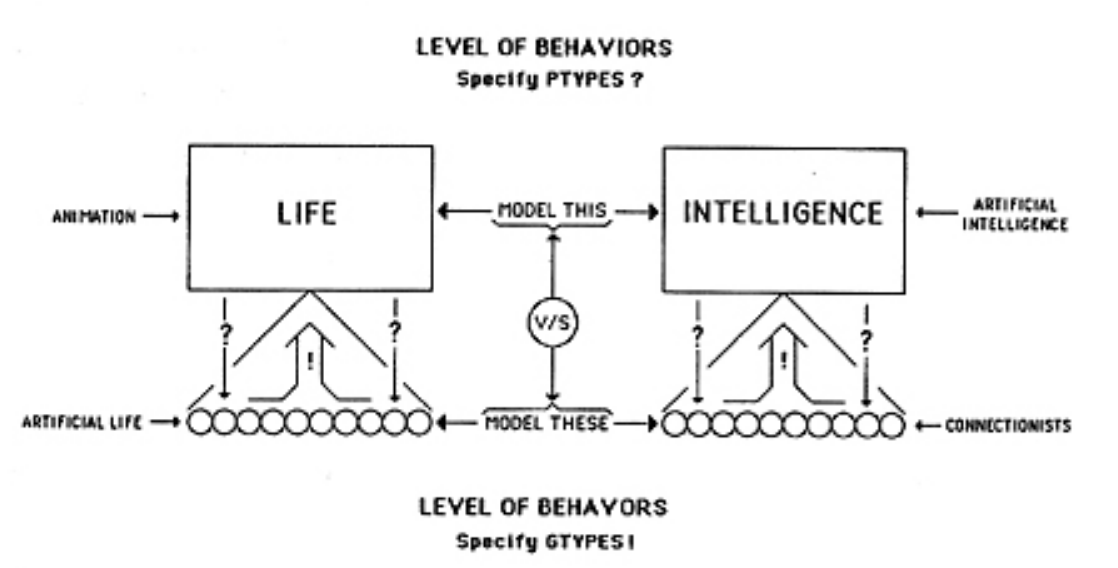
After Langton disappeared from the ALife community in the 1990s, he reappeared in the 2007 as author of "Military Balance" by "International Institute for Strategic Studies".
-
Neti Neti (नेति नेति) is a Sanskrit expression which means "not this, not that", or "neither this, nor that". It is found in the Upanishads and constitutes an analytical meditation helping a person to understand the nature of Brahman by first understanding what is not Brahman.
Neti Neti as understood through the quadrilemma articulated by Kinhide Mushakoji (Global Issues and Interparadigmatic Dialogue; essays on multipolar politics, 1988):
- this
- that (namely not this)
- this and that (namely this and not this)
- neither this nor that
-
"People out of Stone" - a brief backstory of modern-day robotics and AI:
In India, it is a tradition amongst certain Tantric sects to anoint their phallic lingam images with oil, milk, and sometimes semen. A similar tradition involving living statues and plaster busts exists in Western culture - at least on a literary level. E.T.A. Hoffman, Edgar Allen Poe, Ambrose Bierce, and Jules Verne amongst others, have reinterpreted the original myth of Pygmalion from Ovid; it can even be seen in the musical 'My Fair Lady'. This tradition fulfills an ancient human dream, that of bringing the dead back to life, either artificially or with the help of the gods of magic. Even today there are hints of it in cybernetics and genetic engineering. Inspired by the attempts of Charles Darwin's grandfather Erasmus Darwin to re-animate dead worms, the nineteen-year-old Mary Shelley wrote the novel 'Frankenstein: or the new Prometheus' which was published in 1818. More on the theme has been written more recently by authors such as Philip K. Dick (as in 'Blade Runner'), Alfred Bester, Stanislaw Lem and Pierre Klossowsky. In Switzerland in 1972, a drama based on the classical myth of Galatea appeared, expressing the eternal dream of a man for a woman who is wholly dedicated to him. In the play, which was a reworking of an 'Alpensaga' (Swiss mountain fairy tale), some farmers create a 'Sennentuntschi', an artificial woman grown in a bottle from a mixture of dung and cheese. Needless to say, Sennentuntschi soon frees herself from their attentions.
In Jewish mysticism, there is the legend of the Golem, which is ultimately based on Psalm 139 verse 16; the story is best known from the mediæval golem created by Rabbi Löw of Prague, as described in Gustav Meyrink's impressive novel The Golem (1915). Golems are reproductions of Adam, formed from the dust of the earth, and they go even further back in Jewish culture, as may be discovered in a commentary on the ancient Cabalistic text the Sefer Yetzirah, as expounded by the eminent scholar Gershom Scholem. The German author of occult and erotic potboilers H.H. Ewers added a sexual twist to the legend with his novel Alraune in 1911. Also in Germany, Paul Wegener directed a film of The Golem in 1915, the first in a series of German films such as Nosferatu, Das Kabinett des Doktor Caligari and Dr. Mabuse which evoked a fascination for evil. Neo-Gnostics and secret societies in Germany and elsewhere got a lot of inspiration from fictional sources such as these - enough for them to devise their own 'Order Secrets'. The concept of the Homunculus, an alchemical mannikin produced in a bottle, was not foreign to Theodor Reuss, the O.T.O.'s founder. The prescribed reading-list for O.T.O. members included G. Herman's work called Genesis - das Gesetz der Zeugung (Genesis - the Law of Procreation) which describes the production of a being "who is realized through the odic power of materialization, and which as odic mist streams from the vulvae, and under the traditional uterine influence easily forms child-souls." The alchemist Paracelsus described his formula for creating a Homunculus using blood and semen, and this has been compared to the consecrated hosts of the Spermo-Gnostics. In 1914 Aleister Crowley wrote his Xth degree instruction De Homunculo Epistola in which he described the homunculus, even though he was less than enthusiastic about it. It is quite possible that he had been inspired by Somerset Maugham, who had published a novel called The Magician in 1907, whose villain Oliver Haddo is based on Crowley; in the novel Haddo manufactures a mad homunculus by devilish arts. Similarly, Crowley himself wrote a novel in 1917 (not published until 1929) called Moonchild, in which sex-magicians create a speaking homunculus with astrological enchantments.
"You are my Creator, but I am your Master — Obey!" - Mary Shelley, Frankenstein
Text is an excerpt from: "Nosferatu's Baby (Much Too Much) Too hot To Handle" - by Peter-R. Koenig

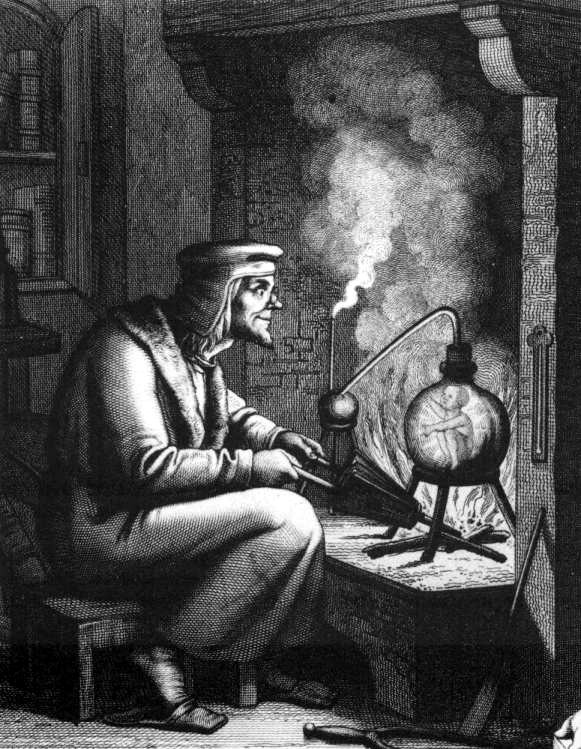
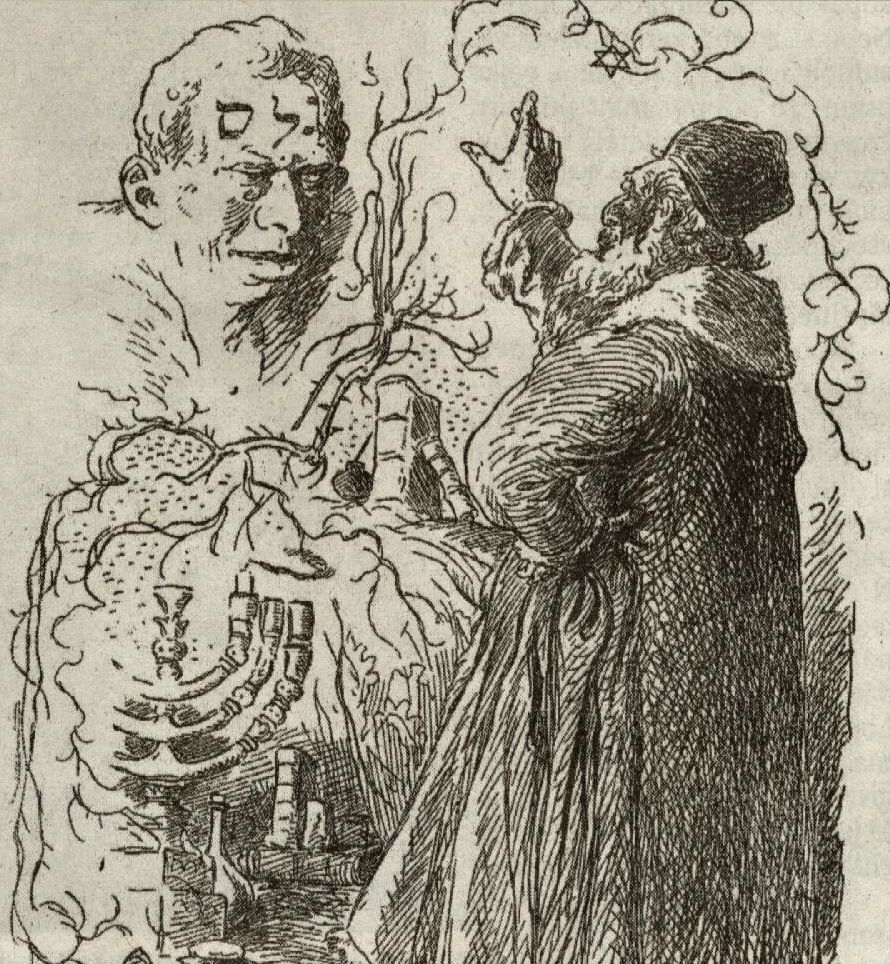
#Comment: It is rather comedic, that generations of highly educated elite men tried to make inanimate matter come alive through ever-evolving complex means. It seem obvious, that the driving psychological force behind such efforts, is a pathological jealousy of men towards women, resulting from the biological inability of males to give birth.
Consider the somewhat related insights, by Robert Anton Wilson: "Elohim," the name for the creative power in Genesis, is a female plural, a fact that generations of learned rabbis and Christian theologians have all explained as merely grammatical convention. The King James and most other Bibles translate it as "God," but if you take the grammar literally, it seems to mean "goddesses." Al Shaddai, god of battles, appears later, and YHWH, mispronounced Jehovah, later still. - Genesis, p. 197
-
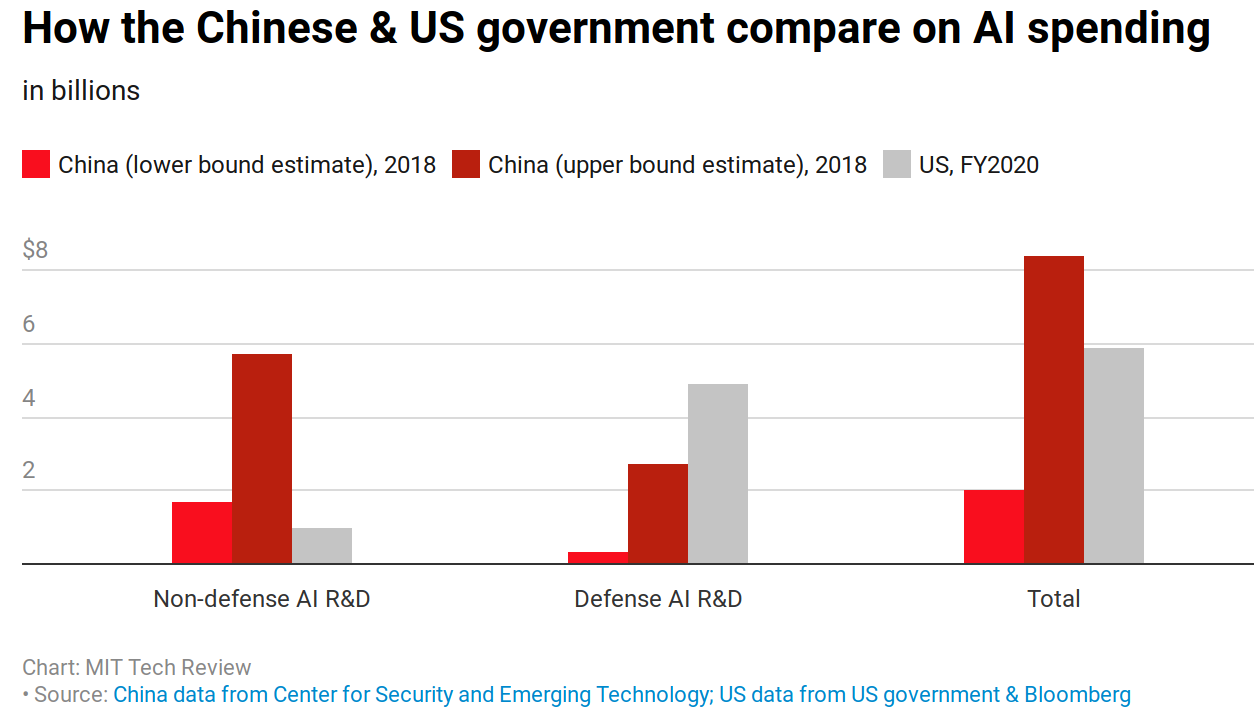
Yes, China is probably outspending the US in AI—but not on defense (MIT TechReview)
"China is likely spending far less on AI than previously assumed...money seems to be going to non-military research, [like] fundamental algorithm development...the US’s spending for fiscal year 2020 allocates the majority of its AI budget to defense"
-
Google's Relightables system makes it possible to customize lighting on characters in real time or re-light them in any given scene or environment. (Project Page)
-
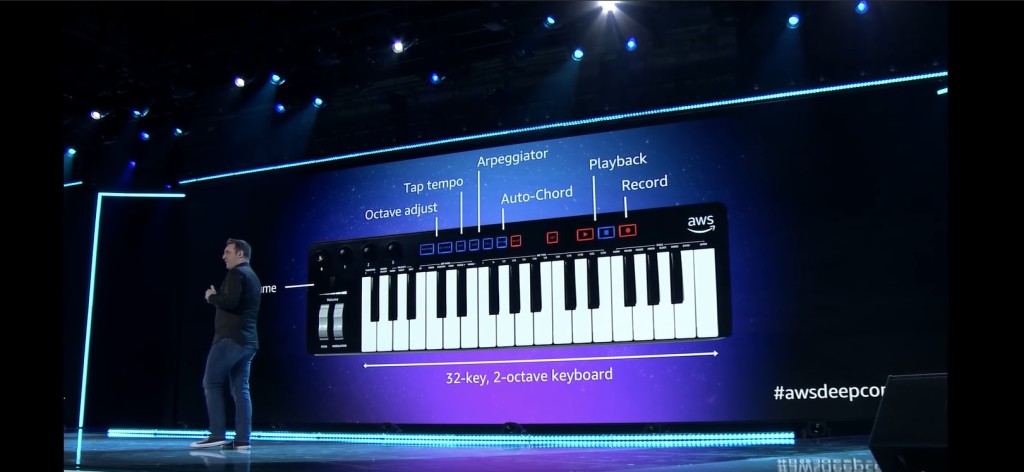
Amazon’s AWS DeepComposer is peak not-knowing-what-AI-is-for (cdm)
Technically this has been available in some form since the mid-80s and is of very limited practical use, but … all on board on the "creative AI" bullshit hype train!
-
Interpolating Anime Videos to 60FPS with DAIN. (via reddit)
DAIN: Depth-Aware Video Frame Interpolation. Code: https://github.com/baowenbo/DAIN
-
What is Information? - Interview with Peter Tse
More talks by Peter Tse:
-
Advances in neuromorphic computing technology - talk by Steve Furber
-
Big Brother is watching: Chinese city with 2.6m cameras is world's most heavily surveilled (guardian)
Chongqing has 1 camera per 6 residents, but “Singapore has plans to install 100,000 facial-recognition cameras on lampposts, Chicago police have asked for 30,000 more, and Moscow intends to have 174,000 by the end of this year.”
-
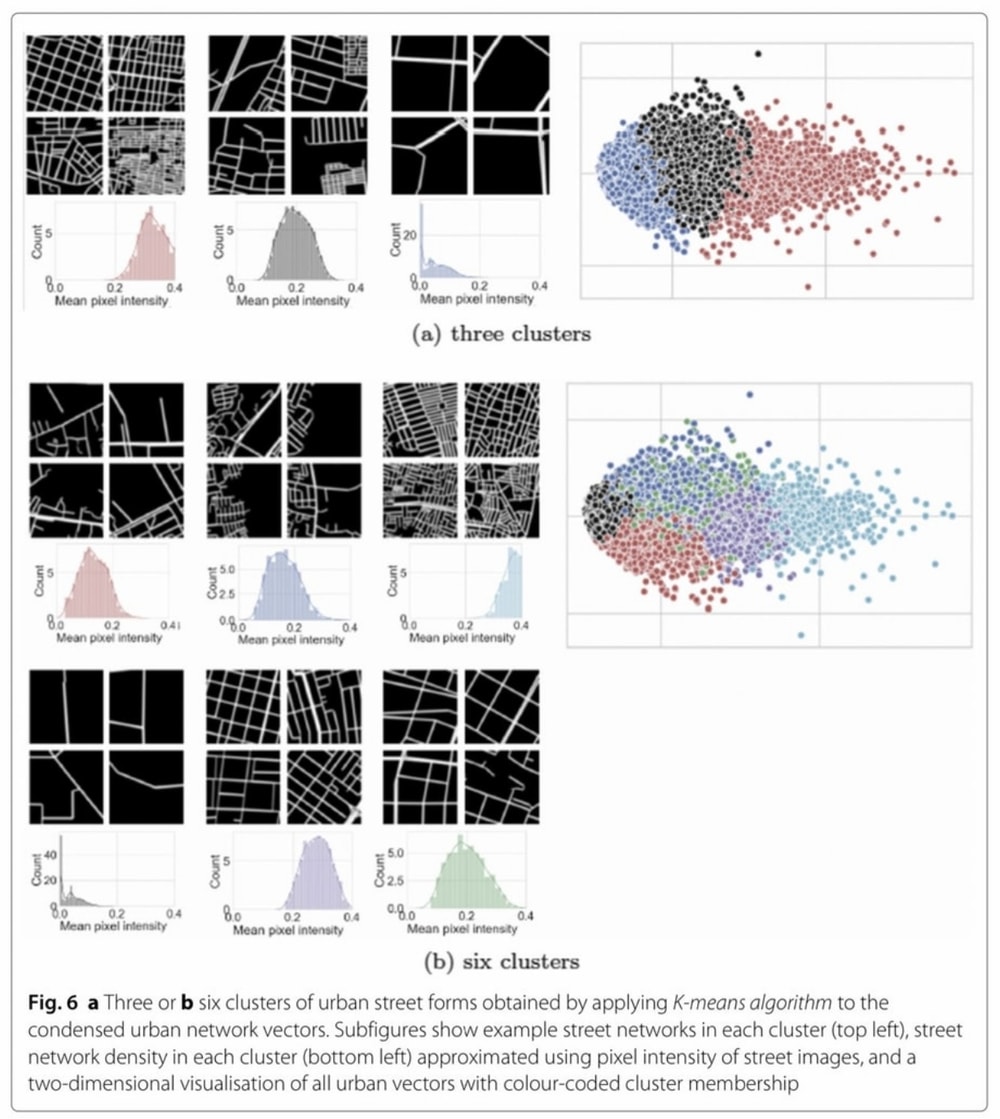
Modelling urban networks using Variational Autoencoders
“VAEs capable of capturing key high-level urban network metrics using low-dimensional vectors and generating new urban forms of complexity matching the cities captured in the street network data”
-
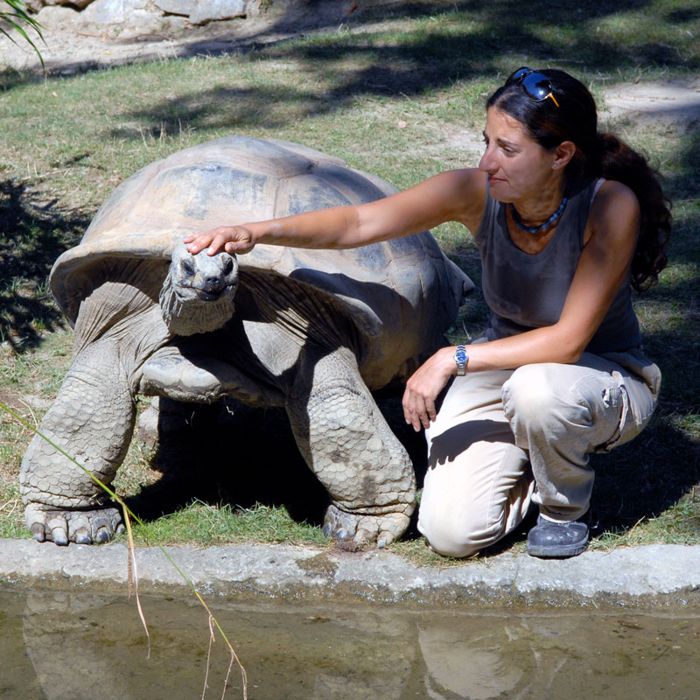
Giant tortoises show surprising cognitive powers (Nature)
Giant tortoises can learn and remember tasks, and master lessons much faster when trained in groups.
Scientists trained Galapagos tortoises and Aldabra tortoises to bite a ball of a particular color — blue, green or yellow.
When tested three months later, the tortoises recalled the task. The authors tested three of the tortoises again after nine years and found that all three responded to toys of the correct color. The researchers also found that both species of tortoise could be conditioned with fewer training sessions if they were taught in groups than if learning occurred in isolation, hinting that tortoises learn from watching their peers.
-
Deutsche Bank To Replace 18,000 Workers With Robots (via)
"The bank's head of operations said that using AI 'massively increased productivity in certain sectors'. Deutsche is pushing to 'automate large parts of its back-office' via a new strategy called 'Operations 4.0', as part of its $6.6 billion savings initiative."
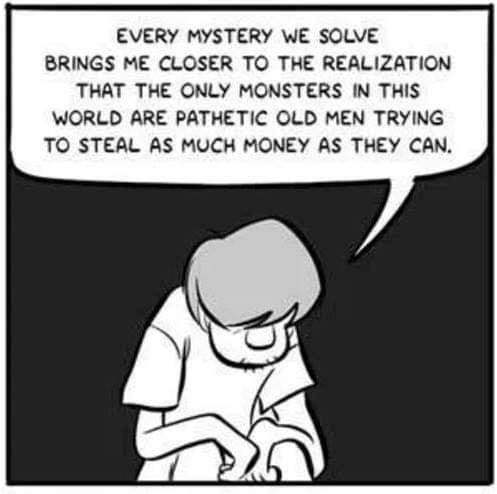
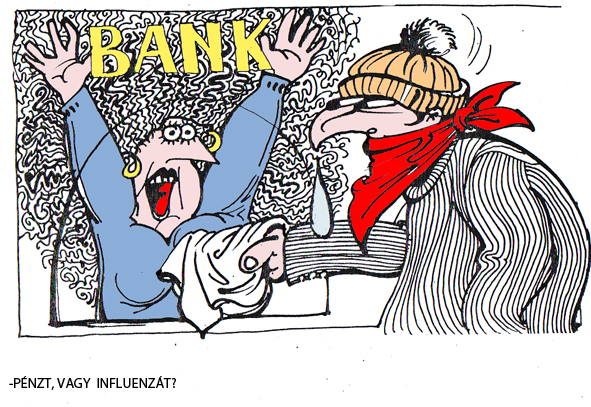
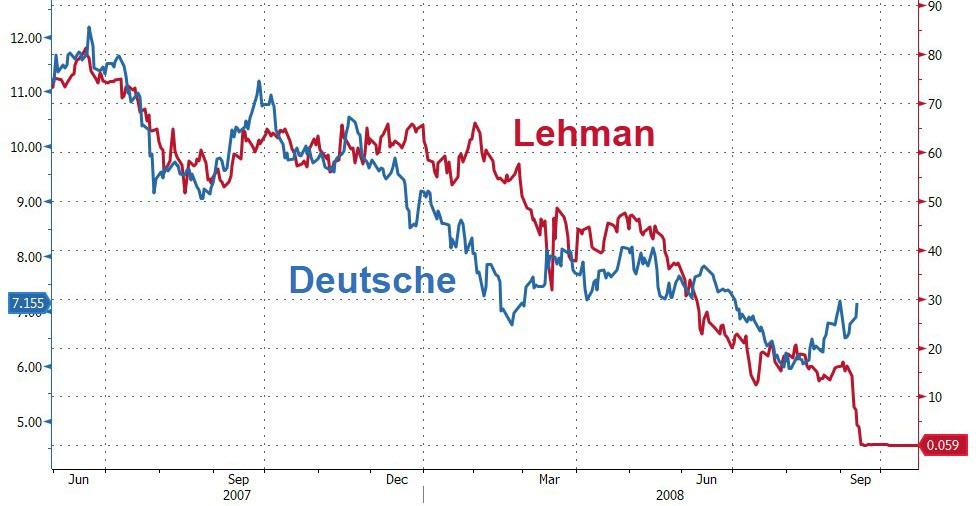
#Comment: This is a shameless, peak bullshit way of announcing corporate collapse and bankruptcy. Long term mismanagement, corruption and criminal activities at a massive scale brought them here - and no fictitious "AI" will fix that.