tag > Science
-
Acclaimed mainstream scientists (Oxford, Standford, MaxPlank, Marie Curie, etc.) speaking up against the corona crisis handling and hysteria.
- 12 Experts Questioning the Coronavirus Panic (off-guardian)
- 10 more Experts Criticising the Coronavirus Panic (off-guardian)
- Perspectives on the Pandemic (off-guardian)
- Why this Nobel laureate predicts a quicker coronavirus recovery (LATimes)
- Wolfgang Wodarg: Corona viruses are not the problem - stay calm
- Corona-Krise: Offener Brief an die Bundeskanzlerin von Prof. Sucharit Bhakdi
- Renowned German mathematician and professor of statistics slams dramatization of Covid-19
- 12 Experts Questioning the Coronavirus Panic (off-guardian)
-
Recent Corona Testing Reliability Weirdness
- Health Ministry delays test results, amid reports patients given false diagnoses (Time of Israel)
- Are coronavirus tests flawed? (BBC)
- Finnish health boss questions WHO coronavirus testing advice (Reuters)
- COVID-19 testing protocol changes, raising concerns about tracking virus in NC (WRAL)
- Why a wave of at-home coronavirus tests is dividing global regulators (Bloomberg)
- 99% of Those Who Died From Virus Had Other Illness, Italy Says (Bloomberg)
- Coronavirus: pathogen could have been spreading in humans for decades, study says (SCMP)
- Coronavirus: Irreführung bei den Fallzahlen nun belegt (KenFM)
-
UK has enough intensive care units for coronavirus, expert predicts (New Scientist)

The UK should now be able to cope with the spread of the covid-19 virus, according to one of the epidemiologists advising the government. Neil Ferguson at Imperial College London said that expected increases in National Health Service capacity and ongoing restrictions to people’s movements make him “reasonably confident” the health service can cope when the predicted peak of the epidemic arrives in two or three weeks. UK deaths from the disease are now unlikely to exceed 20,000, he said, and could be much lower.
Comment by @AlexBerenson: This is a remarkable turn from Neil Ferguson, who led the @imperialcollegeauthors who warned of 500,000 UK deaths - and who has now himself tested positive for COVID; He now says both that the U.K. should have enough ICU beds and that the coronavirus will probably kill under 20,000 people in the U.K. - more than 1/2 of whom would have died by the end of the year in any case bc they were so old and sick. Essentially, what has happened is that estimates of the viruses transmissibility have increased - which implies that many more people have already gotten it than we realize - which in turn implies it is less dangerous. Ferguson now predicts that the epidemic in the U.K. will peak and subside within “two to three weeks” - last week’s paper said 18+ months of quarantine would be necessary. One last point here: Ferguson gives the lockdown credit, which is *interesting* - the UK only began ita lockdown 2 days ago, and the theory is that lockdowns take 2 weeks or more to work. Not surprisingly, this testimony has received no attention in the US - I found it only in UK papers. Team Apocalypse is not interested.
More from Imperial
- Coronavirus pandemic could have caused 40 million deaths if left unchecked (Imperial)
- COVID-19: Imperial researchers model likely impact of public health measures (Imperial)
virus modeling
- Coronavirus pandemic could have caused 40 million deaths if left unchecked (Imperial)
-
Thinker of the day: Paul Feyerabend (1924 - 1994)

Feyerabend defended the idea that science should be separated from the state in the same way that religion and state are separated in a modern secular society (Against Method (3rd ed.). p. 160.). He envisioned a "free society" in which "all traditions have equal rights and equal access to the centres of power" (Science in a Free Society. p. 9.). According to Feyerabend, science should also be subjected to democratic control: not only should the subjects that are investigated by scientists be determined by popular election, scientific assumptions and conclusions should also be supervised by committees of lay people. He thought that citizens should use their own principles when making decisions about these matters. He rejected the view that science is especially "rational" on the grounds that there is no single common "rational" ingredient that unites all the sciences but excludes other modes of thought (Against Method (3rd ed.). p. 246.).
-
Acclaimed German virologists question the corona hysteria
Corona virus COVID-19- hype and hysteria? Demystification of the nightmare - by Prof. Dr. med. Sucharit Bhakdi - Professor an der Johannes-Gutenberg-Universität in Mainz und war 22 Jahre lang Leiter des dortigen Instituts für Medizinische Mikrobiologie und Hygiene.
Am Telefon zur Corona-Virologie: Professor Karin Mölling, Virologin am Max-Planck-Institut für Molekulare Genetik in Berlin und hat einen Lehrstuhl am Institut für Medizinische Virologie an der Universität Zürich. (KenFM)
Corona Virus: Prof. Hornegger im Gespräch mit Prof. Christian Bogdan
Related: 12 Experts Questioning the Coronavirus Panic (off-guardian)
-
Device brings silicon computing power to brain research and prosthetics (Stanford)

A close up of the microwire array Researchers at Stanford University have developed a new device for connecting the brain directly to silicon-based technologies. While brain-machine interface devices already exist—and are used for prosthetics, disease treatment and brain research—this latest device can record more data while being less intrusive than existing options.
-
Scientists create quantum sensor that covers entire radio frequency spectrum (phys.org)
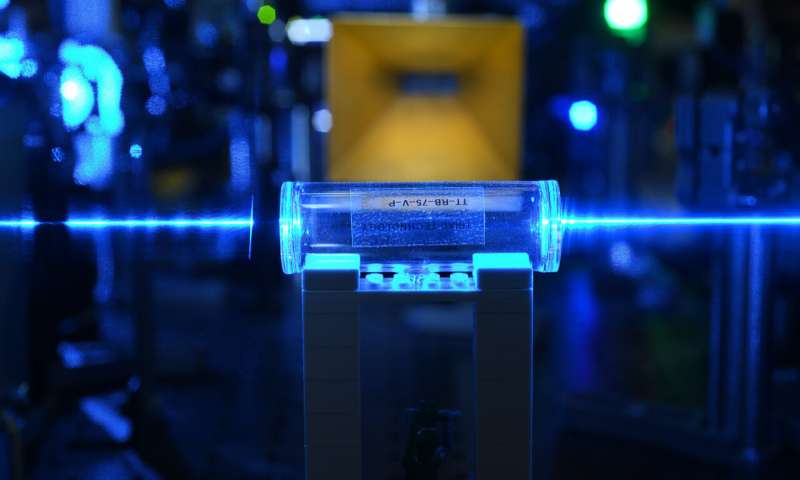
Atoms in a glass vapor cell are excited with laser beams to Rydberg states. They detect the electric fields and imprint the information back onto the laser beams. A quantum sensor could give Soldiers a way to detect communication signals over the entire radio frequency spectrum, from 0 to 100 GHz, said researchers from the Army. Such wide spectral coverage by a single antenna is impossible with a traditional receiver system, and would require multiple systems of individual antennas, amplifiers and other components.
-

Sir Isaac Newton's Self-Quarantine
While the bubonic plague raged elsewhere, Newton, in seclusion, embarked on what he'd later describe as the most intellectually productive period of his life.
-
Niacin - a form of vitamin B3

Niacin, also known as nicotinic acid, is an organic compound and a form of vitamin B3, an essential human nutrient. It has the formula C
6H
5NO
2 and belongs to the group of the pyridinecarboxylic acid. In 2014, concurring with earlier work in 2001 by Arizona State University, researchers from Pennsylvania State University working with NASA found niacin, pyridine carboxylic acids and pyridine dicarboxylic acids inside meteorites.
-
Operation Paperclip - Presentation by Annie Jacobsen
Mentions Otto Ambros, a German chemist known for inventing rubber, and high level Nazi who after WW2 became a highly regarded Scientists in the USA. He was head of Grünenthal's supervisory board and an adviser to Dow Chemical and Army Chemical Corps.
-
Meditation may have shaved 8 years of aging off Buddhist monk's brain (Livescience)
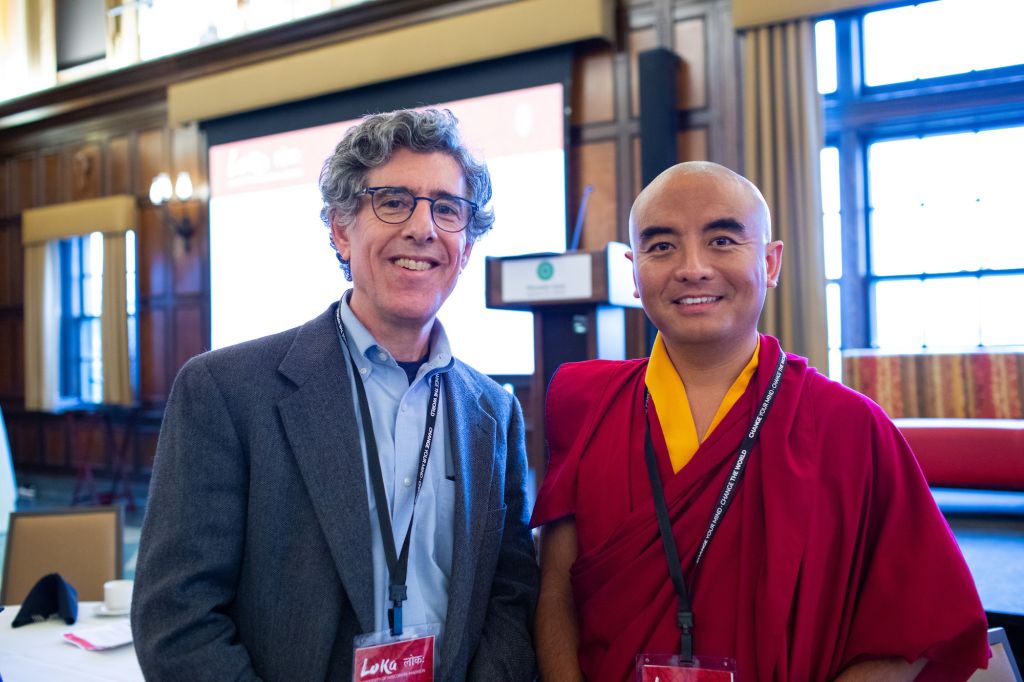
Analysis of the brain of a Tibetian Buddhist monk showing that his 41-year-old brain actually resembles that of a 33-year-old. The monk, Yongey Mingyur Rinpoche (YMR), a renowned meditation practitioner and teacher, began meditating at age 9. The findings add to a growing pile of evidence "that meditative practice may be associated with slowed biological aging," the researchers wrote in the case study, published online Feb. 26 in the journal Neurocase.
-
Will the coronavirus kill off the ‘dinosaur’ world of academic publishing? (SCMP)

Illustration: Lau Ka-kuen The deadly pandemic has brought back to life a long-running debate about companies profiting from the publication of research often freely supplied by the author. As the biggest names in the business respond to academics’ demands to bring down paywalls, new platforms are getting fresh studies out to the public.
Unlock Coronavirus research for world's scientists
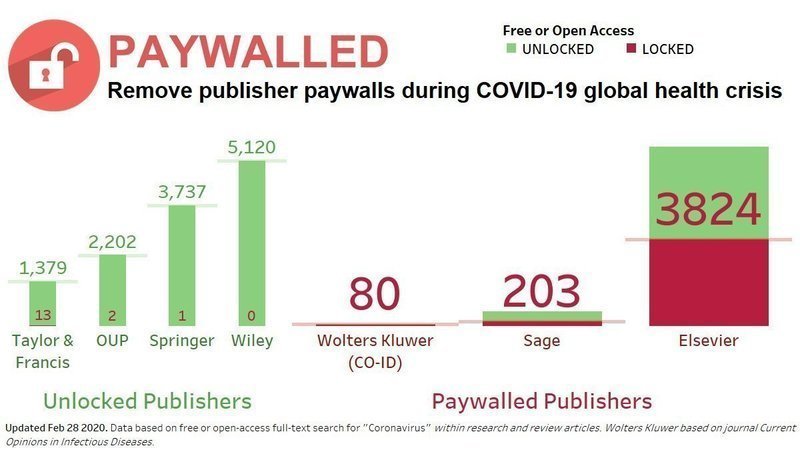
Right now, thousands of scientific studies about the Coronavirus are locked behind subscription paywalls, blocking scientists from getting access to research needed to discover antiviral treatments and a vaccine to stop the virus. Although publishers have made some research available via Open Access, thousands of articles remain locked behind paywalls. Publishers must immediately unlock every scientific article containing the term “Coronavirus.” It is a moral imperative.
Academic Publishing Mafia Stats:

In 2013, the five editorial groups Elsevier, Springer, Wiley-Blackwell, Taylor & Francis, and SAGE Publications published more than half of all academic papers in the peer-reviewed literature. At that time, Elsevier accounted for 16% of the world market in science, technology, and medical publishing. (wikipedia)
A taste of the broken mindset of knowledge oligarchs:
"Leading Through Change" - Video Interview with Kumsal Bayazit, Chief Executive Officer, Elsevier (CogX 2019) -
DNA Animations - by Drew Berry
-
Hydrogen made using rust (popular mechanics - alt: newatlas)

In the search to find an environmentally friendly alternative for fossil fuels, scientists from the Tokyo University of Science developed a new technique for safely and efficiently producing 25 times more hydrogen fuel by using a specific type of rust and light source.
-

Snake oil is a euphemism for deceptive marketing. Many 19th-century US and European entrepreneurs advertised and sold mineral oil as "snake oil liniment", making frivolous claims about its efficacy as a panacea. Fat extracted from the Chinese water snake has been used in traditional Chinese medicine for many centuries, and is a common medication prescribed by doctors.
-
Scientists Finally Reveal The Electronic Structure of Benzene -- in 126 Dimensions
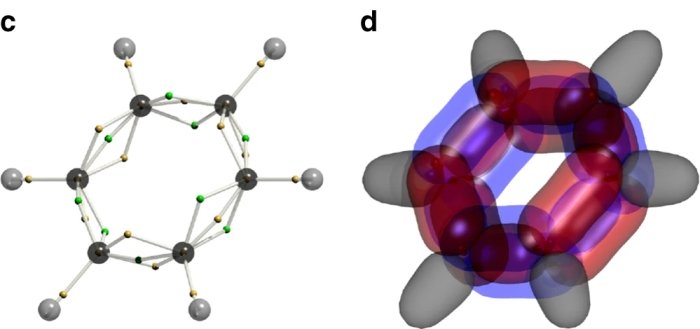
Nearly 200y after the molecule was discovered by Michael Faraday, researchers have finally revealed the complex electronic structure of benzene. This not only settles a debate that has been raging since the 1930s, this step has important implications for the future development of opto-electronic materials, many of which are built on benzenes.
-
Perpetua Mobilia Patent: Motionless electromagnetic generator (US6362718B1)

An electromagnetic generator without moving parts includes a permanent magnet and a magnetic core including first and second magnetic paths. A first input coil and a first output coil extend around portions of the first magnetic path, while a second input coil and a second output coil extend around portions of the second magnetic path.
-
Magnetic Monopole Noise (Nature, 2019) (unpaywalled)
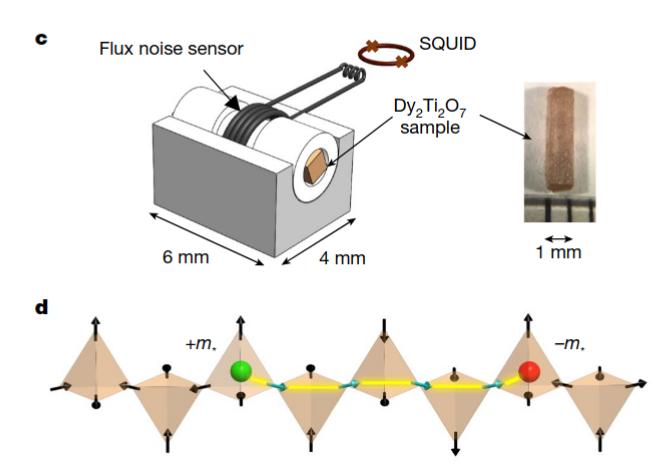
Magnetic monopoles are hypothetical elementary particles with quantized magnetic charge. [...] Here we report the development of a SQUID-based flux noise spectrometer and measurements of the frequency and temperature dependence of magnetic-flux noise generated by Dy2Ti2O7 crystals. We detect almost all of the features of magnetic-flux noise predicted for magnetic monopole plasmas7,8, including the existence of intense magnetization noise and its characteristic frequency and temperature dependence.